
Illusions: Impressions of a Cultural Tourist
Agata Mendrychowska
The impressions that remain after a visit to Kunstarchiv Beeskow are ‘the impressions of a cultural tourist1’—a phrase used by one of the curators of the first exhibition of GDR art in the United States, and one to which I feel close. The works gathered there are often intriguing, yet one cannot be certain of their cultural context, because the artistic production held at Kunstarchiv Beeskow is bound up with the history and reality of the GDR. The most surprising find among the objects in the archive during my research at the institution was a realistic portrait of Erich Honecker painted on the fur-covered hide of an antelope; unfortunately, for conservation reasons, it could not be made available for the exhibition at Atlas Sztuki. It turned out to be a gift from Ethiopia, which explained its unusual medium. Other works, though less exotic, likewise require their iconography to be traced. In the text below, I seek to explain several themes relating to portraits and various kinds of images that most readily conveyed ideological and propagandistic content and constitute a large part of the Kunstarchiv Beeskow collection. I shall focus primarily on the changes in gender iconography that took place in response to social and political conditions. The work of women artists presented in the exhibition is equally interesting.

Nor can one fail to mention landscape, which—by contrast with portraiture—is the most independent genre. As a representation of nature, landscape is least subject to ideology and therefore least likely to be suspected of smuggling in any particular content, something Wolfgang Mattheuer exploited in his work. Yet nature, too, was appropriated in the service of social utility. In GDR art, one may encounter a lunar landscape entitled Vietnam After America or industrial landscapes with a didactic message. The relationship between artist and viewer, the weakening and intensification of the former’s didactic role, and the tension between a subjective and a collective gaze are also among the exhibition’s themes.
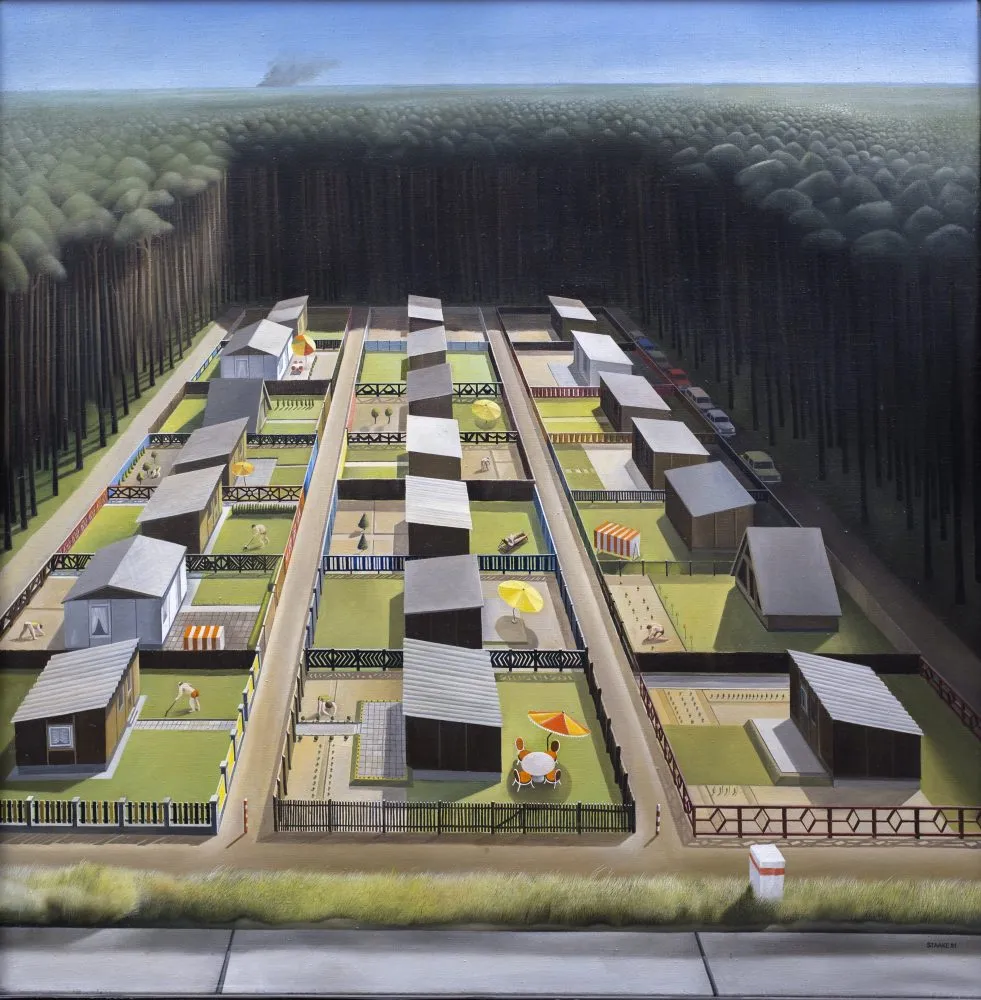
The exhibition’s title, Illusions, refers to the illusion of a system that ultimately collapsed, the illusion of happiness reflected in the distorting mirror of the works on display, and the illusion to which we succumb when looking at works from Kunstarchiv Beeskow through contemporary filters, such as those associated with advertising. We involuntarily superimpose the images surrounding us on works belonging to another moment in history and to the reality of a different political system. Finally, the past itself generates illusions, hence the nostalgia that sometimes accompanies our viewing of these works.
Ostalgia
The exhibition of works from the Kunstarchiv Beeskow collection, assembled after 1989 from holiday homes, training centres, directors’ offices and canteens, fits well within the phenomenon of Ostalgia. Ostalgia—a form of nostalgia for the reality behind the Iron Curtain, discussed by Agata Pyzik in her book Poor but Sexy: Culture Clashes in Europe East and West2—became a subject of discussion in eastern Germany in the 1990s. At that time, many people voted for the Party of Democratic Socialism (PDS), the former communist party. It became apparent that some citizens of the former East Germany were disappointed with the reality that followed reunification, while at the same time refusing to accept the wholesale rejection of their past and their lives in the GDR.

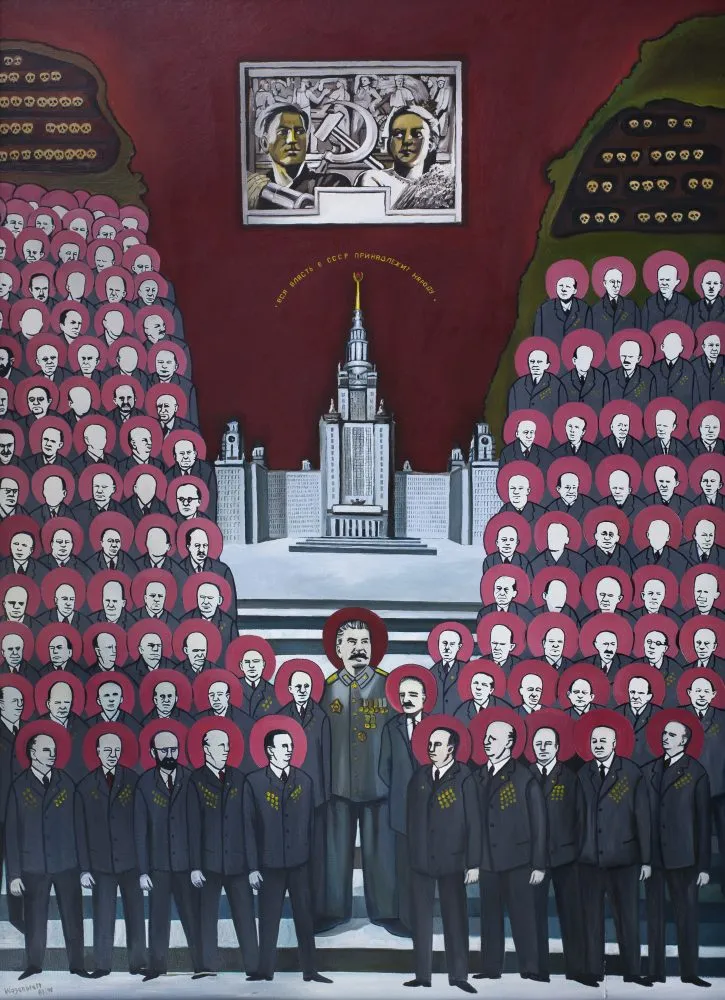
Norbert Wagenbrett’s Sozialistische Ikone (1989/90) (Socialist Icon, 1989/90), one of a series of seven paintings on the history of the USSR, was created only after German reunification. Wagenbrett uses motifs from the Socialist Realist past in a Pop Art manner.
The Zeitgeist is particularly evident in still lifes, which preserve ephemeral objects in pictorial form, portray their owner’s possessions and way of life, and acquire changing meanings and contexts over time.
Images of Gender
In 2012, paintings from Kunstarchiv Beeskow were presented in an exhibition exploring social gender roles through representations of women

in GDR art: ROLE MODELS! Die Frau in der DDR in Selbst- und Fremdbildern3. We are also presenting some works from this selection in the exhibition at Atlas Sztuki. One of the conclusions to emerge from research into art of the GDR period for a similar but more wide-ranging exhibition, Gender Check! Femininity and Masculinity in the Art of Eastern Europe4, was that in the 1960s and 1970s women were represented in art in conventional ways: as model workers, anonymous models or mothers. This is also reflected in the Kunstarchiv Beeskow collection. On the one hand, it resulted from government policy, for which equal rights for women and the idea of emancipation stemmed from the tradition of workers’ movements. On the other hand, although more than ninety per cent of women were in paid employment by the end of the 1980s, most of them remained responsible for children and the home as well, a result of enduring patriarchal divisions of roles5.

Moreover, women’s work was inadequately represented on the art scene. As Angelika Richter states in an interview about her research into GDR art: ‘What is striking is that, when looking through the exhibitions, publications and documentation from the final twenty years of the GDR’s existence, one has the impression that not only official but also unofficial art was predominantly a male domain. Particularly striking was the general absence of theory and discourse in GDR art, and especially the lack of any feminist theory or gender studies6.’ Richter attributes this state of affairs to the fact that: ‘Some women artists saw no need to develop a feminist consciousness under the conditions of a socialist state. Many of them were economically independent, just like their husbands; they were active members of various artistic groups and took part in exhibitions. Within a culturally and socially insular environment, women artists had little need, or lacked the position, to question men’s position. Yet their lives and artistic careers were restricted by the authorities…’ The first attempts to develop a new female aesthetic and representations of women that departed from stereotypes date from the early 1970s. They include the fashion photographs of Sibylle Bergemann, the celebrated photojournalist and portraitist, which Richter regards as an example of female subjectivity.
Kunstarchiv Beeskow holds one of Bergemann’s best-known photographs, Sellin-Ostsee (1981) (Sellin—Baltic Sea, 1981), depicting two models on a beach. The photograph was made for the magazine Sibylle, the most important institution in the GDR fashion world, which enjoyed the status of an ‘Eastern Vogue’ and with which Bergemann had worked since the early 1970s. It is typical of Bergemann’s style: her choice of outdoor setting creates the effect of a scene from everyday life. Fashion was also, for her, a means of creating portrait photography—‘fashion is portraiture’. Bergemann instructed the models to look dissatisfied in the photograph because the weather on the beach was poor. She wanted to achieve a humorous effect, but when the magazine was being prepared the censors decided that the image should be retouched: the models had to smile7.
Comparing Bergemann’s photograph with Gerhard Füsser’s painting bearing the propagandistic title Für den Frieden der Welt (1963) (For World Peace, 1963) makes it possible to understand how far the artist had departed from convention. In Füsser’s painting, two girls walk hand in hand in the sunshine along a beach, turned towards one another in conversation and smiling. Yet the representation also accords with the ideology of the USSR’s anti-colonial policy towards African countries at the time—one of the girls in the painting is Black. Iconographically, the painting refers to allegories of the continents familiar from art history, paradoxically dating from the colonial era. I am thinking in particular of William Blake’s 1792 illustration to John Gabriel Stedman’s Narrative of a Five Years’ Expedition Against the Revolted Negroes of Surinam, Europe Supported by Africa and America. Like Füsser’s painting, the illustration itself carries a propagandistic message.

According to Richter, women artists active in the 1950s and 1960s sought to create a ‘free space’ for themselves while working within the context of institutionalised art. Susanne Kandt-Horn’s triptych Camara M’Balia (1963), from the Kunstarchiv Beeskow collection, is a visual narrative about Guinea’s national heroine, who became a symbol of struggle and resistance to colonial rule in the 1950s8. Her paintings from three years later, Junge Gärtnerinnen I (1966) and II (1966–67) (Young Women Gardeners I, 1966, and II, 1966–67), offer an unusual depiction of women engaged in work connected with nature.
The Kunstarchiv Beeskow collection also includes a painting by Irena Rüther-Rabinowicz, the first woman to study at the Kunstakademie in Dresden, beginning in 1919, where her fellow students included Otto Dix. Before the war, in 1934, the Nazis banned her from exhibiting and practising her profession. As a Jewish woman, she narrowly escaped transport to a concentration camp: an Allied bomb struck the prison in which she was being held in 1945. In 1951, Rüther-Rabinowicz received the Nationalpreis der DDR, a state honour awarded in fields including art and literature. In the same year, she painted Nationalpreisträger Erich Wirth lehrt das Schnelldrehen (National Prize Winner Erich Wirth Teaches High-Speed Turning). Despite its propagandistic message, the group portrait from Beeskow is devoid of pathos because of the psychologically nuanced expressions on the figures’ faces.

Charlotte E. Pauly (born 1886) did not begin learning printmaking techniques until she was in her seventies. The lithograph Untergang der Pferde am Morgen, 1975 (The Horses’ Demise in the Morning, 1975), in the Kunstarchiv Beeskow collection, was made when the artist was eighty-nine. Four years later, she was nominated for the Nationalpreis der DDR, which she did not receive, on account of her personality, her delight in discovery despite her advanced age, and her status as a role model for aspiring artists; her prints were described as cheerful and naïve, realistic and poetic. She belonged to the official associations of artists in the GDR, but her work was too personal to gain wider recognition.

Pauly’s artistic biography was one of constant exploration. She studied zoology, literature, philosophy, archaeology and art history at several universities. During her studies, she travelled around Italy and later completed a doctorate on Venetian painting. After the First World War, she began studying painting at academies in Stuttgart and Munich. In the mid-1920s she went to Madrid, where she took drawing lessons from Daniel Vázquez Díaz, whose pupils also included Salvador Dalí, and entered Federico García Lorca’s circle of friends. From there she set off on a journey through the Iberian Peninsula and Spanish Morocco, about which she wrote an autobiographical novel. She lived among Roma people, translated Lorca’s Gypsy Ballads into German and recorded her impressions of the journey in watercolours. Indeed, works from this period provided the Nazis with a pretext for banning her from exhibiting. Pauly also lived for a time in Paris and Portugal. For a year, she travelled through Greece, the Middle East and the southern USSR. She later settled in the Giant Mountains, where she befriended the writer Gerhart Hauptmann, winner of the 1912 Nobel Prize. She produced a series of illustrations for one of his novels and wrote another book herself, an anti-war novel. After the war, she moved to Berlin. In her work, however, she continued to return to memories and motifs from her travels. In one photograph from her Berlin years, the grey-haired Charlotte E. Pauly, wearing an exotic headdress, smiles as she raises a glass of wine in a toast.
According to Richter, ‘the traditional image of men in the GDR remained virtually untouched’, something that may be symbolised by Uwe Pfeifer’s print Massnahme (1984) (Taking Measure, 1984), which juxtaposes a man and a boy standing on a chair, facing one another and connected by the lines of a diagram.
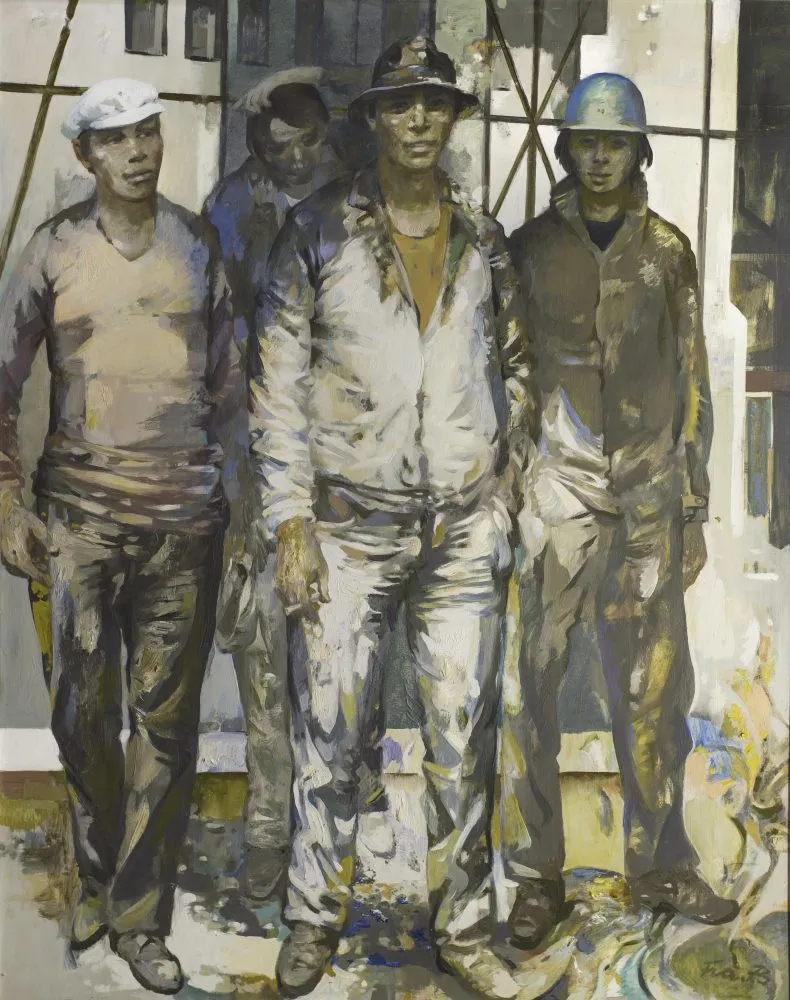
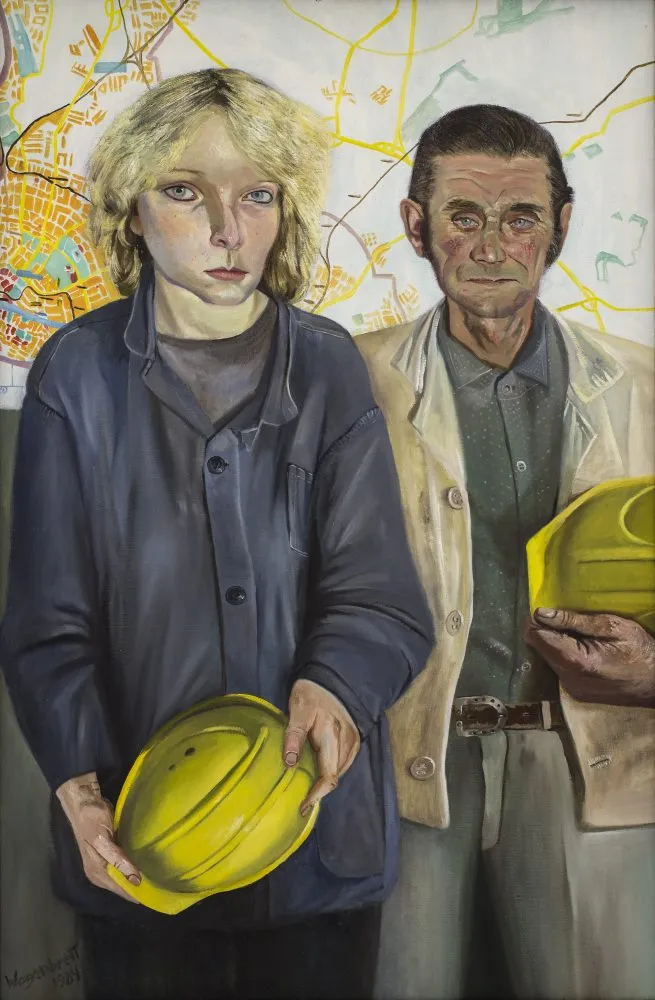
The contrast between early depictions of model workers from the 1960s and Norbert Wagenbrett’s painting made twenty years later, Bauarbeiter und Bauarbeiterin (1984) (Male and Female Construction Workers, 1984), is also interesting. The artist permits himself to portray uncertainty in his protagonists’ body language and facial expressions. Wagenbrett, a pupil of Arno Rink and, like his teacher, a representative of the New Leipzig School, depicts the reality of the GDR by drawing on the pre-war avant-garde and the social satire of New Objectivity (Neue Sachlichkeit).
In the portrait Junges Paar (1985) (Young Couple, 1985), painted a year later, Wagenbrett treats his models still more freely: as representatives of ordinary everyday life.
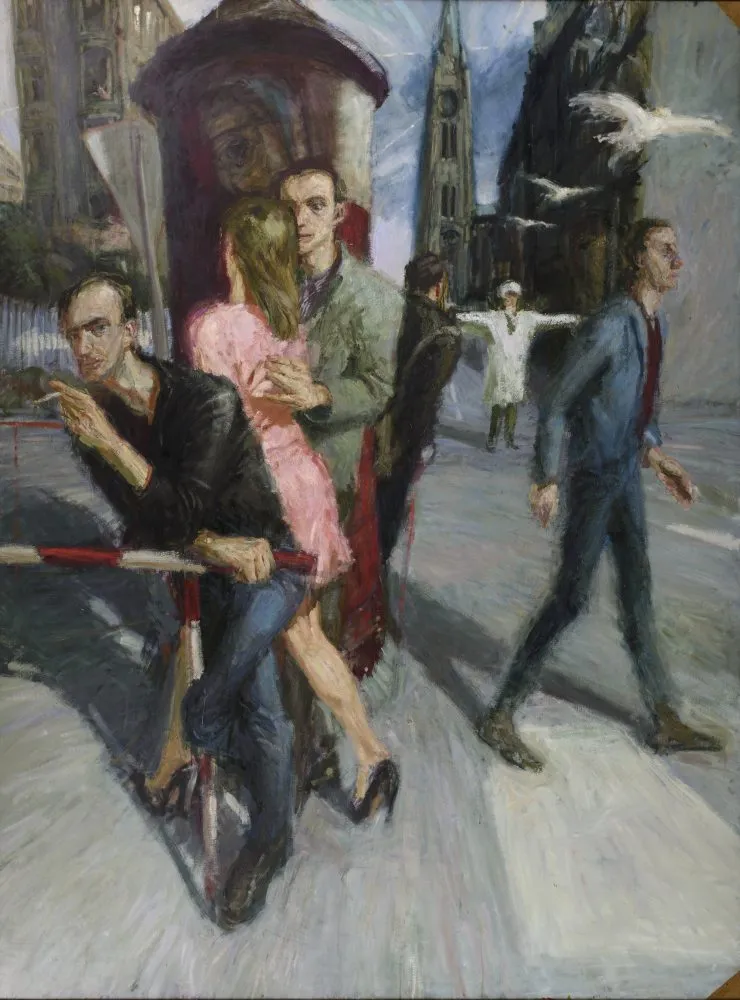
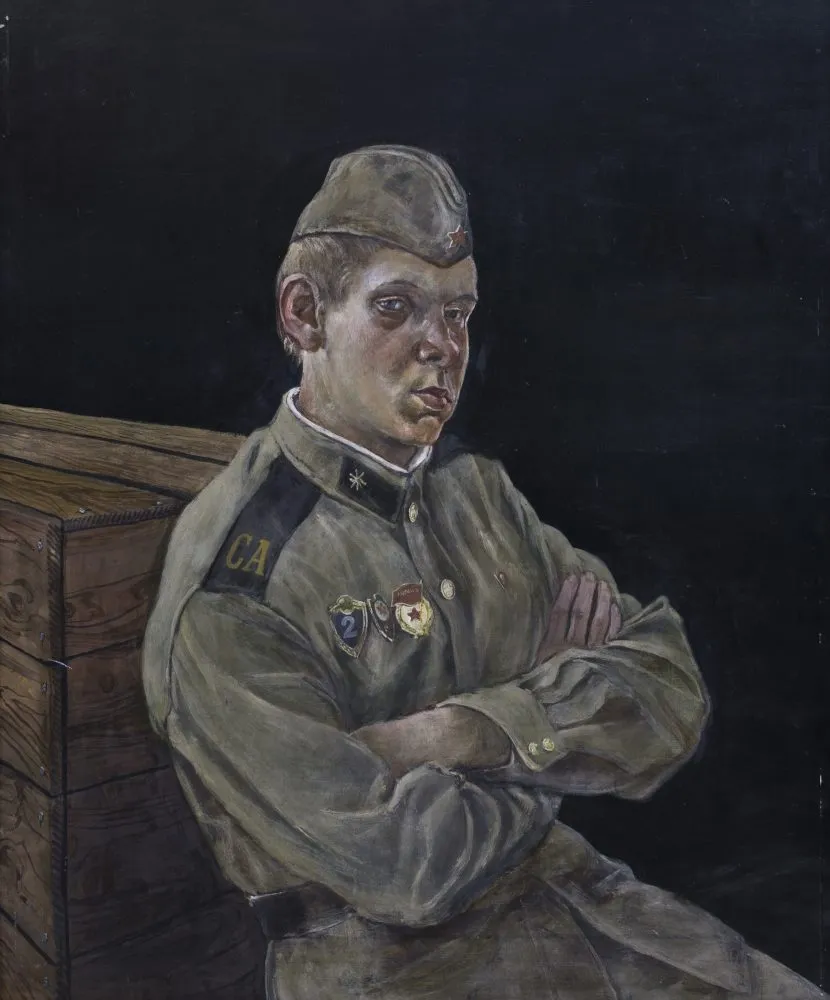
After 1985, perestroika and glasnost—Russian for ‘openness’—in the USSR also affected politics and, consequently, art in the GDR. An example of these changes in the exhibition is a series by Thomas Ziegler, who, like Wagenbrett, graduated from the renowned Hochschule für Grafik und Buchkunst in Leipzig, where Ziegler studied under Werner Tübke. The 1987 paintings from the series Sowjetische Soldaten (Soviet Soldiers), portraits of four soldiers against a uniform red background, sitting or even slipping from a narrow plank running through all the works in the series, form a coherent whole with an ironic message. Interestingly, despite their import, the portraits were acquired by the Gesellschaft für Deutsch-Sowjetische Freundschaft (Society for German–Soviet Friendship) and were also shown in official exhibitions. At one of these, the ambiguity of Ziegler’s series attracted the attention of curator Peter Nisbet, who selected it for Twelve Artists from the German Democratic Republic, prepared as a travelling exhibition for museums and university galleries in the United States. Despite the news of the fall of the Berlin Wall, the exhibition, which opened in 1988, by no means lost its audience.
Writing about it in 1989, the Los Angeles Times observed: ‘The exhibition entitled Twelve Artists from the German Democratic Republic is the first of its kind in the United States and reportedly comes as a revelation to any citizen labouring under the delusion that art behind the Berlin Wall is no more than slavish Soviet-style Socialist Realism, populated by illustrative Stakhanovite supermen and Amazons in babushka scarves9.’ According to the article’s author, what might appear caricatural in Ziegler’s portraits, such as the figures’ large heads, is an element of the artist’s Expressionist style, while his attitude towards his models is full of humanism and, in part, sentimentalism. Indeed, although unrealistic, the images of the soldiers contain psychological characterisations of the figures. They were described as follows in the catalogue of the American exhibition: ‘The four soldiers sat before the artist in his studio in different ways, self-aware and relaxed: from the left, a reflective Balt; then a strong Siberian, the only one in full uniform; next, a sensitive Ukrainian, with the decorations on his chest indicating his rank; and finally another Siberian, bold and full of humour (…) The stance of each of the four men is different, but each is strong and active10.’ Yet when compared with the earlier, realistic portraits of Soviet soldiers painted by Ziegler in the early 1980s, the irony of this representation and its departure from the clichés of typical Soviet-soldier iconography become all the clearer: these models occupy what is perhaps the role most readily associated with masculinity.

The military representations also include the naïve artist Wolfgang Petzold’s sculpture Freunschaft (Friendship, undated), which depicts the relationship between the GDR and the USSR with an almost amorous intensity, like the famous kiss between Brezhnev and Honecker.
Naturism is another theme connected with gender representation and GDR culture. Hannes H. Wagner’s painting Pleinair (1) (1975) represents the lifestyle popular in East Germany known as Freikörperkultur (FKK), or ‘free body culture’.
The Regime Was Not the Whole World
The painting Autobahn bei Pirk (1960) (Road near Pirk, 1960) was created before Wolfgang Mattheuer became one of East Germany’s best-known artists and a representative of the Old Leipzig School; before he received the Kunstpreis der DDR a decade later; and before the Hamburger Kunsthalle became the first institution in West Germany to acquire one of his paintings.
Although Mattheuer was a committed socialist, he used metaphor in his paintings and graphic works to express criticism of the ruling SED party: ‘Instead of the rejection I might have expected, what I actually encountered was approval, even gratitude. It came from the fact that someone had captured in a picture what many people felt and thought—above all, what it was dangerous even to think, but what was generally understood,’ he said in an interview given in 199011.
According to the information on the painting’s record card at Kunstarchiv Beeskow, the landscape had previously hung in a guest house—Haus an der Spree in Berlin—belonging to the SED.
Autobahn bei Pirk was painted by Mattheuer in the year before the construction of the Berlin Wall. The artist places the viewer on a road that does not lead into the distance but disappears behind the nearest hill; storm clouds are gathering in the sky. In one interview, the artist discussed the metaphorical meaning of a later landscape made in the same area: ‘Perhaps I am too conscious of political matters after all. I am thinking of a particular landscape that I regard as one of my best: Gewitter vor Schöneck (Storm Approaching Schöneck). Schöneck is a town in the Vogtland region—Mattheuer’s birthplace [A.M.]—on the slopes of the Erzgebirge, with views of the Fichtelgebirge and the summit of the Ochsenkopf. It was always a special mountain for us; it was from there that we could connect with the world through the television and radio masts. My partner and I like going there because it offers a magnificent view of the surrounding villages. In any event, in those days we observed something else: when we saw trails in the sky, we knew that GDR aircraft or aircraft “from over there” were patrolling the borders. It produced a strangely heavy feeling12.’
The painting from Kunstarchiv Beeskow is compositionally related to one of Mattheuer’s best-known works, Hinter den Sieben Bergen (1973) (Beyond the Seven Mountains, 1973), with its narrow road along which vehicles travel towards the distant horizon. The later painting depicts the figure of the goddess of liberty floating against a blue sky and holding colourful balloons; the road leads towards her. In the interview mentioned above, when asked what consequences the fall of the regime had for him, Mattheuer replied: ‘None. The regime was not the whole world. I am still working as I did before. Only now I have to reckon with the fact that pictures with critical content are not particularly welcome in any system. And so our “fun society” simply wants to amuse itself and have as little cause for reflection as possible13.’
*Agata Mendrychowska, art historian and book editor, whose work includes Wojciech Wilczyk’s There’s No Such Thing as an Innocent Eye, Teresa Tyszkiewicz’s diaries Notes (1940–1983), and exhibition catalogues. Curator at Atlas Sztuki.
1 See Dore Ashton, ‘Impressions of a Cultural Tourist in the GDR’, in Twelve Artists from the German Democratic Republic: Gerhard Altenbourg [et al.], catalogue of an exhibition organised by the Busch-Reisinger Museum, Harvard University, in cooperation with the Zentrum für Kunstausstellungen der DDR, ed. Peter Nisbet, Cambridge, MA, 1989, p. 15.
2 Agata Pyzik, Poor but Sexy: Culture Clashes in Europe East and West, Winchester (UK) and Washington (USA), 2014.
3 ROLE MODELS! Die Frau in der DDR in Selbst- und Fremdbildern, Kunststiftung Poll, 22 May–31 July 2012.
4 Gender Check! Femininity and Masculinity in the Art of Eastern Europe, MUMOK, 13 November 2009–14 February 2010; the exhibition was also presented at Zachęta in Warsaw under the title Gender Check! Femininity and Masculinity in the Art of Eastern Europe.
5 See ‘Interview with Angelika Richter on Her Research in the German Democratic Republic’, http://www.erstestiftung.org/gender-check/german-democratic-republic-angelika- -richter/ (accessed 21 December 2014).
6 Ibid. (this and subsequent quotations, unless otherwise indicated).
7 ‘Sibylle Bergemann. Die Grande Dame der DDR-Modefotografie im Porträt’,
http://www.mdr.de/damals/archiv/artikel87474.html.
8 In 1958, after gaining independence, Guinea became a socialist state within the USSR’s sphere of influence. The artist refers to events from 1955. Camara M’Balia—a pregnant member of the women’s committee of the anti-colonial RDA party and the wife of a party activist—was attacked by her husband’s opponent after riots in Tondon. As a result, she lost her child and died several days later.
9 William Wilson, ‘Before the Wall Cracked: Rapidly Changing Times Date a Show of 12 East German Artists at UCLA’s Wight Gallery’, Los Angeles Times, 10 December 1989, http://articles.latimes.com/1989-12-10/entertainment/ca-367_1_german-artists (accessed 3 January 2015)
10 Werner Stockfisch, ‘On the Painting Soviet Soldiers, 1987, by Thomas Ziegler’, in Twelve Artists from the German Democratic Republic: Gerhard Altenbourg [et al.], exhibition catalogue, op. cit., p. 137.
11 ‘About Our Image of the World—Wolfgang Mattheuer About His Art Past and Present’, in Fortunate to Be an Artist/Vom Glück Ein Künstler Zu Sein: Peter Iden Interviews, eds Ingrid Mössinger and Anja Richter, Kunstsammlungen Chemnitz, 2008, p. 159.
12 Ibid., p. 161.
13 Ibid., p. 160.