
The Radiant Child
Maria Poprzęcka
The Hoffmann Collection presented at Atlas Sztuki includes works by Jean-Michel Basquiat. It transpires that only now, thanks to this exhibition, do we have the first opportunity in Poland to encounter directly the art of one of the most fascinating American artists of the 1980s—and to learn about the meteoric career of the “Black Picasso”, who died at the age of twenty-seven.
The Radiant Child—the title of an article by the critic René Ricard published in the December 1981 issue of the influential periodical “Artforum”—decisively shaped the image of the twenty-one-year-old artist who had just burst onto the New York art scene. Even in that world of careers that flared and faded with equal suddenness, Jean-Michel Basquiat’s case is unprecedented. Born in 1960 and dead in 1988 from a drug overdose after a turbulent career lasting less than ten years, Basquiat not only joins the 27 Club, the group of cult musicians such as Janis Joplin, Jim Morrison and Amy Winehouse who died at that age, destroyed by alcohol and drug addiction. The life of Basquiat, the Haitian-Puerto Rican boy who rose in just a few years from street graffiti artist to international celebrity, selling paintings for enormous sums and inexorably descending into self-destruction, concentrates a great charge of artistic mythologies. These mythologies are both deeply rooted in the tradition of artists’ biographies and present among the legends and pop-cultural icons created by the mass media: the miraculous radiant child; the American dream of rising from street urchin to millionaire; a natural talent endowed with many gifts; the savage brazenly entering polite society and feeding on its snobbery; but also the accursed artist, the outsider tormented by difference, a youngster hungry for fame and money yet squandering both like a contrary brat; and finally the genius who died tragically and young.
The Basquiat myth, in part created by the artist himself and sustained by the film Basquiat, made after his death by Julian Schnabel and Lech Majewski, is suggestive, but requires not so much revision as additions that in fact make this life and art still more dramatic. Basquiat did not come from a Black ghetto. His parents belonged to the white-collar middle class and sent their son to a Catholic school; his mother ensured that he learnt languages and took the little boy to New York museums. During his lengthy recovery in hospital after a road accident, it was she who brought him an old anatomy textbook—traces of this reading can later be found in many paintings. Only his parents’ divorce and the teenager’s growing conflict with his despotic father brought rebellion, running away from home, abandoning successive schools and finally a complete break with both education and home. Yet this critical moment was simultaneously the beginning of Basquiat the artist—a beginning on the street, risky but also cunning. The seventeen-year-old boy, with no fixed abode and earning money from odd jobs (including prostitution), worked with his friend Al Diaz to write enigmatic, subversive maxims on walls around SoHo, signed SAMO (in a later interview he expanded the acronym as SAMe Old shit). These were not the commonplace street graffiti that then entirely covered the New York subway and the slums of the Bronx and Brooklyn, but rather a kind of visual poetry. Basquiat deliberately placed the anonymous SAMO texts not there, but in the art district, near galleries and fashionable clubs.
With a bleached-blond mohawk, an excellent dancer and rapper, occasionally working as a DJ and trying different musical groups, he quickly became a recognisable figure in avant-garde art circles, which soon bore fruit.
In what context did Jean-Michel begin his lightning career? The early 1980s in the United States were a time of boom in the newest art, with demand driven by multiplying galleries, including alternative ones, and by the intensive activity of gallery owners such as Charles Saatchi, who achieved enormous incomes and star status. Importantly in Basquiat’s case, it was also a time when Graffiti Art was being commercialised, when street art was being pulled into galleries and museums and incorporated into the gallery and commercial circuit. Following Pop Art’s levelling of artistic hierarchies, the blurring of boundaries between high and low art, and viewers’ fatigue with the cold, intellectual art of Conceptualism and Minimalism, spontaneous, “wild”, “authentic” graffiti fitted perfectly with the expectations and needs of new buyers. When Basquiat, as SAMO, began writing on the walls of SoHo, the graffiti being absorbed by the art market were losing their anonymous, anarchic and illegal character.
They were transformed from criminal vandalism into Graffiti Art. Their creators—such as Kenny Scharf, Lee Quiñones and Rammellzee—were no longer frustrated teenagers from the margins of society, but artists with recognisable individualities.
From 1980, Basquiat’s career exploded: the glamorous years arrived. In 1980, Jean-Michel took part for the first time in a group exhibition in a Times Square squat, but the following year already brought several exhibitions, including in Europe. The Radiant Child was surrounded by famous gallery owners; he had his first solo exhibition in Modena; shortly afterwards, his paintings were presented at documenta 7 in Kassel, an official international consecration. For the film Downtown 81, he repeated the SAMO actions, reconstructing something that had been ephemeral and impermanent. His success grew at lightning speed, the reviews were excellent and prices soared. Basquiat painted a great deal and rapidly, travelled extensively for exhibitions, spent considerable time in California, rented a studio in Venice in 1983, and had a brief affair with Madonna… His dream of meeting Warhol came true, although the collaboration initiated by the well-known gallery owner Bruno Bischofberger failed to produce the expected results, artistic or financial. The price of success and an intense life also rose: not only harmless marijuana was in constant use, but also heroin mixed with whatever was available. In photographs from the final years of his life, Basquiat’s still-young face is covered with sickly blotches, evidence of the drug poisoning his body.
Basquiat was therefore not a Black rapper from the Bronx discovered by chance, but a boy from a bourgeois home who consciously pursued artistic fame. He also consciously played with stereotypes in shaping his image. His arrogant behaviour, which excited visitors to exhibition openings, became legendary. Maintaining his Bad Boy style, Basquiat paid no attention to dealers and collectors, did not remove the headphones of his Walkman and smoked marijuana.
And his paintings sold immediately. A superb example of masterful self-creation is the photograph on the cover of “The New York Times Magazine”, itself proof of the artist’s celebrity status. Dressed like the chief executive of a large corporation in a black pinstripe Armani suit, white shirt and tie, Basquiat rests his dirty bare feet on an overturned, cheap little chair. He supports his head with his hand in the age-old gesture of melancholy. In the other hand he holds not the attributes of painting but a pipe for smoking herbs. He looks at the viewer penetratingly, without smiling. The photo shoot took place in 1985 at the artist’s New York studio on Great Jones Street. Belonging to the long historical sequence of images of “the artist in his studio”, Basquiat’s portrait oscillates between the great tradition of melancholia artificialis—the labour and sadness of creation—and ostentatious nonchalance, a provocative violation of convention, and finally the pride of the artist-creator presenting himself against the background of his works.
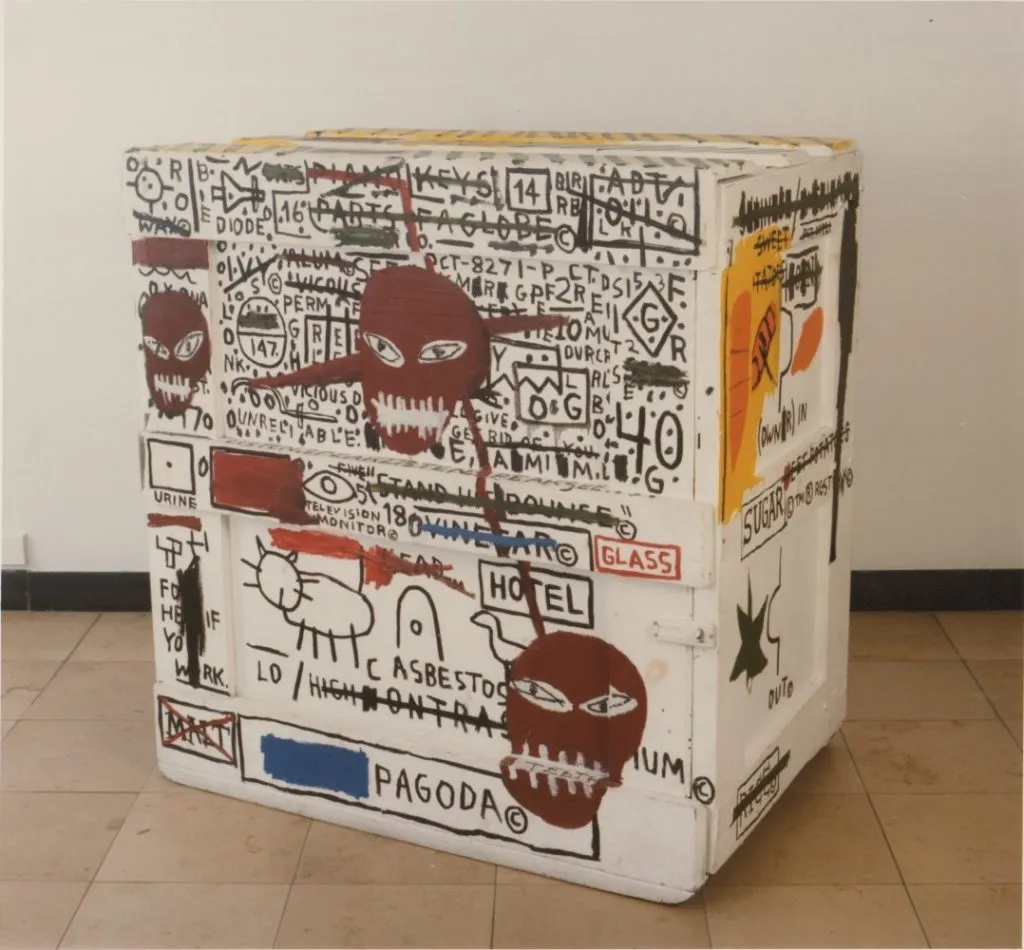
Basquiat’s painting is an equally intricate tangle. It was painting that determined the artist’s great career, not his excesses and extravagances. New York had never lacked similarly fame-hungry, drug-addled freaks. His career was determined by a talent that erupted with tremendous force and never lost its violence or power. Basquiat’s painting grew out of street art and retained its barbaric, iconoclastic character, but had nothing in common with the asemantic howl of illegal tags. Nor was it a sequence of uncontrolled, narcotic hallucinations. Basquiat painted compulsively, on everything—walls, canvases, boards, paper, metal sheets, refrigerator doors, stools, window frames, his own clothes and those of others. He paid no attention to technique; indeed, he did not know it, since no one had taught him. He painted with fast-drying acrylic, but also smeared, daubed, scribbled, scratched, scraped, tore, glued and cut. Anything could be a tool: spray paint, a broad decorating brush, a tube of paint, pencil, marker, crayons or a nail. His imagery is chaotic, insistent and clamorous, like the iconosphere of a metropolis. Some paintings are dense and layered like palimpsests of street graffiti. Others seem to have been thrown down in a few sweeping gestures. At the same time, however, this instinctive, wild, untutored painting is full of meanings, while its range of subjects surprises with its diversity and seriousness. Basquiat said that he painted “Royalty, Heroism and the Streets”, but in fact his iconography is far more complex. Around human figures of maximally heightened expression, apparently unconnected tags, slogans, maxims and words proliferate. Yet there is nothing accidental in this visual chaos. The image signifies and the words signify.
Anti-racist themes are closest to indigenous American street art. The question of race never disappeared from Basquiat’s art, but underwent a significant evolution. In his early work, the artist accusatorily explored the history of African Americans, slavery and contemporary acts of violence. He crowned his idols—Black sportsmen such as the boxer Joe Louis and campaigners for Black rights such as Black Muslim leader Malcolm X. He canonised Black musicians such as Charlie Parker, honoured in the triptych Charles the First. He commemorated victims of police brutality such as Michael Stewart, beaten to death by white officers. He threw racist insults into his paintings: asbestos, carbon, tar. Towards the end of his life, however, after travelling to the Ivory Coast and beginning to collaborate with artists from Africa, he began to affirm and emphasise his Africanness.
Although racism remained at the centre of Basquiat’s art, he himself—the son of a Haitian father and a Puerto Rican mother—appeared still to be searching for a racial and cultural identity. He rebelled against his parents’ aspirations towards the white middle class, but also wanted more from life than fame as a rapper and graffiti artist from the non-white ghetto. He was also conscious of the dangers and humiliations threatened by the role of Black mascot to the snobbish art world. Through his appearance he manifested shifts in group affiliation, replacing his punk mohawk with Rastafarian dreadlocks. After the artist’s death, critics proposed the term “creolité” for his art, understood as a fusion of multiple ethnic and cultural influences: Caribbean, American and European. “Creolité” allows Basquiat’s art to be nuanced and frees him from simplified labels such as “the only Black painter to leave a mark on art history”.
Basquiat surrounded the heads of his Kings and Heroes with haloes, often bristling with spikes like a crown of thorns or a coil of barbed wire. This most commonplace attribute of sainthood is not the only recurring motif of Christian iconography in the art of Basquiat, who was raised Catholic. Many self-portraits of the Black artist also bear a sacred, martyrological character: he raises his arms in protest or in the gesture of the Crucified, with a halo stretched above his head. A nimbus of sanctity also floats above the Asbestos Black man. After Andy Warhol’s unexpected death, a deeply grieving Basquiat created the painted Gravestone—a painted funerary monument referring to the altarpiece form of the triptych (1987). Doors are framed by wings bearing familiar cemetery symbols—a skull and cross. Ordinary doors attached with large hinges here become the age-old symbol of the Gates of Death, with a scrawled reminder that man is perishable. In creating similar works of allegorical meaning, Basquiat also drew on a popular dictionary of symbols, not only Christian ones.
Basquiat’s painting, superficially seen as an explosion of fury and revolt by a talented graffiti artist who, as a “new wild one”, succeeded in forcing his way into the great art world, carries a surprising number of cultural, historical and artistic references. Basquiat refers particularly often, sarcastically and accusatorily, to American history. Thus, in the painting Per Capita (1981), a Black boxer with a halo above his head holds a flaming torch, a clear allusion to the Statue of Liberty. The inscription “E Pluribus” is the beginning of the motto E Pluribus Unum—One Made from Many—placed on the Great Seal of the United States, which also serves as the country’s coat of arms. Here the painter mocks the lofty values of the Founding Fathers—liberty, equality and fraternity—by confronting them with the ruthless current financial data per capita, the level of income per inhabitant in Alabama, Arizona, Arkansas… The noble idea remains only empty words, forgotten even though everyone sees them every day on the one-dollar bill.
Alongside references to American history, Basquiat frequently invokes great works of Western art. Never mind the numerous merciless transformations of the Mona Lisa, the art fetish maltreated by popular culture. The painter confronts Leonardo also as the master of anatomy that always fascinated him. During his period of collaboration with Warhol, the artists made an iconoclastic paraphrase of Leonardo’s Last Supper in the form of twelve punching bags bearing images of the Apostles (they were provocatively exhibited in a gallery opposite the Milan monastery housing Leonardo’s painting). Basquiat also referred several times to Manet’s Olympia, naturally on account of the Black maid, extracting her from the painting and emancipating her as an autonomous representation. Figures from Greek and Roman mythology are also present in Basquiat’s art—not only the inevitable obscene Venus, but also Pluto, god of the underworld, and Pegasus, which gave its title to an elaborate work that is
in fact a great visual poem (1987). Another example of a canonical work of European art invoked by Basquiat is Beethoven’s Third Symphony, the Eroica. The symphony presides over paintings made shortly before the artist’s death, with mantrically repeated sequences of words: man dies, man dies, man dies, whose rhythm is beaten out by the tracks of a raven’s feet—the harbinger of death.
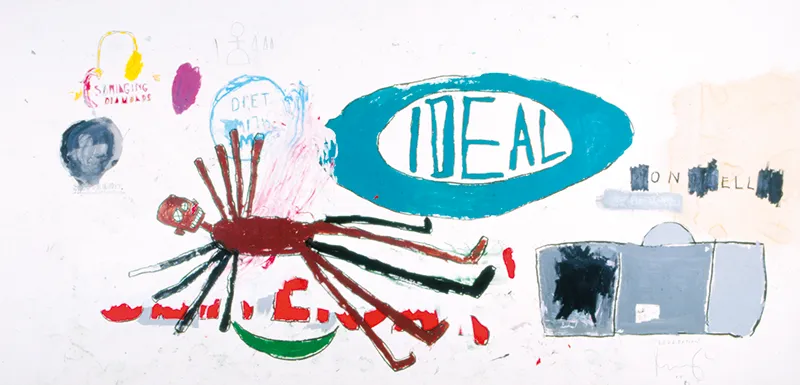
Independently of these cultural references, Basquiat’s art is dominated by timeless, archetypal images: the snake, skeleton and naked human being. It is impossible not to view his painting from the perspective of the artist’s tragic, premature death. Over the brief years of Jean-Michel’s career, his art became increasingly dominated by the motif of death and consumed by an obsession with it. There are more skeletons than bodies in the paintings, more skulls than faces. Yet the skeletons are alive, gesticulating violently and thrashing spasmodically. The skulls, too, are alive: screaming, baring their teeth, twisted into dreadful grimaces. It is difficult not to see a premonition of his own death in Riding with Death (1988). In place of the artist’s typical explosion of colour, there is a uniform grey background. The macabre-grotesque steed is a white skeleton bearing a brown, boyish figure on its non-existent back.
How did Jean-Michel—the radiant child—function in the art world, the world of dealers, collectors, museums and enormous sums of money? A barbarian in the garden? A phenomenally gifted boy exploited by gallery owners? A victim of speculation in an art market always hungry for fresh merchandise, sensational discoveries and scandalous artistic personalities living on the edge—conditions that Basquiat fulfilled perfectly? Or, like other members of the 27 Club, was Basquiat psychologically unable to cope with a star’s life, escaping into drugs and progressive self-destruction?
None of the answers will be unambiguous. Basquiat’s story, with all its fatalism and burden of mythologising yet simultaneously pop-cultural clichés, imposes a sensationalist and melodramatic register, one in which Julian Schnabel’s film is, moreover, maintained.
Jean-Michel probably had no control over the commercialisation of his art, just as over the years he appeared to lose control of his life, which was also for sale. Working under the growing pressure of the market and his own fame, he managed to preserve his personality, however difficult it was for those around him and for himself. He was certainly the first Black painter to attain the status of an international star. In subsequent years, important Black artists appeared on the American and European art scenes, including Yinka Shonibare, Kara Walker and Carrie Mae Weems. Educated, their views shaped by postcolonial thought, politically and socially engaged, and conscious of the laws governing the art world, they reach for varied and sometimes highly sophisticated media far removed from street graffiti.
Only one thing links them with Basquiat: the unresolved problem of Black skin and racism.
*Maria Poprzęcka, art historian and critic, full professor at the Faculty of “Artes Liberales”, University of Warsaw. Her principal interests are modern art, the migrations and “long duration” of images, and relationships between the visual arts and other fields of creative practice. She is the author of numerous books, including Feast of the Goddesses: Women, Life and Art, 2012, and Other Images: Eye—Vision—Art, from Alberti to Duchamp, 2008. She is a recipient of the Gdynia Literary Prize in the essay category.