
Diamond Dust
Marta Skłodowska
What matters is this sensory experience: the moment when a person stands before a work of art. That single moment should be an intense experience. Afterwards one can, of course, read about it, but it can be experienced only here and now, while standing before the work. (…) In my view, there is no substitute for this almost physical experience1.
Erika Hoffmann-Koenige
Medieval theologians imagined eternal bliss as the visio beatifica, an unceasing “vision” that “blesses” the beholder. Manfred Sommer writes about this in his book Collecting2, adding that the object was God, who contained within himself everything worth seeing and could therefore be contemplated without end. This was the original understanding of vita contemplativa, the contemplative life. When this vision of heaven is transferred to earth, it is perhaps embodied most fully in the experience of art. Art extracts extraordinary elements from earthly experience: it is a little like a diamond formed from coal, and a little like a pearl forming around a grain of sand that causes suffering. Sometimes it is simply the beauty of the transience of sand itself, or of the deep black of a piece of coal, with its potential for warmth or a diamond.

One way of bringing this state of contemplation, uninterrupted and unrestricted by visiting hours, into reality is to collect works of art, ensuring daily contact with art and incorporating it into one’s private, and hence inner, space.
Collecting makes it possible to view works in daylight that changes with the time of day and season, to supplement sight with touch, and to have an unlimited amount of time in which to interpret the meanings contained in a work of art.
The Hoffmann Collection is one of the world’s most important private collections of contemporary art.
It was created by Erika and Rolf Hoffmann. Since her husband’s death in 2001, Erika has developed the collection alone.
The more worth seeing something is, the more valuable it becomes. As a result, besides creating the conditions in which one can become an “ideal viewer”, collecting also has an ambiguity of its own. It can easily become a game of power, and one of its motivations may be not the vita contemplativa but the desire to display one’s means, when economics rather than experience comes to the fore.
Erika and Rolf Hoffmann’s approach to collecting places them outside that current.

Although their activity has affected the art market, and their purchases support artists, from the outset they wished to measure the value of the collection not in financial terms or by the number of works, but by what contact with them provides.
This attitude largely stems from the path that led them to collect art. Art entered Erika Hoffmann-Koenige’s life through her mother’s second marriage — her mother was a doctor — to Heinrich Dattenberg, director of the Abteiberg Museum in Mönchengladbach.
The museum’s holdings consisted principally of works by the Expressionists, and after the Nazis came to power they were classified as entartete Kunst and largely destroyed or dispersed.
In the early 1950s, the institution could not afford to repurchase Expressionist paintings, so Erika’s stepfather decided at least to recall those lost holdings through Expressionist prints. In search of such works, he undertook many journeys, including to the Netherlands and Belgium.

Seeing Erika’s interest, he took her with him. One telling detail appears in her memories: when children in the towns they passed saw a car with German number plates, they might spit at it. Yet when she and her stepfather entered the homes of collectors and art conservators, they were invariably met with openness and hospitality.
In this way, the space of contemporary art became a world of freedom, without war and without borders.
Remembering that feeling, Erika decided to study art history despite the opposition of her mother, who feared for her daughter’s financial future and called the course “a tree on which no bread grows”. The future showed that her fears were unnecessary.
While studying, Erika met Rolf Hoffmann, son of the founder of the luxury-shirt manufacturer van Laack and a brilliant manager in the family firm.
After marrying, they became jointly involved in developing the business. They soon had three children, and Erika began designing fabric patterns and later women’s fashion collections.
They nevertheless tried to ensure that contemporary art remained constantly present in their lives. In the 1960s they visited exhibitions and openings in search of inspiration for fabric designs. In the 1970s they became active in art associations — the so-called Kunstvereine founded in every larger German town. Successive editions of Documenta in Kassel also played a major role in their knowledge of the latest tendencies in art, as did the proximity of the museum in Mönchengladbach. Its director soon became the legendary Johannes Cladders, who concentrated on presenting art that now belongs to the canon but was controversial at the time, including Minimal Art and Conceptualism. The then unknown Joseph Beuys, for example, held his first museum exhibition there.

They spent a great deal of time talking to artists, learning about their motivations and exploring issues addressed in art that were important to society at the time.
Although they consciously turned to art to enrich their lives, they had no intention of becoming collectors. In the rebellious 1960s, owning art objects struck them as a form of bourgeois materialism with which they wanted nothing to do.
The first work appeared in their home by chance. In 1968 Erika Hoffmann-Koenige opened a boutique in Mönchengladbach. In an empty niche above the entrance — originally intended for a statue of the Madonna or the image of a saint — she placed Signal, a sculpture pulsing with blue light by the Greek artist Panagiotis Vassilakis Takis, associated with Group ZERO.
Because it might distract passing drivers, however, Signal had to be removed, and so it entered the Hoffmanns’ home. In an interview, Erika Hoffmann-Koenige compared its arrival to eating the fruit of the tree of the knowledge of good and evil. Other works followed, and they began to live surrounded by art. The artists’ courage in following what moved them, changing the rules and thereby discovering the new, and taking artistic and personal risks became for them a model of what art could contribute to their lives. With few exceptions, they bought mainly recently made works that were in tune with their time and helped them understand it better.
***
In a loft in central Berlin, open to visitors on Saturdays, one can view a collection assembled according to these principles over almost fifty years. It is displayed across 1,400 square metres on two floors of a former factory in the Sophie-Gips-Höfe courtyard in Mitte.
The first work encountered, already in the entrance hall, is a life-size figure — an iron sculpture by Antony Gormley whose surface, or skin, reveals itself only under our gaze as composed of thousands of densely packed, round, smoothly ended stainless-steel rods, as if this dark human figure had exposed nerves (Under My Skin, 1997).
The rooms on the upper levels feel open, hospitable and inviting. Large former-factory windows allow the space of Berlin to penetrate freely into the interior.
Art itself occupies the intersection of the “private” and the “public”, resting to a large extent on artists revealing their most personal experiences. The same applies to its presentation. On the one hand, we usually encounter original works of art in museums and galleries derived from sacred spaces such as the Museion, the House of the Muses on the Acropolis, or the churches in which art found a space for its effects from the Middle Ages onwards. On the other, exhibition-making is linked with the tradition of the Kunstkammer in private homes and palaces: cabinets of curiosities displaying astonishing objects at the boundary of nature, art and horror, intended to delight guests and prompt conversation. Yet the experience of art itself — even when we stand in a crowd of other exhibition visitors — is a private experience, although it can be shared.
In the Hoffmann Collection, these two traditions of displaying art interpenetrate, while the journey through spaces that open up as one proceeds leads to extraordinary encounters.
Already in the first rooms, we are confronted by Astrid Klein’s large-format, catastrophic photographic compositions. When we enter a small sitting room, Andy Warhol’s beautiful but also terrifying, nuclearly connoted screenprints from the Sunsets series begin to act upon us through their infinite number of colour combinations. The poetic works of Felix Gonzalez-Torres, Jean Tinguely’s mobiles and Isa Genzken’s objects, which deconstruct and reassemble the language of sculpture, each have their own spheres of influence.
The display changes every year, creating a new arrangement and new spatial relations that reveal different aspects of the works. It may present works in the collection by artists including El Lissitzky, Marcel Broodthaers, Lucio Fontana, Eduardo Chillida, François Morellet, Andy Warhol, Allen Jones, Jean Tinguely, Hermann Nitsch, Arnulf Rainer, A. R. Penck, Georg Baselitz, Gerhard Richter, Richard Serra, Mike Kelley, VALIE EXPORT, Nan Goldin, Bruce Nauman, Nobuyoshi Araki, Günther Förg, Isa Genzken, Georg Herold, Vanessa Beecroft, Monica Bonvicini, Silvia Kolbowski and Olga Chernysheva… The collection also holds works by Polish artists: Katarzyna Kobro and Henryk Stażewski, Katarzyna Kozyra and Zuzanna Janin; Teresa Murak made the lawn sculpture in the courtyard.
A special place, unchanged since the Hoffmanns moved in, is occupied by a multicoloured, three-dimensional painting by Frank Stella from 1989 on the end wall of the tall room: essentially a hybrid at the boundary of painting and sculpture, belonging to the Moby Dick group of works.
Areas of intense presence interpenetrate with areas of emptiness that allow the works to resonate fully, creating a free-flowing narrative vibrating with colour and based on the dialogue among the works and with the space. This calls to mind Peggy Guggenheim and her Palazzo Venier dei Leoni in Venice, where living space and the space of artistic enquiry resonate together congenially.
Despite these involuntary associations, however, Erika Hoffmann-Koenige does not simply place works in space according to aesthetic motivations. In making her collection accessible, she adopts a conscious strategy of framing the fullest possible experience of works of art.
There are no labels beside the works, so that viewers can focus on what they actually are instead of interpreting them through the prism of familiar names. Erika Hoffmann-Koenige, or the guides in whose company the exhibition is visited, do not speak about the works from the position of their knowledge, but encourage guests to grant themselves the right to personal observations.
Only after the visit do guests receive a list of all the works. The decision not to produce catalogues for the collection’s annual displays has a similar purpose, making it impossible to postpone attentive engagement with the works until later.
The only form in which the changing constellations of works are preserved is the Passages published for every display. Their name alludes deliberately to Walter Benjamin and his idea of the flâneur gathering experiences while wandering through Paris.
The Hoffmann Passages contain observations and notes about the reception of a particular display — written both by viewers and collection staff — as well as quotations, poems and photographs of the spatial arrangements of the works.
In this way, Erika Hoffmann-Koenige makes it difficult for visitors to become consumers of art. Instead, she offers them successive stages of reception: first sensory pleasure, then the emotions that emerge through contact with the work, and finally the intellectual reflection inspired by them, which may influence choices made in life.
***
The move away from the object in favour of the idea is linked with Joseph Beuys’s conception of art, which is important to Erika Hoffmann-Koenige. From the shamans who saved him after he was shot down over Crimea as a Luftwaffe pilot during the Second World War, he adopted a belief in the healing union of matter and spirit and transferred their thought into his art. Connected with this was his conception of social sculpture. Following the avant-garde artists, he believed in art’s influence on the shape of society and its ability to transform it.

To some extent, this idea influenced Erika and Rolf Hoffmann’s decisions concerning the works of art they had collected.
Shortly after the fall of the Iron Curtain, they made their first attempt to share their experience of art with others. They commissioned Frank Stella to design a Kunsthalle in Dresden, intending to create an institution presenting contemporary art in changing exhibitions based on loans from various international private collections — usually “invisible” because of their private character and containing works entirely unknown in eastern Germany. Collaboration with the city did not, however, come about.
After the project’s failure, still moved by German reunification, the Hoffmanns moved to Berlin in order to participate in the development and transformation of the city as it grew together again, using the most precious thing they possessed — their works of art — to support these processes. They opened the Hoffmann Collection in 1997. At first it met with residents’ distrust, but over time it assumed an important place in the city’s cultural landscape.
***
For viewers in Łódź, the collector created — as she once did for audiences visiting her in Berlin — a personal experience of encountering works by artists including Jean-Michel Basquiat, Vanessa Beecroft, Monica Bonvicini, Dan Flavin, Isa Genzken, Nan Goldin, Felix Gonzalez-Torres, Steve McQueen, Pipilotti Rist and Andy Warhol. Presenting the collection outside Erika Hoffmann-Koenige’s private space is a special situation. The only previous instance was the exhibition Mit dem Fahrrad zur Milchstrasse (By Bicycle to the Milky Way), organised in Dresden in 2009.
As in the Berlin exhibition, intuition, adventure and the collision of opposites became the deliberate strategy. As she herself says of the exhibition’s idea: “I wanted to show what moves me and give viewers an opportunity to become aware of their own feelings and thoughts. I want to create a dialogue between works by different artists and moments from different times, so as to encourage viewers to exchange ideas.”
Sharing the experience of these works with others also repeats, in a sense, the gesture of Joseph Beuys, who in 1981 came from North Rhine-Westphalia to the Museum of Art in Łódź in an act of support for the Solidarity movement, bringing as a gift a group of his works known as Polentransport and thereby symbolically uniting Eastern and Western Europe.
It is a kind of gift from Erika Hoffmann-Koenige to Łódź: she wanted paintings, sculptures and photographs to appear here that cannot usually be seen in the city — unique, energetic works of tremendous impact. Another context may be the Neoplastic Room, familiar to Erika from previous visits to Łódź: something radiating colour in the heart of a grey city and thereby becoming the beating heart that sets it in motion.
Despite its often attractive form, this is not easy art. It is confrontational, provocative and developmental as an experience. A film by the artist and director Steve McQueen — whose films include Shame (2011) — addresses the discomfort of looking attentively. In its tight frame, the artist’s finger can be seen insistently trying to touch the eye of the actress Charlotte Rampling.
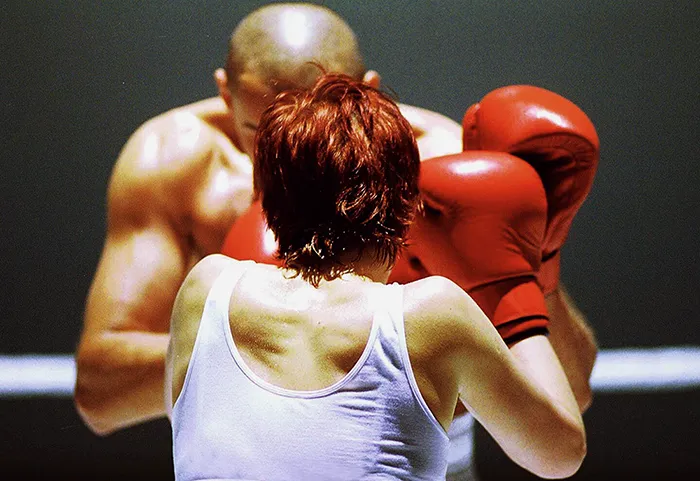
An important theme that appears in the exhibition is the struggle that artists wage with and for art, admired by the Hoffmanns since they began creating their collection. Zuzanna Janin’s Fight (2001) can be viewed here as a starting point. The white ring in which the artist fights the powerful boxer Przemysław Saleta also becomes the field of art, the rectangular surface of a picture and the geometric rules of modernism. This pairing places the work in a highly interesting context. Until now, Janin’s work in Poland has chiefly been shown in the context of feminist ideas and often treated simply as an illustration of a woman’s struggle with a man. In Erika Hoffmann’s approach, it becomes far more multidimensional. Through its prism one can view the exhibition’s other works, especially those belonging to the current of geometry and its negation: Dan Flavin’s “Monument” for V. Tatlin, Frank Stella’s Tuftonboro I, Günther Förg’s architectural paintings, and sculptures by Monica Bonvicini, Isa Genzken and Katharina Grosse.

The theme of defining one’s own identity in a world of constant change also becomes important. The issue is addressed by several works, including a large-format drawing by Jean-Michel Basquiat that refers, at one level of meaning, to the situation of the “coloured” minority in the United States, and a transport crate “stamped” by him with, among other things, the ideograms of the Hobo subculture — itinerants earning money from casual work — and thereby enriched with additional existential meanings. Erika Hoffmann remembers that when she and her husband had the opportunity to speak with Basquiat in Düsseldorf, he asked: “You bought that crate? I wanted to be buried in it.” It was their last conversation; the drug-addicted Basquiat died soon afterwards.
An attempt to fight for one’s identity is also visible in the polyptych formed on the wall by Nan Goldin’s photographs of the queer community.
These works, which directly reveal intimacy, join the theme of love strongly felt throughout the exhibition. It is clear that the collection was an element in the relationship between two people united by a close bond. Thus, alongside works derived from geometry, there are many suspended between eroticism and intimacy.
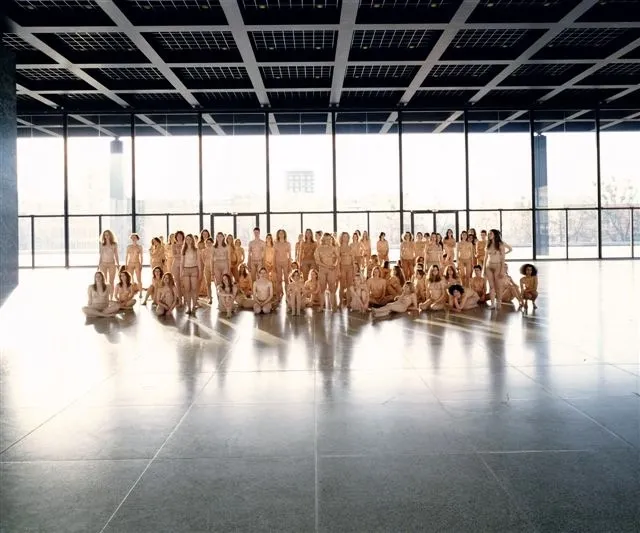
This is true of Pipilotti Rist incorporating her body into art in Mutaflor, and of the documentation at the opposite pole of Vanessa Beecroft’s hermetic performances. Beecroft confronts gallery viewers with naked models and, through them — in a sense showing the challenge of standing before and confronting a work of art — asks what happens between these two groups, and what their relations and intentions are.
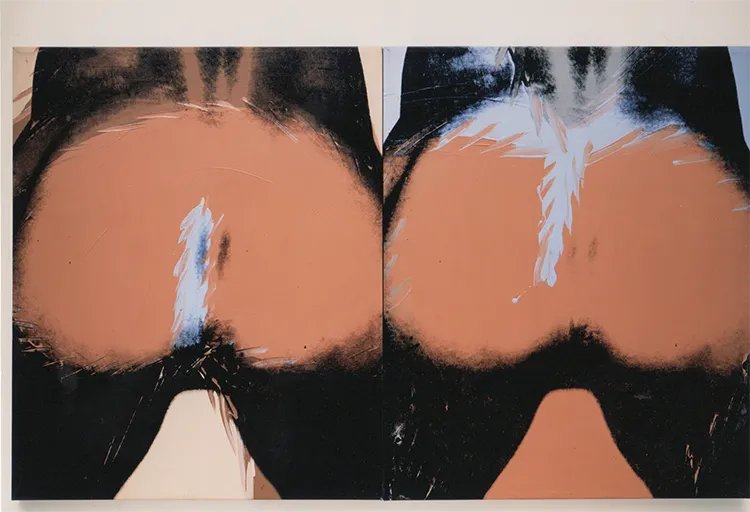
The portrait showing the collection’s founders is most directly connected with its history. Andy Warhol made the double — although multiple — portrait of Erika and her husband in his New York studio in 1980. The differently coloured panels, bearing screenprinted photographic portraits of Erika and her husband stylised as images of Hollywood stars, were covered with paint containing diamond dust.
This precious component, reduced at the same time to dust, may become a metaphor for Erika and Rolf Hoffmann’s thinking about their collection. It does not aspire to be a monument, but, retaining a memory of the properties and brilliance of diamonds, becomes something elusive and transient, measurable only in experience.
*Marta Skłodowska, art historian, studied at the University of Łódź and the Rheinische Friedrich-Wilhelms-Universität Bonn, and was a Robert Bosch Stiftung fellow at the Westfälischer Kunstverein in Münster (2009–10). The author of texts on art, she works at the Museum of the City of Łódź, where in 2015–16 she carried out the project Karl Dedecius: Literature — Dialogue — Europe, devoted to issues of translation.
1 Erika Hoffmann-Koenige, interview for Collecting Now, a project of the Technical University of Berlin, February 2010.
2 Manfred Sommer, Collecting, Warsaw 2003.