Zbigniew Libera’s Process of Looking, or Several Reasons Why Reality Is Flat
Marta Leśniakowska
1. Zbigniew Libera has been working on the project since 2010. He titled his “work in progress” Reality Is Flat, in which, as Bożena Czubak suggests, a parallel can be discerned with the ideas of Alain Robbe-Grillet, the French writer, screenwriter and precursor of the nouveau roman1. Robbe-Grillet regarded “flattening” vision as one of the rudiments of the modernist condition, the antithesis of the traditional, pre-modernist understanding of depth. Be that as it may, it is also the starting point of Libera’s work, which seeks to demonstrate the truth of the theory of flat reality. To this end, he uses not so much the car as a canonical product of modernist culture as its image. Reality is flat, Libera says, because we see it mediated through an image that stereotypes vision.
If that is so, what will happen when an attempt is made to restore this image to the three-dimensional reality from which it originates? And how will this restored reality appear? In other words, what will be the result of such a hyper-constructivist conversion?
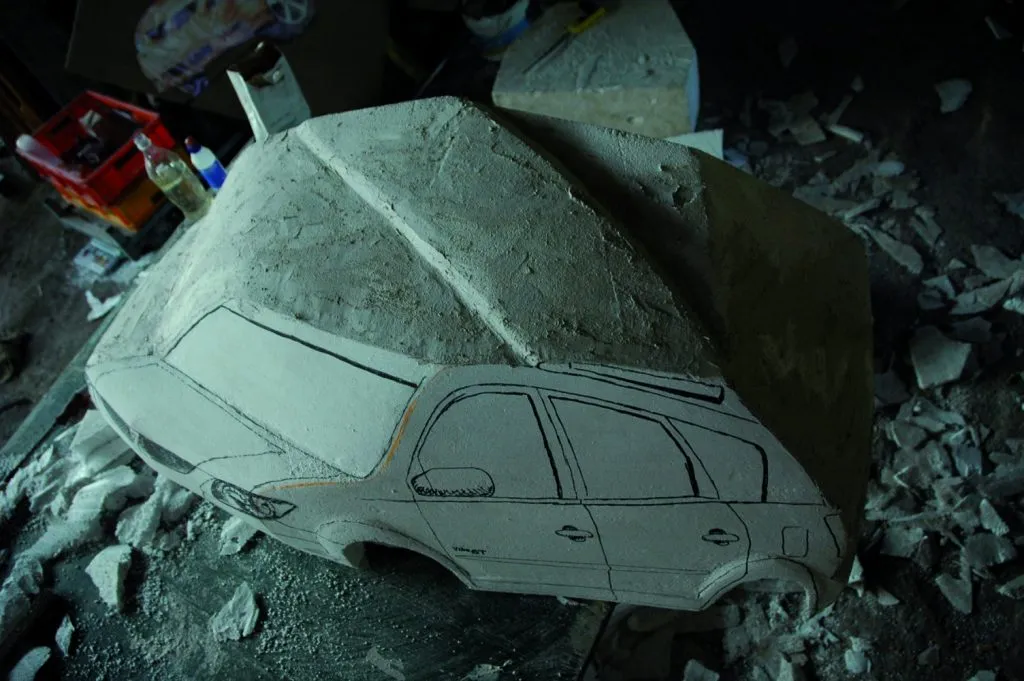
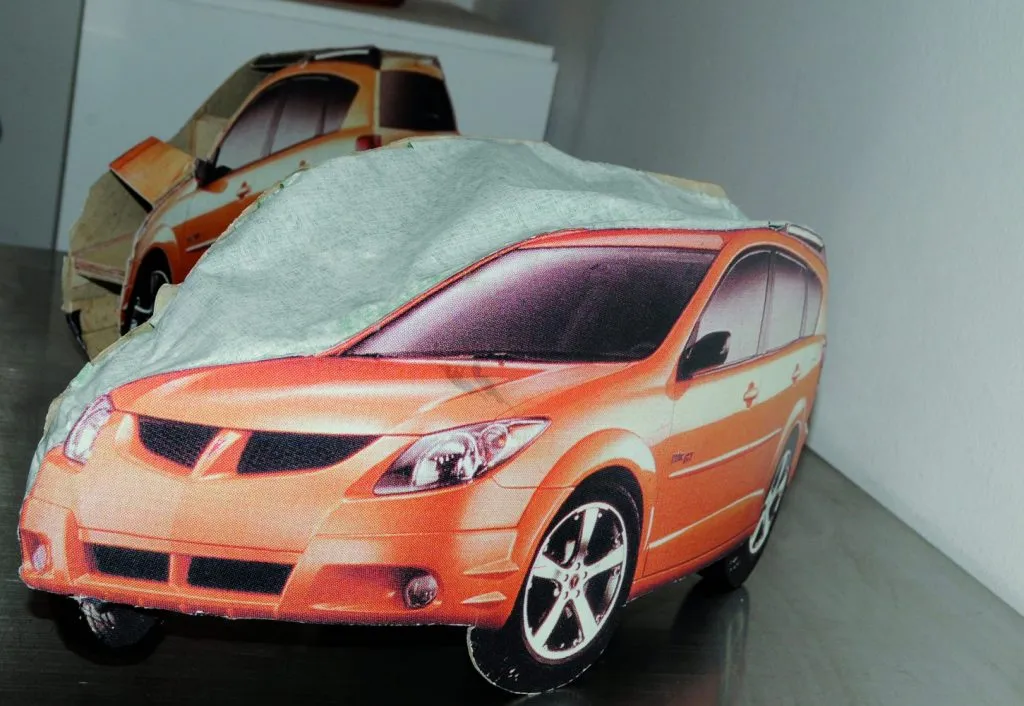
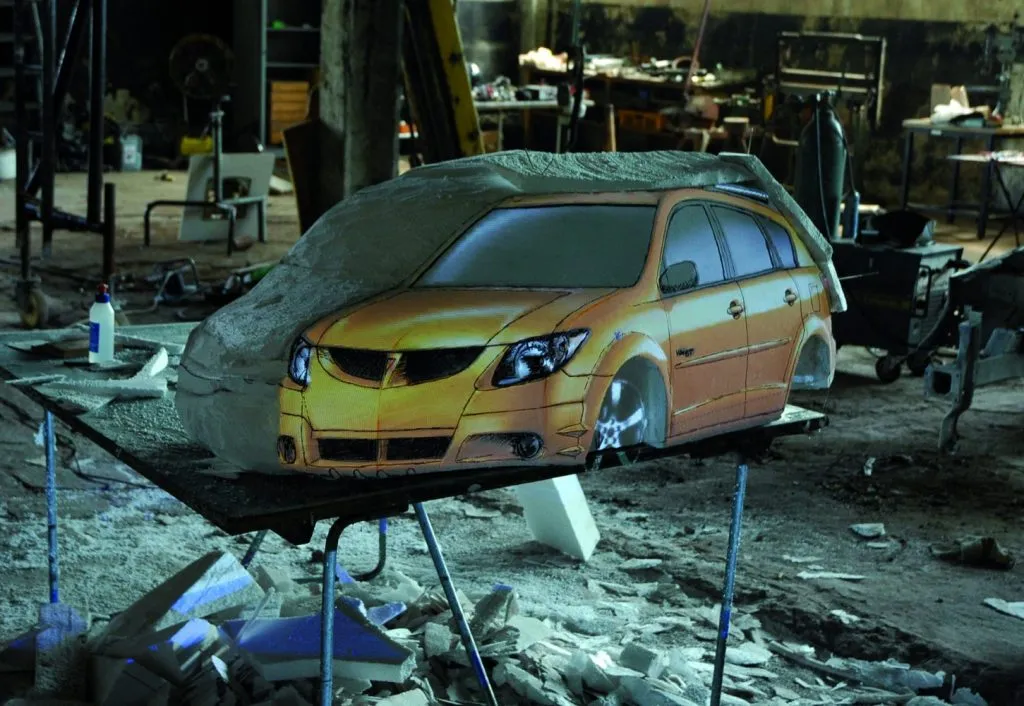
This is the problem Libera addresses in his project, which consists of a model of a hybrid car and documentation of its production: drawings preceding the construction of the polystyrene dummy model and a filmed interview with the model’s maker, a German mechanic and Harley rider. The second part comprises drawings of a hyper-mountain-bike, protagonist of innumerable campaigns promoting the so-called healthy lifestyle, used in an analogous process of restitution.
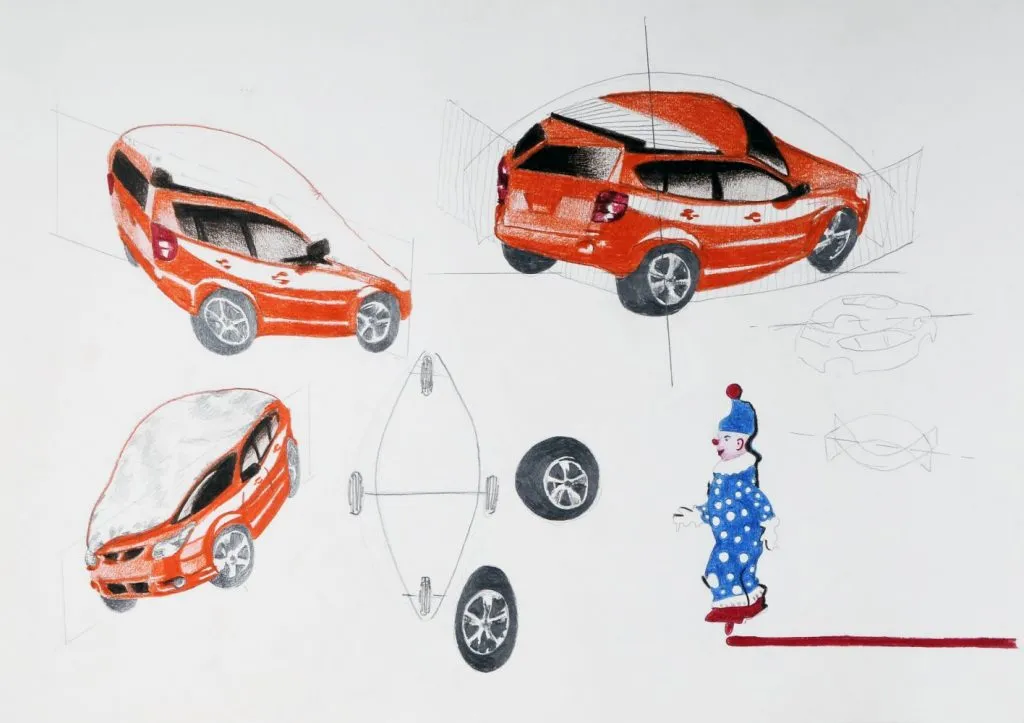
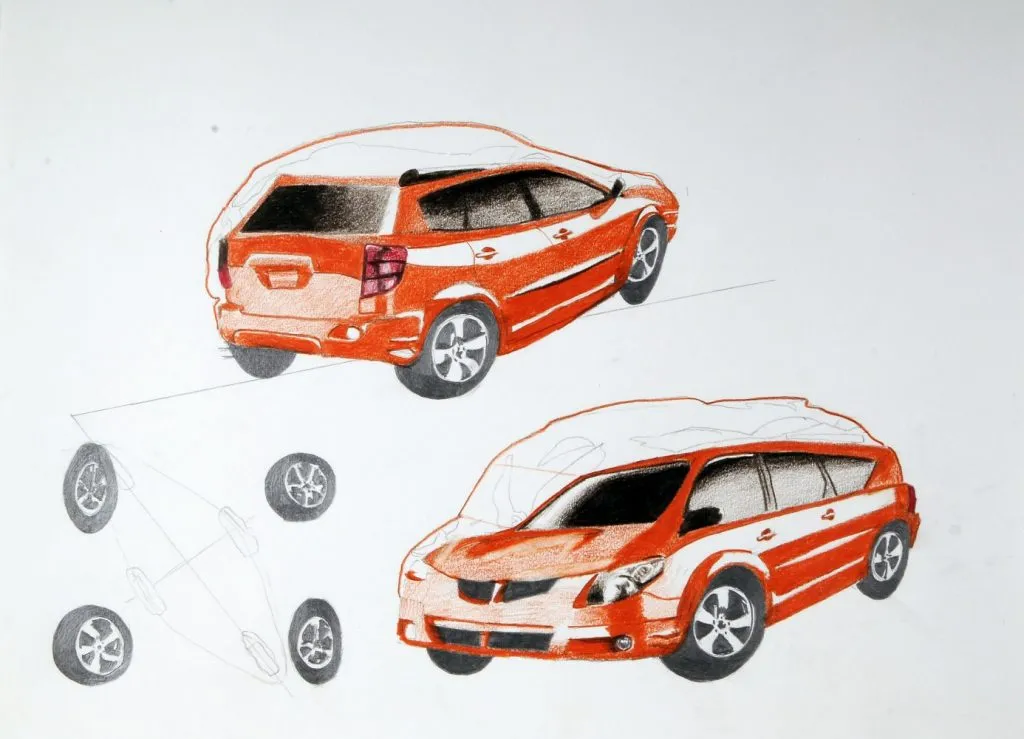
Libera’s project has several levels. First, its subject is modernism and its philosophy of modern consumerism. The artist critically reworks the modernist paradigm — especially its authoritarian self-confidence, aimed at visual colonisation and employing the image as a persuasive strategy — by means of another canonical product of modernism: photography. More precisely, advertising photography, with its agency in mass culture and marketing. Operating within the field of visual-culture criticism, Libera’s work also reveals the numerous trails and traps laid for us here, producing cognitive situations that have no counterpart outside art.
2. On one sketch for his model car, Libera placed a drawing of a blue jumping jack, a popular children’s toy moved by strings or wires. It is an archetypal figure: the Polish word pajac, derived from Pagliaccio, a character in the Italian commedia dell’arte, and translated as clown, harlequin, jester or buffoon, figuratively describes someone who behaves foolishly. Why does it appear in Libera’s drawing? Is it accidental that it appears as if in the margin of the principal (?) subject, which we assume to be the car sketches? What role is it to play? In fact, the blue jumping jack is neither marginal nor accidental: it is the key to understanding Libera’s artistic strategy.
The jumping jack appears in a white, abstract void, balancing on the end of a red line that, drawn from the very edge of the page, subtly suggests that it has entered from outside the frame, hence from “our” side of “ordinary” reality. Its figure makes visible the fundamental problem Libera addresses: an ironic play with the conventions of representation developed by Western culture; with illusion and imitation, which begin at the point where the black shadow outlining the flat silhouette cut from card produces the illusion of three dimensions on a two-dimensional plane. And chiaroscuro, as Vladimir Jankélévitch observes, is a figure of irony because, combining light, classically associated with truth, and darkness, associated with falsehood, it belongs neither to the side of light nor to the side of darkness2.
3. Libera’s first step in constructing irony is therefore to use a toy. It is a strategy he employs frequently. As early as the 1980s, in the circle of Łódź Kaliska, a group radically opposed to the political and artistic reality of the time, the artists developed an “art of legitimising rebellion” that permitted an escape from artistic mythologisation: an anti-artistic practice employing wit, irony, provocation and kitsch3. Libera was then at the forefront of the toy-art current, which uses toys in a variety of ways and thus moves within a space of visual culture often perceived as bizarre4. Drawing on the repository of toys, Libera uses them deliberately: with them he creates simulacra of consumer-culture products and, using the kitsch inscribed in the specificity of the so-called aesthetics of the market, exposes cultural mechanisms that format models of behaviour as power. In this way, he participates in art’s critical debate. As a declared advocate of art’s critical engagement, Libera is of course aware that critical art is itself inherently embedded in the system of power. He therefore makes no secret of using critical tools to activate certain subliminal contents: “I want to set in motion processes capable of engaging with a subject, extracting its potential and provoking a deeper resonance within us. […] [Therefore] the appropriate strategy for an artist should be the language of commodity, production and trade”5. The artist should thus assume the role of a producer of symbols and, through strategies borrowed directly from marketing and advertising, activate “the archetypes common to us all, or perhaps the ways in which they present themselves to us, [which] undergo continual transformation and reach our consciousness […]. Today, when advertising has taken over art’s former function of creating the aesthetics of the environment in which we live, the immense persuasive force of advertising, its effectiveness, rests on the professional skill of its makers in using archetypes as a kind of bait on which the viewer is caught. One might put it the other way round: advertising is a manifestation of the world of archetypes tailored to our times. I have the impression that things are now produced solely in order to be advertised”6.
4. Libera consistently constructs an artistic strategy arising from these reflections: “today one does not work through sudden revelations or impulses. The principal effort should be directed towards developing a sufficiently capacious method that permits different problems to be examined from different points of view and remains open to further modification”7. He therefore uses products familiar to us since childhood — Lego bricks, the Barbie doll, model toys and so forth — whose universality appeals to every person’s rudimentary psychological needs: a sense of security, play and ideas of a (happy) childhood. Libera employs the old Surrealist method of transferring cultural context. He creates an imitation toy, but emphatically not one intended for play: through the language of consumer culture, the artist speaks about fundamental matters and, as Piotr Rypson aptly observed, uses his “toys” like a computer virus that, once introduced into a system, exposes how it works.
The drawing of the toy jumping jack thus reveals these mechanisms to us in a perverse and grotesque fashion. First, it tells us that the jumping jack does not belong to the same space in which the drawings of cars float; it merely appears against their background, while its function is legible. Although what we see are drawings of “real” cars familiar from a dealer’s catalogue, the jumping jack radically changes their status. It seems a grotesquely reworked version of Le Corbusier’s Modulor, reducing the car’s identity to that of a toy.
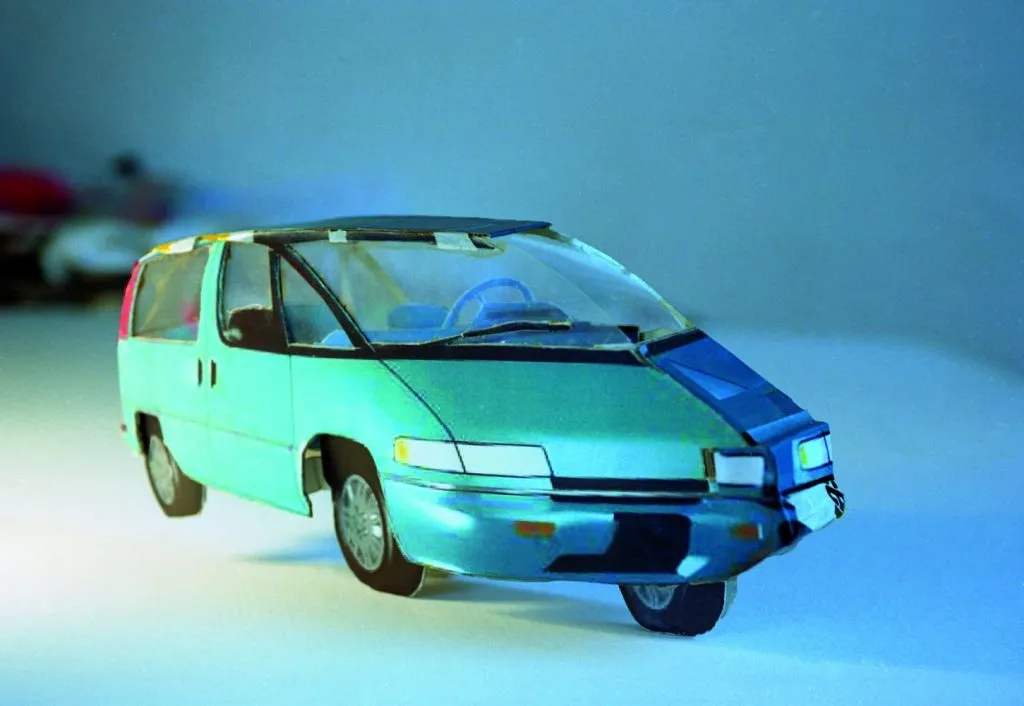
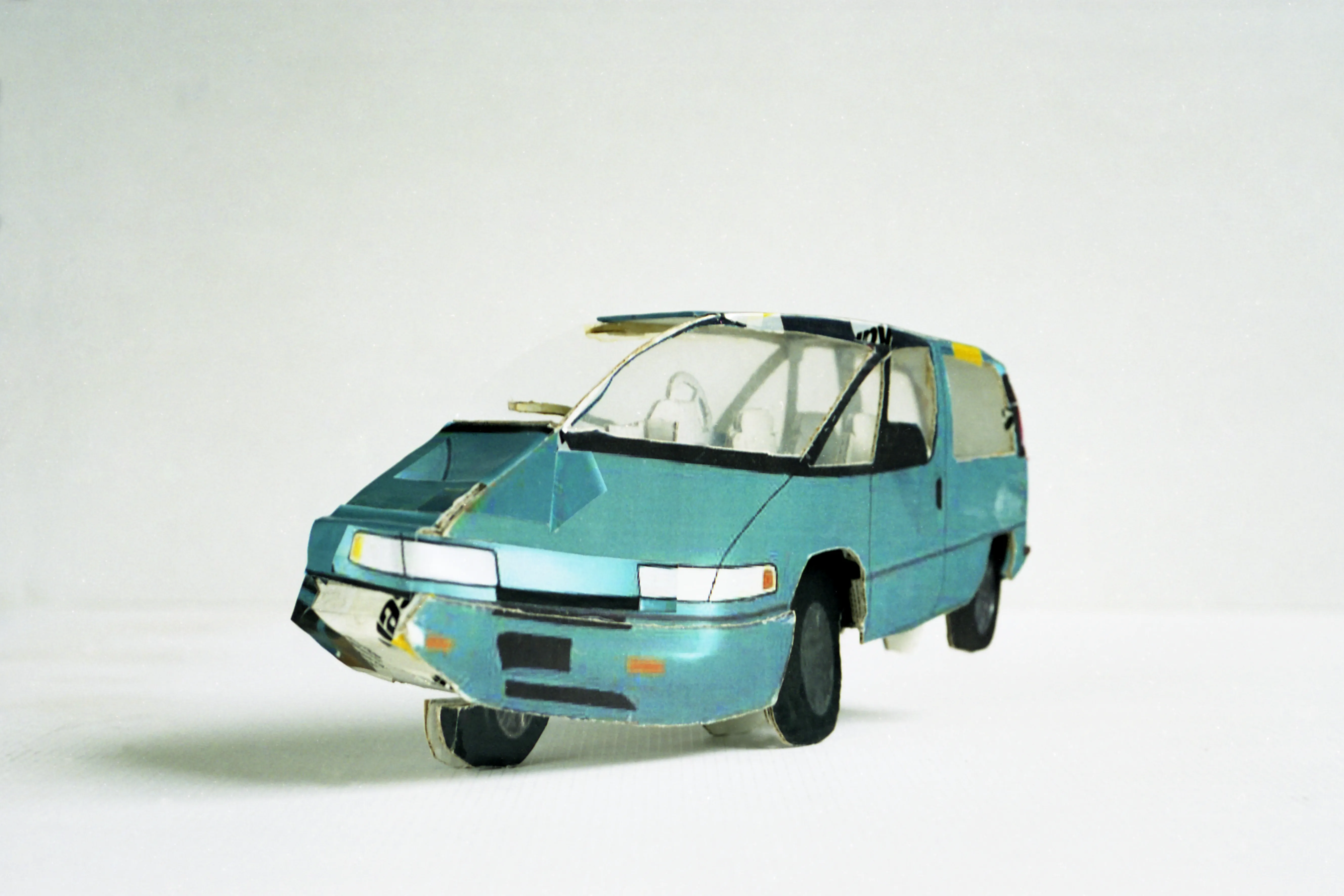
A doubt arises here, however: are we dealing with one car model shown from different angles, or perhaps three different models, as the subtle differences discernible as soon as we play “spot the difference” seem to suggest? And is it truly a representation consistent with the rules of perspectival vision — is what we see consistent with what we know about the object? A glance is enough to establish that the sketches of the car, as well as of the red bicycle, directly demolish what perceptual psychology calls a perceptual set: the mind’s preliminary preparation to receive particular information. Libera induces in viewers a state of uncertainty about their knowledge of reality. He presents ambiguous information that suggests what they ought to see. If at first we are under the power of this suggestion — recte, of the artist — and see, because we wish to see, an image of a car or bicycle, we soon discover that the object viewed is wholly inadequate to reality: the wheels bend, the shape of the bodywork or bicycle frame defies structural logic, parts of the device break off in unexpected places, and the solid is misshapen and irritatingly bizarre.
5. What, then, do these drawings represent? A kind of precession that produces mutations of objects? A hybrid from the series of “impossible figures”? We appear to be looking at “ordinary” representations of three-dimensional figures on a plane, whereas they seem a direct illustration of the problem described by Leibniz: they lead to a confusion of what one sees with what one knows — taking the effect for the cause. We see the object, hence the cause, when in fact we see only an image on the retina, hence the effect. The key to these drawings is the recognition that their source is not a physically existing “real” object — a car or bicycle and/or its model — but its photograph from an advertising catalogue. The subject of Libera’s drawings is therefore the image of an image, perceived as a reality that refers only to itself, not to what it represents. Here Libera uses a method tested in earlier photographic cycles in which he investigated the relationship between two and three dimensions (Untitled, 2003–06; La Vue, 2004–06). Using an analogue camera with a macro lens, the artist made a series of large-format photographs suggesting semi-abstract landscapes. In reality, they showed images appearing in the gaps between the pages of a colour magazine or album. The inspiration for these indeterminate, unnoticed traces, excluded in the process of seeing and revealing their hidden, “peripheral” existence only through Libera’s lens, was the Surrealist writing of Raymond Roussel (1877–1933), more precisely the experimental poem La Vue (View, 1904). Employing a method of “language that writes by itself”, Roussel described the image in a miniature photograph embedded in a pen holder. Roussel’s micro-observation, his “myopic eye and its madly precise and persistent capacity for observation, which magnifies everything”, as if by means of an optical device — binoculars or a microscope8 — is also a feature of Libera’s vision. Sight is the privileged sense here and, per analogiam with Roussel’s method, it “sees by itself”. This makes possible the creation of a double “description”: a description of a world that “does not appear as real but as already represented. […] The immense magnification of certain distant or tiny elements takes on particular significance in this context […]. The view here is an invented view. […] we find ourselves in a flat and discontinuous reality in which each thing refers only to itself”, as Alain Robbe-Grillet comments on Roussel’s writing strategy9. The same strategy fits these two cycles by Libera perfectly, allowing us to observe the very process of looking.
6. Sight and seeing are also active in the creation of these unsettling images of a car that does not exist in reality, produced through a metamorphosis of images and afterimages. Matters become still more complicated when Libera converts them and uses them to construct a three-dimensional model. Only at this point does he conclusively prove that we are dealing with a non-existent, apparent reality: a fiction based on illusion and possessing the features of metaphor, a rhetorical figure inscribed in the field of visibility. In accordance with the Greek meaning of the term, metaphor denotes carrying across (translatio) and may assume the form of a real metaphor in the shape of conceptual images — images that represent not external, sensory things, but the mental images a person forms through experience and knowledge. One form of these conceptual images consists of flat images that manifest their flatness in order to explain what they represent, hence to reveal the concept of the object10. Thus arises a double metaphor based on the mechanism of “transforming one material into an index of another”; the two-dimensional model is identified as a special variety of it, as distinct from the three-dimensional model, which functions as a real metaphor and may be treated as the original object11.
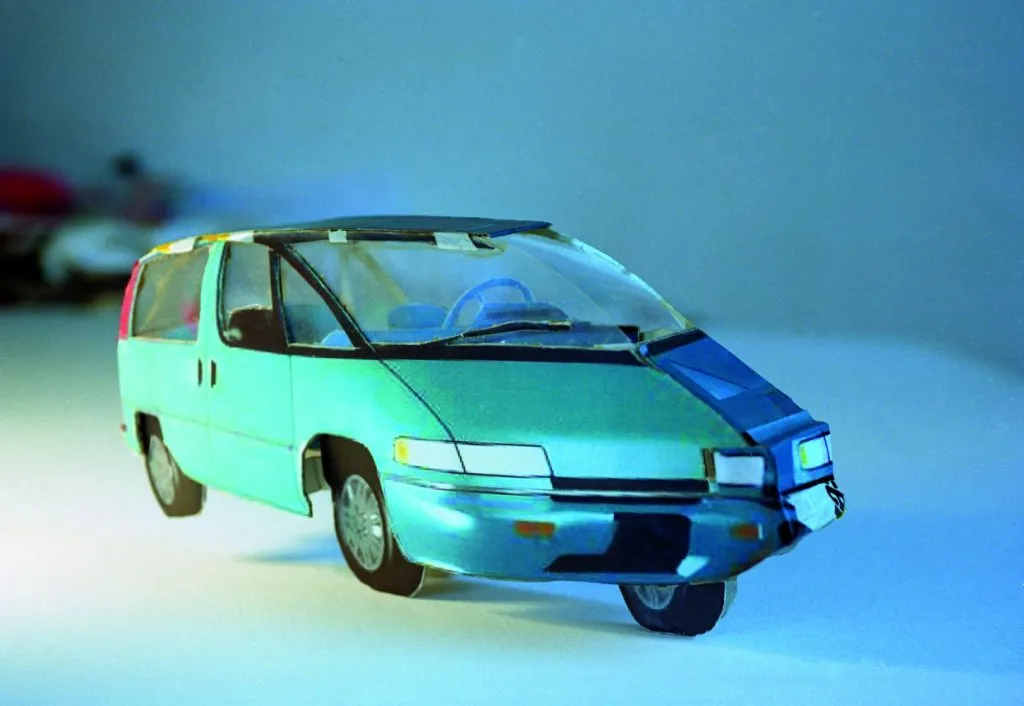
The polystyrene dummy “car” is therefore not a mimetic reconstruction of a car, but a spatial restitution of its image as it emerges, distorted, through the camera lens — a lens that thereby undermines photography’s status as document. This “scientific” strategy serves cognition. One might say that Libera adopts the position of the artist-scientist, following Lévi-Strauss’s view that the artist’s task is to produce a material object which, while a work of art, is simultaneously an object of knowledge, an effect of scientific thought: the image as a reduced model of the original serves cognition, “and even if this is an illusion, the point is precisely to create and sustain that illusion, because it affords an intellectual satisfaction and a pleasure which, for that reason alone, may be called aesthetic”12.
7. Within this framework, and in today’s posthumanist paradigm, Libera exposes the mechanism of deceiving the eye that art has analysed for centuries and that is contained in two Kantian concepts: illusion, a property of art defined as aesthetic semblance — the product of creative imagination, “a sensory phenomenon that the mind recognises as […] caused by the very nature of perception”13; and delusion, alien to art, defined as a deception that authoritatively imposes an image upon the viewer. The illusion–delusion problem rests on what may be called a tour de force: whether the image deceives the eye (trompe-l’œil), meaning that it is a fiction to which the viewer consents, knowing that only an image stands before them; or whether it is a trompe-l’esprit, deceiving the mind in order to make the viewer believe they face a real object rather than its image14. In other words, Libera’s model and its “documentation” reveal the essence of the Adornian paradox: we are dealing with a work of art which, as Adorno puts it, is an “act of balancing”, a semblance pretending to be what it is not, a paradox and revelation of what is impossible and unrealizable15.
Yet it is semblance that conditions the existence of truth: “there would be no truth if it did not appear and reveal itself” (Hegel)16.
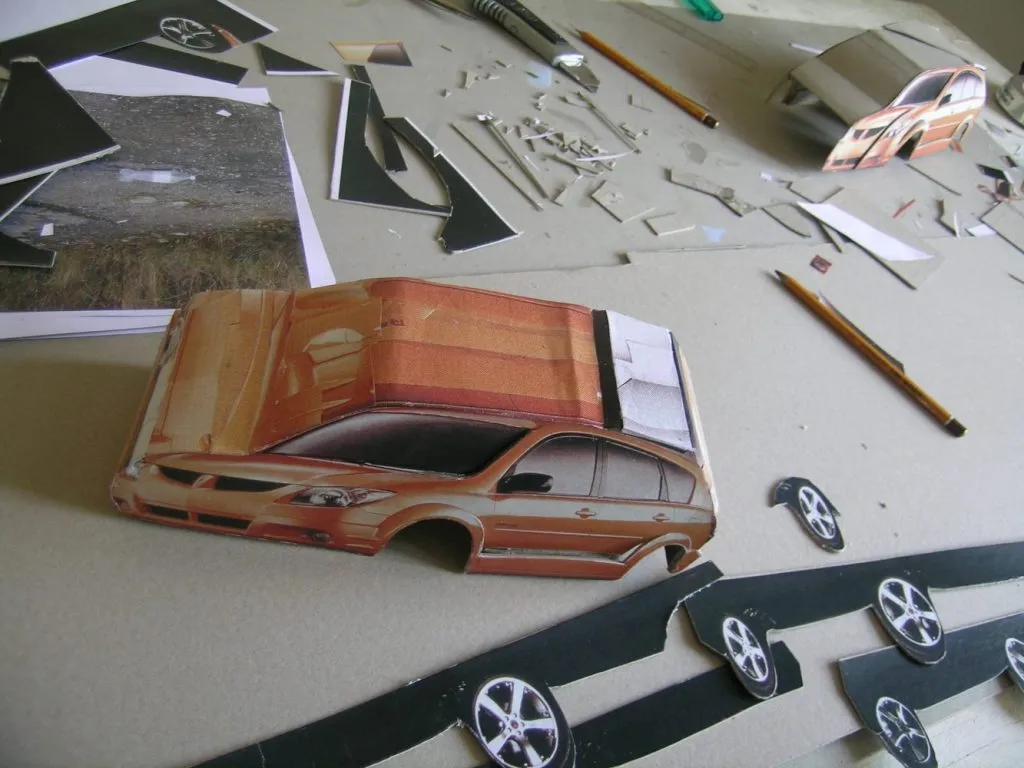
Libera continually confronts this Hegelian axiom, although he refers expressis verbis neither to Hegel nor to Schopenhauer, even though it was the latter who argued that we are led to understand what an idea is not by the real, but by the image, defined as an object that only after being filtered through the subject is revealed to us as form17. Yet even if Libera does not invoke this philosophical and theoretical doctrine directly, his art is clearly rooted in it. The question of the truth or truthfulness of the image, operative in the theory of the image as deceptive fiction that is fundamental to art history, is reworked by Libera within the paradigm of contemporary visual culture, which now focuses on conventions of representation understood as social conventions. At the centre and source of Libera’s art and its relation to reality, one can thus discern the old Platonic-Kantian canon: the problem of perceiving the world through the reality–semblance dichotomy, and the image and its model as a play with cultural conventions of representation that establish regimes of vision and power.
8. Libera is an artist of conflict. His aim is not formalism but the production of conflict through deconstructing habits of seeing, questioning and invalidating them, and exposing the ambiguity of the cultural training in which we participate, relationally, as viewer-actors. Reality Is Flat creates a dense network of meanings in which modernist linearity is replaced by a mechanics of irony grounded in intertextuality, inversion and dispersion. The art of Libera — artist-researcher and anthropologist, observing visual culture from outside, from the artist’s position — is based on the strategy of just observe: studying only what is visible. Hence its “subversiveness”. Observing the image as, nevertheless, a cultural construct capable of establishing social norms, Libera approaches it in a fundamentally “revisionist” manner, close to the non-anthropocentric contemporary posthumanities and their Latourian conception of the agency of objects18. In this way, he reveals significant social controversies present within and produced through the image, and unmasks the ironic nature of visual culture as representation and, per se, its relational, agentive capacity to produce conflict within culture understood as a hybrid collective.
Marta Leśniakowska, habilitated doctor and associate professor at the Institute of Art of the Polish Academy of Sciences, art historian and university lecturer, author of ten books and numerous articles on modern art, methodology, theory and art criticism.
1. B. Czubak, Reality Is Flat, in Reality Is Flat, Profile Foundation, Warsaw 2010, reprinted in Flat Reality, Atlas Sztuki, Łódź 2013.
2. V. Jankélévitch, L’ironie, Paris 1936, p. 11, quoted in M. Salwa, Illusion in Painting: An Attempt at a Philosophical Interpretation, Kraków 2010, p. 297.
3. The Art of Legitimising Rebellion: Zbigniew Libera in conversation with Bożena Czubak, Magazyn Sztuki, 1997, no. 15, http://magazynsztuki.eu/old/archiwum/nr_15/libera/zbigniew%20libera_sztuka_legalizowania_buntu.html
4. E. van Alphen, Playing the Holocaust, translated into Polish by K. Bojarska, Literatura na świecie, 2004, nos 1–2, pp. 217–43.
5. The Art of Legitimising Rebellion…, op. cit.
6. The Art of Legitimising Rebellion…, op. cit.
7. The Art of Legitimising Rebellion…, op. cit.
8. R. de Montesquieu, Raymond Roussel — A Difficult Author, translated into Polish by W. Gilewski, Literatura na świecie, 2007, nos 9–10, p. 185; A. Robbe-Grillet, Enigma and Transparency in Raymond Roussel, translated into Polish by E. Wieleżyńska, Literatura na świecie, 2007, nos 9–10, p. 202.
9. A. Robbe-Grillet, Enigma and Transparency…, op. cit., pp. 202–03.
10. D. Summers, “Metaphor”, in Encyclopedia of Aesthetics, Oxford 1998, pp. 219–21. The problem is discussed in detail by M. Salwa, Illusion in Painting…, op. cit., pp. 164–66.
11. M. Black, Models and Metaphors, Ithaca 1962, pp. 219–43; see M. Salwa, op. cit., pp. 164–66.
12. C. Lévi-Strauss, The Savage Mind, translated into Polish by A. Zajączkowski, Warsaw 1969, p. 41.
13. F. Burwick, “The Grotesque: Illusion vs. Delusion”, in Aesthetic Illusion: Theoretical and Historical Approaches, ed. F. Burwick and W. Pape, Berlin–New York 1990, p. 126.
14. M. Salwa, Illusion in Painting, op. cit., pp. 39–41.
15. T. W. Adorno, Aesthetic Theory, translated into Polish by K. Krzemienowa, Warsaw 1994, pp. 195–98.
16. G. W. F. Hegel, Lectures on Aesthetics, translated into Polish by J. Grabowski and A. Landman, Warsaw 1964, vol. 1, p. 15.
17. A. Schopenhauer, In Search of the Wisdom of Life: Parerga and Paralipomena, translated into Polish by J. Garewicz, Kęty 2004, vol. 2, pp. 361–62.
18. B. Latour, Objects Too Have Agency, in Theory of Knowledge of the Past against the Background of the Contemporary Humanities: An Anthology, ed. E. Domańska, Poznań 2010, pp. 519–54.