
Flat Reality
Bożena Czubak
One of the creators of the nouveau roman opposed a vision of the world as flat and incoherent to the “old myth of depth”. Yet Alain Robbe-Grillet’s purifying vision, restoring objects to their “essential flatness”, was to prove all too compatible with the spirit of post-war modernisation, which removed too much from its new field of vision1.
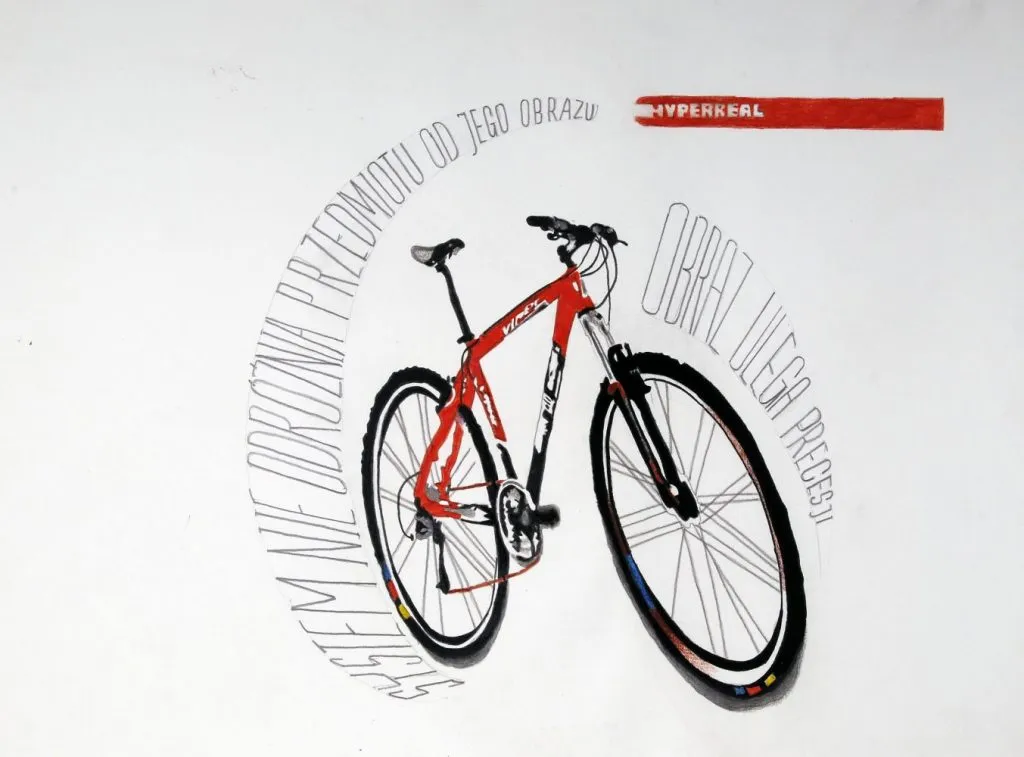
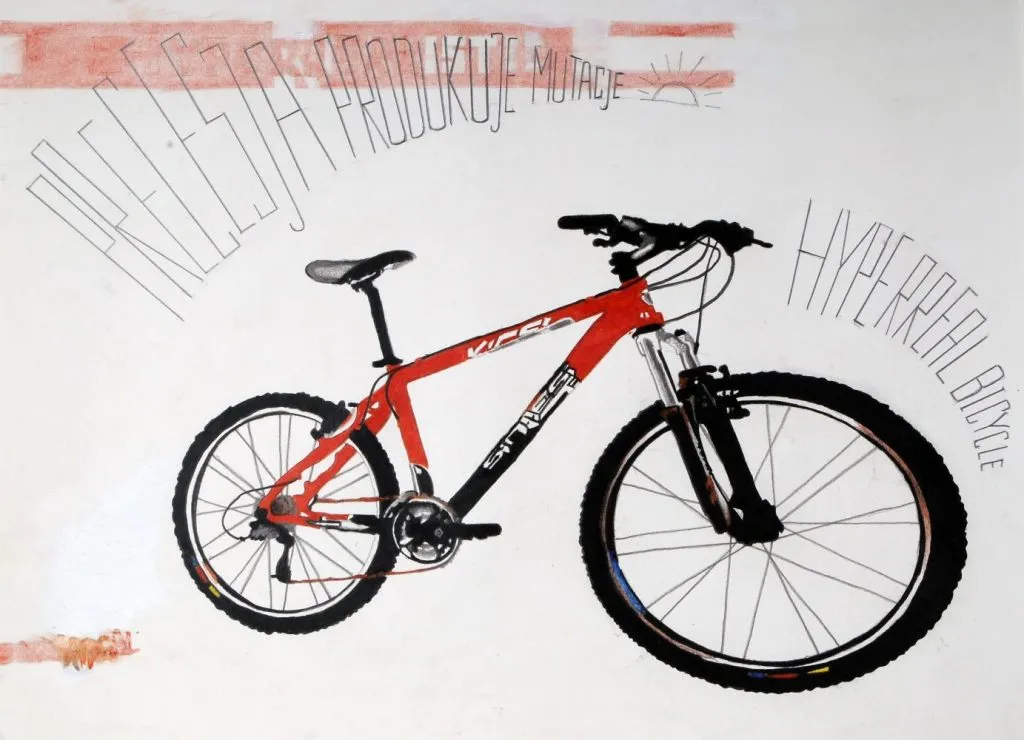
In his latest project, Zbigniew Libera reconstructs this flattened world in three dimensions, restoring its invisible regions to sight. The project involves building a prototype car: a visual and spatial hybrid that transfers into the third dimension the perspectival deformations and foreshortenings employed in photographic and film recordings. Its points of reference are representations that overlay a reality experienced and consumed through images. The shapes of the car derived from photographs prove far removed from its actual forms and proportions. With characteristic perversity, the artist demonstrates the methods of visual deception and strips them of their “hypnotic charm”. The surprising forms of his car visualise the traps of a way of seeing shaped by media representations. He uses a similar device in the model and drawings of a bicycle whose shapes have been deformed by vision. By wresting them from the power of the gaze, he reveals how the images of consumer culture influence our perception of reality and the creation of its myths.
In the project presented here, Libera develops themes he explored in earlier works concerned with consumer culture, the mechanisms of vision and the ways in which we perceive the visual culture around us. Speaking in an interview thirteen years ago about the works he was making at the time, he emphasised the importance of their manufacture, technological quality and commercial image2. In the Corrective Devices series (1994–1997), he adopted the language of commodities and consumer culture, taking on the role of a manufacturer producing symbols and advertising “lures”. While those works were defined in terms of production and consumption, Libera’s latest pieces operate in the space between: he no longer identifies with the producer, nor does he target consumer desire. His recent series concern instead the discursive production of the commodity — the visual means by which it is transformed into discourse. In the interview mentioned above, the artist spoke enthusiastically of operating like a virus. At the time he infected products with the virus; now he seems to diagnose a viral infection located no longer in the product, but in the act of seeing it.
He addressed the problem of vision in the works that preceded this project, in the series La Vue (2004–2006) and Untitled (2003–2006). In the latter, he used a camera to record what escaped sight. In photographs of pages from illustrated guides or colour albums of historic architecture (Untitled), he brought out every stumble of the eye, every piece of visual waste: blurred, out-of-focus shapes and the foreshortening of pages seen obliquely.
In La Vue, enlarged photographs of pages from colour magazines reveal images formed around the gaps between pages. They disclose vistas of an unacknowledged visibility — everything eliminated by the dominant way of seeing. In both series, Libera led the viewer into regions of visual exclusion, into an invisibility guarded by the power of the gaze. He activated a critical eye in order to record this “peripheral vision” in photographs.
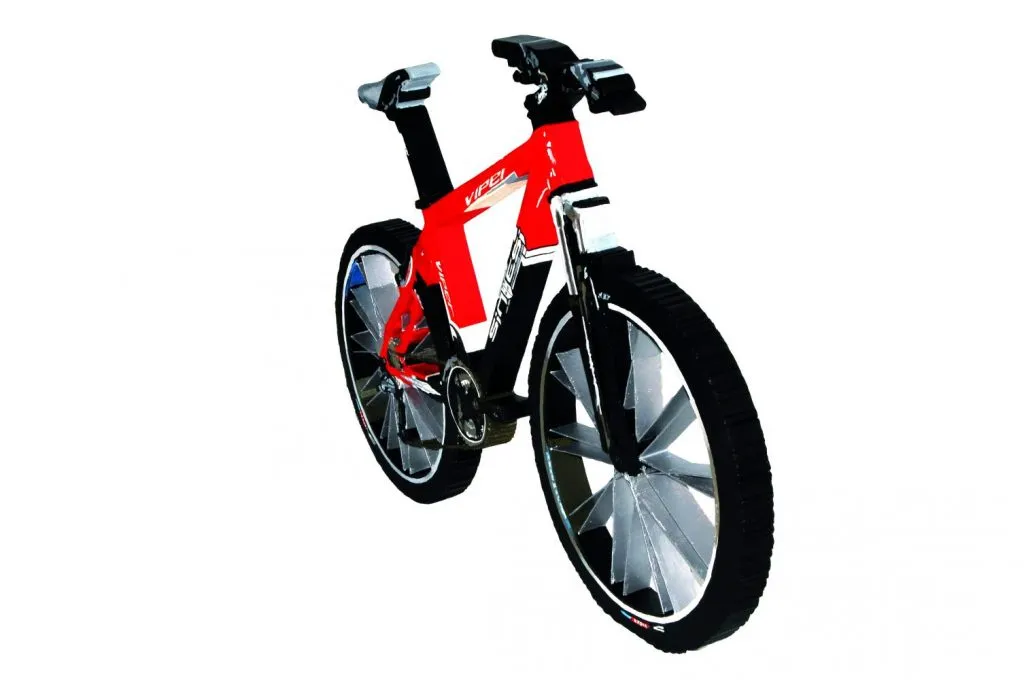
In his latest project he uses the opposite method: here the critical eye follows what has already been represented and imposed upon vision. In drawings and models that reproduce photographic views, he makes us aware of the naturalisation of a way of seeing that proves unnatural. Their “reality effect” is an effect of the ideological conditioning of the gaze. In the bicycle drawings, the shapes and sizes of the wheels change according to the vision reconstructed from the image. Media reflections masquerading as reality transform it into hyperreal images. The slogans in the drawings clearly refer to the processes by which reality is made unreal, as described by Baudrillard. The system does not distinguish the object from the image. The image undergoes precession. In a hyperreal reality fitted to its media representations, we encounter a mutation of reality, its interpretation by the media. PRECESSION PRODUCES MUTATIONS. HYPER-REAL BICYCLE. The bicycle’s elliptical wheels, the car’s bulging curves and its distorted proportions show us something that does not exist. Deformations taken from photography contradict its presumed objectivity.
Through its images we see differently; in its reflections it is impossible to distinguish a lie from fabrication, fiction from reality. Photography’s lie is not here a “lie in the service of truth”. And making its images real sets in motion a process that makes reality unreal. The emancipation of images and signs begins with photography and its capacity to generate new meanings. The magical meanings of the new Citroën, decoded in Barthes’s Mythologies, endowed it with the qualities of an object from another world through the spiritualisation of the new car’s gleaming smoothness. The new myths offered by means of the new model were quickly absorbed by an audience “kept in suspense by a long-running press campaign”3.
For this project, Libera reaches for one of consumer culture’s most mythologised objects: the car. An object of worship and an instrument in the shaping of mass tastes and behaviour, it served as an attribute of twentieth-century utopias and a central motif of modernising ideologies. As a form generating myths on a mass scale, it has repeatedly been described by eminent cultural theorists including Roland Barthes, Jean Baudrillard and Gillo Dorfles. When Barthes demystified bourgeois mythologies in the 1950s and described the car as a “projection of the ego” at the beginning of the following decade, he observed that perhaps only food occupied as much space in French discourse as cars. A scholar of the phenomenon adds that in France the cultural discourse on the car preceded its widespread use: before becoming a mass commodity, it was first a central motif of contemporary literature and cinema. Kristin Ross analyses various cinematic techniques used to create the magic of cars, such as extreme close-ups in which they fill almost the entire frame like gigantic insects. She also draws attention to parallels and interdependencies between the film and motor industries that made cars and films both key commodities and vehicles of change in European patterns of consumption and social behaviour4. These transformations entailed changes in modes of perception: reality came to be perceived like moving images, a “vanishing and ephemeral reality” passing across a cinema screen or beyond the windows of a moving car.
In cinematic narratives, the car embodied a new way of life and was inscribed in myths of modernisation and the disappearance of the traditional world. It was also to become a trap for a vision that, as in Barthes, delighted in the gleam of polished bodywork and surrendered in desire to spectacles of consumption that obscured less desirable aspects of reality. For Baudrillard, the history of the image is the history of the erasure and disappearance of reality.
In Libera’s work, we encounter a vision of the car used not so much in practice as, above all, in the gaze, which it provides with the material realisation of what it has been fed through media representations. His models and photographs of cars are, in their own way, a disillusionment of pictorial illusions. But their “flat reality” differs from Alain Robbe-Grillet’s “purifying power of the gaze”, stripped of “depth”, meaning or reference of any kind. Libera’s “flat reality”, with all its distortions, escapes the supervision of the gaze, exposing the falsifications of images and of the way they are seen — the falsifications of photography, which never shows the world as it really is. Libera’s vision is not purifying, but inscribed within the history of vision. In the bicycle drawings, the lettering recalls the dynamism of Constructivist typography and the rhetoric of agitational slogans used by advocates of “visual hygiene”, who sought to “look at the world through different eyes”. The models of distorted cars and the bicycle arrest a gaze losing itself in the images of contemporary design and its ambitions to design both the world and the way it is seen in their entirety.
Bożena Czubak is an art historian and critic, curator of exhibition projects, author of numerous publications on contemporary visual culture, member of the International Association of Art Critics (AICA), and president of Profile Foundation in Warsaw.
1. See Kristin Ross, Fast Cars, Clean Bodies: Decolonization and the Reordering of French Culture, MIT Press, Cambridge, Massachusetts, and London, 1996.
2. See The Art of Legitimising Rebellion, Bożena Czubak in conversation with Zbigniew Libera, “Magazyn Sztuki”, nos. 15–16, 1997.
3. See “The New Citroën”, in Roland Barthes, Mythologies.
4. Kristin Ross, op. cit.