Narrative Drive
Tomasz Załuski in conversation with Christian Tomaszewski
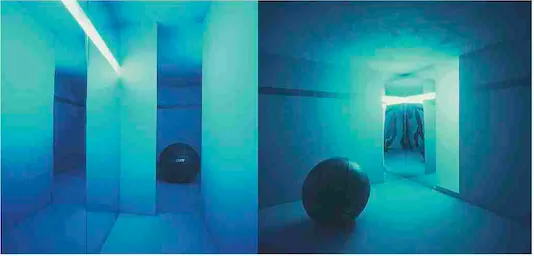
Tomasz Załuski: In the project you are currently realising at Atlas Sztuki, you use certain ‘set-design’ elements drawn from David Lynch’s film Blue Velvet. At the same time, this installation crowns almost two years of work on other projects in which you have referred to the film in various ways. What is the source of your fascination with Blue Velvet—or perhaps even your obsession with it? What interested you so much about it?
Christian Tomaszewski: I shall try to answer your question as to why Lynch’s Blue Velvet in particular, rather than Eraserhead or Lost Highway, even though those are also among my favourite films. For a long time, I had been thinking about reconstructing something that had come into existence, but not in a real form, if I may put it that way; rather, in the Lacanian form of a postmodern pastiche of clichés. Moreover, my obsession with film as material for play has accompanied me for a long time. In this case, Blue Velvet seemed to me one of the best materials available: the magnificent, emblematic America of the 1950s as a cliché that becomes the ‘Thing’ to be repeated and used to collage a new story over and over again. The America Lynch presents here is precisely an America that feeds on its own myth, an America of porcelain Elvis Presley heads and pastel Cadillacs that seem to be more than mere decoration or scenery—they are instead a dramatic thread propelling the criminal plot forwards.
My interest in Lynch and Blue Velvet is therefore undoubtedly personal. To me, Lynch is one of the few American directors who have become firmly lodged in my consciousness—the consciousness of someone on the border between two cultures. Blue Velvet depicts America as I see it. The town of Lumberton represented in the film is an America full of naivety and apparent comfort, yet also horror and unhealthy deviance. That is all. Blue Velvet is a very American film. Lynch makes quintessentially American films that are close to my own observations, films in which fantasy is the fundamental support for one’s sense of reality. The reality of his films strikes me as a traumatic lining concealed beneath the surface of that society’s collective consciousness. Lynch is also, for me, an intriguing enigma of postmodernism—even though in my everyday practice I am more interested in modernism and all its utopias. Lynch’s films are not so much stories as sensational events; nor are they anthropological or psychological analyses of the characters. Moreover, most of the strands in his films, at least in my view, do not so much function conceptually—they are not intended to communicate any particular ideas or meanings—as result from a natural need to reproduce hermetic clichés. That is why I use Lynch as material from which to mould another form. My work with Blue Velvet is not an essay on why I like one thing rather than another. Perhaps it is more my own subconscious attempt to adapt than an adaptation of someone else’s material. In Blue Velvet, I find many strands that I can use, combine and digest, give another dimension to, and employ to continue Lynch’s need for reproduction. Moreover, it is a game—a game with my, or our, subconscious and with disappointment in both senses of the word. First, by using such a distinctive film, I merely repeat what can be expected; second, it is a kind of personal consent to being overpowered, because Lynch’s vision remains stronger, whether one wants it to or not. To some extent, therefore, the project contains the idea of defeat and meaninglessness in its very premise. By its very nature, it remains unfinished.
T. Z.: I would not say at all that, by turning to ‘such a distinctive film’ as Blue Velvet, you repeat those of its elements that are predictable, obvious and easily expected. Part of your current project is an expanded version of the earlier work Light in Lynch, which involved reconstructing lamps appearing in various scenes of Blue Velvet. Detached from the interior architecture whose character they help shape in the film, you brought the lamps together in a manner that created a kind of accumulation, somewhat reminiscent of Arman’s works—accumulations of individual objects from the same conceptual category. This may be a silly question, but why did you choose lamps in particular? What does this repetition of an element borrowed from the film entail—is it merely about satisfying the need to reproduce? What effect did you have in mind when making this peculiar inventory of Lynch’s lamps?
Ch. T.: The choice of lamps was accidental to some extent, though not entirely. I find all kinds of details in Lynch’s films extremely intriguing, and there is no sense of anything accidental about them—rather, a fully deliberate desire to isolate something distinctive and rather sombre within apparently carefree American kitsch. From my point of view, in most of Lynch’s films the shots showing lamps or another distinctive element of lighting usually precede some important moment, a turning point in the plot.
The motif of obsessive reconstruction was the principal thread for me, although I was, of course, also interested in the final effect and the first impression produced by such a grouping of lamps. I was interested in a kind of parody of a museum exhibition presenting the evolution of a particular object or style. In addition, it is rather amusing that the lamps are not only objects fulfilling the function of a ‘work of art’, but also perform their primary task of providing illumination in the place where they are displayed. It is a rather comical effect—something like a lighting shop. I also thought about these lamps in the context of ready-mades—although they are not actual lamps ready to hand but replicas constructed on the basis of the film, something that is not, in fact, obvious—and here I was interested in the extent to which Duchamp’s revolutionary invention has aged, so that today it seems to possess purely historical value, while all kinds of reconstruction have become a trend of our times and perhaps a manifestation of a certain ‘postmodern frustration’.
I also make no secret of the fact that the aesthetic of Lynch’s lamps appeals to me greatly. A lamp in itself also seems an intriguing object, apparently entirely banal yet very symbolic at the same time.
T. Z.: I am curious what conclusions you reached while realising your work as far as ready-mades are concerned. Today—at a time when ‘installations’ have become so commonplace—is it still possible to extract anything interesting from the very idea or the historical fact of the emergence of ready-mades? Could you also say how you understand this ‘postmodern frustration’—why should the desire to reconstruct be its manifestation?
Ch. T.: It seems to me that nothing more can really be extracted, and that this is not an original thought but a kind of axiom I do not consider in everyday life, although the completed series of lamps—which are not ready-mades, even if they may appear to be at first glance—provided me with another ‘laboratory’, tangible proof of this sterility. Physical confirmation of that state of affairs was by no means the principal aim of my project. Nor does the fact of this sterility signify to me the end of the possibility of interesting art being made—art for which that sterility would serve as the point of departure. ‘Postmodern frustration’ is, of course, a major simplification and only one possible strand in a view of the contemporary artist’s condition, an artist who seems to me to be condemned, to varying degrees, to reconstruction in a more or less literal sense.
T. Z.: When making the individual works referring to Lynch, were you already thinking about the comprehensive installation now being presented? Did the idea for this project arise only in connection with the exhibition at Atlas Sztuki, or had it emerged earlier?
Ch. T.: No, all the works referring to Lynch are part of a single, expanding whole. The exhibition at Atlas Sztuki is the next phase of the overall project; that was my premise from the very beginning. After Atlas Sztuki, I intend to continue it until I decide that the end has come.
T. Z.: Lynch appears to be a master at playing with our imagination. He seems to know how particular means and devices act on the imagination and, in using them, often creates certain narrative tensions only to disappoint our expectations and shatter the illusion a moment later, or even in the very same gesture. This leads to a situation in which we are aware of the conventionality, and sometimes even the crudeness, of the cinematic means that provide impulses for the imagination, yet we are also aware that, despite everything, we submit to their effects as though under compulsion; perhaps this is the source of at least part of the disquieting and uncanny effect produced in Lynch’s films. Lynch’s subject therefore appears to be the complex relationship, or elusive boundary, between the ‘objective’ and ‘imaginary’ dimensions of reality. Is this boundary also something you try to take into account and accentuate in your work?
Ch. T.: Yes.
T. Z.: And do you think one might speak of a particular narrative drive in human beings?
Ch. T.: I think so; I think it is a kind of unconditional reflex.
T. Z.: It seems to me, then, that something else that may have attracted your attention in Lynch’s film was the fact that elements of the set design, particularly the interior architecture, play a leading narrative role—at times they even seem more important in this respect than the characters and events depicted. This interest in the narrative possibilities of architecture is clearly visible in your work, especially the possibilities of interior architecture: architecture understood as a way of shaping internal spaces and, at the same time, creating a particular ‘atmosphere’ in places.
Ch. T.: Yes, definitely—architecture, not only interiors, as a potential or tool of narrative is one of the principal strands in my work, and my present work on reconstructing Lynch continues these interests, which strongly influenced my previous projects. In addition, the relationship between space and architecture and those who are, or are not, present within it is important to me—in the current project I want to achieve a state of total absence, as though Blue Velvet were a deserted town. In my earlier works, an important aspect was the ‘interactivity’ of the architecture or one of its elements. The appearance of viewers was, to some extent, the moment at which the project became complete—even if, in many cases, their presence was entirely passive. As for Blue Velvet, I think that the film’s spaces are so strongly oriented towards propelling the action forwards and portraying the psychology of the characters because it is a film about looking, or even peeping. Jeffrey looks; the viewer seems to stand directly behind him and peer over his shoulder; Sandy, too, looks at the world through Jeffrey’s eyes; and many scenes are magnificent spectacles viewed through a keyhole or a crack in a wardrobe door.
T. Z.: Is the viewer of your installation therefore meant to feel like an intruder?
Ch. T.: Yes. During the presentation of an earlier phase of the project, I considered introducing an additional narrative line in the form of various images of viruses—Ebola, for example—scattered throughout the installation, so that Blue Velvet, dismantled into its constituent parts, would seem like a post-‘plague’ reality; later, however, I abandoned that intention. I think the motif of the audience as intruder is quite consistent with Blue Velvet and the fact that Jeffrey is a perpetual intruder there.
T. Z.: The title of the current installation—Of Chapels, Caves and Erotic Hopelessness—contains a clear allusion to Schwitters’s Merzbau, the Dadaist construction in which the artist placed, among other things, rather random, curious objects left behind by visiting artists: a piece of tie, a bra, a length of shoelace, a bottle of urine, a fragment of dental bridge and so forth. Is Schwitters’s work still relevant and inspiring?
Ch. T.: I don’t know whether the adjectives ‘relevant’ and ‘inspiring’ best represent the way I think about Merzbau. Certainly, Merzbau, as a manifestation of process art, is a highly relevant work. And that is one of the aspects I particularly appreciate about it. In addition, from my point of view, Merzbau is a highly idiosyncratic architectural creation. Seen from today’s perspective, Merzbau does not appear to be a conceptual trick—unlike many other Dadaist works. Despite the famous ties and bras, Merzbau does not smack of sentimental cataloguing, but seems instead to express a stubborn drive to separate oneself from the difficult political reality of the time and constitutes an obsessive yet highly systematic attempt to create an autonomous structure, an alternative entity.
T. Z.: I described the contents of Schwitters’s ‘chapels’ and ‘grottoes’ because you yourself refer to them in the title of your work and, besides, it is impossible to ignore the presence of the curious objects stored in them—though not for sentimental reasons, of course. Moreover, one module in your installation contains a remnant as curious as those in Schwitters’s work: a severed ear, a quotation from Lynch’s film.
Ch. T.: In a sense, the ear, like other elements from Blue Velvet, has the character of an ‘abject’, something it shares with Schwitters’s ‘components’.
T. Z.: Your current work also includes elements referring to Brâncuși’s Endless Column. Why this juxtaposition of Schwitters and Brâncuși, modernist artists, with a variation on Lynch’s film—a director sometimes regarded as a model ‘postmodernist’?
Ch. T.: In this case, I am not particularly concerned with the line of demarcation separating emblems of modernism from what is regarded as postmodernism. Merzbau and the Endless Column fascinate me more as a kind of mathematical structure; they are two parallel processes that could theoretically continue without end. On the other hand, they are two examples of compulsive expansion. My plan to dismantle and expand Blue Velvet is a similar process. On the one hand, it is a model of obsessive expansion; on the other, an attempt to transform the narrative succession of time into architectural simultaneity. I am also interested in the absurd drive to create a monument.
T. Z.: As for creating a monument—have you thought about any works in public space? What might the function of such a monument be today?
Ch. T.: So far I have not had the opportunity to work on my own projects in public space—apart, of course, from galleries and museums, which are also public spaces—but that does not mean I am uninterested. I have, however, participated in the realisation of other artists’ ‘public projects’. During an artist’s residency at the museum in Chemnitz, I agreed to execute a ‘project’ devised by an artist friend from New York who, half joking and half serious during a telephone conversation, asked me to decorate the enormous monument to Marx in central Chemnitz with a garland of flowers. My friend imagined it as a subversive action that I was to perform secretly at night. I mentioned it in passing to the museum director, and the next day I received official permission from the Chemnitz city authorities to carry out the act—and there was no turning back. I had to struggle with weaving a garland several metres long and with ladders in order to install it, after which the whole story was described in the local press with great seriousness and ceremony. More amusingly still, the articles presented me as the project’s author. But to return to monuments—I am absolutely in favour, provided their task is to stimulate their surroundings. I believe that projects of this kind are greatly needed, because they constitute a form of polemic between artists and the rest of the world. Here I think with great fondness, for example, of Thomas Hirschhorn’s monuments to philosophers and Joanna Rajkowska’s Palm Tree.
T. Z.: This polemic between artists and the rest of the world by means of public art—how effective do you think it is, and how effective could it be? Are people willing to listen to and consider it? Does the artistic character of this polemic not conflict from the outset with its public and political effectiveness?
Ch. T.: Public art is a very broad subject, and setting aside the dogma that everything is political in some sense, it is difficult to speak of political effectiveness or purely political premises in the case of Mark di Suvero’s gigantic works. If, however, we take the works of Krzysztof Wodiczko, which occupy the opposite end of the spectrum, I think that their potential to produce a certain breakthrough, perhaps only for an individual, is undeniable. Whatever the case, public works are greatly needed, if only to set the cat among the pigeons for a moment.
T. Z.: You are a Polish artist living in New York. How does this status affect your ability to participate in artistic life—in America on the one hand, and Poland on the other?
Ch. T.: Living on the border between two worlds is interesting and stimulating, but also difficult, and it certainly does not make participation in the artistic life of both cultures any easier. Indeed, I think it makes it more difficult.
T. Z.: Have you had any difficulties exhibiting in Poland?
Ch. T.: No.
T. Z.: And exhibiting in the United States? In your view, how does the exhibition system there differ from ours?
Ch. T.: I haven’t, but what do difficulties exhibiting actually mean… I think one can speak of difficulties with context—perhaps not so much difficulties as a sense that exhibiting in different parts of the world always involves the inevitable cultural baggage of the audience and of those behind the entire exhibition machine. This may be the source of difficulties, though not so much with exhibiting as with the way something is exhibited. It is difficult to deny that, in the United States, one of the principal forces driving this machine is the art market, which shapes the identity of the exhibition system and every individual institution, regardless of whether one opposes it or supports it.
T. Z.: Have you encountered any works by American artists that speak about the America you see?
Ch. T.: I find America as I see it in the work of Mike Kelley, Elizabeth Peyton, Richard Prince, Charles Ray, Larry Clark, Christian Marclay, Doug Aitken and, to some extent, Bruce Nauman, as well as in the work of many younger, lesser-known artists.
T. Z.: And what do you think about America at a time when scenes that astonish the entire world are unfolding in New Orleans and other cities struck by Hurricane Katrina?
Ch. T.: While I must admit that these scenes are extremely shocking and depressing to me, I cannot say that they have inspired any particularly new way of perceiving this country. Although I have lived here for several years and the country suits me in many respects, I also make no secret of my highly critical view of America. For a long time, I have disagreed with many aspects of American foreign and domestic policy. The devastation caused by Katrina is simply further tangible proof of many problems—Katrina showed that the problem of a certain ethnic or economic segregation has not yet been resolved. In addition, Katrina largely undermined American aspirations to heal the rest of the world by showing that the American government is clearly unable to deal efficiently with fundamental needs on its own soil. I think that the consequences of this hurricane are a bitter awakening for many Americans who decided to re-elect the current president.
T. Z.: I know that for a time in America you were an assistant to Ilya Kabakov. An artist serving as another artist’s assistant is quite an interesting situation and one not often analysed in art discourse. What was your experience in this respect? Was the situation inspiring and liberating for you as an artist, or rather limiting and destructive?
Ch. T.: My encounter with Kabakov was accidental. We met when Ilya needed help with the New York realisation of one of the projects of his I like most, entitled The Life of Flies, which I had already had the opportunity to see in Europe. In the United States, despite the enormous art market, most young artists are condemned to undertake all kinds of casual work in order to secure the means to practise their own art. My work for Kabakov was similar. I have not been his assistant for a long time—although the myth of my work for him seems eternally alive—but we remain close and warm friends. My collaboration with Ilya was always based on mutual respect for our individual artistic convictions.
T. Z.: Earlier you mentioned your interest in modernist utopias. In what sense do you find them interesting?
Ch. T.: Perhaps what attracts me to modernist utopias is precisely the fact that they ultimately proved to be utopias. On the other hand, nothing seems to indicate that we could free ourselves from them.
T. Z.: What is attractive about the very utopianism of utopias? Their imaginary character? Their being an impossible narrative about a place that cannot be realised?
Ch. T.: It is difficult not to relish the utopianism of utopia—whether one treats it ironically or feels seriously aggrieved by it. Utopia is like a perfect system that creates itself in order inevitably to annihilate itself.
T. Z.: You say that we cannot free ourselves from modernist utopias—but do you mean that they are something negative and that we should therefore free ourselves from them, that we want to but something stands in our way; or perhaps we do not entirely want to do so and should not, because utopias contain elements worth preserving? Aren’t these avant-garde and modernist projects generally called ‘utopias’ rather too lightly?
Ch. T.: I think that if we treat certain avant-garde and modernist postulates in a very dogmatic or orthodox way, calling them utopias does not seem something done lightly. My earlier opinion that we cannot free ourselves from them is not so much an attempt to create some catastrophic theory of history—I leave that to art theorists—as a simple, spontaneous observation that, from a certain perspective, today’s art is a more or less conscious reference to modernism, and that in some sense every contemporary work of art can be, or is, considered in relation to modernism.
I must also say that, quite apart from utopias, I am formally interested in all manifestations of modernist architecture and design, both from a strictly aesthetic point of view and because of their political and ideological foundations—the foundations that gave rise to these particular formal solutions.
T. Z.: Yet there are no political references in your work, unless we adopt a broader conception of the political according to which every aesthetic form has certain social and political implications.
Ch. T.: As you say, every aesthetic form, or any other form, has certain political and social implications, but in the case of my work they are not the overriding aim, although they inevitably appear—as, for example, in the project of interventions based on the principles of feng shui that I realised during the Biennale in Łódź. In that instance, the very fact that the project was realised in Poland had its own political and social subtext. The fact that I do not pigeonhole myself as a political and social prophet does not alter the fact that, privately, I am interested in the political lining of modernist architecture.
T. Z.: Could you explain the social and political subtext of using feng shui at the Łódź Biennale?
Ch. T.: Perhaps this is a major simplification and shorthand, but I have the impression that Poland and many other parts of the world are undergoing a dramatic turn away from Enlightenment views towards obsessive religiosity, which in the long term appears to cause enormous devastation. My use of feng shui—which is not quite a religion, but is a system of principles to which many religions owe a great deal—was undoubtedly an essentially innocent and non-aggressive parody of that state of affairs. Introducing feng shui into a Polish context also interested me because of a certain paradox: on the one hand, our society, like many others, is marked by strong xenophobic tendencies; on the other, Polish soil appears highly receptive to every kind of quasi-religious and occult current imported from distant parts of the world and having little in common with our culture.
T. Z.: And how do the political attitudes and premises that form what you call the political ‘lining’ of modernist architecture relate to your own political views?
Ch. T.: This subject requires an in-depth analysis that I cannot undertake here. A large part of what constitutes that ‘lining’ has undoubtedly been undermined by history, and although it may be difficult today to insist on many modernist postulates, they cannot be entirely rejected—quite the opposite: they should be subjected to further evaluation and examined for new sources of solutions.
T. Z.: How, then, would you define the reference to modernism in your work—negative, critical, nostalgic, indifferent, transformational…?
Ch. T.: I fear that, despite everything, it is nostalgic.
T. Z.: Let us dwell on this motif of nostalgia. In your commentary on an earlier exhibition, at which one fragment of the current work was presented, you wrote of the artist as combining the roles of ‘a nostalgic film lover seeking an outlet for his interests, an amateur urbanist and planner, and a manic constructor who torments himself trying to cope with his ambitions of total creation, with the realisation of a project that exceeds its own purpose and function’. Do you currently identify—at least to some extent—with any of these roles? How would you describe your role as an artist?
Ch. T.: The text you refer to in this question is a fragment of a press release written for the exhibition of the project Plague/Vol. 1 December, which was a preliminary phase of the work being prepared for Atlas Sztuki. All the roles listed above remain relevant in the context of the project on which I am currently working, but I by no means treat them as an expression of a universal personal artistic manifesto.
T. Z.: What, then, defines your artistic identity? Or would you rather leave it undefined, open to every possibility? Can your work Theatre and Its Double be read in this way—a peculiar ‘chandelier’ fitted, instead of light bulbs, with small video monitors that show the same actor, wearing different disguises and costumes, declaiming randomly selected statements by contemporary artists? What about your own declaration that the work is concerned with processing these statements by male and female artists—statements that, after all, express or construct their artistic identity—for the sake of processing itself?
Ch. T.: I would not treat my chandelier as a declaration, but rather as an expression of scepticism towards the many declarations made by various artists, or towards the very expectation that an artist must necessarily declare a position. I favour the coexistence of contradictions. Yet I also do not deny that I have great respect for artists who treat their activity as a kind of mission to bring about change.
T. Z.: Most of your works are characterised by exceptionally strong sensuousness. Can you say something about that?
Ch. T.: I wonder whether I agree with that statement. On the one hand, I am prepared to fight for the proposition that my works have nothing to do with sensuousness. On the other, by enclosing viewers within my works, I largely compel them towards a sensuous reception—at least in the context of architecture or design, which always seem sensuous to me, irrespective of their conceptual context, and which, through their sensuousness, compel the inevitable creation of narrative.
T. Z.: Let us therefore test another controversial statement: most of your works have a very ‘poetic’ character. I think one can say so if we assume that the emergence of ‘poetry’ in the visual arts has something to do with the impression that the course of time has been interrupted, or that a particular place has been ‘thrown’ outside time. What do you think of ‘poetry’ defined in this way and of using it to characterise your work?
Ch. T.: Every work of art is political in some context, and by the same token everything is poetry and silence is music; yet poetry, however defined, is not something I try to explore or create in my art with full awareness and deliberate intent. Many of my earlier works took the form of spaces torn from the context of their surrounding architecture, and perhaps that is why they can be perceived as a manifestation of poetry.
T. Z.: You write evocative commentaries on your works that contain poetic elements and in this respect resonate perfectly with the works themselves. How important are these commentaries to you? What relationship do they have with the works themselves; what part of the works do they constitute?
Ch. T.: Contrary to appearances, I do not attach a great deal of importance to these ‘commentaries’. I am even inclined to go so far as to say that they are superfluous to me, and I sometimes feel outright irritation when faced with the requirement to supply a text justifying a particular work. While I respect the fact that, for many artists, writing various kinds of manifestos or texts commenting on their artistic activity is an integral part of their practice, in my own case writing is an insignificant, superfluous ornament. For a long time I have been considering simply putting an end to writing these commentaries once and for all. This does not mean, however, that I am uninterested in text as such, and its communicative possibilities. In several earlier works, I used text as part of the project rather than as a separate commentary—an addition.
T. Z.: Who would be the ideal viewer of your current work? Is an exact reading of your intentions important to you, or are you instead hoping for unforeseen, unexpected readings?
Ch. T.: I am not entirely certain that my intentions are so determinate and unambiguous—I think they are multidirectional—that I could expect them to be read precisely. For me, the audience is an extension of a certain infinity within the project. To some extent, I think of my works as ‘interactive’ installations intended to stimulate the narrative drive we discussed earlier. Thus, the ‘unforeseen’ viewer is decidedly the most desirable.