The Material Dimension of Fantasy
Adam Mazur
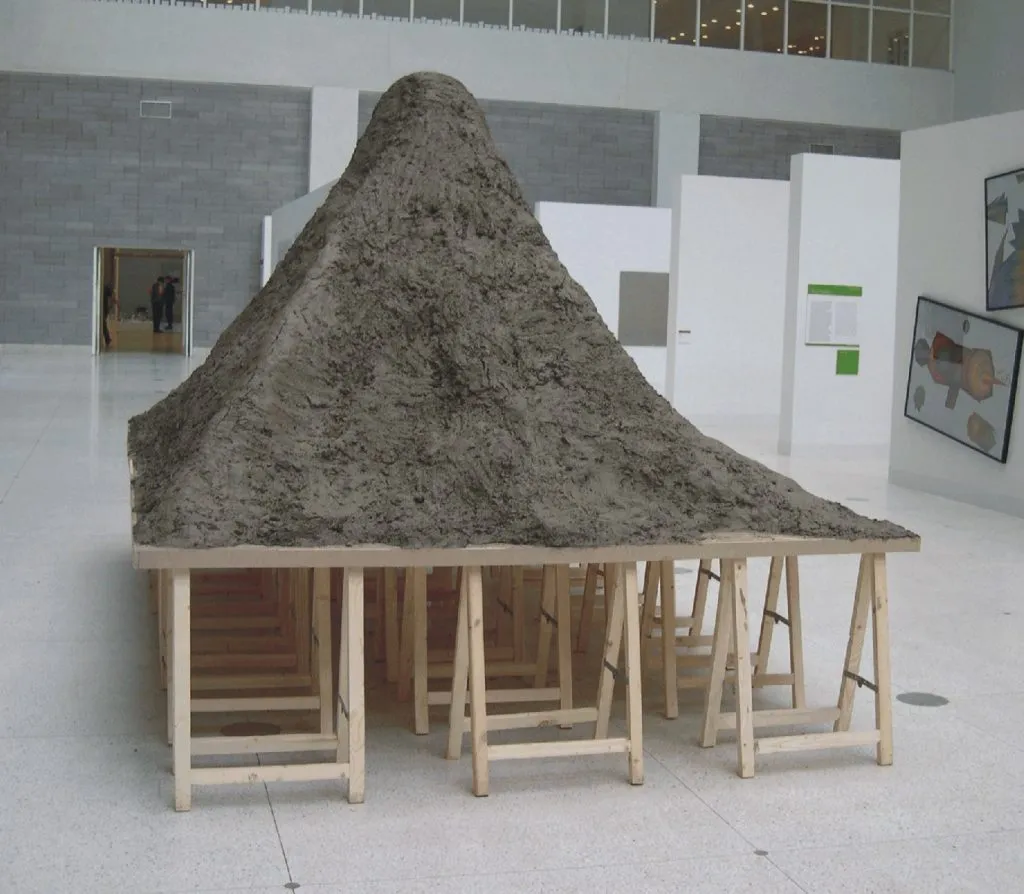
A mound of clay weighing more than 1.5 tonnes and a stone abandoned on the first floor; a flower stand; a hyperrealistically painted image of a resting man, measuring two by three centimetres, left in the Swiss section; and a crystal made from mirror in the Chinese section — these were the works Christian Tomaszewski exhibited at the most recent Prague Biennale. Strangely ordinary and difficult to notice, yet at the same time imposing themselves on the viewer, these objects of uncertain status appeared to have been misplaced by accident. In fact, they were a deliberate and therefore devious intervention by the artist into an exhibition prepared by other artists and curators. These “works of art” — for that is probably what Tomaszewski’s carefully made and positioned gallery objects should be called — subtly undermined the status of the entire exhibition and the autonomy and meaning of the works on display. At the same time, they mercilessly mocked themselves and a viewer who, as in the famous perceptual drawing of an old woman and a lady in a hat, might first perceive the mound of clay as a modernist masterpiece of form, also invoking the Japanese traditions of Zen or Shinto, only to see the very same object moments later as a hopelessly literal heap of mud. Tomaszewski’s Prague works were astutely placed by Adam Budak within the framework of an interventionist project entitled Manipulations: On Economies of Deceit. They point us towards the “pathological” imbalance between a work and its meaning — also present in the exhibition being prepared for Atlas Sztuki — an imbalance that undermines art’s universal character. At present it is difficult to imagine exactly what Christian Tomaszewski’s reconstruction in Łódź of the atmosphere, scenes and objects from David Lynch’s Blue Velvet will look like. It is already clear, however, that the problem around which the artist circles in this work — and not only here, but in his previous projects as well — concerns the eruption of fiction into reality. That eruption is released by inconspicuous objects, works of art and, to some extent, fetishes that constitute the material dimension of the artist’s imagination.
David Lynch’s film — invoked by Slavoj Žižek in the chapter on fetishism in The Plague of Fantasies — did not become the point of departure for Tomaszewski’s work by accident. The repetition the artist has undertaken to perform in the gallery undoubtedly contains something of a heroic attempt to liberate oneself from an unnamed trauma. Yet while personal experiences are generally worked through in the privacy of a psychoanalyst’s consulting room, the artist offers us what is only ostensibly an innocent game of crossing the boundaries of fantasy in a gallery. Entering its interior, connecting objects and recalling the scenes, atmosphere and dark meaning of Lynch’s film, we do not notice the perversion being implanted within us. It is all the more dangerous because, unlike Lynch’s film, it lacks the safe mediation afforded by cinema and television.

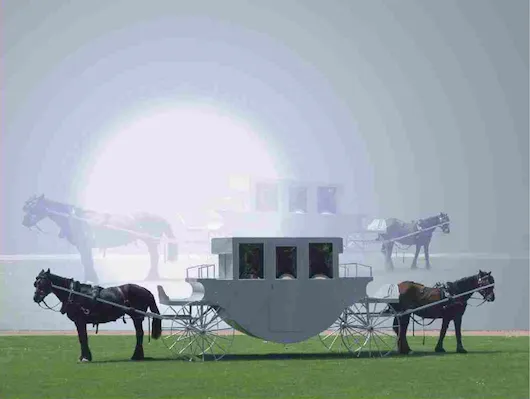
“It’s a strange world,” Jeff and Sandy, the protagonists of Blue Velvet, repeat in astonishment at the turn of events. A sense of the world’s strangeness also accompanies the perception of Tomaszewski’s works. His attempts to reach the hidden plane of an apparently trivial reality recall the efforts of the film’s protagonist. Like Jeffrey Beaumont, the artist has something of the amateur detective about him: tirelessly and obsessively, he seeks a breach in reality through which he may glimpse the Real described by analysts. Lynch, however, is no Agatha Christie. The detective figure would not be nearly so compelling without its perilous proximity to the founding crime in whose shadow it can shine. Jeffrey indeed has something of both detective and pervert about him (“I don’t know if you’re a detective or a pervert,” Sandy tells Jeff, frightened by the course of events). Similarly, the artist does not simply reveal the dark underside of reality. Abusing his power, he ushers an innocent public into the “deeper nights of his imagination”, as another perverse contemporary artist, Tomasz Kozak, has put it. Paradoxically, and contrary to Freud, we might venture the thesis that the purpose of contemporary art is to liberate fantasy transgressively from the shackles imposed upon it by an oppressive culture. If art today retains any revolutionary potential — some prefer the term “political” — it lies in precisely this strange transgression, which offers no guarantee of a return to innocence or a desired equilibrium, but intensifies and stimulates the perversions suppressed in daily life. Christian Tomaszewski’s art, which involves the laborious creation of objects with uncertain functions — a splendid royal carriage with two teams of horses facing in opposite directions, or a talking chandelier resembling an octopus suspended from the ceiling — as well as replicas of objects spotted in Hollywood films, such as the atmospheric lamps in Lynch’s cinema, is aptly described by the phrase “American Surrealism”, which Dennis Hopper used of David Lynch’s artistic practice. Tomaszewski’s works combine Surrealism’s characteristic interest in revolutionising the imagination, altered states of consciousness, perversion and every form of aberration with the fiction celebrated by postmodernism and the triumph of the copy over the original. In other words, we can never be entirely sure whether an inconspicuous lamp in the corner of a gallery is a mass-produced functional object, an autonomous work of art or a copy of another, significant lamp that will transport us into a fictional world, setting off a cascade of associations and recollections in our minds.