
Newsha Tavakolian
Alison Nordström
Newsha Tavakolian’s photographs challenge stereotypes and resist easy classification. This alone is reason enough to examine them. Beyond that, the pictures convey not only knowledge of places and people but also a feeling for them — something rarely encountered in the cacophony of manufactured press images that surrounds us today. Although her personal vision is mature and assured, Tavakolian is still young. We expect her photographs to remain part of our lives for some time; what is required of us now is familiarity with her work and consideration of how her present practice relates to the photographic world of which it is a part. Her fresh and surprising images combine originality of vision and creative thought — qualities usually associated with photography as art — with the topicality and gravity of photojournalism.

As with most photography, where we see Tavakolian’s pictures and the purposes for which they are used affect how we understand her work. Although she may be regarded as an artist who exhibits prints in museums and galleries, the same photographs in other circumstances present her as a social activist, readily categorised as a “concerned photographer” in the terms that underpinned Magnum, the legendary collective she joined in 2014. Tavakolian describes herself as a social documentarian; she is often employed as a photojournalist. None of these terms is clear or unambiguous, and each deserves more attention than this short essay permits. When we consider her work historically, the genre of photojournalism offers an opportunity to examine contemporary photographic practice of every kind and to ask how Tavakolian’s work fits within it while challenging and changing our understanding of the field.
Culturally and circumstantially, photojournalism appears an appropriate description of what Tavakolian does. Her career began when, at the age of sixteen, she published photographs in “Zan”, a women’s daily issued in Tehran from 1998 until it was banned in 1999. Today her reports on everyday life inside and outside war zones are widely available in high-circulation newspapers and magazines across Europe and North America. Her international career began with the Visa pour l’Image photojournalism festival in Perpignan. Since then, Tavakolian has continued to use her camera to reach current events in time and to communicate information honestly, as befits a photojournalist. Despite her many exhibitions, however, it is through magazines such as “Time”, “Newsweek”, “Stern” and “The New York Times Magazine” that her work has become recognisable.
Photojournalism is a way of using pictures to tell a story of immediate general interest. It was traditionally disseminated through newspapers and magazines, although the growth of digital publishing in all its forms has blurred this definition. Photojournalism has long been shaped by protocols and conventions demanding honesty and impartiality. In more conservative photojournalistic institutions, any visible departure from the photograph’s verisimilitude — from staging the frame to digitally correcting shadows or highlights — is strictly forbidden. Audiences generally regard photographs associated with such sources and institutions as reliable and objective and, except in unusual circumstances, attach greater importance to the image’s content than to the person who made it.
In the nineteenth century, photojournalism was discussed in terms of mechanical verisimilitude: belief in the objectivity of the machine as distinct from its “operator”, as photographers were then understood. Roger Fenton’s 1855 photographs of the Crimean battlefields, for example, were described as “true evidence… nature viewed through a square mirror and transferred to that mirror”1. Today, however, for many reasons, we are more concerned than ever about the sources of the images we consume and about the sensibility and intentions of those who make them.
Two entirely opposing ideas underlie our contemporary understanding of photojournalism. The first is truth: the belief that the photographs we see in most newspapers and on their websites represent an effort to communicate information scrupulously and literally in visual form. The second is witness: the idea of the photographer as our surrogate, someone who presents hard-won knowledge to the eyes of the world. Our demand that the story be true accounts for photojournalism’s rigorous imperative of objectivity. Our need for witness, on the other hand, involves an embodied vicarious experience. Consciously or otherwise, we value the wisdom, convictions and perspective that led the photographer to present these particular people and events in this particular way. Perhaps this is a distinction between “operator” and “author”.
The outstanding and respected photojournalist Don McCullin addressed the profoundly personal and human side of his craft when he said: “Photography for me is not looking, it is feeling. If you cannot feel what you are looking at, you will never make others feel anything when they look at your pictures”2. The ability to communicate personal feeling and passion in treating a subject is part of what distinguishes Tavakolian from her colleagues, as do her youth, gender and nationality. If we seek passionate authors of images that shape our knowledge and who we are, we benefit from experiencing the personal perspectives of many different people. This is especially important in a field that remains dominated by men from Europe and North America.
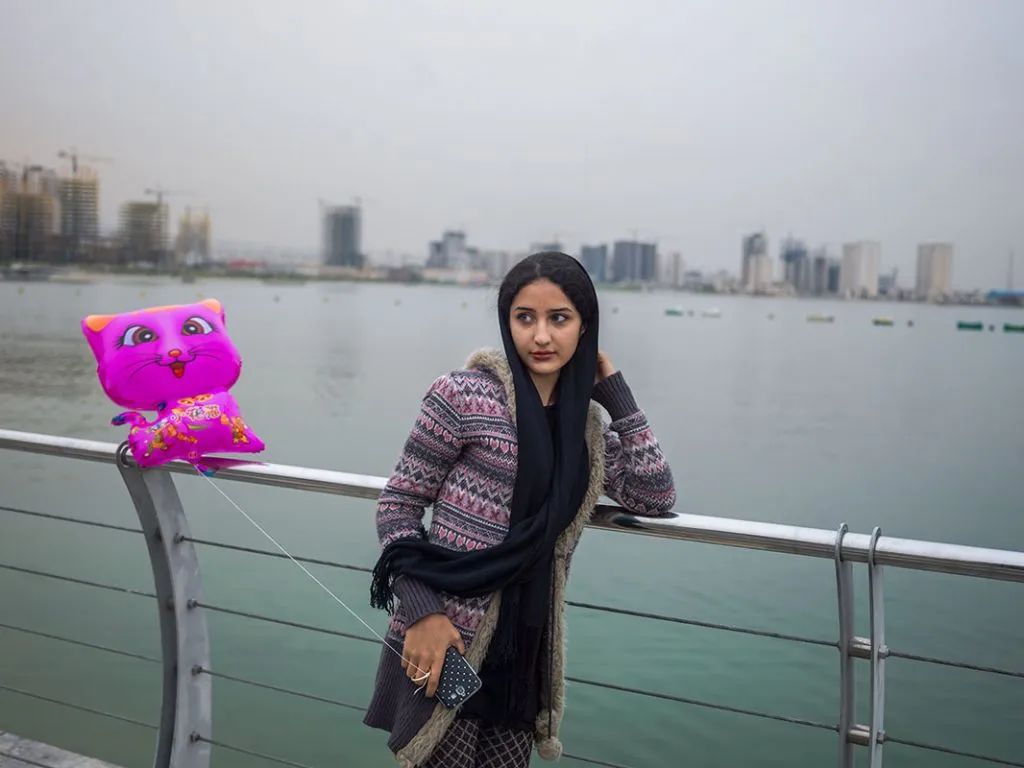
Tavakolian is perhaps best known for her portraits, and the importance of her personal interpretation of the world may be clearest in these works. Her 2012 series Look was not included in the Atlas Sztuki exhibition accompanied by this essay. It is nevertheless an important anticipation of the themes and creative approach found in the more recent works selected for the exhibition and may help to explain them. In Look, Tavakolian presents young middle-class Iranians and their collaboration, creativity, courage and resourcefulness. When the political situation in Iran cost Tavakolian her press accreditation, she decided to photograph people she knew, deliberately choosing those who represented an attitude towards their culture that she shared. She made portraits in the seclusion of her bedroom, explaining: “it was as though, the moment they found themselves there, they silently revealed in some indefinable way all the emotions they had concealed, and that was what I wanted to capture in the photograph”. This approach is visible even in her street photography. In one image, a woman’s face emerges from the crowd, surrounded by a headscarf and clouds of smoke like an ominous prophecy. The fleeting, particular qualities of photojournalism are absorbed here by art’s enduring and symbolic character.
A similar method underlies the portraits of young Kurdish women involved in the struggle against ISIS. The photographs are direct and descriptive, yet the maker’s emotional intelligence carries us beyond the familiar patterns of news imagery and heroic representation. The camera arrests the shy, schoolgirl smile of a heavily armed teenager, but it is the sensitivity of the person on the other side of the camera that recognises the moment’s significance. We read these images as the result of a human encounter rather than a mechanical record because we trust the photographer to communicate the truth she herself sees.
Modern technologies have made authentic authorship possible and led us to value its power more highly than before. Although photojournalists have always exercised personal judgement in choosing a subject and framing a photograph, photojournalism in its early years was rarely the product of an individual point of view. Photographers often did not even see their pictures, because film exposed on a battlefield was sent to cities where someone else developed, processed and submitted it for publication. Today, however, we are closer than ever to the ideal of witness — personal truth — because images are processed in the camera, incorporating the maker’s choices of view, tone, caption and crop before being transmitted. The impact is surely stronger when these decisions are experienced as the witness’s own than when they are made elsewhere by someone else. Our faith in the witness is even more important than the photograph’s content. Trust in the photographer’s integrity can lead us to a higher truth that, because of the creator’s knowledge and choices, surpasses the literal reality of the circumstances recorded.
It is often said today that technological progress has made photographers of us all. I suspect this is true, but in a sense close to the nineteenth-century idea of the photographer as operator. A rapid record of something that flashed before a phone camera has its value; the ubiquitous posting of images of every kind may provide information. Yet nothing can replace what a skilled, knowledgeable, passionate and ethical photographer has to offer. Today, amid the quantities of images flooding over us and the propaganda and falsehoods among which we live, we need principled guides and storytellers such as Tavakolian, whom we trust to communicate a higher truth about what she herself knows and sees.
*Alison Nordström is an independent scholar based in Cambridge, Massachusetts, specialising in photography. She was artistic director of Fotofestiwal Łódź in 2015 and 2016 and a visiting professor in the Graduate Department of Photography at Lesley University. From 2004 to 2013, Nordström was senior curator at George Eastman House, the oldest and largest photography museum in the United States. She holds a BA in English literature, an MA in library science specialising in museums, and a doctorate in visual culture.
[Translated from English into Polish by Agata Mendrychowska]
1 Author unknown, “Photographs from the Crimea”, in “The Athenæum: A Journal of Literature, Science, the Fine Arts, Music, and the Drama”, no. 1457, 29 September 1855, p. 1117, available at: https://books.google.com/books?id=Ha9HAQAAIAAJ&pg=PA1118&lpg=PA1118&dq
2 Donald McCullin, Sleeping With Ghosts: A Life’s Work in Photography by Don McCullin, Aperture Foundation, New York, 1996, p. 96.