
THE COUNTESS
Ludmiła Murawska-Péju
One cold autumn afternoon, there was a knock at the door in Karolkowa Street. I opened it. Miron, wearing a hat and a shabby black overcoat buttoned all the way up, announced that the Countess would be in Poznańska Street in twenty minutes. Without stopping, he ran down the stairs. Ludwik and I grabbed our warm coats and chased Miron to the tram stop. He jumped on a tram just ahead of us. We waited for the next one. We assumed that the Countess was Teresa Tyszkiewiczowa — a painter and Ludwik’s friend from before the war. After the war she lived in Pabianice, near Łódź. She shared a villa with Professor Feliks Kowarski. Ludwik had told her a great deal about Miron. In Poznańska Street we raced up the stairs, three at a time, to the second floor. A large entrance hall; the first door on the right led to what had once been a drawing room, now divided in half by a partition. Miron’s part was entered through a small makeshift vestibule. I opened the plywood door. I wanted to step inside, but it was impossible to take a single step. An ice rink. My legs slid apart like a calf’s. The once beautiful parquet floor had become a black, greasy threshing floor. Miron had wanted to wash it for the Countess in five minutes and had poured a bucket of water over it. Helpless, we stopped in the doorway.
To the left was a window with one pane partly broken. The hole had been plugged with a red cushion.
In the corner stood a little divan and a bedside cabinet half buried in rubbish. Bones, apple cores, fish bones, grease-stained pieces of newspaper, crumpled sheets bearing failed poems. Miron, in his hat, overcoat and tractor-like boots, stood on the divan atop a swollen, pockmarked, dirty, steel-coloured eiderdown. With a brush on a pole, he was trying to push the rubbish towards the stove; it was ruined inside, so Miron used it as a rubbish chute.
I stared, hypnotised, at the black pool. Miron said the water would soak in at any moment.
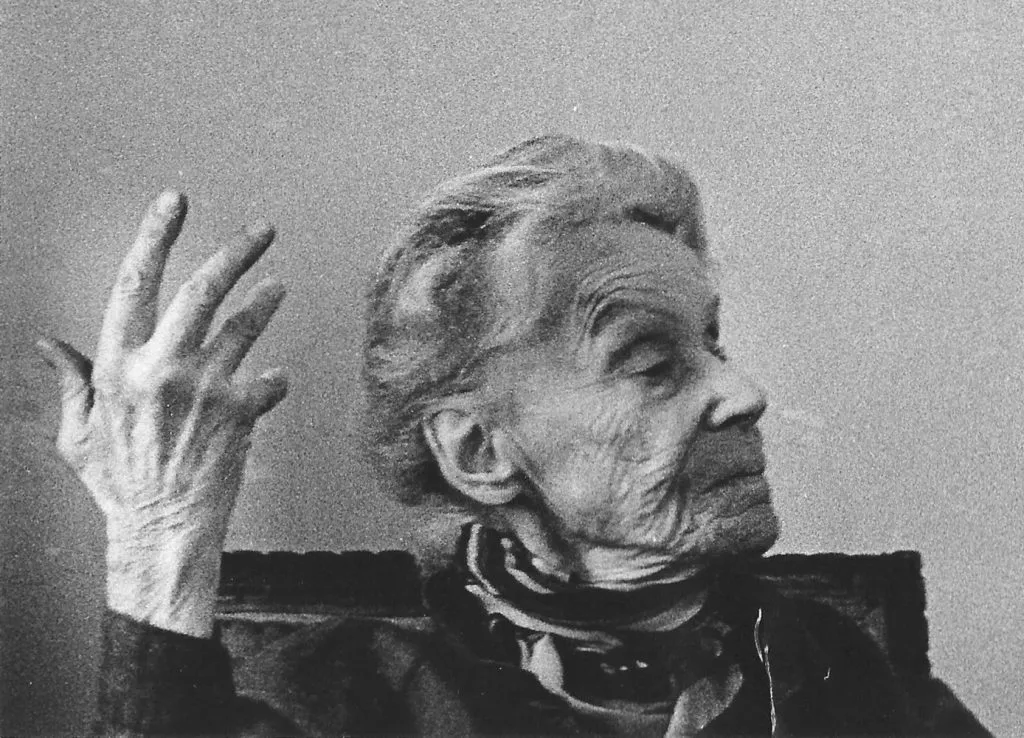
It did not. The floor, impregnated with grime, would absorb nothing. The Countess was late. The water seemed to subside a little. Suddenly, with a great commotion, Teresa appeared. Enthusiastic greetings, kisses, embraces and… a countess is a countess: without a moment’s hesitation she crossed the impassable expanse with a light step, flung herself across the divan into the shabby bedding, crossed one leg over the other and immediately gave herself over to the experience of poetry.
That evening, as we walked her home, we sounded her out about what she really thought. Ludwik felt guilty that, by carelessly arousing her curiosity, he had drawn her into this mad situation. Teresa insisted that she had been prepared, that she had known where she was going, that everything had been confirmed, that the evening had been wonderful and Miron’s poetry truly beautiful.
Ludmiła Murawska-Péju, a painter, was born in Warsaw in 1935 and is Ludwik Hering’s niece. In 1958 she graduated from Artur Nacht-Samborski’s painting studio. From 1955 to 1966, as a set designer and actor, she worked with Miron Białoszewski and Ludwik Hering at the Teatr na Tarczyńskiej and, from 1958, at the Separate Theatre of Three Persons (Białoszewski, Hering and Murawska). She lives in Warsaw and Paris.
The text was originally published in the magazine “Pokaz. Pismo krytyki artystycznej”, 2001, no. 35.
Further information about Teresa Tyszkiewiczowa, her father Ignacy Ledóchowski and her brother Włodzimierz Ledóchowski is available at www.ledochowski.eu/rodzina