
History and the Senses (On Wardrobes and Mushrooms)
Jane A. Sharp
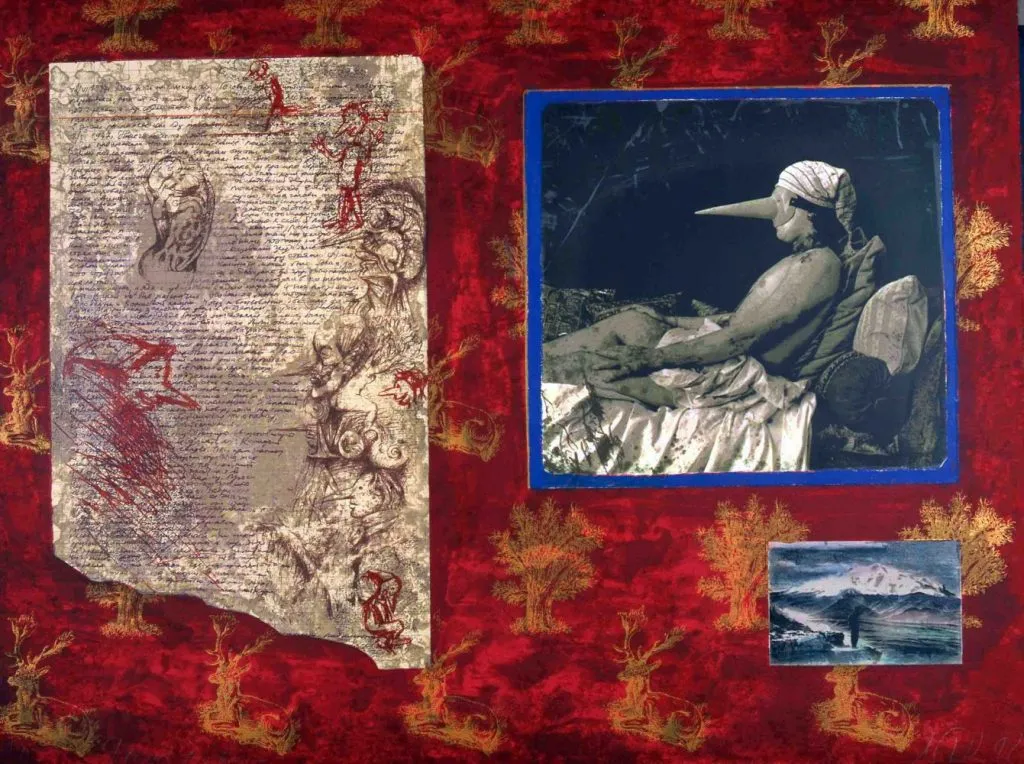
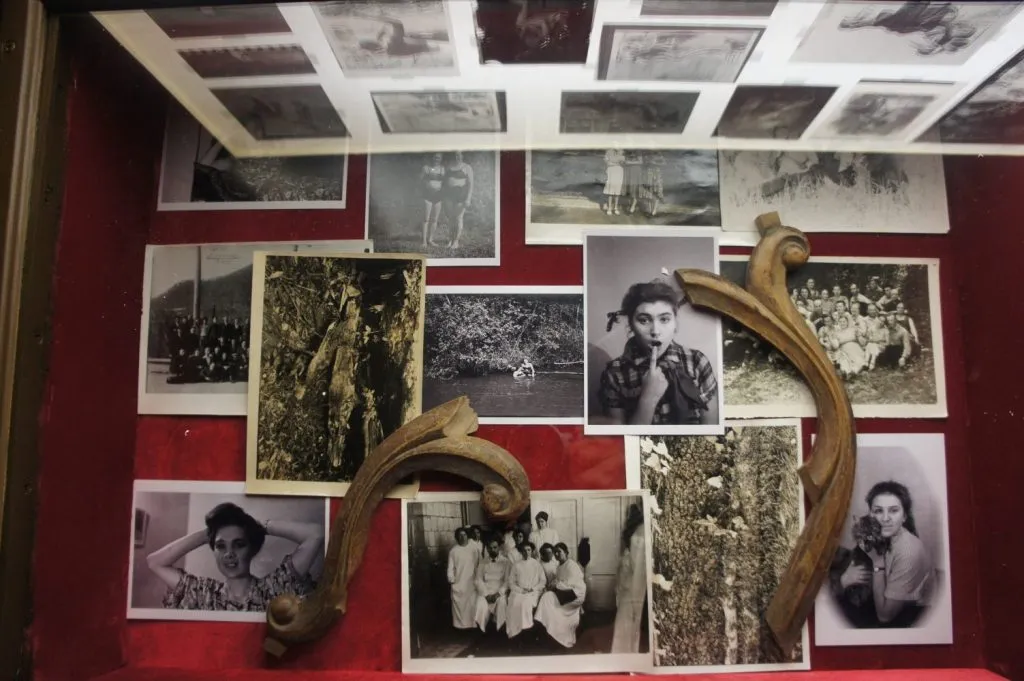
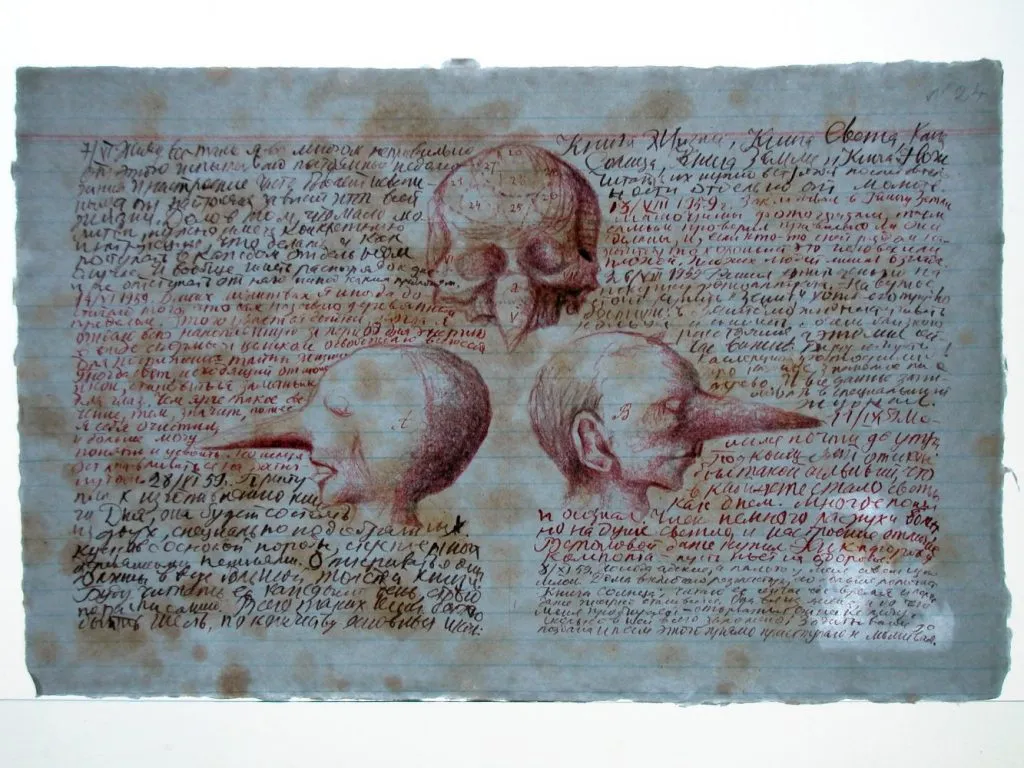
The present display of work by Igor Makarevich and Elena Elagina brings together two projects, although they were conceived independently and developed in different ways. The first, Pagan, shown in Warsaw (at Fundacja Profile), consists of paintings and a single sculpture conceived as a coherent cycle, previously presented in London (2008) and in fragments in Moscow (2003, 2015)1. The second project, Homo lignum at Atlas Sztuki in Łódź, is a newly added strand in an epic history that is part narrative (based on the fictional diaries of its protagonist, Nikolai Borisov) and part visual—including sculptural—materialisation of the allusive elements contained in that narrative. By being placed in different locations and contexts, both projects have become self-developing creative systems2. Although the project presented at Atlas Sztuki, like Pagan, is the result of collaboration between the two artists, its authorship has been attributed to Makarevich, because he created the “autobiographical” text (the diary entries) and most of its visual imaginary. The present Łódź version of Homo lignum includes wholly new entries in Borisov/Makarevich’s diary, as well as a new locus for the story: a wardrobe adapted to an unusual purpose. It serves as documentation of the protagonist’s actions and state of mind. The objects in the exhibition have been connected with photographic and screenprinted images created by the artist, showing Makarevich/Borisov in states of exhaustion, resignation and meditative trance…
The interdependence of the two projects is therefore not immediately apparent. It is crucial, however, for the viewer to understand how strongly Makarevich and Elagina emphasise the formative and delusional role of the historical Russian avant-garde, explored in the paintings Mushrooms of the Russian Avant-Garde from the Pagan installation, because this anticipates the history and obsessions of Homo lignum.
Like the diary entries, the paintings bear witness to a compulsive self-referential practice. Their iconography (primarily “fly agarics”) can be repeated just as rectangles, circles and intersecting planes are repeated, in order to demonstrate their potential as generative systems of self-knowledge and historical transfiguration, as the individual moves from subjective reflection towards unity with a larger social and, indeed, cosmic order3. The replicated images become topoi of humility and imitation intended to lead to an ultimate revelation, much like the repeated rituals performed by Borisov, which in fact lead to states of spiritual ecstasy and orgasmic release. As other critics have observed, mushrooms also form part of popular culture as remedies for illness, or as means of inducing trance… and death4. They are uncertain “sources of life” (Sources of Life is the title of a related series of paintings from an earlier installation by the artists). By using this emblematic icon of Russianness5, the artists suggest that blindly following a system may ultimately lead to hypocrisy and the betrayal of one’s own ideals. Yet the risk involved is alluring and accounts for the appeal of their art.
The paintings combine the messianic logic derived from Malevich and Tatlin with that of their contemporaries, particularly the poetics of absurdity associated with Daniil Kharms and Alexander Vvedensky. The transition from serious social aims to speculative, often primitive (and ingenious) wordplay also reveals Elagina’s presence, whether as the initiator or the actual maker of elements in both projects. Makarevich signs the paintings with his own surname, simultaneously as tautology and paradox, in order to signal the excessive function of authorship, the national idea or a universal visual language. In these paintings, Makarevich and Elagina therefore point to the consequences of the Russian avant-garde’s utopian programme, which they identify with Malevich and Tatlin in their other series, Russian Idea and Source of Life. Depictions of infinite abstract space, monochromatic backgrounds and horizontal bands extend the poetics of the absurd characteristic of the OBERIU writers (Association of Real Art) to the equally bizarre—though perhaps once persuasive—cosmological concerns of the philosopher-scientists Nikolai Fedorov and Konstantin Tsiolkovsky.
Like Borisov’s diaries, the paintings in the Pagan installation lay no claim to an authenticity that is the source of delusion’s self-destructive force. Since it consists of contemporary paintings, the cycle dramatises an act of personification rather than imitation. Arranged and signed, the paintings appeal for a reconsideration of the historical role of the creative individual in Russia today. Malevich’s rectangles (mushrooms) intrude upon coloured planes; the figure of the square joins Tatlin’s spiral—pairings unimaginable to either the art historian or the artist (from today’s perspective). Hollowed forms supplemented by an abstract boletus (less distinctive than the fly agaric) refer to a present transfigured by a traumatic gap in historical consciousness. In this way, both artists emphasise the powerful influence of a rejected, distorted and forgotten history upon the present.
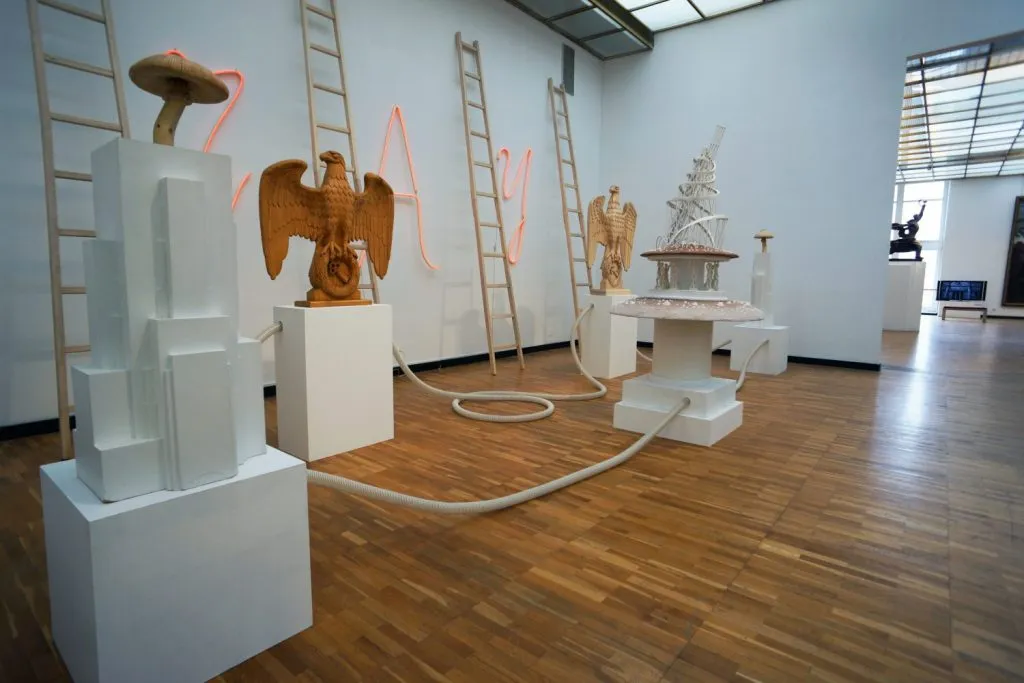
Makarevich and Elagina have consistently described their project as the work of an archaeologist examining “the ruins of an immense lost civilisation”6. The post-war avant-garde’s marginal references to the historical past limited speculation—and historical research—concerning the meaning of contemporary Russian art, whether exhibited in Moscow or abroad. For many years, the work of the unofficial artists’ generation was a response to institutional neglect and its consequences for most artists, who worked in studios and flats on the margins of Soviet and Western modernist art. After the collapse of the Soviet empire, artists became involved in institutions (museums and galleries) whose obsession with returning to the avant-garde’s mythical status often obscures the true picture of intergenerational relations and makes authentic contemporary artistic expression impossible to reach7.
In the projects discussed here, however, artistic self-realisation occurs precisely through these gaps in historical consciousness. We need only recognise their value, following the artists’ narratives as a sequence of successive reversals and assertions that may be withdrawn a moment later. Just as Malevich’s fictional “first” Suprematist painting, Black Square, contains the spirit of earlier experiments (the black surface in the 1915 version barely conceals an earlier composition), so Mushrooms of the Russian Avant-Garde, with their references to the past, intervene in a linear sequence of formal development whose forms possess their own complex genealogy.
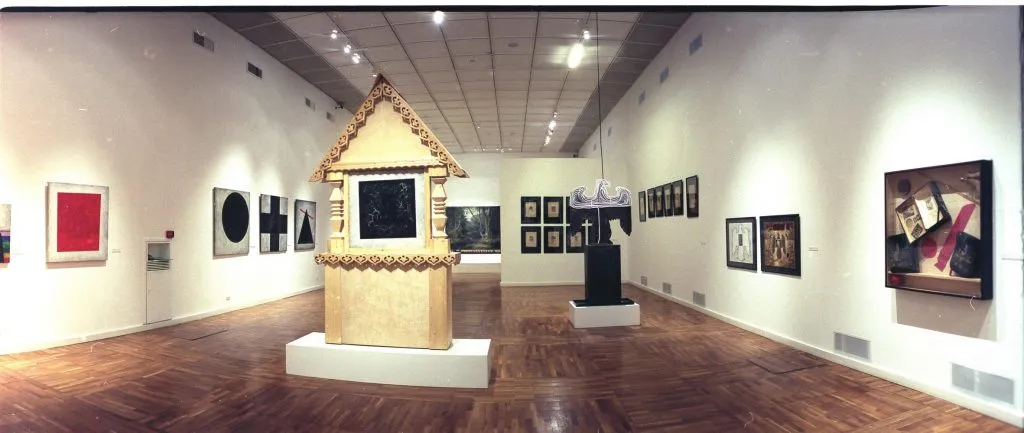
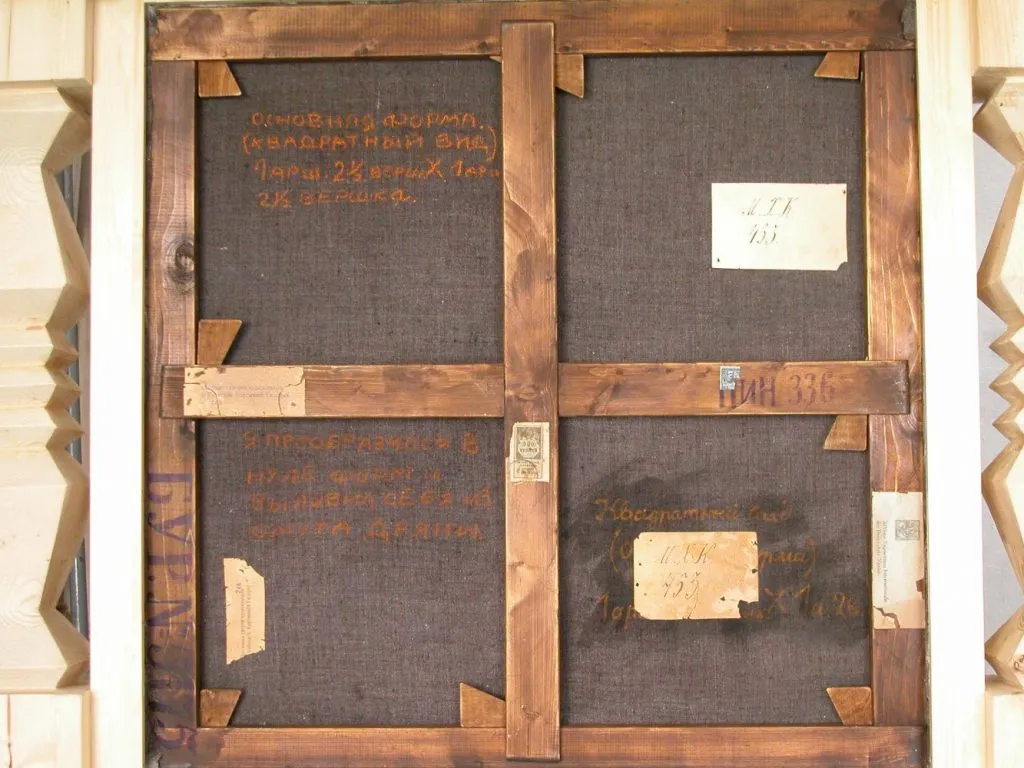
The project The Source of Life: Life in the Snow (1995–) was created to examine these contradictions in Malevich’s practice. It is a cycle of paintings that apparently reconstructs Malevich’s path from Cubism to Suprematism, but in fact conceals a second narrative. Beneath the layer of paint, we discern the story of Pinocchio in Alexei Tolstoy’s Russian version (The Golden Key, or the Adventures of Buratino, 1935). The wooden puppet appears under close examination of the paintings’ surfaces, while their texture remains almost identical to the originals (the historical titles of Malevich’s paintings have also been recreated on the backs of the canvases). Yet the cycle also owes its origins to a Soviet-era story about an artistic talent born by accident when a peasant woman was struck on the head with a wooden log by her drunken husband8. The frequently invoked Soviet ideal of the self-taught artist, the naïve genius endowed with a unique talent, materialises in the corners of peasant huts in which the iconic paintings of the black and red squares have been placed (figs 1, 2, p. 8). This extraordinary event is joined with Malevich’s own “origin parable” in The Source of Life; as in the Pagan project, the emotional force of an absurd narrative prevails over the logic of creative invention. Both installations prevent us from reading history as myth, displacing the promise of historical transfiguration evoked by the paintings with the affective force of its present consequences. Utopias are never what their authors proposed—the visual testimony supplied by art is, at best, ambiguous.
Homo lignum and The Secret Life of Trees
In Tolstoy’s novel, Buratino, the wooden boy, ultimately finds solace and self-realisation in a magical theatre. Makarevich’s Borisov is not only an inversion of this model (the protagonist tries to unite with nature by becoming a hybrid, half man and half tree), but is also connected to numerous other fictional characters, from Akaky Akakievich Bashmachkin (Nikolai Gogol’s The Overcoat), through Édouard Manet’s Boy with Cherries (invoked by Charles Baudelaire), to the anxiety-ridden narrator of Georges Bataille’s novel Story of the Eye (1928). Chapters from that pornographic masterpiece, particularly The Norman Wardrobe, inspire Borisov’s imaginary world, recreated here in Łódź in History of the Wardrobe and Borisov’s Museum. Unlike the source text, however, in Makarevich’s story the wardrobe itself becomes an image upon which the protagonist places objects like materials, with all their associations extending the possibilities of its imagined and physical use.
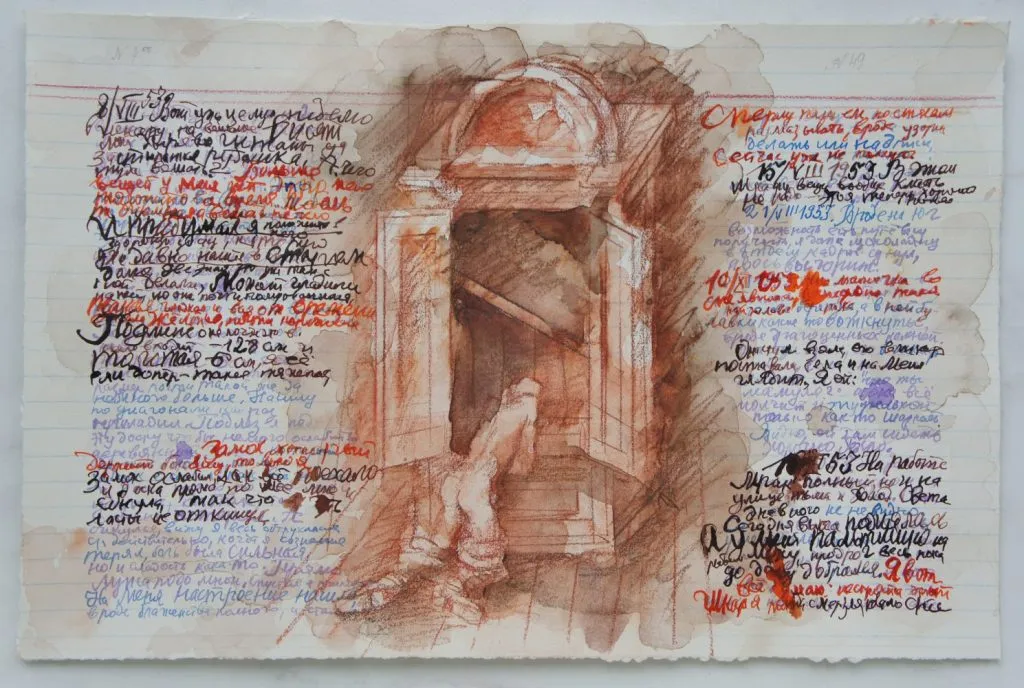
In Makarevich’s earlier paintings (fig. 3, p. 8), the wardrobe itself is the source of fascination. As a found object, a readymade bearing tangible traces of use imprinted upon its surface, the wardrobe retains a primary significance for the artist. It is filled with memory, providing a constant source of creative motivation. As in the paintings that depict medical instruments in meticulous detail, in Makarevich’s wardrobe paintings the rhetorical force of excessive ornament is joined with an external description, thereby reversing the principal tenet of Socialist Realism (which claimed to record things “truthfully”). In effect, the artist repeats Kharms’s (and OBERIU’s) proposition about the metaphorical meaning of the object, which operates in both directions: “art like a wardrobe”. Its contents will remain inaccessible to the viewer until it is investigated—at which point its potential will be revealed as inexhaustible.
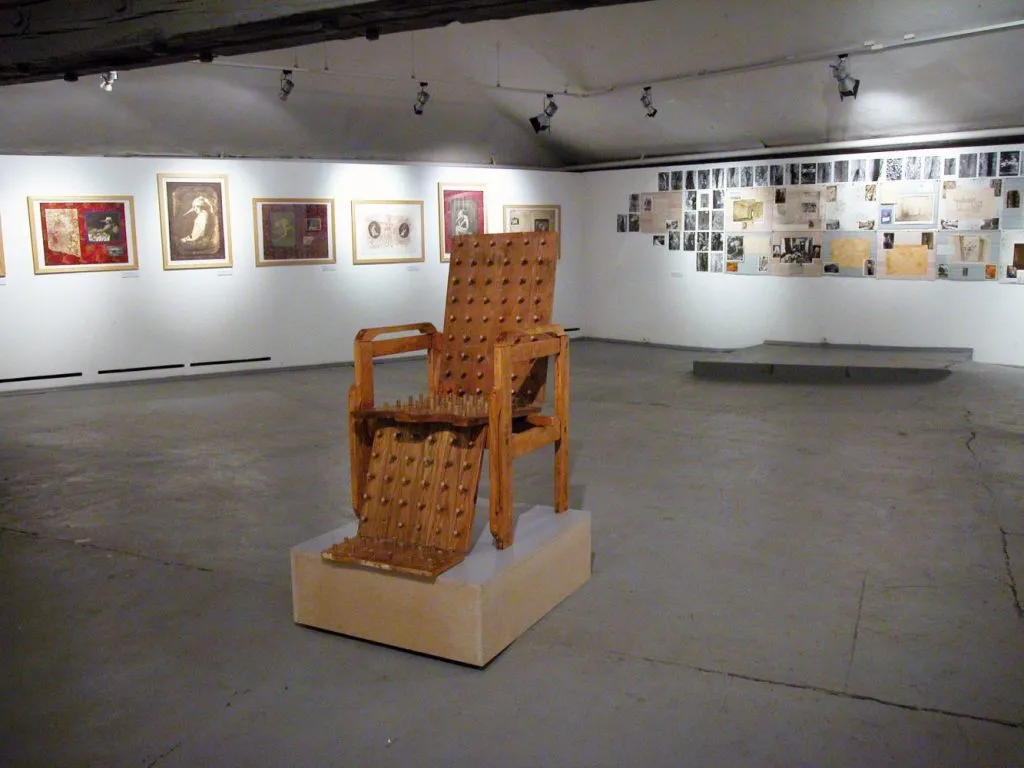
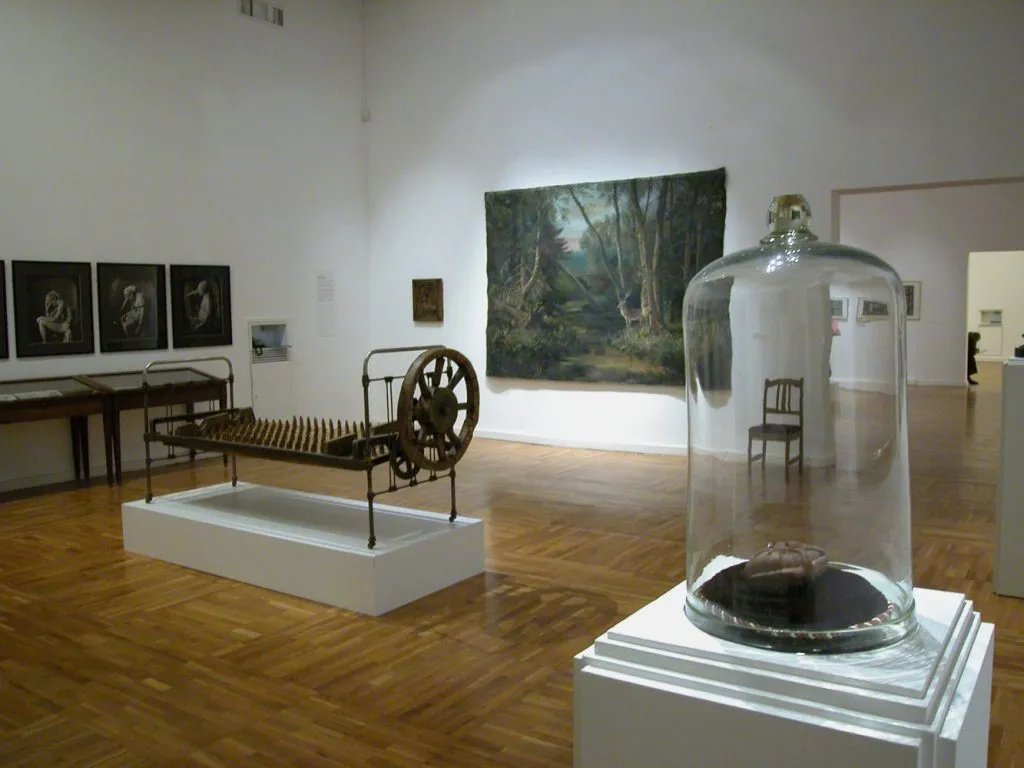
Borisov, the character invented by Makarevich, differs significantly from the protagonist of Bataille’s book, particularly in his mode of narration. Both speak in the first person singular, as though embodying the author. Yet if Bataille’s young man, in Susan Sontag’s words, “uses a limited, vulgar vocabulary of feeling, referring entirely to the intended action…”, Makarevich is polyphonic: at one moment lachrymose, fearful and pathetic; at another, given to exaggeration, paranoia and euphoria9. The artist’s aim is therefore clearly not pornography. Borisov endures endless humiliations, real or imagined, for one simple reason: so as not to lose his arduous work. His actions are masochistic rather than sadistic. He must suffer social injustice in order to experience suffering as sexual and spiritual catharsis. Every form of pleasure results from self-inflicted pain, physically experienced and present in the exhibition as a bed-torture instrument and a wardrobe-guillotine.
As viewers, we may feel a certain sympathy for the protagonist, yet identification with him is thwarted. Our eyes tell us that we are in a public place and remind us of a fact woven into the fictional narrative. The act of looking partly contributes to Borisov’s destructive hostility towards other people—his obsession with the objects he builds is accompanied by a fear of being seen while making and using them.
29/06/1953 The wardrobe I hid in the shed fills all my time with a certain pleasure and tranquillity, but also with fear. I keep imagining that someone will discover those boards and either throw them away or take them. One thing is clear: I have been watched all along. As soon as I let myself become distracted, they will plot against me, so I must remain vigilant. (The Notebooks of Nikolai Ivanovich Borisov [New Entry])
What picture of a personality emerges from the description of this scopophobic state? Like Bataille’s narrator, Borisov is more unpredictable than one might expect of a pornographic picaresque novel. On the surface, he appears to have inherited the voice of Ilya Kabakov, a conceptual artist from Makarevich’s artistic milieu. Yet Homo lignum is a different kind of social misfit; his pathological behaviour reflects the reality around him, ruled by the consequences of history and by fear.
Over the years, the installations have emphasised different aspects of the narrative and different concerns (of the artist) about history. Even so, every account of Makarevich connects the artist’s biography with that of his protagonist, while distinguishing between them.
In the first version of Ligomania from 1996, this protagonist was portrayed as socially excluded because of the matters that preoccupied him. Borisov possesses a biography and family history that would have been regarded as insignificant in Soviet Russia. Although his biography is wholly different from Makarevich’s, it may acknowledge the group of artists excluded from the narratives of both Western and official Soviet modernist art with which Makarevich was associated. Their fate resembles Borisov’s tragic fate insofar as, like him, they are represented as though they remained dependent on values inherited from the Stalinist era.
Borisov’s concerns seem literally to emerge from this distant past, whose imaginary was drawn from a real urban environment. The places named in the texts, as well as the forms of the objects in the installation, derive directly from Makarevich’s memories of Moscow in the 1950s and 1960s (particularly the city centre around Bolshaya and Malaya Bronnaya streets). The found objects that are described (and recreated in the exhibition) appear in other works, including his “readymade reliquaries”10. By 1997, Homo lignum, and by 1999 the works Selections from the Diaries of Nikolai Ivanovich Borisov and The Secret Life of Trees, had been fully shaped by these memories and experiences. The related section of the present installation, entitled Borisov’s Museum, consists of Buratino’s masks and skull, along with a bed and chair that serve as instruments of torture. Both are made of wood and designed (by Borisov) to facilitate the process of merging body and matter. The matter itself is almost Eucharistic—as though a new order of the world were to emerge from its transmutation (transubstantiation).
The installation highlights the formal tautologies essential to the two artists’ purpose: wood literally denotes wood and metonymically refers to a primitive past (including machines/guillotines). Borisov’s Museum also contains objects in wooden boxes that evoke woodworking tools. For Makarevich, these tautologies invite endless variation. Borisov works as an accountant in a timber-processing plant in order to remain close to the natural (wooden) world; we learn that as a child he lived on Plotnikov Lane (Carpenters’ Lane). This excess of information (redundancy) is both ironically amusing and cathartic. The actual objects, particularly the bed and guillotine, are shocking because they disrupt the social narratives that we, as contemporary viewers peering from the external world into Borisov’s, impose upon the work. These objects, however, obey a logic of their own—one that serves the fulfilment of the individual within his own intricately constructed and varied environment. Elagina explains their strategic significance as follows:
Verbal-visual tautology creates a particular illusory cultural-conceptual space. The external construction of objects depends on various kinds of traditional ideological clichés. On the one hand, verbal stereotypes acquire a concrete, sensory form by being given material shape; on the other, utilitarian objects attain the status of a symbol understood throughout the world. (statement by the artist, undated)
Unlike the first Moscow installations of Homo lignum, the Łódź version includes painting in the form of realistic depictions of a sylvan paradise. Borisov’s Museum refers directly to the significance of painting and sculpture within the hierarchy of genres, which was reflected in the structure of Russia’s academic institutions until the regime collapsed in 1991. The tautological function of the materials coincides here with the tautological rhetoric of the image that determined meaning in Soviet art. Painting as a “realist”, the artist presents what has already been accepted (but did not in fact happen) as a certain, verified fact. Like the idealist work of Socialist Realism, his paintings depict a recognisable but illusory world. Similarly, the sculptures, whether readymades or “wooden” objects carved from wood, present a formal, self-evident truth. They represent the historical avant-garde’s belief in the authenticity of materials that display their own natural properties—Tatlin’s belief in the texture of his corner reliefs, or in the materials selected for the Monument to the Third International (1920). The fetish of realism is also the solipsism of modernist discourse. In both systems, Elagina and Makarevich seem to suggest, art should be held accountable for the illusion (and fanaticism) of ideological coherence.
This ironic doubling of representational systems once again connects the exhibitions in Warsaw and Łódź. In Łódź, the drawings created by Borisov as designs for objects that he himself (and the artist) builds resemble Makarevich’s drawings—and indeed are Makarevich’s drawings. Makarevich gives Borisov a voice by making diary entries as the narrator and, as a result, feels a connection with his own past. What both projects emphasise, in a manner as complex as their genesis, is Makarevich and Elagina’s ethical commitment to a critical-historical reckoning with contemporary Russian culture. Style may be elusive (both artists change style frequently), while the consequences of replacing one regime with another remain unpredictable, alluring and real.
*Dr Jane A. Sharp teaches art history at Rutgers University, specialising in twentieth- and twenty-first-century art, the Russian avant-garde and unofficial art in the Soviet Union; she is also a curator associated with the Norton and Nancy Dodge Collection of Nonconformist Art from the Soviet Union at the Zimmerli Art Museum at Rutgers. Her curatorial work focuses primarily on research into unofficial art in the Soviet Union, including preparations for a forthcoming exhibition devoted to Moscow Conceptualism. In 2007 the Dedalus Art Foundation awarded her the Robert Motherwell Book Award for Russian Modernism between East and West: Natal’ia Goncharova and the Moscow Avant-Garde, 1905–14, Cambridge University Press, 2006. Her scholarly essays have appeared in anthologies published by the Victoria and Albert Museum (London, 2008), Yale University Press (2008) and Brill Academic Press (2015). She is currently completing a book manuscript on abstract painting in Moscow during the Thaw.
Polish translation: Agata Mendrychowska
1 Igor Makarevich, Elena Elagina, Mushrooms of the Russian Avant-Garde, exhibition curator: Nadim Samman (A Foundation and Rochelle School, London, and Galerie Sandmann, Berlin, 2008). The earlier Pagan installation (consisting only of photographs and sculptures) was shown at XL Gallery in Moscow in 2003; some of its elements were also incorporated into the current installation at Moscow’s Tretyakov Gallery.
2 The character Nikolai Ivanovich Borisov first appeared in the context of a fictional diary and installation in two exhibitions by Igor Makarevich at XL Gallery in Moscow: Ligomania (1996) and Homo lignum (1997). The related screenprints entitled Selections from The Diary of Nikolai Ivanovich Borisov, 1927–1989 were created for Hand Print Workshop International and presented in Alexandria, Virginia, USA, in 1998; the photogravures were produced at the Rutgers Center for Innovative Print and Paper, New Brunswick, New Jersey, USA. A larger Homo lignum installation was created in 2003 at the National Centre for Contemporary Art in Moscow. Makarevich frequently selects individual objects from this larger project for his exhibitions, most notably at the Kunsthistorisches Museum in Vienna (2009) and the Tretyakov Gallery in Moscow (2015). In both museums, the objects and paintings were incorporated into displays of the historical collections.
3 Kazimir Malevich’s teaching system (including self-education) for students at Vkhutemas in Vitebsk in 1920–21 involved the constant repetition of individual Suprematist forms. See, for example, Lazar Khidekel’s series of drawings of squares (rotating and dividing the square, arranging fragments into a whole), which, following Malevich’s example, he described as meditative designs. Their realisation would lead to self-transformation/transfiguration. Lazar Markovich Khidekel, Suprematism and Architecture, ed. Regina Khidekel, Leonard Hutton Galleries, New York, 1995, pp. 12–23.
4 See Nadim Samman’s essay Of Mushrooms and Malevich in the exhibition catalogue Mushrooms of the Russian Avant-Garde, London, 2008, pp. 9–12.
5 Russians regard the fly agaric as a symbol of primal, mystical Russia—translator’s note.
6 See, for example, Gerald Pirog’s interview with Igor Makarevich, Unusual Perspectives/Fantastic Possibilities, in the exhibition catalogue Beyond Memory, ed. Diane Neumaier, The Jane Voorhees Zimmerli Art Museum, New Brunswick, New Jersey, 2004, p. 281 [and the interview with the artist conducted by Bożena Czubak and published in the present catalogue—translator’s note].
7 Elagina worked as an assistant in Ernst Neizvestny’s studio before his emigration in 1976, and also informally with Alisa Poret; Makarevich, in turn, has written about the influence of his teachers. Elena Elagina, Igor Makarevich, Dialogicheskii Monolog ››Pro Eto‹‹, in Eti Strannye Semidesialetie, ili Poteria Vevinnosti, ed. Georgii Kizevalter, Moscow, 2010, pp. 66–77.
8 Life in the Snow, as an installation combined with the one from the Buratino Gallery. See Igor Makarevich’s explanation of the significance of E. Novikova-Vashnetseva’s story in his essay The Well of Time, in Elena Elagina, Igor Makarevich, Within the Limits of the Beautiful: Objects and Installations, XL Gallery, Moscow, 2005, p. 95.
9 In her essay The Pornographic Imagination (1967), Susan Sontag also refers to Roland Barthes’s analysis of Bataille’s book, The Metaphor of the Eye (1963). Sontag’s essay was first published in her collection Styles of Radical Will, New York, 1969.
10 In 1992 Makarevich created two works entitled Reincarnations of the Relics of Saint Ignatius. See Jane A. Sharp, Action-Paradise and Readymade Reliquaries: Eccentric Histories of Russian Art, in Byzantium and Modernism, eds Maria Taroutina and Roland Bettancourt, Leiden, 2015, pp. 271–310.