
Fractal Geometry in Stefan Krygier’s Work
Henryk Żołądek
Contemporary art appears to have much in common with mathematics. Both fields of human activity count reaching the widest possible audience among their aims. It should therefore be somewhat disappointing that the overwhelming majority of society openly admits to having no idea what modern art is about, while its knowledge of mathematics extends no further than getting through the school-leaving examination. This naturally does nothing to persuade genuine artists or passionate mathematicians to stop working or abandon their research.
Another common denominator is the aesthetic dimension. From my own, somewhat naive, observation, I conclude that when an artist creates a painting or sculpture, they take care that the work moves its audience. This often involves a reference to nature, but may also depend on more abstract associations. A mathematician — and I consider myself one — must likewise attend to the aesthetics of their papers. Even an important result, achieved only with difficulty, will not be published in a respected journal if it is written incomprehensibly. Fashion in both fields is another matter, but I will not dwell on it here.
A substantial portion of Stefan Krygier’s work is connected to mathematics, and more precisely to geometry and so-called fractals.
Geometry is one of the three principal branches of mathematics; the others are algebra and analysis. Geometric figures appear in art most often, where they are called forms. Władysław Strzemiński, Stefan Krygier’s teacher, was an innovator in this area. I have encountered the use in art of number theory, a branch of algebra, in the work of García, but analysis appears rather resistant to artistic overtures.
Symmetry is an exceptionally important phenomenon present in practically every field of science and art. We say that a given geometric figure is symmetrical if there exists a non-trivial transformation, or isometry, that maps the figure onto itself. All such transformations form a group known as the symmetry group of the figure.
The simplest example is reflection symmetry. Its symmetry group has two elements because repeating a reflection twice — a double iteration — produces the identity transformation. Another example is a cyclic group of order n, comprising rotations about a fixed axis in space, or a point in the plane, through angles that are multiples of 360°/n. It is generated by a single element, a rotation through 360°/n, whose n-fold iteration is the identity. More complex groups also exist. The symmetry group of a cube, for example, consists of twenty-four transformations and is not cyclic. There are infinite groups, too, in which translations appear alongside rotations or reflections. The arrangement of buds on a stem, for example, displays this kind of symmetry, though only locally.
Hermann Weyl writes beautifully about symmetry in nature and classical art in his book Symmetry. Without the concept of symmetry, physicists would be unable to understand quantum phenomena or the properties of elementary particles. (One wonders when artists will discover the extraordinary world of quantum physics.)
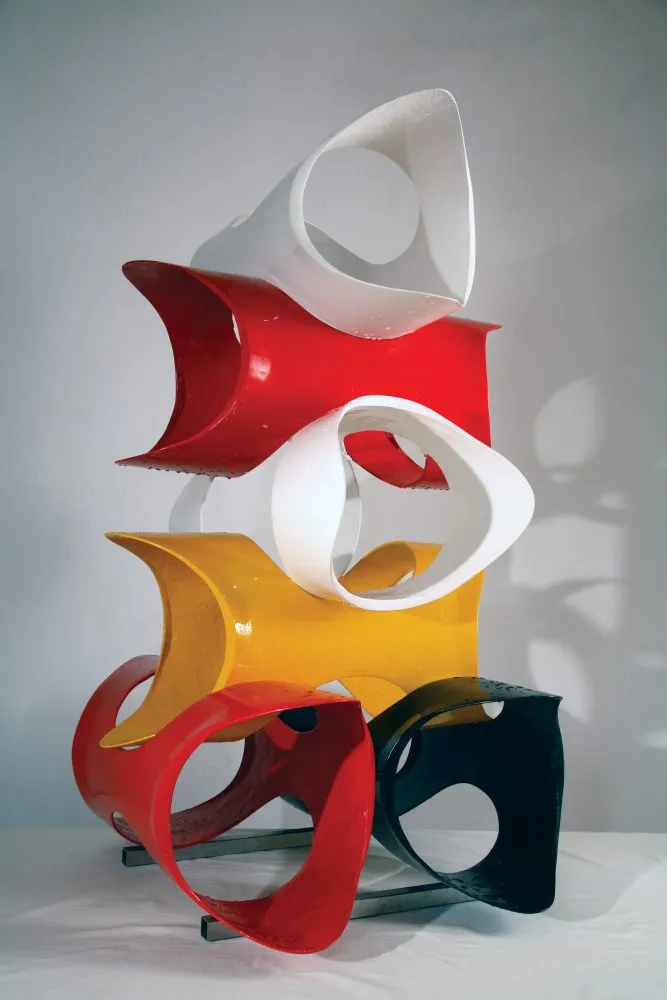
Artists need not, of course, copy diagrams from geometry or biology textbooks. They have their own ways of discovering and preserving symmetries, perhaps incomplete ones, in the forms they create. This is clearly visible in Stefan Krygier’s Centre for the Condensation of Form, Conflicts, Collineations and Transformation of a Cube.
Fractals are especially rewarding geometric objects. The word “fractal” itself expresses the fact that such an object has a fractional dimension. There are fractals in the plane with dimensions between one and two: when we measure their length, the result is infinite, while measuring their area yields zero. The dimension of Norway’s coastline on a map, for example, is approximately 1.52.
It is very common to generate fractal objects on a computer. The concept is simple enough for me to attempt a description of a suitable example. Let A be a square in the plane with sides of length one, and let f1 and f2 be simple affine transformations of the plane such that each maps A onto a quadrilateral, f1(A) or f2(A), lying strictly inside A. Select any point x0 in A and apply either f1 or f2 to it, each with a specified probability. This gives a point x1 equal to either f1(x0) or f2(x0); naturally, x1 lies within A. We repeat the same operation on x1 to obtain x2 = f1(x1) or x2 = f2(x1), and so on. It turns out that, for large values of n, the resulting sequence of points xn begins to form a fractal set bearing a striking resemblance to a fern leaf.
Benoît Mandelbrot, the mathematician of Polish origin who died last year, pioneered fractal theory. The so-called Mandelbrot set can be generated easily on a computer using a simple transformation of the plane into itself, and has a highly complex structure that is still not fully understood. In The Emperor’s New Mind, the distinguished physicist Roger Penrose presents the Mandelbrot set as evidence of the limitations, or non-recursiveness, of formal mathematics and as a work of art discovered, rather than created, by humanity.
An important feature of most fractal figures is self-similarity: if such a figure is scaled down appropriately and translated, it coincides exactly with a proper subset of the original figure. One might say that the figure is the same at a small scale as at a large one, as in the computer-generated fern leaf.
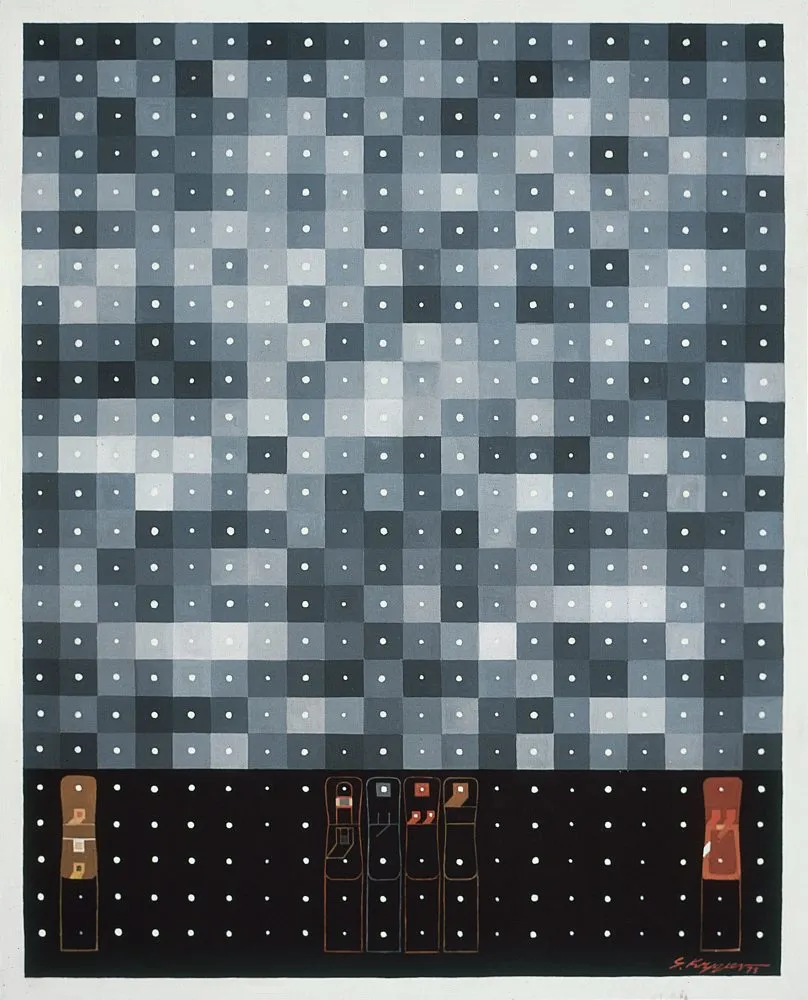
Self-similarity appears in many of Stefan Krygier’s paintings, including Multiplication, Concrete Space and Eo ipso, and even in works inspired by ancient art. It must be acknowledged that self-similarity occurs in Krygier’s paintings only over a limited range of scales. Even so, the association with fractals is irresistible. Fractal qualities can likewise be discerned in his Centre for the Condensation of Form compositions.
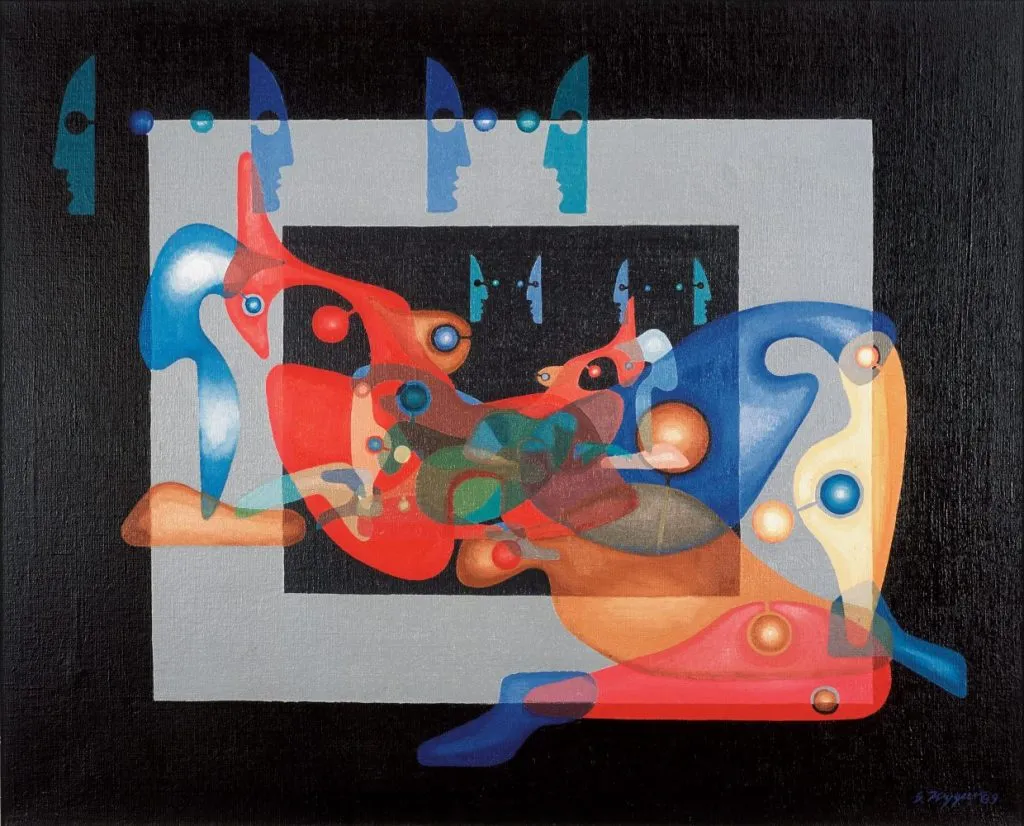
Finally, I would like to consider such paintings by Stefan Krygier as Black Sphere, …for Giorgione and Feast at Lucrezia Borgia’s. In my view, their fundamental characteristic is an insistent three-dimensionality. The artist explained this in his own terms — he wished to bring certain hidden features to the foreground — but I find it compelling from a geometric perspective.
Professor Henryk Żołądek heads the Department of Dynamical Systems in the Faculty of Mathematics, Informatics and Mechanics at the University of Warsaw. He is the author of more than seventy mathematical research papers.