
Black Clouds, Grey Smoke
Magdalena Ujma-Gawlik
The inspector could not get to sleep for a long time, and when he finally did he dreamt of the faces of those most recently arrested. He rose at five, put his head beneath the cold tap, went into the kitchen and poured himself a coffee. Ever since he had begun living alone, he had been surprised by how much noise the telephone could make when it rang—as it did just then. He was the first at the station. He went through the case files once more, stared at the grey sky beyond the window, then practised snapping handcuffs onto a leg of the desk with a single movement. At the investigative team meeting, everyone painstakingly reported on their progress. Nobody admitted it, but they all knew they were at an impasse. There was a crime, but no criminal. That evening, he could not bear the empty house. Without informing his superiors, he set out alone to question suspects—or broke into the suspects’ house without anyone’s knowledge—or went to the pub and blacked out. And so on. Everyday life is a battleground between good and evil. One’s own mind is a battleground against demons.
Their crime novels often follow the pattern of “the lone wolf against society”.
One might think there could be no worse setting for such literature. Yet nowhere else can one find such an apt combination of psychological insight and knowledge of evil. Laconic descriptions of everyday activities create a mood of numbing monotony and melancholy. The days pass one after another, until suddenly something happens that at first seems utterly incomprehensible.
At this point one might venture an analogy—admittedly a little strained, but is any analogy perfectly exact? People think contemporary art is incomprehensible. What if it were approached like a crime novel? Sometimes it is easy to understand; at other times it is indigestible and banal. Sometimes it keeps us in suspense; sometimes it disappoints. By speaking of the pursuit of evil, crime and punishment, crime fiction attempts to satisfy our need to understand the world. We need order if we are to master the chaos of reality and somehow make ourselves at home within it. The crime novel orders the world by naming evil and taking up the fight against it. Contemporary art often uses similar devices: mysteries and a gradual building of tension. Art can be enthralling, but first it demands something from people: attention, engagement and effort.
Art is a monster that feeds on tragedy, Karolina Breguła said.
•• •
The Art Translation Agency operated in 2010–11. Karolina Breguła created it to reduce the distance between the work of art and its audience, to broaden the field of references and associations, and to embolden people to spin their own stories and speculations and conduct a conversation with works on their own terms. Making use of the Agency’s services was easy: one submitted a question on its website. One could also post one’s own translation. By my count, more than seventy translators worked with the Agency, interpreting a wide variety of works of contemporary art according to their own knowledge and views. As the artist explains, the condition was infidelity to the “canonical” interpretation established by experts (or by an institution).
The translators present every work of art as an unfinished form, while the Agency invites its audience to co-create meanings and thereby overcome problems with understanding contemporary art. Asked about Arek the parasite, urban activist Joanna Erbel replies that, unable to support himself through making art, the artist preys on those who are stronger (by living in museums and art centres). She adds that female and male tenants in Poland face similar difficulties keeping a roof over their heads. Another question—one that, according to its author, troubles many Poles—concerns Joseph Beuys and his butter on the wall, not to mention Piero Manzoni’s Merda d’artista: […] why is a tin of shit worth PLN 120,000 and called art? The writer and philosopher Paweł Laufer replies: I understand your aporias perfectly… Discussions of this kind have cost me many impatient acquaintances, so please exercise caution and restraint. Thus we can see that the translators treat the work boldly, while at the same time not avoiding personal themes, speaking about themselves or offering advice to those in doubt.
I wonder whether these attempts to broaden the field of criticism—sometimes extravagant, but usually absorbing and well written—were genuinely useful to the public.
•• •
Works of public art are remarkable examples of freeing the process by which meaning is assigned. Translators are no longer required here, because meaning is created by the audience—people in the street, square or park, wherever the work is situated. Public art is an empty sign filled with whatever content its users choose to give it. It is therefore perhaps the most democratic kind of art, because everyone without exception, using whatever language they wish, can tell their own stories inspired by the work. Kuba Szreder comments: the artist experiments with forms of human togetherness and separateness […] instead of creating objects, […] creates social sculptures, new forms in which people assemble. […] a feature of good public art is the suspension of control over the creation of meaning…
And indeed, people gather around certain works—for various purposes. Someone urinated on Mirosław Bałka’s corridor AUSCHWITZWIELICZKA (2009), installed in Independence Square in the Podgórze district of Kraków. The media reported that drinking sessions took place inside the work and that homeless people slept there. When the corridor was moved near the underpass beneath the railway tracks in Zabłocie, someone discovered traces of blood and broken glass there and concluded that criminals were using the work of art to attack innocent people. The corridor is covered in spray-painted scrawls, and passers-by always choose the path alongside it. Because the object arouses hostility—or, at best, indifference—local residents have decided to treat it according to their own needs and use it for their own purposes.
This is why so many people lose confidence when confronted with contemporary art. One never knows whether what we see with our own eyes is really what we think we see. The story of Kantor’s plank provides an example. An inventory of Tadeusz Kantor’s works was under way at a prestigious museum in a large city. An abandoned piece of wood lay in a corner. The staff used it as a cutting board for paper. One bored museum employee had an idea: he labelled the plank “Kantor”. Consternation spread among the curators. Nobody knew which work the newly discovered piece belonged to. The storerooms and inventory cards were searched in a panic. No one, however, questioned the plank itself.
•• •
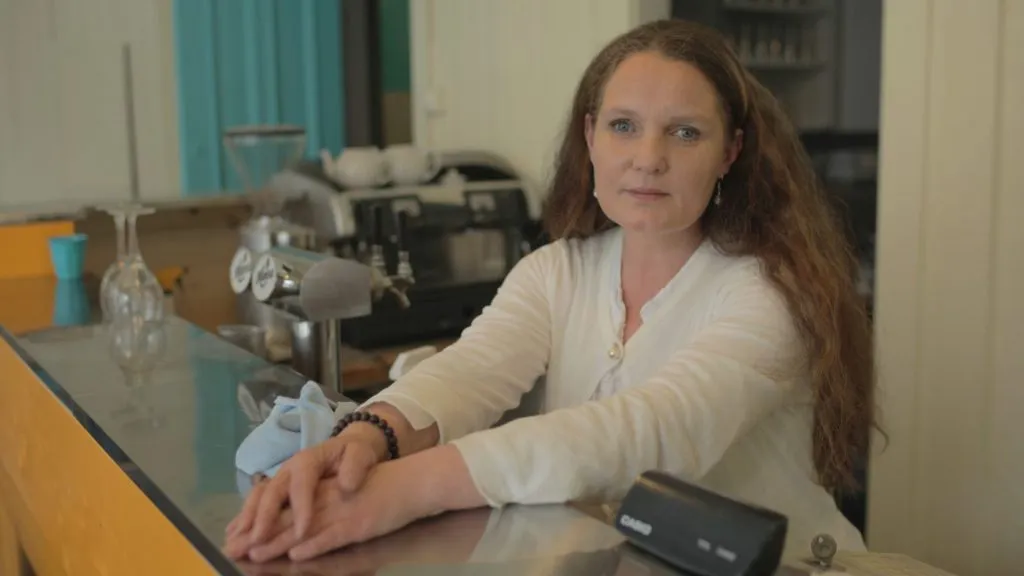
Disorientation, hostility and fear, but scandals too. A grey-haired woman with a punk hairstyle explains something to a man sitting with his back to us. He nods as her words flow. They are seated at a table beneath a burning lamp, and we witness an intense conversation. We see body language and emphatic gestures. We watch the scene, but cannot eavesdrop. We can therefore create our own version of the conversation. We will never know the real one.

The era of contemporary art in Poland began in 1989. The years following the political turning point brought a whole series of scandals. Many concerned the Zachęta Gallery in Warsaw, which was directed by the woman seen in the film. In November 2000, the star of Polish cinema Daniel Olbrychski entered the gallery, where Piotr Uklański’s exhibition The Nazis was under way. A television crew accompanied him. From beneath his coat he drew a sabre that had served as a prop when he played Kmicic in The Deluge. The actor destroyed photographs depicting himself and his friends Jean-Paul Belmondo, Jan Englert and Stanisław Mikulski. The Nazis is a series of 164 film stills from various productions, showing well-known actors in the roles of Nazis. As Stach Szabłowski comments, the Nazis affair saw new, critical and postmodern artistic strategies collide with a conservative understanding of art and the artist’s role. Its material consisted of ready-made media images appropriated and edited by the artist, as well as the substance of a collective imagination shaped by popular culture. […] the real problem seems to have been not so much the controversial content as the language used by the artist. Discursive, post-conceptual art, boldly crossing the boundary between the strictly artistic realm and social, political and media reality, disorientated viewers.
The film’s silent scene might end with Anda Rottenberg—for it is she who appears in this episode—falling silent and the man beginning to speak. Perhaps he would ask her why even famous actors mistake fictional images for reality. Why does even the elite fail to understand contemporary art and ritually destroy it? Perhaps she would answer: scandals do not have to result from the cynicism of artists, the media or audiences. They can testify to confusion and disorientation amid the thicket of contemporary culture, which is fundamentally self-critical and doubts itself.
•• •
Contemporary art is thus a history of audiences’ disappointed expectations. The Museum of Longing and Failure, run by Chloe Lewis and Andrew Taggart, collects small objects, each of which embodies ideas of longing and failure. And virtually nothing else is known: where these ideas come from, or why painful and distressing emotions are to be expressed through different kinds of artistic objects. MoLaF reveals itself through small installations in places that are not necessarily museums—an empty building’s window, for example.

In November 2012, they installed themselves in Tadeusz Kantor’s studio on Sienna Street in Kraków. A mug with a mass-produced design, small photographs and semi-abstract constructions made from found objects looked as though they had been abandoned there by accident.
The objects in the MoLaF collection do not really illustrate anything. We do not know what stories lie behind them, or whether they simply express extreme ennui or boredom.
•• •
Fire: the burning of works of art and cultural objects, books above all. An infamous tradition extending over many centuries. Objectionable volumes were burned in ancient China, but the Nazis made the most lasting impression with their practices. On 10 May 1933, bonfires were lit in many German cities and works that stood “against the German spirit” were spectacularly consigned to the flames. In Berlin, the fire consumed twenty thousand volumes, including books by Walter Benjamin, Bertolt Brecht, Sigmund Freud and Thomas Mann. Other totalitarian regimes preferred to avoid spectacular actions. The Soviet Union sent books to be pulped.
451 degrees Fahrenheit is the temperature at which paper ignites. Before our eyes, Ray Bradbury’s vision is effectively becoming reality. François Truffaut made the film Fahrenheit 451 (1966) from Bradbury’s 1953 novel. Through his acquaintance with the teacher Clarisse, the fireman Guy Montag becomes aware of the importance of the printed word. At first he declares: Books make people unhappy; they disturb them and prevent them from living with others. Later, however, he begins stealing works of literature from piles destined for destruction and reading them. His wife denounces him. Montag ends up among fugitives living outside the city, in the midst of nature. They learn books by heart and themselves become living books, preserving them for posterity. This is a clear allusion to the behaviour of prisoners under the totalitarian regimes of the twentieth century—in prisoner-of-war camps, gulags and concentration camps.
Piles of burning paintings, canvases thrown into the rubbish, shattered sculptures. They were burned for religious and political reasons. An entire succession of iconoclasms. Images were attacked in Byzantium, in medieval Europe and during the triumph of Protestantism in Germany, Switzerland, the Low Countries and Scandinavia.
Protestantism left painters unemployed.

In 1526, the painters’ guild in Basel sent a desperate petition to the city council: “… they ask the Council graciously to take into consideration that they too have wives and children, and to enable them to remain in Basel, because the painters’ profession is in a poor state as it is. Many painters have already abandoned their profession…” At the end of the fifteenth century, works burned on bonfires in the capital of Tuscany. At the height of Renaissance art’s flourishing in Florence, the charismatic Dominican Savonarola called upon the Florentines to repent, and many artists answered his appeal, Sandro Botticelli among them. The Counter-Reformation also took its toll. The sculptor Bartolommeo Ammannati suffered a creative crisis, which he revealed in a letter to members of Florence’s Accademia del Disegno (1582): For the love of God, if you seek your salvation, take care […] not to fall into the error into which I fell in my works, making many of my figures entirely nude and unclothed…
Then came the persecution of works and artists on a much broader, if not mass, scale: the Entartete Kunst exhibitions in Nazi Germany and the Socialist Realist showpieces in the countries of people’s democracy.
•• •
A city in the North. Its sheer walls descend to the water, crammed into a narrow basin between mountains. It is grey, with low-hanging clouds. Narrow streets and colourful houses. White frames around the windows and doors. Pastel walls, some clad in boards. It has even been called the “wooden city”, which is unsurprising when one sees the forested mountains surrounding it on every side. “Look how many spruces there are. Hundreds of thousands of spruces.” A young man, travelling in a boat, points to the mountainsides, the dark-green slopes. “Spruce is the king of our forests; it is durable and reliable. Yet some people”—the young man cannot understand this—“order furniture made from inferior, highly flammable aspen. That is what they do at the Albert Museum. It is as though they were deliberately tempting fate.”
The city does not remember its history precisely, because its monuments and archives have been devoured by fire hundreds of times over the centuries.
The run of bad luck continued from the Middle Ages and ended only in 1955. One critic wrote of artists from the city: “… in their dialogue with the element, they are the weaker party. Fire has the advantage over them. Observing this situation is a truly extraordinary experience for visitors from a country in which an ecological catastrophe has occurred.”
The people who live here are remarkably colourful. Everyone has a passion of some kind. Their interests do not generally lead towards contemporary art, however. People know about music; two girls sit over lunch and sing loudly. And museums? When did they last visit one? When they were still at school. Something disturbing is happening to contemporary art here. The city’s museums are locked up tight. A pub has been established where a thriving contemporary art centre once stood. The centre was falling into ruin; the pub saved the building. Lovers of popular music now meet there. Everyone plays an instrument and sings. Sometimes the old art lovers appear, says the owner, who would prefer to chase them away. It is difficult to play music when they order wine and talk, but—she shrugs—they are customers too, and the pub has to support itself somehow.
The galleries do not operate either. They are turning into storerooms. One last opening is being prepared at the final gallery, after which it will close so that its staff can conduct research and the works can receive the conservation they so badly need… “Before you disperse to see the exhibition, I would like to thank you for being with us. We are all the more pleased because this is the final exhibition of the season.” A young woman repeats the words she is about to address to a small group of art lovers. Her face is tense. A moment later she sighs and sips coffee from a mug; it is impossible to tell whether she finally feels relief or the burden of responsibility. Or perhaps she is simply sad that this is how it ends, uncertain whether it will not be the last exhibition ever.
One of the city’s museums is rebuilding its space to become a store for privately owned works. People do not know how to conserve them; they keep them in the wrong light and at the wrong humidity. The director decided to respond to collectors’ needs (even if those needs remain unconscious) and store their works under suitable conditions. For the time being, few works of art are visible. There are crates, ladders and scaffolding. In this setting, a fantasy unfolds of empty museums, kilometres of vacant exhibition space through which the wind whistles. There is no art. The walls are bare; boards and pallets, crates and boxes lie everywhere; curtains of plastic sheeting hang from the walls. People wander through it all; someone stands on a ladder dismantling something. It is difficult to understand what any of it is supposed to mean. There is no action, only a kind of ominous expectation. Nothing signifies what can be seen; nothing is what it seems.
•• •
The film Fire-Followers is a series of encounters with the city’s inhabitants, interspersed with apparently meaningless views of houses, streets, squares and the surrounding area. The film is a record of an investigation, a search for the solution to a mystery. Nobody says directly what that mystery is or how it should be solved. Discovering the mystery and formulating the right question are left to the viewer.
The people who appear in the film always direct their words, gestures and gazes towards an invisible figure. They speak to her and look at her, seeking silent confirmation; they smile slightly and test the effect of the words they have spoken to the camera.
In several cases one can see their inner resistance to what they are describing (the young man from the architectural office). On only one occasion can this invisible person be heard. She prompts an elderly performance artist who does not want to pack his belongings and move to the South, as his daughters urge him to do; she instructs him how to behave (“don’t look at me, look at the photographs”) and what to say. The voice of a young woman instructing an old man (he himself is very authentic—perhaps the most credible of all the fascinating figures we meet in the film). We can assume that she is conducting the investigation. We see the city and its inhabitants through her eyes. In this way, of course, the film’s author, Karolina Breguła, reveals herself, appearing here in a double role. On the one hand, she herself tracks strange events, learns about the inhabitants’ customs and tries to understand them; on the other, she may herself be involved in the intrigue that we are expected to unravel.
We pick unusual things out of everyday life. We listen as an elderly couple boast that they sleep and go everywhere in fireproof suits. We watch an engineer proud of having built a wooden (!) launcher for bags of water, capable of reaching places inaccessible to the fire brigade. The launcher, admittedly, does not yet work perfectly. We look at the water and suddenly see a diver emerging from beneath its surface. We see a boat, men transporting something in it, carrying out parcels and putting something aboard. Something is happening—but what? Can we decipher what we see?
•• •
The theory of catastrophism was devised by the French zoologist Georges Cuvier (1769–1832) as he searched for an answer to the question of antediluvian reptiles and the causes of mass animal extinctions in the history of our planet. There had to be some explanation for the fact that God had created them, yet they had not survived to the present day. Incidentally, Cuvier himself used the term “revolution” rather than “catastrophe”. It was this theory that broke with the modern understanding of history as a single logical sequence of events from A to B, a chain of cause and effect. According to Cuvier, there were many such sequences, each of which came to an abrupt end. One of his pupils apparently counted as many as twenty-seven acts in the creation of the world.
Periods of glaciation began where the city stands: the ice sheet set off from the nearby mountains to conquer the northern hemisphere. Paradoxically, the Ice Age was caused by intense volcanic activity. By spreading conflagration and expelling immense clouds of dust, the volcanoes blocked the sun’s rays and cooled the climate. One of the people speaking in the film says: Black clouds hang over our city. As it turns out, this has been going on for millennia.
A biologist studying a particular type of plant known as fire-followers, which appears in areas burned by fire, found ideal conditions for his work in this city. He analyses the regeneration of vegetation after a fire. He is particularly interested in the grass known as wood small-reed (Calamagrostis epigejos). It belongs to the grass family. Spreading rapidly by means of underground and above-ground runners, it forms extensive stands. The species has few habitat requirements. It favours light and indicates a low groundwater level.
In the city, people train dogs to find art. The dogs are taught to detect the scent of turpentine, wood glue and other chemicals used by artists. Residents lean paintings against the walls of their houses. Nobody pays any attention.
Painted canvases on stretchers just stand there, then disappear. The bin lorry collects them. So says a doctor at the local hospital. At present, twenty thousand people use its services, two thousand of whom are inpatients. Epidemiological statistics show that in every second family at least one person receives medical assistance. Most residents suffer from folie du feu. The term “pyrophobia” is also used. Those affected have lost loved ones and everything they owned. Their fear of fire breaking out is so intense that it compels foolish, apparently irrational behaviour which is, in essence, entirely justified.
A model of Vladimir Tatlin’s Monument to the Third International is hidden in a vast aquarium containing enormous Mediterranean moray eels. Why there? What connects the Russian revolutionary with the aquatic world? Revolution—the drive to overthrow the old order and build a new world—suddenly sinks beneath the water… And in a city regularly devastated by fires? But also in a city situated beside the water. Or is someone hiding the work of art from demonstrators? People here demonstrate under the slogan “We Say No to Art!”. People want to preserve their heritage, says the bartender; we do not need Futurism, because in the past we were tormented too much by sudden and tragic events. We need continuity. To emphasise the force of her words, she nods before returning to wipe the metal counter.
The weekly cultural programme on television on 15 March was devoted to the winners of the Kunstens Mastere competition. Mats, a journalist, reports that the competition was intended to select the most talented artist of the younger generation, and that this year’s edition aroused a great deal of controversy—the whole city discussed it. In the studio, however, the conversation quickly turned to the development of art in general. Overall, Mats concluded, it was not particularly exciting. And yet we did learn something from it. Prominent representatives of the art world advocate the ideas of revolution, terrifying the rest of society. It is possible that destruction is precisely what shapes our culture, said Director Utvik, former chairman of the Fine Arts Society and long-standing head of the Museum of Modern Art. This is presumably why frightened residents hide works of art in closely guarded places where the conflagration cannot reach them. It may be why the model of the Monument to the Third International ended up in the water, beyond the fire’s reach. Utvik utters deeply disturbing words: Today fire does not destroy our art, so if we are dissatisfied with our artists’ work, perhaps we need a new Futurist revolution. Could he be planning to take direct action?
A fire started by some fanatical admirer might renew art—but at what cost? By sacrificing the material legacy of many generations? At the cost of how many human lives?
•• •
Contemporary art grows out of the idea of a rebellion intended to shake the world to its foundations. This is, after all, a venerable tradition by now. The avant-gardists lost their struggle, but left us the conviction that only violent change can rouse art and society from lethargy. Such a conviction awakens fear, but also hidden longings.
Magdalena Ujma, art critic and curator of contemporary art exhibitions. She was a member of the editorial board of the literary quarterly Kresy and was associated with Muzeum Sztuki in Łódź and Bunkier Sztuki in Kraków. She writes the blog Art Critic on the Verge of a Nervous Breakdown. She published the book Visual Arts: Art and Scandal (WSPWN, Warsaw 2011).