
Is Art Flammable?
Maria Poprzęcka
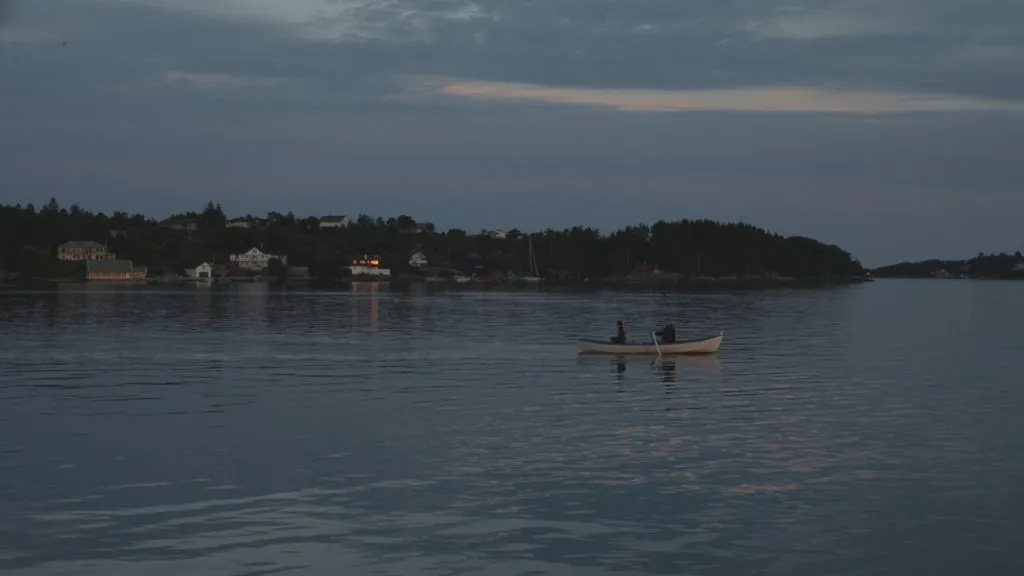
The film unfolds at an unhurried pace: the camera is static, the takes are long and there is no plot. No editing effects, rapid cuts or twists. Successive sequences follow one another in a measured order. At first one may be deceived into thinking this is a conventional account of an unnamed city. Although picturesquely situated — surrounded by water, mountains and forest — the city is bland, devoid of distinguishing features. It is neat, rather empty and nondescript; the sky is grey and silence prevails, disturbed only by the hum of cars. Against this background the residents speak in turn. They seem fairly random and remain anonymous; nothing connects them. They speak in a foreign language. They address the camera, or at least are aware of its presence. They do not answer questions or pause to reflect, but deliver their lines fluently.
Gradually their accounts reveal a city afflicted by a strange psychosis. By way of introduction, a young man resembling a teacher in an empty classroom acquaints us with the city’s history — or rather with the history of the fires that have devastated it for centuries.
Although the most recent catastrophe took place in 1955, the present-day city is no longer built of wood, as we have seen, and solid buildings long ago replaced the ruins. Yet its inhabitants retain an abiding fear of a fiery disaster: inherited post-traumatic stress. The traumatic history is recounted with little emotion, however. The lecturer feeds a carrot to a guinea pig, which emerges from behind his briefcase and introduces an unexpectedly frivolous note into the scene.
The next scene is even less serious. A marital bed, lace-trimmed sheets — except that the elderly couple sleeping there are dressed in fire-resistant suits. A moment later we encounter them in the street, still wearing the suits. It turns out that the garments not only protect against fire but also provide thermal insulation. They are warmer. And, the energy-conscious old gentleman assures us as the silver foil rustles, the purchase pays for itself “after only seventeen heating months”.
But just when we think we know what the film is about — yet another tale of boredom, of sterile existence amid petit-bourgeois prosperity breeding fanciful fears and traumas — a new thread appears. We meet a likeable young woman who has bought a building and runs a rock pub in it. It used to be an arts centre, she admits, and former art lovers still come in occasionally. They talk loudly and disturb the music — but they are customers too, so one has to put up with them. We are also given a sample of the pub’s repertoire: it turns out to be a post-Dylan ballad, far removed from hard-rock sounds. It is, incidentally, the only musical passage in a film with an otherwise austere soundtrack.
From this point onwards, the two strands — fire phobia and the elimination of art — will continually alternate, though never intertwining in any obvious way. Something is going on nevertheless. Ambiguities mount; a shadow of suspicion and traces of some connection appear…
Sipping coffee from a paper cup, a girl rehearses her speech for the farewell opening as an actress might rehearse before a premiere. The customary thanks to those who have come “despite the black clouds hanging over the city”. An assurance that although the gallery will close, its works will undergo conservation and its staff devote themselves to research. Then more thanks to those who have come despite the black clouds… and so on and so forth, ending with a hopelessly sad look directed at us.

Fire, however, inspires greater ingenuity. An excitable greenhouse worker presents his cultivation of wood small-reed (Calamagrostis epigejos) — a grass that supposedly owes its life to fires, germinating on burnt ground only to die soon afterwards. The young man proudly displays these fire-followers: frail green shoots growing in jars covered with silver foil, dozens of jars. The reeds die after eighty days, he assures us; their chance of rebirth lies in the next fire. He tells the story with great conviction, but if we check, we discover that the entire account of this common grass, which grows in abundance, is an invention. For the first time we begin to doubt the credibility of the lines being delivered.
Yet the narrative continues to develop. We meet the grotesque inventor of an anti-fire catapult — a wooden structure modelled on the ancient launchers used to demolish the walls of besieged cities. Its creator eagerly demonstrates how it works: the machine hurls a plastic bag of water, which lands with a smack and bursts across the floor. The catapult can also be used to destroy buildings, because it is better to demolish a burning house than allow the fire to spread. The ranks of those gripped by fear of disaster are joined by a hyperactive obsessive: the owner of the city’s oldest listed house, who rushes between his computer and architectural drawings to produce three-dimensional documentation of it, “because you never know”, and this will at least provide a basis for reconstruction. Then a young architect appears with plans for a house that, through a difficult and costly conversion, could acquire an additional storey intended for water storage…

The film’s calm, serious narration is deceptive. For a long time we may remain under the impression that this is still a sociological record — a peculiar one, but a record nonetheless. Meanwhile we draw ever closer to the limits of absurdity, as at the training centre where dogs are taught to “sense art” by the smell of turpentine, glue and paint — all flammable materials. Any doubt is settled by a startling scene in a marine aquarium. An eloquent guide presents predatory moray eels (“they can grow up to four metres long and as thick as a human thigh”), beside which leading works of the Russian avant-garde have been submerged: El Lissitzky’s Beat the Whites with the Red Wedge and Tatlin’s design for the Monument to the Third International, carefully explained by the guide. The educator does not explain why famous works of art have been placed in the aquarium, as though drowning the avant-garde and abandoning it to voracious eels required no comment. Art immersed in water cannot catch fire.
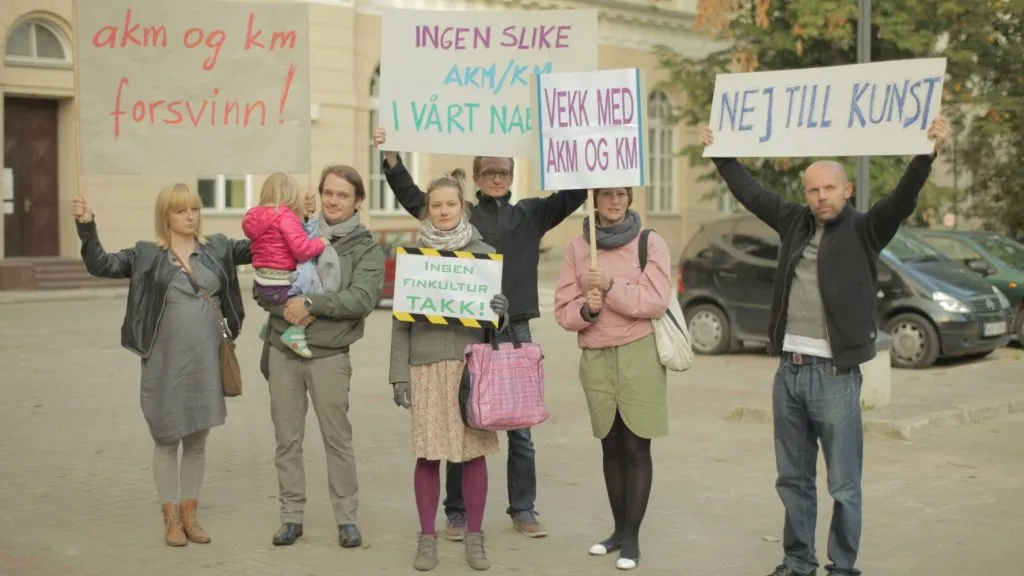
Although the action takes place in a cool Scandinavian setting, we sense a mechanism familiar from Latin American novels: the imperceptible crossing of the boundary between real and unreal, ordinary life and staged fiction. Yet this is not the enchanting “magical realism” of Macondo, but rather a disruption of our expectations and conjectures, a confusion of interpretative trails and proliferation of ambiguities. More and more signals tell us that something is amiss, but we are continually left uncertain. A demonstration by young people chanting “Down with art!” is plainly staged, but the scene of paintings waiting beside rubbish skips to be taken away is entirely plausible. So too is the irritation of the plump canteen worker who is “tired of novelty”. But is the arrogance of the private gallery owner who declares that the “collective madness” of acquiring art does not concern her merely an act?
And how are we to take the speech by the director of the local museum, who confidently announces that the entire institution will be transformed into an exemplary storage facility, where the private collections of the city’s residents will find suitable conditions? And does the empty room in which “it is a little untidy for now, but it will be fine” not seem familiar from somewhere?
Views of the port city return as intervals between the residents’ statements: on overcast days, in the rain, at dusk and at night. Even so, some places seem familiar. Not in any obvious way, but familiar nonetheless.
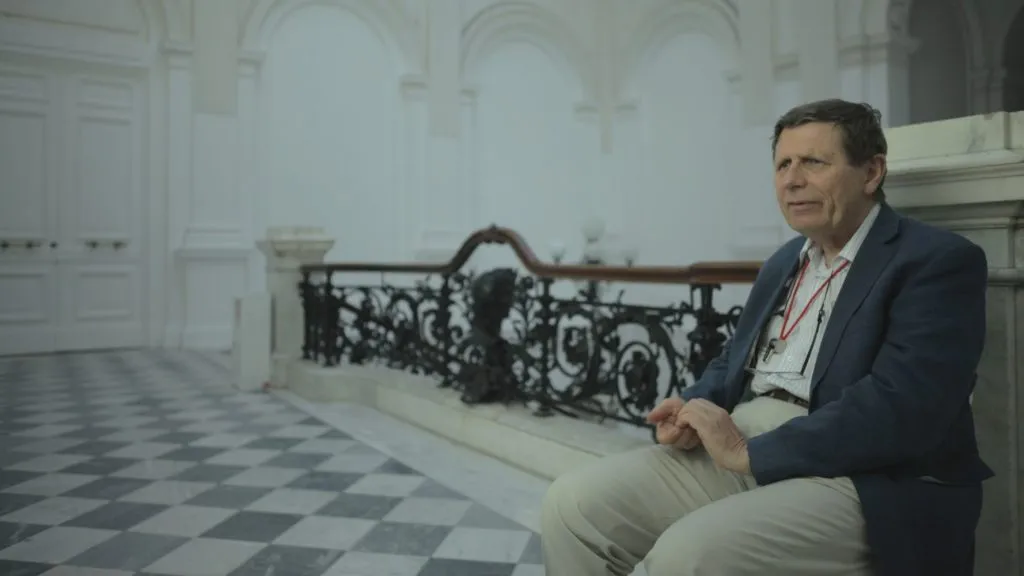
There are familiar figures too. Anda Rottenberg appears in a brief glimpse. A man walking down the street in a gleaming suit bears a curious resemblance to a participant in Paweł Althamer’s well-known neighbourhood action. The ambiguities multiply. And finally — certainty. An elderly gentleman — let us preserve his anonymity and call him “the art critic” — sits against the background of a magnificent ornamental grille.

Yes, we are on the stair landing at Zachęta in Warsaw.
In the space of art.
The critic speaks about the artist Kirsti Bore. We know of no such artist. Online we find only one Kirsti Bore: a forty-year-old childminder living in Sheffield. Another mystification, then. But what the critic says is no mystification. Here we hear the artistic credo, the most important words in the film: “the substance of her practice is blandness”; “deliberate ordinariness becomes a new quality”; “she describes our contemporary human condition”; “she shows what we do not want to notice”. A moment later another voice adds that Kirsti Bore deserves admiration because she has the courage to represent reality. And that reality is terrifying. Do the fictional artist’s initials, K.B., point to the filmmaker’s alter ego? Is this her coded way of speaking to us about her own art?

In one of the final scenes, the artist at last reveals her presence. An impetuous ninety-year-old artist refuses the exile to Spain his daughters are planning for him, to the warmth in which many Scandinavians live out their days. First he would have to put his studio in order — in other words, his whole life. With his rage and Klaus Kinski glare, he seems thoroughly authentic, but from off camera comes the director’s voice arranging the scene: “turn towards the paintings”; “talk about the exhibitions you took part in — Documenta, the Biennale, Elbląg”; “do you remember how you and Marian Bogusz…”. But does the mechanism of film narration revealed here apply to everyone? To the grower of reeds, the catapult inventor, the thrifty pensioners in their thermal suits and the provident owner of the historic house? Two girls sing a charming brief duet, but when they begin explaining that museums are expensive to maintain and nobody visits them anyway, so they are a waste of our taxes, they deliver a prepared text like poor actresses. Others, however — the sad girl from the closing gallery, the pub owner, the architect extolling his design — seem drawn from life. All one need do is set up the camera and film.
In all its ambiguity, the film speaks not only about the folie du feu that grips the residents of a peaceful city and prompts them to rid themselves of art — which is not, incidentally, accused of causing danger, but at most of generating unnecessary expense. Its apparently simple structure confronts us with fundamental questions: about the boundary between “life” and “art”, between reflecting reality and creating it. The uncertainty emanating from the film is not merely uncertainty about what befell a northern city where people speak a language we cannot understand. It is the uncertainty of “our human condition”, addressed in the art of “Kirsti Bore”. Can we name what we fear? Where do we seek the causes of anxiety? Why is it so easy to arouse a sense of danger in people? Why must they look for the guilty or the suspect? And why can art become suspect?
Finally, as in a classic crime story, the film contains almost imperceptible details that unexpectedly assume an important role. Several people wear whistles around their necks. We pay them no attention; they differ little from lanyards and identity cards. Then comes the final scene: a view of the city square, the same view with which the film began. Suddenly a shrill whistle. An alarm. Passers-by scatter. Another whistle. Emptiness. But after a moment everything returns to normal. The people come back. There is nothing to fear. As usual, it is grey. A fine rain falls.
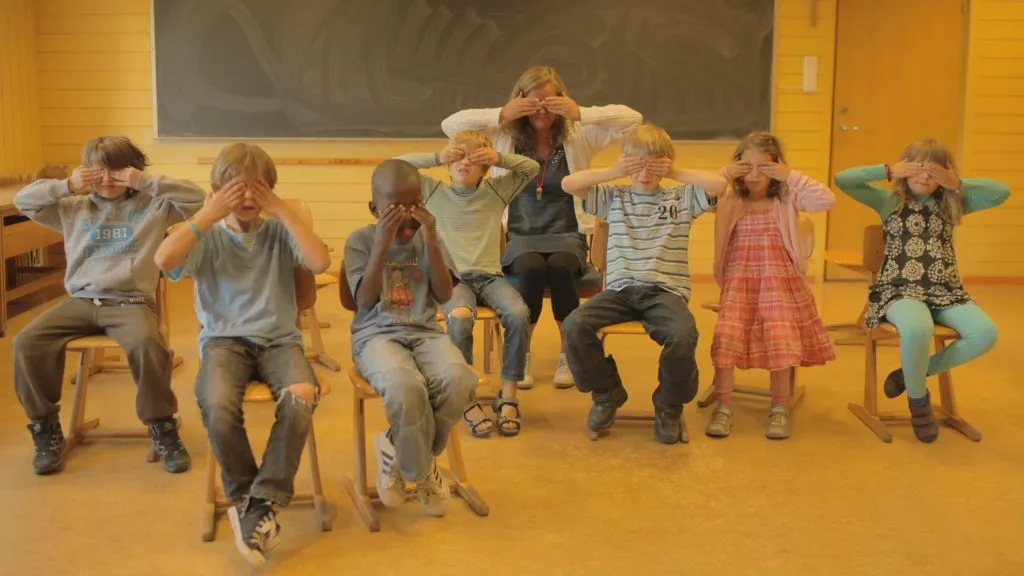
Yet the alarm scene is not what brackets the film. The entire narrative is framed by the repetition of an identical sequence. We recognise the setting. It is not that distant city. We are in a ballet school rehearsal room, with barres and mirrors along the walls. The building of the Teatr Wielki in Warsaw looms indistinctly beyond the windows. A dozen or so people stand motionless, covering their eyes with their hands. The artist counts them off in a monotone. Are we taking part in a psychotherapeutic session? Is everything merely an imagined scenario intended to warn us? To reassure us, or to disturb us? There is so much art all around… one never knows what might happen…
arranging the scene
breaking convention
continual uncertainty
also as to the message
Is the whole thing not a therapy assigned to us? Are we — our eyes covered — taking part in a therapeutic session?
Professor Maria Poprzęcka is an art historian and critic at the University of Warsaw. Her most recent book is Uczta bogiń. Kobiety, sztuka i życie [A Feast of Goddesses: Women, Art and Life] (Agora, 2012).