
The Avant-Garde in an Age of Horror and the Grotesque
Kuba Banasiak
At the turn of the 1970s and 1980s, increasingly numerous voices declared that the language of the neo-avant-garde had been exhausted. If 13 December 1981 is taken as the symbolic end of the dominance of its strategies, the bells were tolling not only in the Repassage Gallery, closed that day, but also at the open-air workshop in Osieki.
After the trauma of martial law, Polish art definitively ‘grew tired of the void of logic’1 and turned towards a language of irony akin to Dadaist, anarchic mischief. To appreciate that language fully, however, it is also worth looking back at the work of artists active in the preceding decade. Not only because the characteristics of particular phenomena are most clearly seen through contrast. Above all, it is because the avant-gardes of the final two decades of communist Poland, although diametrically opposed and extraordinarily diverse, are the obverse and reverse of the same coin. In other words, neo-avant-garde strategies did not disappear entirely on the day martial law was imposed; conversely, artists were also winking at their audience in the 1970s.
Visual Games and Play
Maryla Sitkowska was undoubtedly right when she wrote that ‘the Repassage Gallery, as a “collective creation” sustained for a full ten years, may provide the canvas for a Rieglian account of the art of its decade without fear that any strand might be omitted’2. Michał Woliński, meanwhile, observes that the premises at 24 Krakowskie Przedmieście were effectively an extension of the Studio of Solid Forms and Planes led by Oskar Hansen—‘the Academy’s countercultural off-space’3. It therefore seems reasonable to treat the Repassage Gallery as a lens focusing both the essence and the diversity of the neo-avant-garde strategies of the 1970s. The character of this quasi-institution and the flexibility in decision-making enjoyed by its successive stewards meant that artists representing the most important positions of the time could meet there. It was there, too, that the cool language of the neo-avant-garde gradually dissolved, ultimately giving way to shamanic collectivism and anarchic games only nominally connected with strictly artistic practice. Let Repassage, then, remain the symbolic base for this essay, a place through which the artists discussed below, representative of 1970s art, passed4 at various stages of its existence. For the sake of order, it should be noted that other narratives of this period are certainly possible, although this is unquestionably one of the safer ones.
Can one identify an equally characteristic group of artists for the 1980s? If a distinction is drawn between practices of underground and avant-garde provenance—undoubtedly so. Let us cite Stewart Home’s basic, radically concise distinction: ‘The avant-garde was distinguished not only by greater critical rigour, but also operated in smaller and more closed groups than the loosely organised underground’5. Let us add that underground movements, besides being numerous, transnational, decentralised and ideologically engaged, place at the heart of their activity not artistic practice but rather ‘a discourse taking the form of sociopolitical agitation and revolt’6. Artistic activities, if they appear at all in anything other than the role of colourful background, are invariably subordinated to the articulation of virtually political demands. Underground movements also construct a distinctive infrastructure intended to guarantee the greatest possible separation of a given movement from state, or official, structures. This activity—based solely on the unpaid work of individual members or entire centres—is expressed in the slogan Do It Yourself (DIY).

The most important underground movements must include punk in its broadest possible sense, but also the Dutch Provos, as well as Class War, King Mob and the Yippies. Allowing for departures from the above theory arising from the geopolitical specificity of the communist bloc, we must regard Wrocław’s Orange Alternative as the only underground movement in Poland during the 1980s. Although Home himself—precisely because of these sociopolitical dissonances—does not classify Major Fydrych’s movement as a typical underground formation7, on reflection that decision must be regarded as overly hasty. Leaving aside further deliberations about the Polish underground, let us conclude by stressing that more unites the Orange Alternative with comparable Western movements than divides them.
In this context, one of the most significant avant-garde formations of the 1980s remains the Pitch-In Culture and its most accomplished artistic emanation, the Łódź Kaliska group. It was this group that continued the various strategies that may be described under the banner of post-Dadaist ‘anti-art’. Although, with the advent of the 1990s, Łódź Kaliska ultimately entered the orbit of poetics characteristic of postmodernism, the period of its activity falling within the final decade of the Polish People’s Republic was unequivocally avant-garde.
Art Involuntarily Entangled
Although sociopolitical reality determines art only to a certain extent, in communist Poland it was undoubtedly the fundamental dominant. An inescapable point of reference placed every artistic endeavour either closer to or farther from its centre. As Michał Woliński summarises, in the 1960s ‘the gesture of turning away from the affairs of the socialist state, which had previously violated art, had a political dimension. Yet immersion in a stew of formal deliberations—whether existential, abstract or aesthetic in character—or in the sphere of conceptual self-analysis, dealing with grammar rather than the content of the message, acquired conformist qualities by the end of Gomułka’s “little stabilisation”’8.
The 1970s already bore signs of a certain, though unquestionably illusory, creative freedom. All ‘experimental’ activities were therefore permitted only insofar as they did not come into conflict with the system’s official cultural policy: ‘for whenever artistic actions proved too closely connected with the social situation, the authorities reacted immediately’9. Paradoxically, this particular form of isolationism could sometimes be beneficial, allowing artists to work undisturbed in the seclusion of studios, galleries or academies. For artists whose fundamental strategies included participation, however, and whose practices involved interdisciplinary, collective activities taking place in public space10, this advantage was somewhat illusory. In order not to be interpreted by politics, at some point they had to interpret politics themselves.
Audacious Attempts at Negotiation
Within this politically defined landscape, one could find both criticism of the system and attempts to negotiate its presumed form. As Łukasz Ronduda notes11, one motivation was the classic revolt against an artistic order preserved by the older generation—in this instance, the modernist order. Yet that was not the only motivation, for socialism in its idealistic form, nil novi sub sole, was close to the hearts of a large proportion of the artists of the day. Maryla Sitkowska even compares the ideological sympathies of artists associated with the Repassage Gallery and the Studio of Solid Forms and Planes to ‘anarchism in its oldest, utopian-socialist line: Saint-Simon, Proudhon and Kropotkin. This current stood in opposition to the reconstructionist-revolutionary concepts of anarchists from Bakunin’s lineage’12. Zofia Kulik, Przemysław Kwiek, Zygmunt Piotrowski and Anastazy Wiśniewski believed that the existing situation could be changed not only through struggle but also through dialogue. They therefore attempted to participate in ‘defining future state structures and institutions, particularly those connected with art and aesthetics. They wished to develop a new avant-garde political art that would be directly engaged in the social, economic, cultural and political context’13. It is difficult to judge conclusively whether the failure of these activities was built into the cost of carrying them out; the attempts themselves remained important. Nevertheless, seen with hindsight, the presentation of Think Communism by Zygmunt Piotrowski and the Proagit group must appear an undertaking that was, to say the least, extraordinarily precarious. Staged across several screens and involving a considerable number of participants, the spectacle took place in the Ministry of Culture and Art’s closed approval room, with no public admitted. In the simplest terms, it confronted communist apparatchiks with both the declared and the actual form of the ideas under whose banner they operated14. To quote Ronduda once more, in this case ‘artistic language was not subordinated to ideology; ideology was subordinated to artistic language15’—which must be regarded as an achievement in itself. At the same time, and this must be stressed clearly, it was not a critique of socialism par excellence, and thus involved an element of flirtation with the authorities—Piotrowski was even a member of the Polish United Workers’ Party. Ronduda is prepared to compare these and other attempts with the experiences of Soviet Constructivists16; whether he is right need not detain us here.
That this meant walking on thin ice is demonstrated by Something, a work by the KwieKulik duo that Sitkowska calls an act of ‘self-contestation’17. Whether it marked a break with all attempts at revision or merely an admission of certain mistakes, if mistakes they were, is difficult to determine. It certainly foregrounded above all those features of the communist system that forced people to humiliate themselves before themselves. This was not, of course, KwieKulik’s only action critical of actually existing socialism, but because of the date of this performance—the first took place on 29 March 1979—it belongs to a broader process: the abandonment of tactics previously employed towards the authorities.

With hindsight, it is perhaps possible to say that the radical avant-garde’s characteristic demands for the fusion of art and life were definitively shattered against an ideologically imposed order. Attempts arising from this conception to create a field of creative space shared by artists and society also ended in failure. Gestures that were essentially apolitical were egalitarian only in theory, while the language proposed by artists elicited no real social response. As Woliński notes, after making several attempts to work ‘on the scale of the Great Number’, by realising projects in public space, Grzegorz Kowalski ‘lost his illusions and withdrew to activities within a small group, to the safe enclave of the “art of being together”’18. Thus, from the safe distance of several decades, ‘analytical attempts to use rational tools to discover objective, universal conditions of interpersonal communication through visual forms’19 must be regarded as rather unsuccessful in the social field. Krzysztof Jurecki goes so far as to claim that these activities ‘did not correspond to the specific Polish reality and were detached from the social context’20. Nevertheless, the tactics of the Polish neo-avant-garde retained their artistic freshness and remained attractive to subsequent generations. Paradoxically, this brings the formation closer to Western experiences, where the members of the Situationist International, among others, remained revolutionaries in spe, while their repeatedly recorded demands remained socially inert.
System against System
Among the artistic activities staged in the successive galleries at 24 Krakowskie Przedmieście, Maryla Sitkowska distinguished contestatory and oppositional forms of activity21. Although she noted that this distinction was ‘intuitive and provisional’22, it provides a convenient framework here. Contestatory activities were those that employed ‘elements drawn from the reality being contested’23 and, as should also be noted, were ironic in character. One example worth recalling is Individual Conversations, created in 1972 by Leszek Przyjemski and Anastazy Wiśniewski. The artists proposed a dialogue free from all censorship in a space demarcated by the Polish flag. In this enclave of freedom of speech, the idyll was disturbed only by the bars of The Internationale, played loudly. The same category may include a series of activities carried out throughout the 1970s, such as Krzysztof Bednarski’s Total Portrait of Karl Marx (1978)24, as well as works by Grzegorz Kowalski, Nicole Grospierre, Roman Woźniak, and Elżbieta and Emil Cieślar. The prevalence of activities of this kind therefore makes it possible to isolate, from the broader field of the 1970s’ ‘neo-avant-garde purism’25, a clear strategy of applying critique of a profoundly ironic, paradoxical character.
A similarly ambivalent use of the attributes of an oppressive regime became the fundamental strategy of avant-garde artistic practices—and, to some extent, of the underground as well—in the following decade. This is subject to one extremely important qualification: whereas in the 1970s it was primarily the symbols or attributes of power that were subverted, later it was absurdity-soaked reality itself that became a distinctive tableau which, when confronted with an artistic act, unmasked itself.
Let us therefore move to the period that Krzysztof Jurecki called the ‘crisis of the avant-garde’26, the years 1979–1981. As Jurecki writes, it was then that Łódź Kaliska constructed concepts ‘essential to artistic praxis’27. This tactic was adopted at the open-air workshop in Świeszyno, where Łódź Kaliska abandoned ‘the intellectual analysis typical of neo-avant-garde practice in the 1970s in favour of new qualities—absurdity, play and perversity—which expressed, in a subversive manner, an attitude towards both the specific Polish reality and the conventions of photo-media art’28. It is nevertheless worth stressing that the often tautological reflection on the medium and the creative process was not rejected entirely. The direction of these practices did change, however, and from then on was determined by Marek Janiak’s concept of Embarrassing Art, formulated in June 1980. The group’s early appearances simultaneously exposed the grotesque character and terrifying reality of contemporary life, while also disputing the intellectual rigour of neo-avant-garde art. One example was Adam Rzepecki holding a brick for eight hours, with a break for a meal. Such works were accompanied by fairly direct mockery of what, according to those doing the mocking, was the atmosphere of pomposity surrounding 1970s art, which unfolded on the margins of social interest. The unmistakably named Transparent Tent of Art and Science, or Temple of Embarrassing Art, erected at the open-air workshop in Osieki, should be regarded as a direct negation of the imperatives of the neo-avant-garde. It was accompanied by inscriptions painted on the walls of nearby buildings, such as ‘We Salute the Officials of Art’ and ‘From Today, I Am Pretending to Be an Artist’.
From 1982, Łódź Kaliska was associated with the Pitch-In Culture formation, which Jurecki calls ‘the last redoubt of avant-gardism’29. He nevertheless traces its source to the experience of neo-avant-garde practices, which seems natural if we regard the watershed of 1981 as having been imposed somewhat arbitrarily from above. The spectrum of Łódź Kaliska’s practices then expanded to encompass the individual concepts of its various members. Following Jurecki, we may identify the idea of ‘replacing art with life, everyday existence and the unbridled power of chance’, as well as group happenings, humorous collages, travesties of canonical works—often Dadaist ones—parodies of art shown in churches and ‘play with questions of eroticism and pornography’, to name the most important30. All these ideas would be continued in Łódź Kaliska’s actions after 1989.
Manifestos Far Removed from Scientistic Deliberations31
Leaving aside an analysis of the group’s individual appearances, which are not the principal subject here, let us examine the nuances of Łódź Kaliska’s strategy and thus, in effect, the nuances of a strategy characteristic of the 1980s avant-garde. This is all the more worthwhile because artists who employ the poetics of burlesque are particularly vulnerable to the danger of overly facile interpretations. An accusation that ostensibly spontaneous and carefree actions ‘lack seriousness’ appears to be the mildest of the insults. A far more serious consequence is the denial of their critical—and, more broadly, intellectual—weight. This, in turn, means denying them purpose and coherence. Andrzej Lachowicz’s statement seems characteristic in this regard: ‘They cannot do anything; they are a group of hooligans. They have no understanding of ethics, and they are not funny at all’32.
Considering the enumeration above, let us venture the claim that, in the era of actually existing socialism, the driving force of Łódź Kaliska’s art was its brazen unpredictability in relation to everyday life. In a reality stifled beneath a totalitarian bell jar, every gesture that departed from torpid routine was bound to appear subversive.
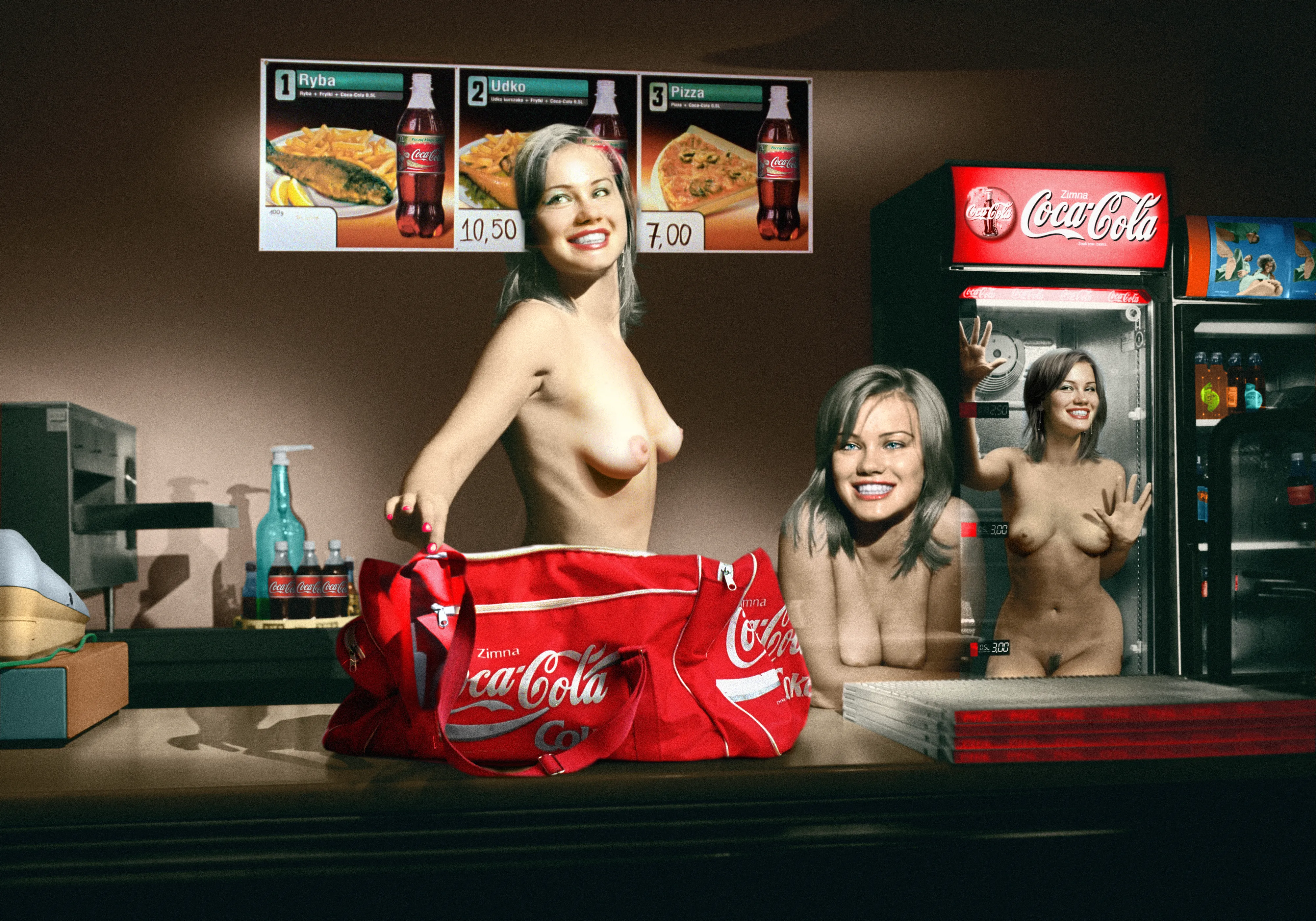
Pure-nonsense humour, however, is merely a gaudy costume concealing the most serious of ideas. We find them at the source, hidden, as it were, in the surreal torrent of words running through successive proclamations, manifestos and leaflets. In the Second / and Final / Manifesto of Embarrassing Art, Marek Janiak wrote, among other things: ‘Embarrassing Art reveals the extent to which the individual is enslaved; Embarrassing Art is an apology for the impossible—“life outside society”’33. Above all: ‘Embarrassing Art is the instrument and expression of an intuition telling us that all artistic gestures, whatever they may be—or indeed the entire domain of art—are dangerous because they only reinforce the system of total organisation of societies. Embarrassing Art is a gigantic mockery—the method—of the efforts of aestheticians implementing a programme of manipulating the artist for the benefit of organising societies that, at present, take no account whatsoever of the individual’s natural condition’34.
Łódź Kaliska’s activity is therefore nothing less than a genuine revolt against an oppressive system, albeit one expressed non-verbally, or metaphorically. It is also, in practice, an open polemic against all attempts to revise the prevailing ideology. These activities are deeply considered, although they do not display the reflection behind them. From the perspective of Janiak et consortes, freedom is the first condition for the validity of any artistic activity, with particular regard to ‘rationalised art’35. An attempt to diagnose the condition of an enslaved society thus meets a question about the very legitimacy of the creative act. The consciousness of the strategy being applied is perhaps most emphatically underscored here by the word ‘method’, which unequivocally invalidates all attempts to deprive Łódź Kaliska’s actions of meaning by infantilising them.
Through the strategy of absurdity, the hopelessness-saturated 1980s were tamed by artists associated with Pitch-In Culture at least as successfully as the Gierek era had been by ‘artists, or rather “scientists”, working with art’36. Although the absence of direct references to the political status quo makes Łódź Kaliska’s revolt somewhat private or hermetic, it seems just as significant as the activities of neo-avant-garde ‘artist-scientists’37. This strategy therefore appears not so much defeatist as premised on the failure of every attempt to rationalise a reality more grotesque than grotesque itself. Those who live by the sword die by the sword—this is how Łódź Kaliska’s tactic might be described, with a wink.
Continuations
To conclude this necessarily selective essay38, it is worth stressing that, although the avant-garde propositions of the 1970s and 1980s differed in method, one may venture to see them as a common set.
The rupture caused by martial law certainly existed in reality, but as an artistic watershed it must appear somewhat artificial and, above all, as an interruption in the continuity and evolution of the strategies discussed. It may therefore be worth suggesting that what was divided, deus ex machina, by an accumulation of orders that were not necessarily artistic belongs in fact to the same tradition and, notwithstanding all the differences, shares common ground. Although such far-reaching analogies are likely to yield only the most general conclusions, the example of the already mentioned Situationist International suggests itself almost automatically: there, tactics of ‘perfecting absolute play’ corresponded with radical ideological zeal and with art treated as a political medium. For although concepts of ‘uniting art and life’ were sometimes a means to different ends for the neo-avant-garde and the artists of the 1980s, they grew from the same trunk of the post-war second avant-gardes and, only because of geopolitical circumstances, were forced above all to wrestle with grand history.
The question of how the concepts outlined above have been continued remains open. While the strategies pursued in the 1970s have remained intellectually alive and found outstanding continuations in both art and teaching, the method of grotesque now seems to be somewhat on the defensive.
- Marek Janiak and Andrzej Kwietniewski, Idiotic Art Manifesto II, [in:] God Envies Us Our Mistakes: Łódź Kaliska Museum, p. 15.
- Maryla Sitkowska, Introduction, [in:] Sigma, Gallery, Repassage, Repassage 2, Re Repassage, exhibition catalogue, ed. Maryla Sitkowska, Zachęta National Gallery of Art, 28 June–1 August 1993, p. 14.
- Michał Woliński, Building Activity, Sculpting Communication, ‘Piktogram’, no. 5/6, p. 24.
- In view of Zofia Kulik’s statement distancing herself from any connection with Repassage, I deliberately avoid the phrase ‘from which they emerged’ here; cf. http://www.raster.art.pl/tygodnik/numer71/list_kulikdoc.htm.
- Stewart Home, The Assault on Culture: Utopia, the Avant-Garde, Counter-Culture: From Lettrism to Class War, Warsaw 1993, p. 6.
- Ibid., p. 95.
- Cf. ibid., pp. 11–12.
- Michał Woliński, Building Activity, Sculpting Communication, op. cit., p. 25, note 1.
- Anda Rottenberg, Places of Art, [in:] Art in Poland 1945–1990, Warsaw 2005, p. 158.
- Cf. various authors, Visual Games and Conversations, Actionsand Interactions, ‘Piktogram’, no. 5/6, pp. 15–149.
- Łukasz Ronduda, Soc-Art: An Attempt to Revitalise Avant-Garde Strategies in Polish Art of the1970s, ‘Piktogram’, no. 1/summer 2005, pp. 108–120.
- Maryla Sitkowska, op. cit., p. 11.
- Łukasz Ronduda, op. cit., p. 108.
- Cf. Łukasz Ronduda, Zygmunt Piotrowski and the Proagit Group’s Spatiotemporal Propaganda Poster ‘Think Communism’ and the Proagit Group, [in:] Soc-Art: An Attempt to Revitalise Avant-Garde Strategies in Polish Art of the1970s, ‘Piktogram’, no. 1/summer 2005, pp. 110–111.
- Łukasz Ronduda, Soc-Art: An Attempt to Revitalise Avant-Garde Strategies in Polish Art of the1970s, op. cit., p. 114.
- Ibid., p. 119.
- Maryla Sitkowska, op. cit., p. 10.
- Michał Woliński, Building Activity, Sculpting Communication, op. cit., p. 24.
- Łukasz Ronduda, Visual Conversations by Wiktor Gutt and Waldemar Raniszewski, ‘Piktogram’, no. 5/6, p. 73.
- Krzysztof Jurecki, [in:] God Envies Us Our Mistakes: Łódź Kaliska Museum, p. 149.
- Maryla Sitkowska, op. cit., p. 12.
- Ibid., p. 12.
- Ibid., p. 12.
- I maintain here the qualification that the division is ‘conventional’ and place Bednarski’s works in the ‘contestatory current’ rather than the ‘oppositional’ one; ibid., p. 13.
- Krzysztof Jurecki, op. cit., p. 149.
- Ibid., p. 147.
- Ibid., p. 149.
- Ibid., p. 149.
- Ibid., p. 151.
30. [after:] Ibid., pp. 151–153.
- Anna Leśniak, NEWPOP [in:] A History of Women’s Photography through the Example of Łódź Kaliska, with Particular Emphasis on the Chest, published by the Łódź Kaliska Artistic Association; no page numbers.
- [after:] Anna Leśniak, ŁódźKaliska [at:] http://www.lodz-art.eu/artysci/lodz_kaliska/lodz_kaliska.php
- Marek Janiak, Second / and Final / Manifesto of Embarrassing Art [in:] God Envies Us Our Mistakes: Łódź Kaliska Museum, p. 31.
- Marek Janiak, Ibid., p. 61.
- Krzysztof Jurecki, op. cit., p. 153.
- Łukasz Ronduda, Soc-Art: An Attempt to Revitalise Avant-Garde Strategies in Polish Art of the 1970s, op. cit., p. 113.
- Łukasz Ronduda, Ibid., p. 113.
- The painting achievements of Luxus and Gruppa undoubtedly deserve separate attention. They too belong to the context of burlesque with anti-system revolt in the background, although they no longer possess an avant-garde provenance or an intellectual affinity with the 1970s. Despite their return to painting, the artists of Gruppa were unquestionably children of Polish conceptualism, Anda Rottenberg concludes (op. cit., p. 295).