
Ilya Kabakov’s Albums
Tomasz Gryglewicz
At documenta IX in Kassel in 1992, Ilya Kabakov exhibited an art installation entitled The Toilet. Built outdoors behind the exhibition’s main building, the Fridericianum, some visitors mistook it for an actual lavatory, despite its appearance as an urban public convenience being unusual in the sterile German setting. Only upon entering could the surprised viewer grasp the work’s idea: a fully furnished and decorated flat had been arranged inside the lavatory. Beside the characteristic Soviet cubicles, open to the interior and without doors, stood wardrobes, beds and a child’s cot with bedding, as well as tables laid with plates and cutlery — which made a particularly revolting impression — while wall hangings, pictures and the like adorned the walls. Leaving aside the fact that adaptations of this kind might occur in a post-communist society struggling with poverty and a housing shortage, Kabakov’s installation can be treated as an extraordinarily apt and suggestive symbol of the reality of the former USSR.
One component of Soviet reality encountered daily by the average inhabitant of a large historic city such as Moscow or Leningrad was the communal flat. Kabakov himself — who repeatedly subjected Soviet reality to critical assessment in installations such as The Red Wagon (Städtische Kunsthalle, Düsseldorf, 1991) and The Red Pavilion (45th Venice Biennale, 1993) — writes: “After the Bolshevik Revolution of 1917, all houses in Russia and, naturally, all the flats within them became state property. Ten- and twelve-room flats, indeed all decent flats, were then subjected to ‘settlement’ and ‘densification’. Their former owners were left only one room, while newcomers were quartered in all the others. Each family being settled likewise received just one room. […] And these truly were genuine ‘communes’: the number of residents in such a ‘communal’ flat reached fifty or sixty. The plan and fittings, however, remained ‘pre-revolutionary’, which meant that all those families shared one toilet, one bathroom and one kitchen. The lives of these families, who had nothing in common but were condemned to live beside one another for ever, were a true hell. […] The ‘communal’ kitchen was an especially terrible and burdensome place — the veritable breeding ground and centre of every problem.”1
Kabakov depicted such a kitchen, with pots and other utensils hanging from the walls, in the installation Communal Kitchen, shown in the exhibition Art on the Edge at the Museum of Modern Art in Nagano in 1991 and later in the permanent display at the Musée Maillol in Paris. In the exhibition The Corridor of Two Banalities at Ujazdowski Castle in Warsaw in 1994 — the other corridor was by Joseph Kosuth, a leading figure of international Conceptual Art, and the quotation above comes from the catalogue — Kabakov presented a series of authentic texts from the early 1960s containing complaints and denunciations of neighbours in a Moscow communal flat. The traumatic experience of communal housing, also familiar to the reality of the Polish People’s Republic in the form of requisitioned flats, recurs in most of Kabakov’s works.
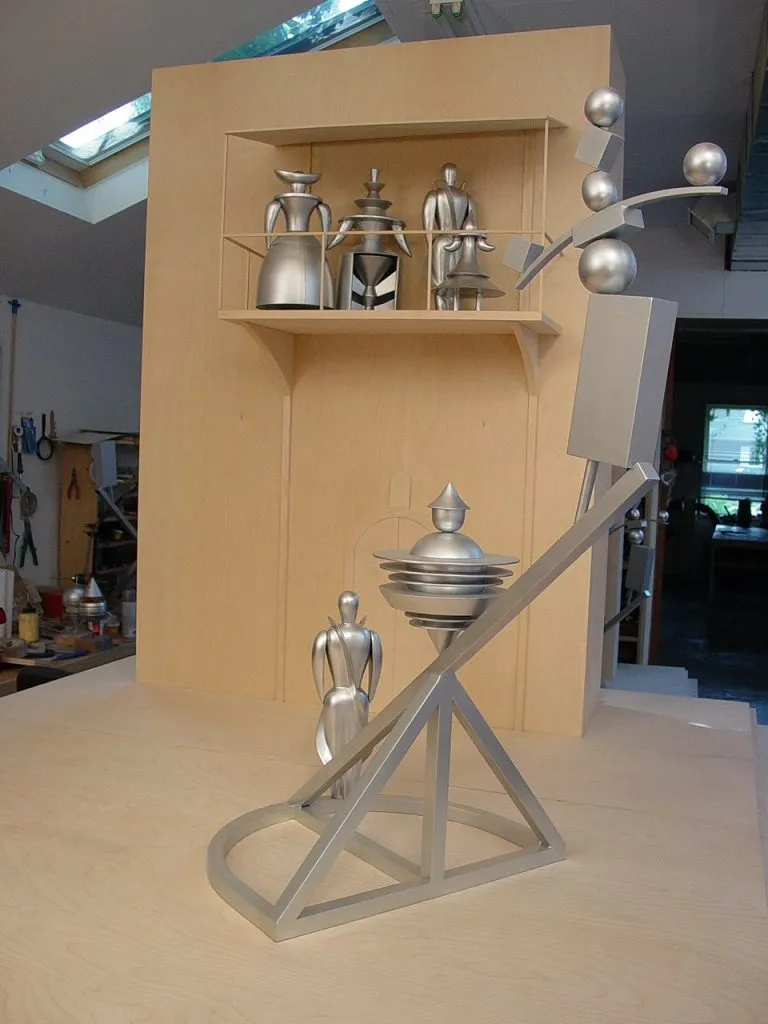
As in his installations, the albums shown in the Łódź exhibition address the problem of communal flats, directly or indirectly. The first series, 10 Characters — sometimes called 10 Albums — was made between 1972 and 1975.2 As the curators of the exhibition 5 Albums at the modern-art museums in Helsinki and Oslo write in the catalogue introduction, “Starting from what he called ‘pure zero’, pure grey anonymity, Kabakov constructed a ‘metaphysics of everyday life’, creating albums of words and images based on the lives of ten people. All were invented beings inhabiting a typical Soviet flat.”3 The action of the first albums in the series, devoted to Primakov Sitting in the Closet, takes place precisely in a cupboard in a communal flat. They tell the story of a boy who locks himself in a cupboard where he has gathered his toys and even arranged a kind of bed from old clothes. Sitting in total darkness, he listens to sounds beyond the closed doors and imagines flying above the city’s houses and soaring over the earth before dissolving into the luminous sky. When his worried parents force the doors after their son has spent a long time inside, they find no one. Primakov’s story can thus be treated as a symbol of the degradation of a sensitive individual in Soviet society: to obtain a minimum of freedom, the boy shuts himself in a cupboard and escapes reality into an idealised imaginary world.
Boris Groys, a friend and commentator on Kabakov’s work, wrote that “The first album of the cycle, Primakov Sitting in the Closet, begins with a series of pages in which Malevich’s famous black square — that symbol of art’s liberation from narrative and banality — is interpreted as a spectacle seen by a boy in a dark cupboard. In the same album, conceptual word-objects are introduced as the final thoughts of the decomposing consciousness of a dying man.”4
We thus see that the world of modern avant-garde art, embodied in Malevich’s leading work, becomes a kind of escape from the gloomy reality of actually existing socialism. For the Moscow Conceptualists of the 1970s, among whose principal representatives was Ilya Kabakov, Black Square on a White Ground — reduced in Kabakov’s album to a black rectangle — symbolised the fortunes of the Russian avant-garde in the twentieth century. The exhibition Moskauer Konzeptualismus, drawn from Haralampi Oroschakoff’s collection and shown at Berlin’s Kulturforum in April 2004, included Nikita Alexeev’s A Short History of Modern Art, or the Life and Death of the Black Square (1986). It took the form of a scroll on which the peculiar adventures of the personified black square were presented sequentially, like a comic strip: from its birth during the Constructivist avant-garde, through repression in the Socialist Realist era, to its revival in underground art during the 1970s and in official art during perestroika in the second half of the 1980s.
Kabakov belongs to the formation of Soviet artists who, in the 1960s and 1970s, opposed official painting, which continued to represent a slightly modified version of Socialist Realism based on academic canons. Born in Dnipropetrovsk, Ukraine, in 1933, as a child he endured the ordeal of the great famine of the 1930s and wartime evacuation. Like his entire artistic generation, whose insatiable appetite for modern art was awakened during the brief Khrushchev Thaw, he completed the secondary Art School and higher studies at the Surikov Art Institute in Moscow during the Stalinist period. These artists created the phenomenon of Russian Conceptualism. Operating in a peculiar underground and exposed to repression and harassment, the Moscow artistic avant-garde comprised, from the 1960s onwards, three interpenetrating groups: Collective Actions, Sots Art and Apt Art. Collective Actions represented a form of performance, while Sots Art became the Soviet counterpart of Pop Art. Apt Art, or “Apartment Art”, was an exceptional phenomenon characteristic of Soviet underground art at the time. The artists associated with it organised exhibitions of installation and Conceptual Art in private flats, outside the official art system. Ilya Kabakov was a leading activist, exhibiting his installations and albums in private homes.
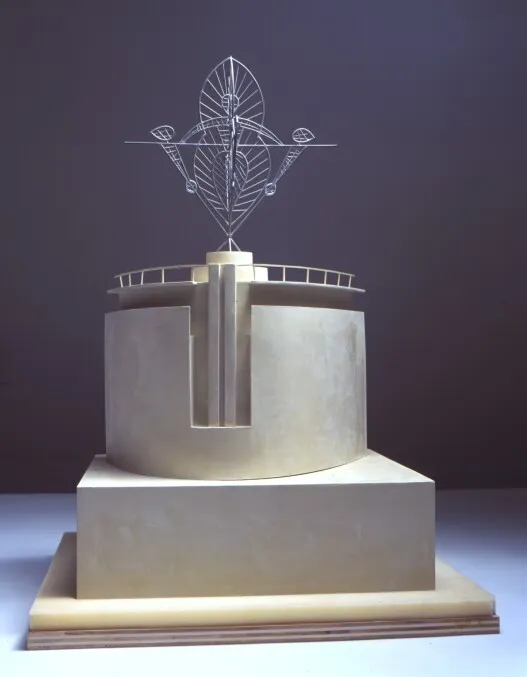
Kabakov’s installation MOMA, or the Moscow Conceptual Circle, shown at Hamburger Kunsthalle in 1993, became a kind of tribute to this artistic formation. In a circular domed room — whose “general impression is of a place of worship where a mysterious ritual is practised: stone ‘altars’ in the centre, separated chambers opening towards the light, semi-darkness” — which also recalled the communal flat mentioned repeatedly in this text, the artist designed twelve rooms opening towards the centre, “reserved for one member of MOMA, MANI, the conceptual circle, etc.”5 The artists or groups were: 1. Joseph Backstein, 2. Boris Groys, 3. Dmitri Prigov, 4. Lev Rubinstein, 5. Victor Sorokin, 6. Andrei Monastyrski, 7. Collective Actions (N. Panitkov, Georgy Kiesewalter, Igor Makarevich, Elena Elagina, Nikita Alexeev), 8. Nikita Alexeev, 9. Medical Hermeneutics (Pavel Pepperstein, Sergei Anufriev), 10. Yuri Leiderman, 11. Vadim Zakharov and 12. Ilya Kabakov.6 While still a student, in 1955, Kabakov began a career as an illustrator of children’s books. Each year he illustrated four or five books, securing a steady income and membership of the official Artists’ Union, in the Graphics Section. In these illustrations — made, as he put it, “for others” — he used the illustrative style characteristic of books published in the USSR, in which prescribed Socialist Realism appeared as a particular idealisation and anonymity of means, especially evident in the treatment of the human figure. This idealisation resulted in saccharine subject matter, particularly when it concerned the realities of life in the communist state. Because the reality depicted in the illustrations was inversely proportional to the nightmare of life experienced every day by the Soviet person, homo sovieticus, it led to a kind of schizophrenic situation.
The style of these illustrations was also well known in Poland, where Soviet books were widely distributed, especially during the Stalinist period. They possessed a peculiarly demonic and perverse flavour produced by the contrast between their idyllic atmosphere and the dramatic political context of the time, as well as the general collapse of civilisation after the Second World War. In that same year, 1955, radically breaking with the “academic” Socialist Realism learnt during his studies, Kabakov worked “for himself” in the total isolation of his room, making hundreds of drawings that for the first time adopted a modern form inspired by avant-garde currents such as Cubism, abstraction, Constructivism and Surrealism. In Kabakov’s later comment on this formal experiment, “From the position of the nightmarish horror of childhood, it seemed ostensibly easy, like jumping into ‘nothing’, into the void.”7 The drawings would return in the late 1970s, reconstructed by Kabakov in the second series of albums, On Grey and White Paper.
The experience of illustrating children’s books is continually present in Kabakov’s avant-garde work, which he began in the 1960s. His albums in particular rest on a formulaic, saccharine illustrative aesthetic employed with full awareness of the absurdity arising from its confrontation with the dramatic nature of the stories and contents conveyed. The style consists of black outline drawings defining areas filled with pale pastel crayon, and handwritten texts and inscriptions in the Russian alphabet. As Kabakov himself writes in his commentary “Albums”: A Special Genre?, they are “a pile of thick, white (or grey) cardboard pages, always of the same dimensions (72.5 × 35 cm), onto which sketches, scraps, documents, texts and different kinds of things drawn by the author or already published are pasted. These piles of paper (from thirty-five to one hundred pages) are placed in boxes measuring 75 × 38 × 15 cm.”8 After Primakov Sitting in the Closet, the remaining nine characters to whom albums in the first series are devoted are Joker Gorokhov, Generous Barmin, Agonising Surikov, Anna Petrovna in Her Dreams, Flying Komarov, Mathematical Gorsky, Decorator Malygin, Released Gavrilov and Archipov Looking Out of the Window. Their stories are related by different people connected with the protagonists. The accounts and comments, in the form of handwritten notes, appear on separate pages alongside the illustrated sheets. Inscriptions and texts are placed in frames carefully ruled in black on the surface. The page layout is generally based on strict symmetry, recalling the aesthetics of a propaganda wall newspaper. The artist was interested in posters and propaganda graphics and referred to the legacy of Soviet Constructivism. In the 1960s he even made a series based on the aesthetics of warning signs. These works belong to the phenomenon of Sots Art, conceived as the Soviet counterpart of American Pop Art. Every story contains an unreal element, even if we regard it as the product of the protagonists’ pathological psychological states; what unites them is their attitude towards the surrounding reality. That attitude is the desire to escape and detach themselves from the world in which they must live: Primakov shuts himself in the cupboard, Komarov flies above the city, Surikov escapes into tormenting paranoid visions, Anna Petrovna enters a dream reality, Malygin is absorbed by conference drawings, Gorokhov by the world of jokes and games, and Gorsky by absurd mathematical theories.
According to Boris Groys, for whom “modern art liberated itself from internal narrativity […], Kabakov’s art […] represents a return to narrative, to the role of the artist as narrator.”9 Groys argues that the protagonists of Kabakov’s albums refer to the “little man possessed by a great idea” typical of classical nineteenth-century Russian literature, except that they “are possessed not so much by socio-political or religious ideas as by purely visual ideas in the original sense of the word (eidos = archetype). The biographical-visual part of these albums reveals the protagonists’ souls, corresponding to their interior, pure subjective world. In addition, the text narrates their history from outside and introduces their vision into a trivial, everyday context.”10
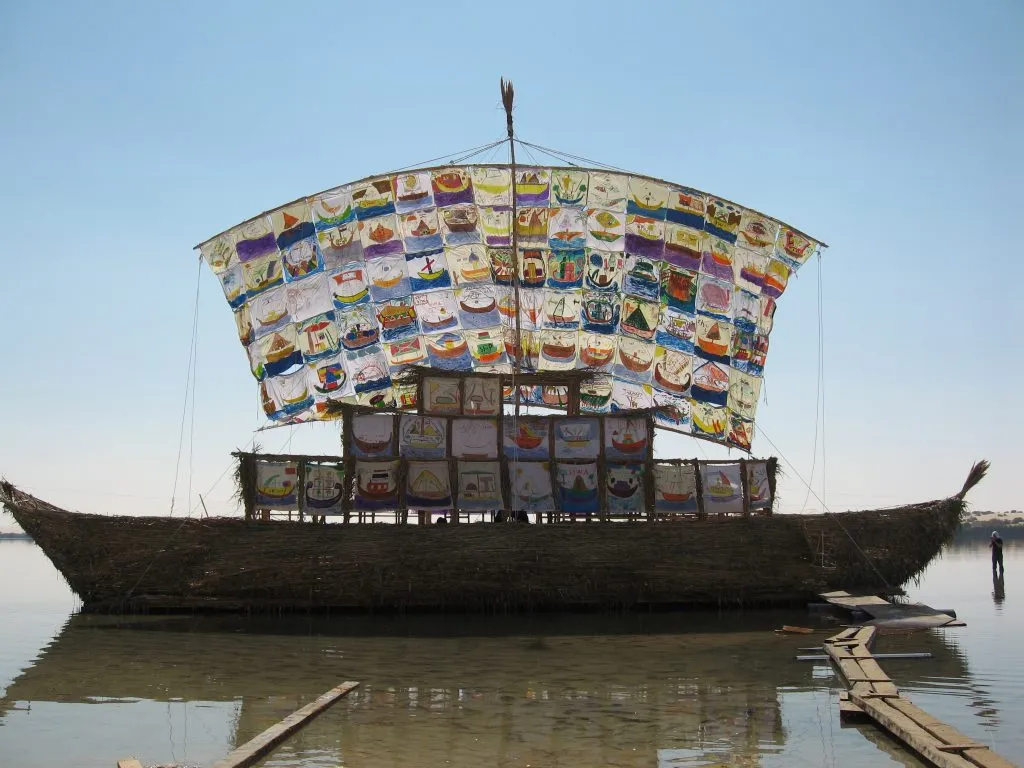
The principal issue addressed in the albums is therefore the relationship between image and word. As Groys writes, discerning in Kabakov an inspiration from Mikhail Bakhtin’s linguistic concepts, “the image is the key to understanding the text as a special graphic symbol.”11 According to Kogan’s commentary, Primakov Sitting in the Closet “became an unconscious nominalist […]. And when he looked out of the cupboard, he saw words instead of things”, because, as Shefner commented, “he had a sudden ontological vision: they were ‘words’.” Alongside the relation between word and image — rudimentary to the twentieth-century avant-garde and Conceptual Art in particular, although in Kabakov, unlike in Western art, there is a “victory of image over word”, as Groys puts it12 — we can trace further topoi of modern art, such as optical illusion.
In the first album devoted to Joker Gorokhov — although the series is customarily called 10 Albums, each protagonist has several — who amused himself by creating visual jokes, fragments of linear drawings stimulate extraordinary situations. A picture of a six-winged angel, for example, provokes a vision of children arranged in an eight-pointed star floating in the air in the Hermitage’s Painting Gallery. In Gorokhov’s second album, we encounter the problem of coincidence between images of very small things and scenes showing very large objects. Their juxtaposition gives viewers a false impression that the former affect the latter. Finally, Gorokhov’s third album, Arkady Lvovich’s Game, contains a peculiar children’s visual game in which a cut-out opening introduces a fragment of the next page showing an ever more distant historical scene. We are thus dealing with a game of temporal planes that recede while overlapping one another. The relation between fragment and whole, observable in Gorokhov’s especially visually elaborate albums, runs through all the illustrations in the 10 Characters series. It was present in Primakov Sitting in the Closet and also occurs in Anna Petrovna in Her Dreams, Mathematical Gorsky and Agonising Surikov, where we encounter the issue of a curtain and openings cut into it through which Surikov sees fragments of reality. In Decorator Malygin, Kabakov additionally addresses the relation between centre and margin, an important problem for the Russian school of linguistics. Kabakov’s world shares many features with Mikhail Bakhtin’s “carnivalised literature”, characterised by the union of “seriousness and laughter”; the menacing demonism of authoritarian power is degraded through comedy, buffoonery and grotesque.
Originally, the albums were presented according to a fixed and unchanging ritual. As Kabakov comments in “Albums”: A Special Genre?, the album cannot be separated from its presentation. Each was placed on a music stand. The stands and albums formed a kind of amphitheatre. Only ten to twelve viewers took part, “which gave the situation something of the atmosphere of a living space, a room. […] The author stands on one side of the music stand with the album, turns the pages and reads the texts written on each page […]. All this together — the sketches themselves, the time during which the viewer looks at them, the turning of pages, the reading of the text, orchestrated in one specific rhythm, the totality of voices, the presence of a real, living ‘person’ who turns the pages — all this constitutes the special quality of this demonstration, in which a unique genre is constituted: the genre of ‘albums’.”13
Thus, in creating his albums, Kabakov took up on the one hand the artist’s book handmade by a painter or graphic artist as a unique work of art, a mode of expression highly important to Conceptual Art. On the other, through his unique form of presentation, which transformed into a kind of happening or performance, he also introduced the actionist element typical of the so-called neo-avant-garde of the 1970s. In the exhibition mentioned above, The Operating Room: Mother and Son, presented in Helsinki in 1994 and Oslo in 1995, the individual album sheets — framed and arranged in accordion formation on plinths — created a kind of labyrinthine installation.
The problem of the albums and the communal flat, equally important in the artist’s work, was addressed in another major exhibition, Ten Characters, shown at Ronald Feldman Fine Arts in New York in 1988. Kabakov’s installation assumed the form of a ten-room flat, each room belonging to one of the titular characters: The Man Who Flew into His Picture; The Man Who Collects the Opinions of Others; The Man Who Flew into Space from His Apartment; The Man Who Never Threw Anything Away — this character illustrated Kabakov’s idea of creating installations from accumulated waste, a tendency close to Italian arte povera — and so forth. Room IX was occupied by The Man Who Described His Life through Other Characters. This man is, of course, Kabakov himself.
Finally, Boris Groys is worth quoting once more: “Kabakov’s art exists in the domain of everyday life […]. What is real can only be conveyed through narrative. Thus Kabakov’s art belongs narratively to its postmodern era, to the collapse of the ideology of omnipotence, and to the attempt to retell the great myths of the modern epoch: the story of art’s emancipation from everyday life and the historical legacy.”14
- Ilya Kabakov, “Commentary on the Exhibited Texts”, in Ilya Kabakov/Joseph Kosuth: The Corridor of Two Banalities, catalogue of the exhibition at the Ujazdowski Castle Centre for Contemporary Art, Warsaw, 25 April–3 September 1994, unpaginated.
- The title 10 персонажей, translated into English as 10 Characters and French as 10 Personnages, might also be rendered in Polish as ten persons, personalities, personages, characters and so forth. It seems to me, however, that the Polish term postać best suits Kabakov’s work while also containing the meanings above.
- T. Arkio and K. Hellandsjø, “Introduction”, in Ilya Kabakov/5 Albumia, Nykytaiteen museo, Helsinki, 3 February–10 April 1994; Museet for Samtidskunst, Oslo, 8 October 1994–8 January 1995 (exhibition catalogue), Helsinki 1994, p. II.
- B. Groys, “The Artist as Narrator”, in Ilya Kabakov/5 Albumia, p. IX.
- Ilya Kabakov, Installations 1983–1995, Centre Georges Pompidou, Paris 1995, p. 209.
- This text uses Polish transcription of names from the Russian alphabet, in accordance with Polish grammatical convention. The exception is Ilya Kabakov, spelt according to the artist’s wishes.
- Quoted after A. Wallach, Ilya Kabakov: The Man Who Never Threw Anything Away, New York 1996, p. 31.
- I. Kabakov, “‘Albums’: A Special Genre?”, in Ilya Kabakov/5 Albumia, p. XIV.
- B. Groys, op. cit., pp. VI–VII.
- Ibid., p. IX.
- Ibid., p. XIII.
- Ibid.
- I. Kabakov, “‘Albums’”, op. cit., p. XV.
- B. Groys, op. cit., p. XIV.