
•
Magdalena Lewoc
Roman Lipski’s personal and artistic biography often shapes the reception of his work, forcing it into interpretative frames drawn too narrowly. While not disregarding several important facts that define the course of Lipski’s rather unusual career, it is worth maintaining a distance from the intrusive biographical reading of his work.
Lipski’s painting, almost entirely unknown to Polish audiences, has in recent years become increasingly recognisable not only in Berlin, where the artist has lived since 1989, but also beyond Europe. His works have entered American collections including the Museum of Fine Arts, Boston, and the Colby College Museum of Art in Waterville. He participates in prestigious exhibitions — including this year’s Beijing Biennale — and his pictures are increasingly included in group shows beside works by celebrated figures such as Hockney, Ruscha and Lichtenstein.
This rapid acceleration in Lipski’s artistic career occurred during the past five or six years, almost fifteen years after he settled in Berlin. He arrived there as a painting-hungry, self-taught nineteen-year-old, determined to make a desperate escape from the hopeless reality of late real socialism. In Berlin he underwent the classic emigrant initiation with its indispensable elements: a camp, welfare and casual jobs, which eventually enabled him to find a place within a difficult but promising reality. Sensitivity and intelligence allowed Lipski quickly to free himself from the sterile context of displacement and become active in the creative milieu of Polish émigrés and co-founders of the Club of Polish Losers in Berlin. Together with its leaders — Leszek Oświęcimski, Wojciech “Lopez” Stamm and Piotr Mordel — Lipski participated in and helped create the group’s initiatives during its finest, heroic period, when the Losers established themselves on Berlin’s alternative scene in an exceptionally exuberant style. The end of the 1990s and beginning of the present decade saw an eruption of activity, initially by an informal circle of artists and cultural organisers and, from 2000, by the Association, which ran the cult club on Torstraße. Its subversive, party-oriented actionism was accompanied by lively publishing and artistic activity in Kolano, the Losers’ press organ. Books appeared under the “Kolano Library” imprint, alongside theatre projects and various, not always legal, happening-style actions. The milieu certainly mobilised Lipski to pursue his own artistic ambitions. At the same time, the 1990s were a period in which he consistently worked towards painting. He attended private art schools such as Die Etage and, from 2000 to 2005, worked for Max Neumann, a well-known Berlin painter whose work he values enormously and whose formative significance for the beginning of his own creative path he emphasises.
Unexpectedly, at his friends’ urging, Lipski appeared at the Festival of Contemporary Polish Painting in Szczecin in 2004. His pictures formed one of its most distinctive and fresh elements, received enthusiastically during the critics’ symposium accompanying the festival, and were swiftly purchased for Szczecin’s newly formed Zachęta Contemporary Art Collection under the Signs of the Times programme.
Soon afterwards, the potential of Lipski’s painting acquired an entirely new and exceptional framework. The artist managed to interest Erich Marx in his pictures. One of Germany’s most important collectors, Marx assembled a collection whose status and quality led Berlin’s foremost museum of contemporary art, Hamburger Bahnhof, to preserve and exhibit it. The establishment of contact between a completely unknown self-taught painter and one of Germany’s most eminent collectors — whose holdings include works by American and European classics, from Warhol and Beuys to Neumann and Barney — testifies on one hand to Lipski’s extraordinary determination and, on the other, to Marx’s enormous openness and sensitivity to authentic artistic positions. From this point onwards, the relationship between Marx and Lipski resembled benevolent patronage more than the detached relationship of collector and artist. The patron trusted his own intuition and knowledge, sensing that the energy of artistic expression before him attested to an unusual talent.
The inclusion of Lipski’s pictures in the Marx Collection, which contains works by leading Polish painters Wilhelm Sasnal, Zbigniew Rogalski and Rafał Bujnowski alongside international stars, radically changed the artist’s situation. His pictures entered professional gallery circulation and simultaneously attracted the interest of further private collectors. For Lipski, however, the most important effect of these exceptionally favourable circumstances was the opportunity to concentrate entirely on painting and abandon other, peripheral activities imposed by the demands of daily life.
Lipski’s painting appeared on the Berlin art scene during the second half of the present decade, soon followed by the first attempts to locate his work within a coherent interpretative context. At the time, somewhat later pictures entered circulation in which the artist had almost entirely abandoned figurative elements and concentrated on darkly expressive suburban landscapes.
Earlier pictures, painted in broad, characteristically outlined planes, are forceful figurative compositions in which the figures often undergo hybrid mutations: on one hand traumatic bodily dysfunctions, on the other lighter and more ironic collisions between sensual femininity and aggressive militarism. The compositional and chromatic solutions in these early works betray a fascination with the painting of Neumann — initially a mentor and soon a friend who closely observed Lipski’s work.
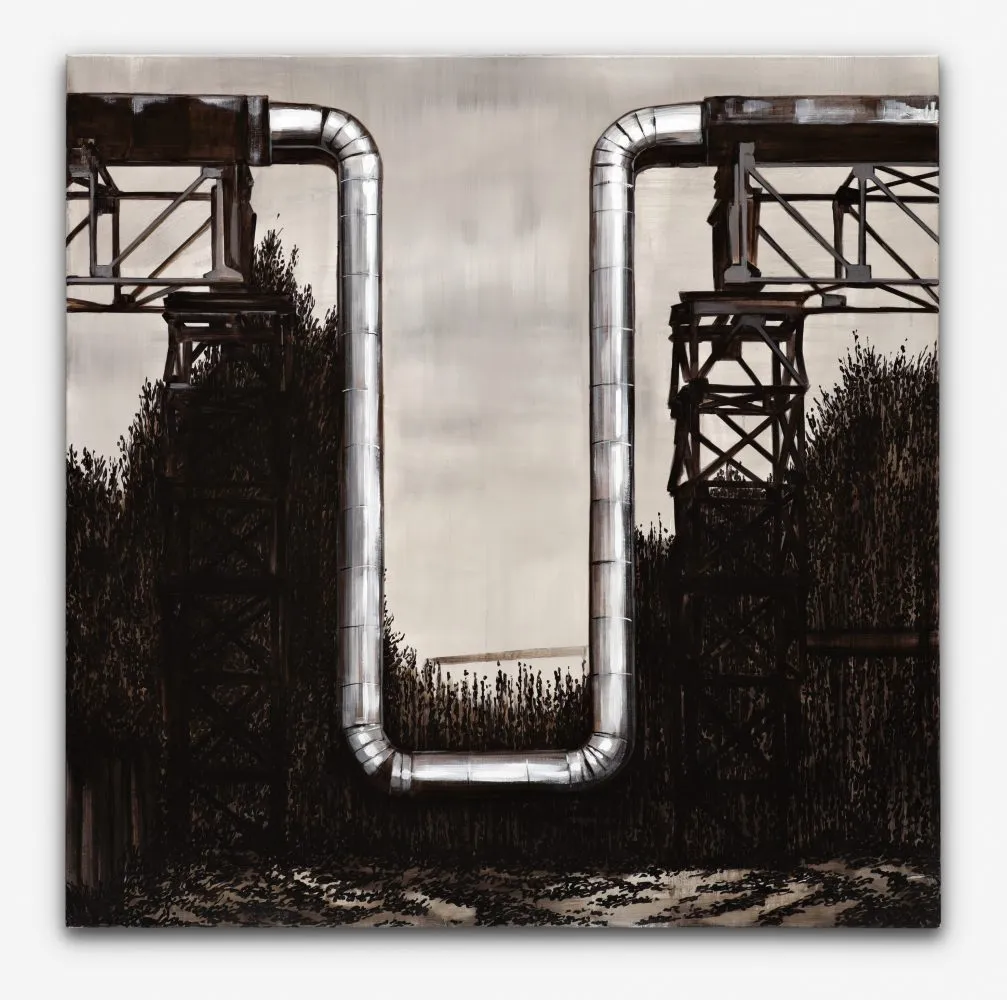
What entered public circulation, therefore, were monumental canvases that reduced narrative and anecdotal content, taking as their principal motifs solitary spectral dwellings and post-industrial relics situated in an indeterminate, empty space. The pictures’ distinctive chromatic atmosphere, reminiscent of a kind of meteorological drama, intensifies the sense of isolation. It was these visual qualities that firmly introduced into the interpretation of Lipski’s work a discourse of melancholic solitude, alienation and the poetics of sad beauty — Dominikus Müller, in an essay published in the catalogue accompanying the artist’s solo exhibition at Galerie Birgit Ostermeier in Berlin — as well as nostalgic loss and the need to exhume images, sensations and afterimages familiar from Poland, now standing pars pro toto for all of Eastern Europe — Christoph Tanner, in materials accompanying Lipski’s solo exhibition at Kunstverein Lippe — Lippische Gesellschaft für Kunst in Detmold.
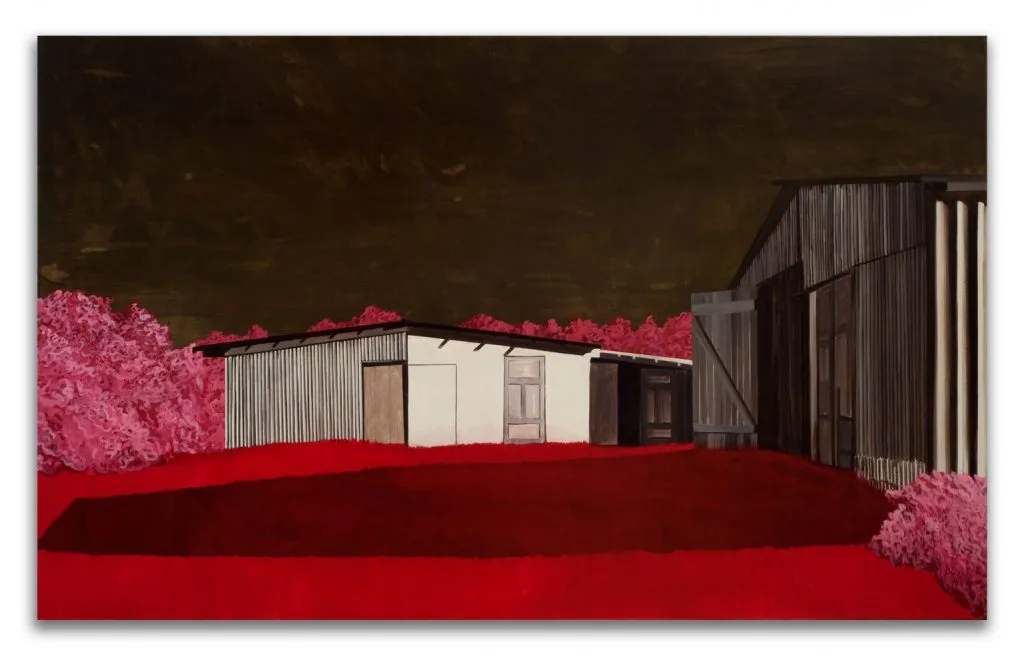
It must be admitted that these interpretative paths are anchored in the painterly facts of Lipski’s pictures. Their distinctive chromatic disposition, timelessly frozen composition, threatening and therefore fascinating quality, acute sense of emptiness and obsessively recurring iconographic motifs create a melancholic aura.
Nor does Lipski conceal the fact that many motifs in his pictures result from repeated returns to Poland and his native region. What is more, he most often reaches for motifs associated with the visual landscape of the early post-Communist transformation. In this sense, Tanner’s voice is unsurprising. Born in the former GDR and therefore carrying a burden of visual experience similar to that of other inhabitants of this part of Europe, he sees Lipski’s work as a form of mourning for a reality that is gradually disappearing.
Yet — also because the artist’s latest works escape the schemes above — we should resist too hasty an identification of Lipski’s work with a celebration of sadness and exposure of the ambiguities within Eastern Europe’s visual and social imaginary. Several other qualities proper to his painting deserve attention.
Above all, Lipski’s painting appears to celebrate everyday visual experience and articulate a need to capture its ambiguous essence. One of the artist’s fundamental working tools — a kind of artistic sketchbook — is photography, which for a fraction of a second tears an image from the deterministic grip of passing time while becoming an immaterial emanation of the photographed motif’s aura. Lipski’s pictures therefore result from a collision between two media: painting and photography. Yet it is painterly sensitivity and the free use of photography as a visual pretext — one that stimulates but does not constrain the imagination — that make possible the pictorial effects characteristic of his pictures. In the most recent works these are increasingly phantasmagorical and abstracted from a veristic perception of reality.
Lipski’s canvases result from impressions captured by the camera lens during the artist’s travels, both East and West. Many are shots selected from digitally catalogued sequences collected during journeys through the United States. Placing Lipski within the narrow perspective of an artist compulsively returning to Polish reality may therefore obscure the overriding contemplative and reflective meaning of his pictures. Lipski emphasises that what he perceives as inspiring arises not so much from a critical observation of reality subjected to particular social or historical fluctuations as from noticing the process of transformation itself and remaining open to change — change that manifests itself in Poland and America alike, regardless of local colour. Reality in transit is one of the categories closest to Lipski. It locates him in the space between present and future and eliminates the false trail of exploring a nostalgically reanimated past.
What interests Lipski, irrespective of the provenance of the images observed, is the painterly transposition of painful visual experiences: “I paint what moves me, often what I dislike, but with love and without irony.” What is at issue, then, is not a critique of social reality but a more personal articulation of his intimate relationship with the world and a tender exposition of the everyday.
Despite the progressive elimination of the human figure in Lipski’s work, paradoxically it is still the human being and human nature that form the principal subject of his canvases. Phantom housing estates — most often blocks of flats or box-like houses devoid of refinement and marked by pragmatism — are, after all, shells concealing more or less dramatic human daily lives within. Their unsettling muteness and detachment from the outside world are sometimes softened by elements such as the satellite dishes recurring throughout Lipski’s canvases, which indicate an exchange of energy and information taking place between inside and outside.
The process by which the effects of human activity stigmatise the landscape is equally legible in pictures where the forces of nature appear to provide the leading subject. Lipski’s monumental landscapes almost invariably find their counterpoint in elements alien to nature, traces of human presence and civilisational intervention. These may be industrial insertions cutting across lush vegetation: heating pipes with unsettling outlines, whose pragmatism perversely combines with the sensual beauty of their forms. But they may also be elements less intrinsically aggressive, entering more gently into quiet and at times pastoral landscapes: fragments of abstract structures difficult to identify, wooden jetties or, finally, discreet forest cuttings almost assimilated by nature.
The tension between the actual absence of human beings and the acute impression of their constitutive role within the image, together with the ability to transcend the banality of selected motifs — which, through painterly procedures, acquire an exceptional universal quality — builds the distinctive aura of Lipski’s pictures and contributes to the visual power of his painting.
In Lipski’s latest work, his characteristic fondness for constructing pictorial drama through strong contrasts is emphasised on one hand by resonant and surprising chromatic decisions and, on the other, by dynamic juxtapositions of stable, rhythmically drawn forms — the recurring motif of a waterside jetty — with amorphous, organic natural phenomena. Lipski’s pictures are now moving towards abstract synthesis, although pure abstraction, as he admits, does not fall within his artistic inclinations. Their concentrated expressive power is assisted by an energising and oneiric palette. Accumulated energy bursts the bounds of the picture’s individual “here and now”, carrying it into the higher registers of phantasmatic vision.
Lipski paints a great deal, with an undiminished need to seek new impulses. He continually emphasises that his painterly education remains unfinished. A distinctive iconography and a kind of essentialist approach lend coherence and continuity to individual series and the results of successive painterly experiments. Through them, even pictures easily situated within a particular social and historical context transcend the horizon of individual visual and existential experience.