
On Dreams Coming True, Dark Paintings and Berlin
Aneta Panek talks to Roman Lipski
Aneta Panek: Let us begin at the end: today you are an artist supported by one of Germany’s most influential collectors, Dr Erich Marx; one of your paintings hangs above Guido Westerwelle’s desk; and Volker Schlöndorff is among your friends. You have established yourself as an artist in Berlin—a city regarded as the European, if not world, capital of art. How did this happen?
Roman Lipski: Let us not exaggerate; put like that, it sounds a bit too much… It is true that my paintings are in excellent private collections, including those of Marx, Schlöndorff and Westerwelle, as well as Dr Vito and the Romba collection. All this is thanks to Marx—apart, of course, from the fact that I painted the pictures. Everything changed for me from the moment I met Dr Marx, and I owe a great deal to that. Through him, I met many people.
A.P.: In that case, let us return to the moment when it all began, when you met Dr Marx. Tell me how it happened.
R.L.: It was a little more complicated, but I usually tell one story and I shall stick to it. It is not a fairy tale; this is how it really happened. For quite a few years, I worked with a group of lads installing exhibitions. We worked mainly for the Guggenheim and the Daimler Kunst Sammlung, sometimes at the Neue Nationalgalerie and less often at Hamburger Bahnhof. They were magnificent places. It was interesting to see everything from behind the scenes, and I met many fascinating people from the art world. For example, I spent two full days as Claude Picasso’s assistant… In fact, it all began with those odd jobs; that was also the beginning of my story with Marx.
A.P.: But first there was the meeting with Immendorff?
R.L.: Exactly. I was helping to install a large Immendorff retrospective at the Neue Nationalgalerie. He was still alive then and took part in hanging the paintings. One day, towards the end of the working day, Immendorff was sitting alone, already in a wheelchair, smoking a cigarette… Usually he was surrounded by an entire guard of people and there was no way to approach him—countless assistants and advisers. But at that moment he was sitting alone, and I thought I would go over and speak to him. I introduced myself and we began to talk… It was a period in my life when, although these jobs were excellent, I was fed up with everything, because I felt something was slipping away from me. I felt that if I did not begin truly functioning as a painter then, I would never have the opportunity to show my work anywhere. This was four or five years ago. I was thirty-six and thought I was already old.
A.P.: What did you and Immendorff talk about?
R.L.: You know, it was actually a brief conversation, but one with far-reaching consequences for me. We introduced ourselves—that is, I introduced myself to him, since I knew who he was. I told him I was a painter and had to supplement my income by installing exhibitions. He said I should not worry too much about that, because most painters earned extra money in this way. He was interested to hear that I was from Poland, because, in his opinion, many outstanding painters currently came from Poland; indeed, he had one such student. And he told me the story of this student. Immendorff had a major retrospective at Zachęta in Warsaw, and during the exhibition opening a young man approached him and said: ‘Mr Immendorff, I want to become your student.’ Immendorff asked: ‘All right, but what do you do? Show me.’ The young man had brought a portfolio, so he showed it to him, and Immendorff said: ‘OK, then you are my student!’ Such a simple story! And in the context of my own failed attempts… I once applied to the Academy, for example, and of course I did not get in. I remember the horror of hundreds of people submitting portfolios and twenty being accepted. It simply cannot be done that way. Besides, I had often seen curators and gallery owners simply throw artists’ proposals in the bin. People prepare beautiful portfolios and go to great trouble, only for everything to end up in the rubbish—and that is the official route. Here, by contrast, an audacious lad walked up, asked directly and immediately became Immendorff’s student. So I thought this must be the way: to achieve anything, one had to act directly and entirely unconventionally.
A.P.: And was that how your meeting with Dr Marx took place—unconventionally?
R.L.: Yes. The opening of the Immendorff exhibition was the following day. We lads always entered such events through the back, naturally, and stood off to one side, as usual… And then a similar situation arose: Dr Marx came down the stairs, also alone, without his entourage. Something prompted me to approach him. I was still under the influence of my conversation with Immendorff. So I went up to Marx and introduced myself, told him I was from Poland and so on. One thing led to another and he said, for reasons I still cannot fathom: ‘That is interesting, because I am just organising an exhibition of Polish painters here in Berlin… Would you like to take part?’ I was dumbfounded. ‘Of course I would,’ I told him, ‘but you have no idea what I paint.’ ‘Then I shall have to see.’ We arranged an initial date. Later we postponed it about five times, but one day Marx finally came to visit me, at the small former studio you know… I had very few paintings then, and they were of rather poor quality. I showed them to him; it literally took a few minutes. I showed him everything and could see that he had absolutely no idea how to behave—whether to say goodbye and leave, or what. Frankly, he did not know what to say. So he asked me directly: ‘Well… what exactly are you getting at?’ Laughter. I was simply determined and felt that I had to say openly everything I thought, without manoeuvring or inventing any unnecessary strategies: I simply had to tell the truth. I told him that I realised what he saw there might not be my best work, but that I was convinced I could paint much better. I simply had no opportunity to concentrate on creative work because I had to spend too much time earning a living. If he, Dr Marx, were willing to enable me to concentrate exclusively on painting for a year, he would soon see for himself. To put it plainly, it was about cash, about money: I wanted him simply to support me financially for a year. He evidently liked this, because he said neither yes nor no. He thought for a moment and made up a little story, playing with me somewhat. ‘You see,’ he said, ‘I am a collector, which means I come along and, if I like something, I buy it, and if I do not, I do not. But this is a different sort of proposal… As a rule, I do not do such things. I once had a similar conversation with an artist, and it was almost exactly the same, word for word.’ I thought: oh dear, it seems he had a bad experience. Then he said that it was…
A.P.: …Cy Twombly.
R.L.: Exactly. When I heard that, I knew I had succeeded and that he had agreed. It was one of those conversations on which everything depended for me. It could have ended in either a yes or a no. But I simply had nothing to lose. My only assets were those poor paintings, in which he was nevertheless able to see a certain potential, and my honesty. That intrigued him. The conversation took place five years ago.
A.P.: What immediate consequences did this have for you, and how did things develop later?
R.L.: It was an incredible feeling: I felt free. I painted without stopping. Brilliant! They were some of the most beautiful moments of my life. At the same time, however, it all involved a great deal of doubt. It was an important and difficult test. After a few months—quite soon—Marx visited me again in my studio. I do not know why he came back so quickly, after three or four months. Not much could have happened by then. I had painted many pictures, but they were not significantly different from what he had seen before. So he was disappointed! Laughter. Frankly, he was devastated. But by then I knew I was like a train: I had gathered momentum and knew that something new would happen soon, so I was not especially concerned. Before his second visit, he gave me a little more time. He came sometime in late autumn and saw the next paintings I had made; let us say that he liked seven out of ten.
A.P.: Apart from Dr Marx, who played an important part in your journey? Was there anyone who inspired you at the time?
R.L.: I have a master in painting, Max Neumann. When he saw what had happened over the course of that year, he compared it to a broken dam: the ideas poured out of me. He had never seen such a change in anyone, and at such a pace. In terms of quality, those paintings simply bore no comparison with what I had painted before.
A.P.: How did you meet Max Neumann? He is also an important figure for you.
R.L.: I met Max Neumann through my various odd jobs. Once, I was supposed to clean the windows of people who collected his paintings. They were an older couple, Roland Wiegenstein and his wife; he is an art critic who wrote columns for the Frankfurter Allgemeine Zeitung, among other publications. I had previously done other things for them, including washing floors, painting walls and carrying out small repairs that I knew how to do. For me, it was always an opportunity to earn money. So I went there to clean their windows, but instead wandered around the flat looking at the art. There were excellent works there, including reliefs by Tàpies and several installations by Kienholz—wonderful! And there were also paintings by Neumann, which I genuinely admired even though I did not yet know Max.
A.P.: So how did you meet him?
R.L.: A year or two later, the collectors rang me and said that Neumann was moving to Berlin and looking for an assistant. They asked whether I would like to help him in the studio with simple tasks: stretching and priming canvases, sweeping and tidying up. I said I would be delighted. By then I was already a father and had children; every job mattered. I went to see Max for the first time. I knew only his paintings and had no idea what sort of person he was. I liked him very much, although he said little. But when we did talk, what he said stayed in my mind for a long time: fascinating observations. He is a very wise man. I became a kind of student of his and brought him work for criticism. He struggled with me for quite a long time and said nothing about what I was doing. Once he even asked whether I really wanted to become a painter. Laughter. It must have been dreadful! Whether I genuinely wanted to paint, or perhaps wanted to do something else.
A.P.: Did that not crush you?
R.L.: Somehow, no. I was a little offended, but I still knew I simply wanted to paint. I probably thought: I’ll show you yet! In truth, however, I was perfectly aware that, apart from sincere intentions, I simply knew very little. I was wandering around somewhere on the periphery… I also understood how dangerous a poor education can be, for example…
A.P.: What education did you have? Tell me about it.
R.L.: Only this much: as far as painting is concerned, just that three-year private school in Kreuzberg. It mainly teaches acting, acrobatics and dance, while painting is a kind of secondary subject supplementing acting or stage design, for example. I ended up there once by chance, out of ignorance.
A.P.: What happened next?
R.L.: Neumann became my true professor, and there really was that moment when he told me to consider whether I wanted to paint. But I did not give up and continued bringing him my scribbles; by then I was painting a great deal. I was also still installing exhibitions, and Iza and I had twins by then—it was back-breaking labour. It was hard; those were the most difficult years I have ever lived through. Later, I once asked Neumann: ‘Listen, I don’t know what to paint.’ I wanted him to advise me what I should actually paint. He replied: ‘Paint whatever you feel like painting.’ And somehow that set me free.
A.P.: Meaning that there is nothing you ought to do: just do what you want.
R.L.: Yes, an absolute change in my view of painting. Until then, I thought I had to prove something, that as a painter I had to be able to paint a portrait and everything else taught at traditional schools, and only then could I begin experimenting with my own style. I imagined many things because I lacked any proper preparation. When he said that, it somehow liberated me. I felt the desire to paint again, believed it was possible and began painting a great deal, more and more. I brought him the results, and they grew better and better. Nevertheless, those were the years when I copied everything from Neumann. Naturally, he saw it, but said nothing. I thought I was wildly original, although when I look now at the things I painted then, they are Neumann through and through. But from that moment onwards, I finally began to identify with those paintings and drawings. For many years, I destroyed everything I painted. I did not identify with what I was painting then, but later I somehow stopped being ashamed of it. It was the same with choosing the format of my works. Once I spoke to Neumann about it and asked which formats were best—the sort of idiotic question one unfortunately asks at the beginning. He said: ‘Such-and-such formats; panoramas are interesting, for example, and so on. But because you are tall and your arm span is almost two metres, it is natural for you to paint large canvases, because then you will paint with your whole body rather than merely your wrist.’
A.P.: Now Max Neumann and his wife Sonja Kopp are your closest friends and faithful companions on your journey, are they not? They seem to spur you on.
R.L.: Constantly. When I need the opinion of someone who is an authority for me, I go to him. Then we talk about painting; he comes to see the new works. But when we meet privately, we do not talk about painting at all. Neumann has a rule that he says little about paintings and, when he does, he is specific: poor or good. Fortunately, he more often says that they are OK, that he likes them; when he does not, he says that openly too. But in general, he says little about painting because there is no point.
A.P.: Dr Marx continues to look after and support you tremendously. Yours is a rather special patron–artist relationship. How did everything unfold after that first year?
R.L.: We extended our agreement for another year. We agreed that, after that period, he would help me find a gallery and enter the market. Marx is a businessman, which means he financed that initial period not as a gift, but on the understanding that we would settle accounts one day: either I would repay the money or give him paintings. So some of the works in his collection are a kind of repayment of that debt. And that is completely fair, all the more so because having one’s work in a collection as prestigious as Dr Marx’s is an extraordinary success for an artist. Besides, he still visits me often and continues to buy paintings from me. Through him, many works later entered other collections belonging to his friends and acquaintances.
A.P.: Indeed, Dr Marx interested many influential people in your art, including Dr Vito, Guido Westerwelle and Volker Schlöndorff…
R.L.: Yes, they are all his contacts. While looking for a gallery for me, Marx went to see Harry Lybke in Leipzig. Lybke somehow wriggled out of it, saying he did not want such a wonderful painter because he would not create competition for Neo Rauch. Laughter. What a charlatan. Naturally, Marx did not believe him. Nevertheless, Lybke recommended the gallery owner Birgit Ostermeier. She had good contacts with Harry Lybke, who, in a sense, helped and advised her on how to run a gallery. And so, somewhat by chance, I came to her. We organised a major exhibition, and all of Marx’s acquaintances were invited to the opening: the Freunde der Nationalgalerie, Schlöndorff, some princess, Raue, Schuster, three ambassadors—the most important people in Berlin. Westerwelle came to the gallery on another day, when I was not there. He telephoned, made an appointment and bought two paintings that very evening. One of them now hangs in his office, and I hope it has a positive influence on German politics. Westerwelle has quite a substantial art collection: he owns a good deal by Bisky and Rauch—he bought those paintings from Lybke—and many excellent works.
A.P.: And Volker Schlöndorff, with whom you have since become friends—how did you meet?
R.L.: At that opening too; he bought a painting from the exhibition. When I met him, I did not realise at all who I was talking to. Lybke was also at the opening, wearing a pinstriped suit, and there was Schlöndorff, whom I did not know was Schlöndorff—also in a pinstriped suit. I spoke to many people, including him, and kept wondering whom I was talking to, who this man was who spoke so interestingly about art. I was convinced that he either painted himself or owned a gallery. Judging by the suit, he had to be a gallery owner! We spoke for a long time, partly about the atmosphere in my paintings, and I told him where I came from. He replied that he knew the area quite well because he had shot his film The Tin Drum there. Then it dawned on me that this was that Schlöndorff. We all crossed the street from the gallery to have dinner in a restaurant, and afterwards we sat in a bar for a long time. I enjoyed talking to Schlöndorff; we drank wine, I got terribly drunk that evening and grew very fond of him. Some time later, he bought a painting. Later, he was making a documentary about Alex Katz in New York and Berlin, and they visited me here: Katz with his wife and muse, their son Vincent, Dr Marx and Schlöndorff. I showed them several paintings and, as a result, a few went to the United States, to various museums, through Katz and thanks to his foundation. In fact, I carried them to New York on my own back. It was interesting: Alex looked at the painting that is now in the Museum of Fine Arts in Boston in a wonderful way. He turned off the light—it was already evening, so it became completely dark—and watched how it worked in the darkness.
A.P.: Do you think that success, the opportunity to make one’s mark, is a matter of such encounters, partly accidental?
R.L.: One needs a great deal of luck and the ability to persuade people. It is certainly a matter of encounters and of the love stories that arise from them. And that is a problem, because I do not particularly like going out. During those two years when I could do nothing but paint, I went absolutely nowhere. But there is nothing new in that. At the beginning of the Renaissance, the treatises of Cennino Cennini and Leonardo da Vinci were already discussing it. They contain advice for young painters: if you want to be a good painter, give up women and wine. Complete concentration, no distractions.
A.P.: And was that true in your case? Neither women nor wine?
R.L.: Well, women did happen occasionally. But I really lived in a state of asceticism and it did me good.
A.P.: Let us talk for a moment about form. You have passed through various phases, from the darkest paintings to today’s luminous works. Tell me about that.
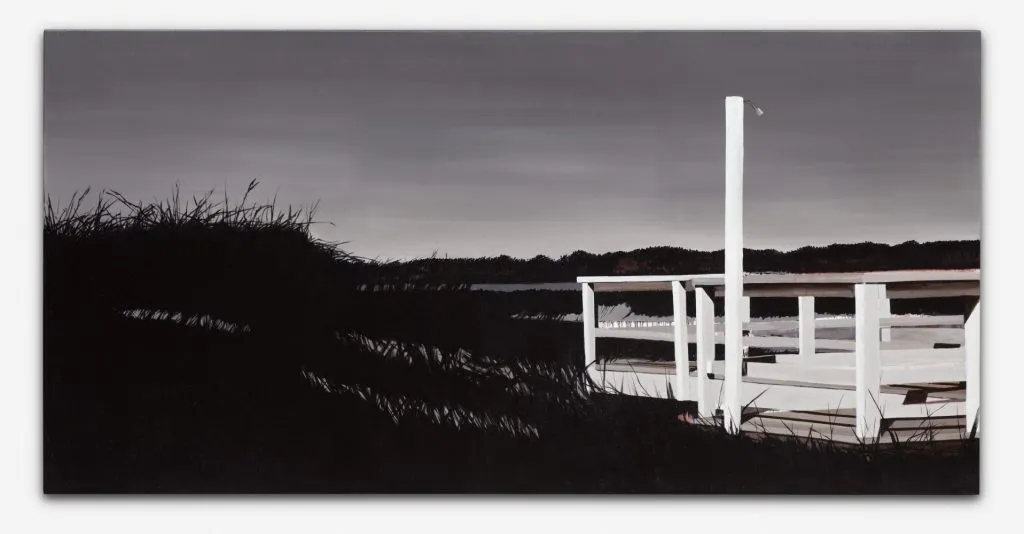
R.L.: Those dark paintings resulted from the fact that I needed dark colours at that point to emphasise a certain story. I went through many things then… It was a black period in my life, the year my family fell apart. And it was a tragic year because I was in hospital for the second time with cancer and experienced eschatological states… I reckoned with the worst: that I would die, that I would be disabled—which, indeed, they virtually assured me at the hospital… It was a dreadful time. It was not the first time I had had a tumour in my head, so the prognosis was terrible, and all of this somehow… It simply brought me to my knees. For a long time afterwards, it remained visible in the paintings. They really were quite dark. Now things are becoming increasingly better, which is why there is more and more colour; I am constantly experimenting. It is some kind of inner need. It is also connected with my not wanting to repeat myself in my work or become attached to symbols, elements or a particular way of handling the brush. My paintings should change together with me.
A.P.: What happens next? It is perfectly clear that a great deal more will occur and there will be many more phases…
R.L.: I do not yet know what comes next. I know only what gives me pleasure. Today, for example, I visited an exhibition and saw art that had no content whatsoever—there was absolutely no content, pure form—and I revelled in it!
A.P.: Are you attracted to abstraction?
R.L.: Perhaps. If I find my own method of abstraction, I shall paint abstract pictures. I am simply open to myself, to my own experiences.
A.P.: Open inwards?
R.L.: Exactly. And that closes certain things outside me… Laughter.
A.P.: At what point did it become clear to you that you wanted to be a painter and that this was your path? Because it took some time, did it not? And what came before?
R.L.: Before that, there were nineteen years in Poland, in Nowy Dwór Gdański. Like my father, I wanted to be an athlete. He practised every possible discipline; half the records at the local club still belong to him. He did everything, absolutely everything, including playing chess. Apart from sport, very little interested me; painting was not part of the picture at all. I disliked studying. I was a complete idler and was never at school. No school-leaving examination, nothing of the sort. I first became ill in the eighth year of primary school. It was a tumour in my head… Naturally, I had to abandon the thought of sport. After the operation, the people at the club were afraid I might die during training… After primary school, I went to a vocational school. I am qualified as a motor-vehicle mechanic and driver. Then came teacher-training college in Gdańsk, specialising in machining. We were simply meant to teach other boys to work with lathes and milling machines, so there was absolutely no place there for refinement, the senses or anything of that kind. Just industry.
A.P.: Then came 1989 and Berlin?
R.L.: Then I left for Berlin, intending eventually to land in the United States. For four years, I wandered between Heime, refugee shelters. Seven of us lived in one room; everyone had his own story, and the police intervened there every week. At first, I did not like Berlin. I did not know the city; I knew it only from the perspective of hours spent in government offices, running around with a clearance form, a Laufzettel. It was rather humiliating. Besides, we were desperately poor and there was a great deal of uncertainty… In one of those shelters, I worked as a night porter to earn money for the Etage school in Kreuzberg. I worked at night, slept a little afterwards and went to school during the day. At Etage, I had the opportunity to paint for the first time. I spent all my time in the studio: I was the first to arrive and the last to leave, and I turned off the lights. In any event, it was some kind of beginning.
A.P.: How did you eventually come to stay in Berlin, grow accustomed to the city and become part of it?
R.L.: Over time, I began to discover the city. East Berlin had only just opened up. Crossing from West to East Berlin was like entering a black hole, because this was still the period when East Berlin was completely empty. Everyone had left, and even in 1992 or 1993 we would sit in other people’s flats in Prenzlauer Berg, entering private apartments and setting up studios there… It was surreal, because entire tenement buildings stood empty, their doors open. One could enter a stranger’s flat, and the rooms looked as though someone had just stepped out for a moment. There was nobody there, yet everything worked: gas, electricity, lighting. Trams ran without passengers. One did not have to buy tickets, because entire rolls of them could be pulled from the ticket machines. It was simply a city belonging to nobody. The first illegal clubs were then emerging in cellars—not like those of today, more like dens—but to get inside one needed five different passes, some stamp or badge. But you know, once the doors of such a club were closed, anything could happen! Tacheles was also established on Oranienburger Strasse. It was an excellent, active place at the time. There were only two establishments opposite it, hastily improvised in a former greengrocer’s and butcher’s shop; their signs still remained: Obst und Gemüse and Fleischerei… But everything was knocked together from boards, entirely makeshift. At Tacheles, I had what amounted to my artistic debut, though as a stage designer rather than a painter. I created a performance with a group of acrobats, friends from Etage. At the time, I had no contact with Poles and did not speak Polish at all. I was absorbed by Berlin and began meeting people, eccentrics from all over the world whom the city attracted like a magnet. It was a fascinating time.
A.P.: How do you see all of this now, from the perspective of the intervening years? Can you describe yourself as a mature artist, as someone who has succeeded?
R.L.: That would be saying far too much. Success? I certainly still have a long road ahead of me… I have difficulty with the word artist, and especially with mature artist. Beuys said that everyone could be an artist; everything depends on one’s attitude. A tractor driver can also be an artist if that is how he feels. In that sense, I too am an artist…
Berlin, 5 May 2010