With Twożywo
Interviewed by Leszek Jażdżewski
Leszek Jażdżewski: Why did you decide to work with Latin maxims?
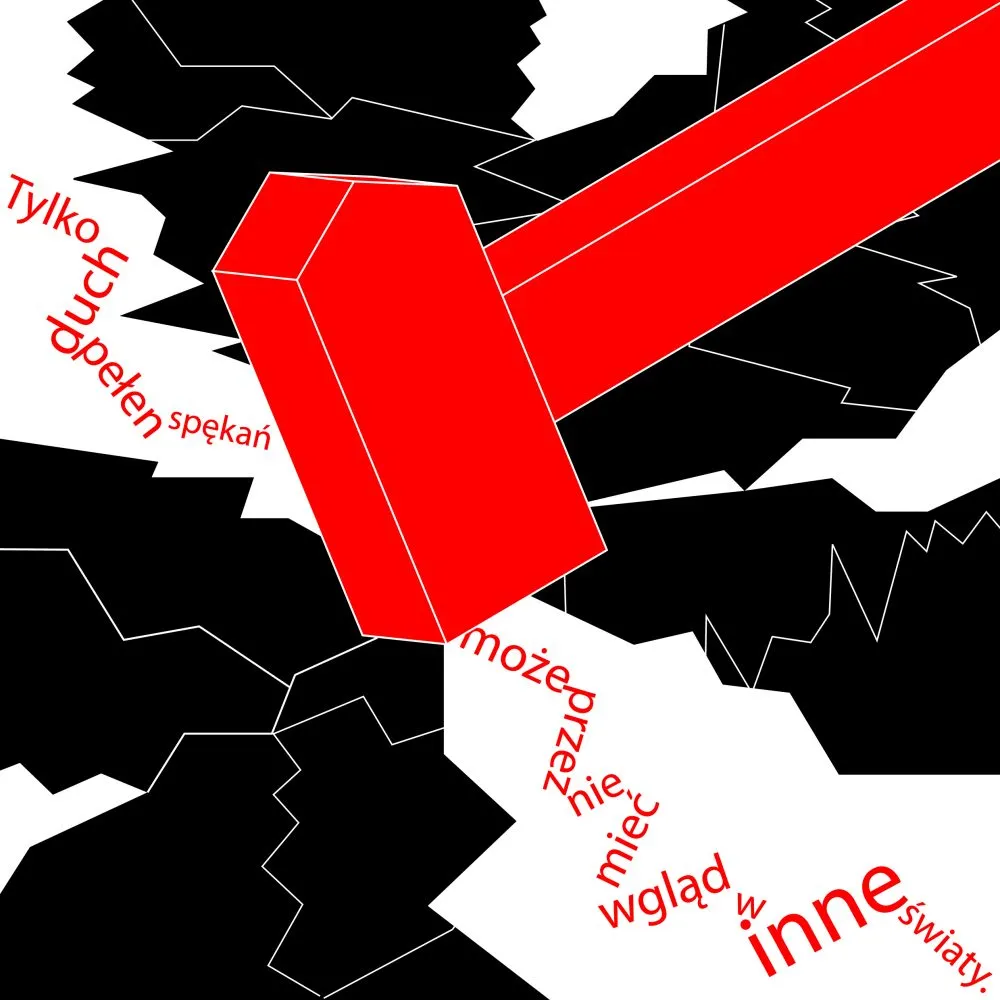
Twożywo: We were invited to make twenty-six works in France, hence Latin as a common linguistic root. These are maxims reasonably familiar to people of average intelligence—they sound recognisable in almost every European language. The Nihil Negativum project did not happen then because of the organisers' ‘anxiety’; instead, we made a project of type-animals—animals made from letters—and everyone was happy. Since Nihil Negativum fits Cioran both thematically and in atmosphere, we are using it as a complement. We had devised a project in the form of twenty-six murals to be realised in Łódź, but we could not find a suitable space—we needed a long wall. Almost every image contains one letter of the main phrase, and together they spell it out. We came up with the idea of publishing them in a book in which Nihil Negativum would appear as an insert. It is an entirely original addition, an appendix to the whole. Formally different but similar—also in black—and I think it will suit Cioran.
L.J.:Where did the idea of engaging with Cioran come from? Was it because he is so singular?
Twożywo: We find in him things worth making public, so that we may confront them—content that is missing. Cioran stands on the margins of every classification. He is neither a poet nor a philosopher; he belongs to no guild, no guild takes care of him, and he is absent from the philosophy curriculum. He may provide a foundation for people who reject materialist reduction. In a world of dying Christianity on the one hand and intensely enlightened atheists on the other, some people accept neither position. They do not want to abandon reflection on metaphysical questions. Cioran tried to descend to certain strata, as deep as he possibly could. These are not even foundations; they lie much deeper, where the jurisdictions not only of civilisation within us but also, for instance, of biology come to an end. When people speak of the opposition between the human being and the world, they usually mean the world as a product of civilisation. But there is a deeper level too—the world as the very condition of existence and the struggle with it. As human beings, we possess a trait we do not fully understand: consciousness combined with reason. This trait enables us to see ourselves in the third person, to gain perspective—that is consciousness. It made possible all generalisations, the creation of concepts and social contracts, and an exit from the biological self.
L.J.: Cioran calls consciousness humanity's curse and fiercely combats it. He writes that he would rather be a mineral. At the same time, by demanding awareness of the wretchedness of our place, he awakens it, criticising its absence in others. Is that not a contradiction?
Twożywo: We cannot entirely agree that he is trying to combat consciousness. This is neither a paean to nature, nor a call to return to the time before life emerged, nor a renunciation of consciousness; it is a metaphorical critique of what he observed. Human beings have made consciousness their principal tool. It is not merely a matter of adaptation and evolution, but a capacity to see, to look at ourselves and our products from outside. Human beings look at themselves and their existence. Cioran refers to that primal activity which is existence—this kind of reasoning has a very short tradition. It is somewhat akin to phenomenology: phenomenology wanted to be scientific, wanted to be a system, and for that reason imposed a particular yoke, particular shackles, upon itself. Cioran runs wherever he pleases; he is interested in different traditions.
L.J.: Such as Buddhism and Hinduism—the Vedas.
Twożywo: He repeatedly wrote that he was unable to renounce his ‘self’, whereas that is the fundamental condition and purpose of Buddhism. He was not entirely in love with that ‘self’ of his, either, but he did not want to rid himself of it. Foremost among the traditions from which he drew is the Gnostic tradition—the great absentee of our culture. It returns ‘in the wild’ in popular, profit-driven phenomena such as The Matrix and Inception. Cioran approached it seriously. The concept that the world is good is dominant. There is no alternative suggesting that something may be faulty in its construction, that perhaps God did not succeed.
L.J.: The Absolute was important to him, although he was an atheist.
Twożywo: He wrestled with it with great commitment. The reduction performed by so-called atheism—‘there is no Absolute, end of story’—is a mistake. This particular religion may not exist, but its emanations and the roots from which it grows are ignored. Cioran consistently, though disjointedly and unsystematically because he disliked systems, addresses neglected subjects. Precisely because these subjects were neglected, his statements were emotional, feverish and highly charged with energy. He wanted to restore an adversary to the debate we conduct. We can approach God only on our knees or not at all. Cioran made him a full partner in conversation. He reproached him and spoke with him. It is not the case that either you pray to God or he does not exist. That does not exhaust the full spectrum of possibilities.
L.J.: Cioran did not want to escape suffering. Did he believe suffering was indispensable?
Twożywo: Suffering is an immanent feature of existence, just as greenness is a feature of plants. Cioran tries to speak on behalf of mute, silent, repressed things that irritate and upset us, that make us feel bad. We live on a treadmill of fun and joy; if someone is sad, they must be cured. We have become so cretinous that we try to eradicate sadness which does not fit, which disrupts our view of our surroundings, at every level—private and public alike. This concerns social acceptance, not only pharmaceuticals. We socially prefer and elevate cheerful, amusing people bursting with energy; they become sociometric stars, while introverted people who experience these kinds of states are not listened to. We certainly live in an incomplete, if not falsified, reality. If life and death are natural phenomena for us, why do we not encounter death?
L.J.: Cioran writes a great deal about suicide. He was even called the ‘patron saint of the defeated’. He often contemplated it himself, although in the end he died of old age in his own bed. How should we approach what he writes? Is reading Cioran a form of therapy, of self-therapy?
Twożywo: What mattered to him was awareness of the possibility—knowing that he could do it, yet did not. At a moment when you are hounded and reality has you up against the wall, there is still an alternative; you still have some say. Awareness of this option is profoundly reassuring. Cioran received letters from people struggling with such thoughts who concluded that their problems were simply nothing compared with his. Cioran shows the bottom from which one can push off; there is always something deeper.
L.J.: When Cioran became involved in politics, he supported fascism and fought rationalism in the 1930s. If Cioran were widely absorbed, would he not be dangerous?
Twożywo: You are asking about a particular episode in Emil's life and youth. It lasted several years. He did not continue it; it is absent from his books. Besides, we decided not to concern ourselves with his biography.
L.J.: Was Cioran's involvement in fascism not an attempt to escape the abyss of inwardness?
Twożywo: That episode may have determined that, as a mature man, he advocated the abandonment of all action to the greatest possible degree—with which we disagree completely. Perhaps because we did not experience such bitterness in our youth.

L.J.: What was the key to Cioran in your selections? Did you perhaps perceive it only post factum? What guided you?
Twożywo: The method was this: subjective choice, our own whim and sympathies; after the selection it turned out that these things could be smoothly systematised. This makes it seem to us like a certain logical arrangement that allows one to learn something about Cioran, plus the graphics, of course. Unlike with Sartre, it will not consist solely of the author himself; we will add certain words or sentences.
L.J.: Cioran did not create an opus magnum; he wrote in aphorisms.
Twożywo: We do not write long statements either, only individual ones. That connects us and may be another reason for our interest in him.
L.J.: You worked with someone else's text before in the project Herostratus, based on Sartre's short story.
Twożywo: The similarity is purely formal. No two texts are alike, and the approach is somewhat different.
L.J.: Cioran claims that ‘music replaces religion because it has saved sublimity from abstraction and monotony’. There is music at the exhibition in Atlas Sztuki too. And it is not Cioran's favourite, Bach.
Twożywo: We believe parodying Bach is inadvisable. We shall hear music created by Kuba Orłowski. We like it very much. I hope it will build and complement the atmosphere in sound, but also refer to the convention of the exhibition opening, with which we have a certain problem.

L.J.: You usually appear in public spaces—murals, posters and newspaper columns. Do you feel different when enclosed in a gallery? Does it change how you are received?
Twożywo: It will not be only an opening; above all, there will be a book, an object accessible to the public, although one will have to pay for it. We intend to publish extensive extracts on the website. We are not, however, planning larger formats as we did with the posters for Herostratus.
L.J.: Cioran characterised the present condition of art as follows: ‘As art advances into a dead end, the number of artists increases; art becomes at once impossible and easy.’ Do you share that view?
Twożywo: It is a beautiful description of our time—from the expansion of advertising and its supply of art-school graduates to the universal availability of cameras in mobile phones and the profusion of images on the Internet. Today everyone is an art photographer: everyone has a camera, everyone takes pictures, and their quality is well known. Never before in the history of our civilisation have there been so many artists—not only self-proclaimed ones, but professionals too.
L.J.: What, then, can serve as a compass in art today? Who can be called an artist?
Twożywo: An artist is anyone who feels like one. As for what art is, we shall not comment because we know nothing about it.
L.J.: You make a point of emphasising your lack of artistic education.
Twożywo: Initially we did not want to do this professionally. As young secondary-school pupils, we made as conscious a decision as possible not to attend art school. We were afraid that they would teach us not so much how to paint as ‘how to be an artist’. That seemed dangerous and might have ended badly—in discouragement or even greater megalomania. At first it was not so much a hobby as a sense of—putting it grandly—a certain mission. After several years our activities became professionalised to some extent; now this is all we do and how we earn our living. At the time, however, it was very important to us not to fall into pure commerce.
L.J.: Did you draw the line somewhere?
Twożywo: The line is at mayonnaise. The line is at art. We do not feel like artists because we do not share art's aims—the search for beauty, or, like the Turpists, beauty's opposite, ugliness. We do not enter that discourse. Our aim is communication.
L.J.: Does art today seek beauty at all? Duchamp placed a urinal in an exhibition.

Twożywo: Duchamp's action showed that the road of art had reached a wall. Then came an entire generation of deconstructors, such as Warhol. He displayed a can of soup and told people to pray to it. He initiated something that was swallowed wholesale; people liked it. What annoys us about art is the function with which it is burdened—that of a substitute for a certain contact with absolute things. At a moment of crisis in the highest values, we automatically seek substitutes, and galleries are one. People in those galleries gaze reverently at the works of the classics, much as a devout woman gazes at an image of the Virgin Mary. Unlike the people who made icons, artists are wholly unsuited to this.
L.J.: Speaking of Westerners in comparison with his compatriots, Cioran said: ‘Some have worn out their soul; others do not know what to do with it.’ Today we too are the West. What does Cioran say about society? What does he say about us?
Twożywo: It is a retirement home. Sometimes a land of zombies. Spiritually, we certainly live in a very difficult period. What we have is the past, which we have deified and mythologised. Only it has survived the turmoil of fashions. Everything we create today is fleeting, superficial and shallow. We are beginning to approach wars with nonchalance, like the latest instalment of Rambo. Something is profoundly wrong with us.
L.J.: As Cioran wrote, ‘we care more about an aching finger than the fate of two hundred million Chinese people’.
Twożywo: It speaks about us and the caricatures we have become of what we imagine ourselves to be. The facts show that we are monstrous hypocrites, incredibly self-centred, unwilling to take responsibility for our actions—in other words, to exercise our freedom.
L.J.: Given such a system, is collaboration the better choice, or struggle, resistance and the attempt to remain outside?
Twożywo: You can live in a workman's railway carriage in Wrocław, drink water from the Oder and regard yourself as someone who does not participate in the system, eating whatever people bring you. You can live with the conviction that you are an outsider. But if you have greater awareness, you realise that you are right in the middle of it all.
L.J.: Is it better, then, not to attempt false rebellion and simply accept it?
Twożywo: No. That is the attitude of the majority, and it is not right. To acquiesce and obediently participate in a miserable fate in which someone tells you from above: ‘little sheep—here is the slaughterhouse, here is the shearing’. We do not accept that. The fact that we have made our lives and surroundings into this is due to our ineptitude and passivity.
L.J.: Are you waging a private battle against the system, gnawing away at it?
Twożywo: We are conducting a dialogue. We have a particular worldview which we share with others. It may somehow reach some people; it will annoy others and entrench them in their position.
L.J.: You have no positive message; you criticise and pick holes.
Twożywo: We believe people have minds of their own; we do not put anything into anyone's head: ‘vote for me’. What we do is more like a negative ‘election campaign’: ‘do not vote for this, do not vote for that’.
L.J.: Are you not trying to create axioms to be absorbed? Perhaps perpetual scepticism is one?
Twożywo: We are trying to create a conscious, individual approach to the world—one's own attitude towards certain matters. We have no right to impose our vision of the world on others. Conscious thought is a useful human tool, and it is worth using.
L.J.: Despite reading Cioran, can one decide to act?
Twożywo: We shall see the world in all its misery, exposed after those masks have been stripped away. This is what the world looks like—what are we to do with it? Lie down and weep, or think it through and make it more bearable, more reasonable?
L.J.: That requires conscious naïveté.
Twożywo: We are naïve. We do not go home to cry; we believe one can fight, one can try. We know how to make pictures. That is what we concentrate on. Naïveté is needed to act in an adverse environment. Reason tells us it is not worth acting in public space because it is only one image, that it will change nothing because school and television shape us. And yet we believe what we do is needed—we offer an example that it is possible to think differently, to shape communication in public space differently. With these hoes we keep taking aim at the sun.