
Giving People Tiny Perceptual Tools
Mariusz Libel in conversation with Piotr Kosiewski
Piotr Kosiewski: Twożywo recently made a new work on Piotrkowska Street in Łódź with the intriguing title Ordinary. On your website, you posted an entry referring to it: “The elemental force of everyday life that drives the entire funfair surrounding us is unaware of the power it possesses and may claim at any moment. Universally enacted normality, trained in gentleness and defencelessness, may in the next banal instant turn into a festival of destruction. Excited by the twists in the plot, we wonder whether it will consume the hierarchy that has parasitised it for centuries or once again gnaw away at itself.” At first one might think your mural would attempt to answer this question. Yet you go on to write that there is no point looking for an answer. Can creative work not provide answers?
Mariusz Libel: In our case, it is principally about posing questions. If they interest someone, they can approach us, but they must find the answers for themselves. Those answers depend on the baggage we bring to a particular work. In reality, we see only what we already know about it or feel towards it. With art, we — the viewers — simply see ourselves reflected in its products.
P.K.: Does a work compel us to see what is already there?
M.L.: It is difficult for me to speak about all works of art. I prefer to discuss our work. I will refer to the human cognitive mechanism itself. We have already named everything we see and know, but also what we cannot see and what is unknown. This helps us build various relationships among ourselves and things, as well as with far less tangible phenomena. I think that contact with art can teach one a great deal about oneself. One must remember, however, that a Bergman film watched by a secondary-school student is something different from the same film watched by that person at thirty-three, after gaining life experience through many encounters, conversations and books. The film has not changed, but its perception is entirely different.
P.K.: Can a creator be indifferent to the surrounding world?
M.L.: Of course they can.
P.K.: You yourselves say that an artist may be blind to it?
M.L.: We make no claim to proclaim universal truths. Of course we advocate a particular position, identify with it and remain close to it in our own work. But the classical artist who seeks beauty or pure form and turns his back completely on the world is equally necessary. We simply adopt a different attitude. At the same time, what we do is not art but communication. Art is only an element, a component of our activity, and by no means the most important one.
P.K.: You do not define your works as art?
M.L.: No.
P.K.: You create messages. Whether they are received as utilitarian objects, another picture in an iconic sequence…
M.L.: …another grain in image culture…
P.K.: …you leave for the viewer to decide?
M.L.: Yes. Once made public, a thing ceases to be mine and begins a life of its own. Someone will remember it; someone else will record it. They will always understand it in their own way. That is the sphere of their freedom. The works themselves matter most. Texts that sometimes arise alongside them are not intended to impose particular interpretations, but to complement them. People have repeatedly discerned things in our works that I did not see there. Others saw them, however. I think that is very good.
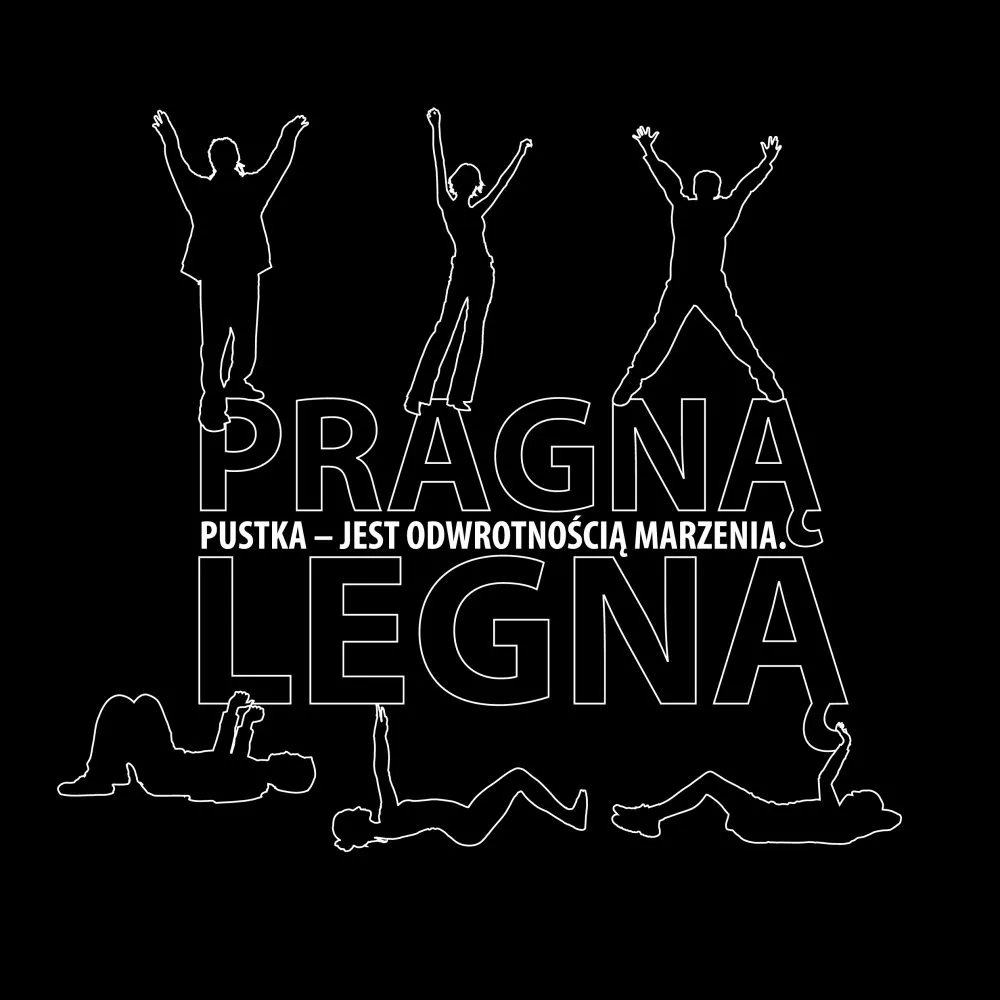
P.K.: You began in 1995 as a trio, with actions that intervened very strongly in the surrounding reality. Was that a form of youthful rebellion?
M.L.: If it had been merely youthful rebellion, we should have stopped all this activity long ago — especially now, at our age. I think it was something more.
P.K.: What did experiences from that period, such as making stickers, give you?
M.L.: To this day, we approach form fairly carelessly. We do not become attached to it. That is probably why we use very different means. I assume that anything can be communicated through different techniques. A sticker, stencil, poster or mural is only one possible form. We are not sticker makers, stencil artists, muralists, graphic artists or designers. Those are merely tools and names of professions. As for our beginnings, there was energy within us that did not entirely know which way to escape. Our activity was not then fully self-aware; it was less concentrated, but necessary. One cannot simply come into the world with a ready-made vision. It is a process.
P.K.: You did not graduate from art school.
M.L.: Some of us did not. At first, there were three of us.
P.K.: Yes, Robert Czajka left the group. Pinokio became Twożywo.
M.L.: Yes. He went to art school and left the group. He said what we were doing was not art. He was right.
P.K.: And you moved away from stickers and began using increasingly varied forms.
M.L.: At that time we would create a work and then spend a month, two months or sometimes even longer reproducing it. Preparing a project such as Antichrist and then printing it several hundred times takes a while. You cannot go out into the city and finish everything in a single evening. It is different now. We devote less time to publishing works. That is a certain compromise with reality, one that allows us to make more projects. Today we simply could not work as we did years ago.
P.K.: When you began making stickers, but also graffiti and murals, they were perceived as a rebellious intervention in public space. Yet all these activities were domesticated and appropriated quite quickly, by advertising among others.
M.L.: Graffiti began in Poland at exactly the same time as we began working. It was a fairly brutal implementation of the format as a complete package: from the manner of painting, through clothing and music, to the form of the signature. It was about cluttering the whole of reality, pissing on everything possible. Before our eyes, the traces of the alternative culture of the 1980s were painted over. Our activity was not directed towards utopian freedom. It was more a reflection on reality. We became aware of what was happening around us. As a society, we fell into a strange hysteria of utterly barbarous consumption. It was early capitalism, and it was very brutal. Today that condition is easy to name, but it was not obvious then. Our system has since become somewhat more civilised. Institutions such as banks have appeared and introduced regulations. No one had that power then. So-called small enterprise was developing. The first McDonald’s restaurants and shopping centres appeared, along with products previously unknown. Like enchanted squirrels, people entered this circus thinking of nothing else. But we, the generation coming of age then, concluded that perhaps something was escaping us, that something seemed to be missing. We were probably right. Take any daily newspaper — even a regime paper from the 1980s — and one from today. Compare the language, the issues addressed and the texts’ level of abstraction. Leaving aside bias and propaganda, they showed a certain respect for the reader. It turned out that we suddenly and very rapidly changed from a society capable of metaphorical thought into one that thinks in a very simple manner. Politics today is chiefly a game of images. There are no arguments in it. Everything begins to resemble choosing a tub of cheese in a shop. Adults begin behaving like children handed boxes of toys in a shop: all of them are appealing and we would like them all. That is impossible, however. I do not mean only economic transformation, but the problem of defining freedom. Everyone spoke of newly regained freedom, but only then did people begin to notice what it actually looked like. Declaratively, everyone possessed it; in practice, it was reduced to the free market. Is that truly freedom, or some rotten reduction of it?
P.K.: It was a period of intoxication with consumption…
M.L.: ...but not only that. Social bonds began to die then. In our normalisation we imitated the cold old nations of Western Europe, proud of their status: rich nations, sometimes thoroughly eaten away from within and certainly extremely bored. We felt that we had joined a larger process. We thought: (a) this needs reflection; (b) if we are already part of the process, perhaps we can add something of our own. Modify or modulate it slightly in some way. In any case, I have always favoured giving people tools: equipping them — not taking away, but giving them tiny perceptual tools.
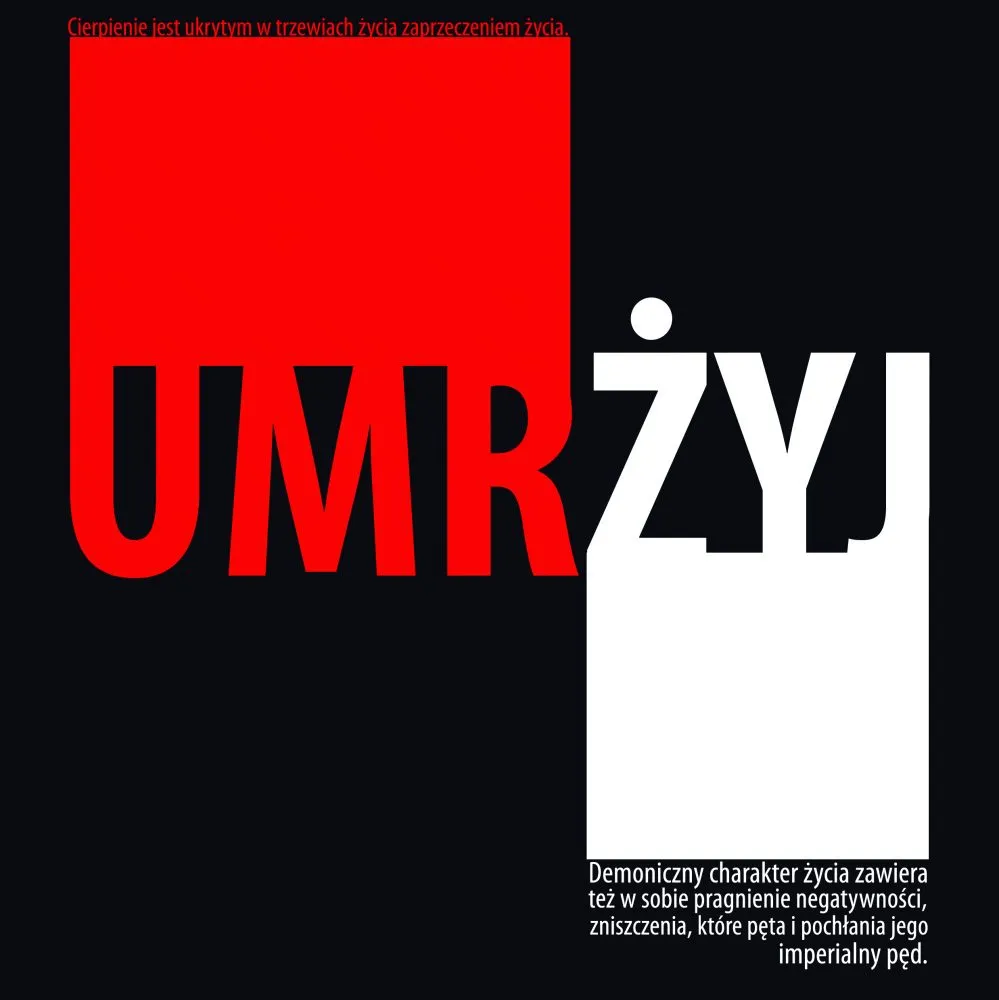
P.K.: You yourselves also began using very different tools quite quickly.
M.L.: It was often accidental: an external proposal appeared, for example an invitation from the AMS Outdoor Gallery to make billboards. That was good practical training for us. To tell the truth, at first we did not know whether we might want to be… a band. We even held several rehearsals. Our energy at the time could have gone in many directions. We do not advertise some of the things we did then. One could, of course, say that we grabbed whatever was to hand, but communication was our concern throughout.
P.K.: In the 1990s, previously familiar forms such as advertising returned to Poland, while new ones such as the Internet arrived. You take the tools of contemporary communication, including advertising, and feed on them to some extent.
M.L.: I would not use the words “feed on”. Count the number of advertising views on the Internet — millions! We are a very modest addition.
P.K.: I do not use the phrase negatively; I mean conscious utilisation.
M.L.: Agreed: we work in the context of advertising because it is as omnipresent as God. When people look at our works, they often ask what is being advertised. We therefore try to show that advertising media can be used to speak about different issues. They need not involve selling in the broad sense, because political or social advertising is also a form of advertising. It does not sell things but ideology or attitudes. We also wanted to show that the medium itself is innocent. It merely carries different contents. We tried to ensure that the message was not necessarily based on the principle “give”…
P.K.: …your trust, money or time.
M.L.: It is always “give”. There is no movement towards “take”. Connected with this is the question of using a particular language. I believe a particular choice expresses respect for the audience. If I address viewers using words or concepts that I use myself, even such words as “emanation”, that says a great deal about my attitude to the addressee. Are we to speak to people as if they were sheep? In simple language, using only the first five hundred or thousand words? Is that the only way we will be understood? Marketing research has shown that the most effective advertisement is a packshot: a photograph of the product, its price and the manufacturer’s logo. Yet even agencies, perhaps out of shame, do not confine themselves to making such advertisements. Why, then, should we accept it?
P.K.: How important is the choice of form for communication?
M.L.: It has no special significance, although a certain compatibility must exist. That determines whether, for example, we use a square. One can also notice our attachment to the principle of contrast. I mean not only our use of colour but other means as well.
P.K.: Your works draw on very different traditions, but there is also one area that seems fairly coherent: art and advertising of the 1920s and 1930s.
M.L.: I cannot say that I have not seen things from that period, but I do not return to them. If we are to speak of inspirations, they lie in method rather than its specific executions. Constructivism, for example, is close to us as a principle or idea, but it does not entirely define everything we do. Many of our works have nothing to do with that tradition. Constructivism is also interesting because of its commitment to contrast. The very etymology of the word — building — is close to us. And the Constructivists themselves? History showed that they were, to a greater or lesser extent, honest. It often cost them their careers and even their lives. What reward did they receive for the propaganda they made for the communists? What testimonial were they given? They were treated much like the anarchists who first made the revolution alongside Lenin and were then surrounded and slaughtered to the last man.
P.K.: How would you define the place of the word in your work?
M.L.: It is complicated. There are several levels to our thinking about the word. There is the word that serves communication. It is a sign-sign. And there is the word that touches what I call inner narrative. We think in words, but also in images. Thoughts come to us in lexical form.
P.K.: An image is translated into a word.
M.L.: Yes. You feel-think. You think-speak. Instincts and sensations are named. For example, I am hungry. Some of society is probably visualising a sausage right now…
P.K.: …or a hamburger.
M.L.: But most will think, “I am hungry”, and name it: “I am hungry.” The word performs three functions: communication, graphic sign and narrative.
P.K.: You often employ wordplay to construct a message, as in Przetrwanie kultury, with its tension between the words “survival” and “interruption”.
M.L.: The way we greet and bid farewell to language says a great deal about it. Children beginning their adventure with language do not know words or how to pronounce them; names and things become confused. They make various alterations. The same applies to elderly people. Sometimes their linguistic faculty begins to fail, producing many distortions.
P.K.: Language decomposes.
M.L.: They perform a natural, uncontrolled analysis of language. We try to do so consciously. We attempt to discover the meanings and persuasions inscribed in language. Language is not neutral, but burdened with baggage. It serves not only communication but socialisation. Language is also our parent. Martin Heidegger wrote about the significance of the impersonal “one”, which is even more visible in Polish than in German because the particle się is used more frequently. This particle, an impersonal something — we made a work about it — guides us and justifies things that are sometimes unjustified. How do we answer certain questions? “Because that is how it is done”, “because that is how it is written”, “because that is how one speaks.” Conduct is explained in this way, and at the same time “one” closes the discussion.
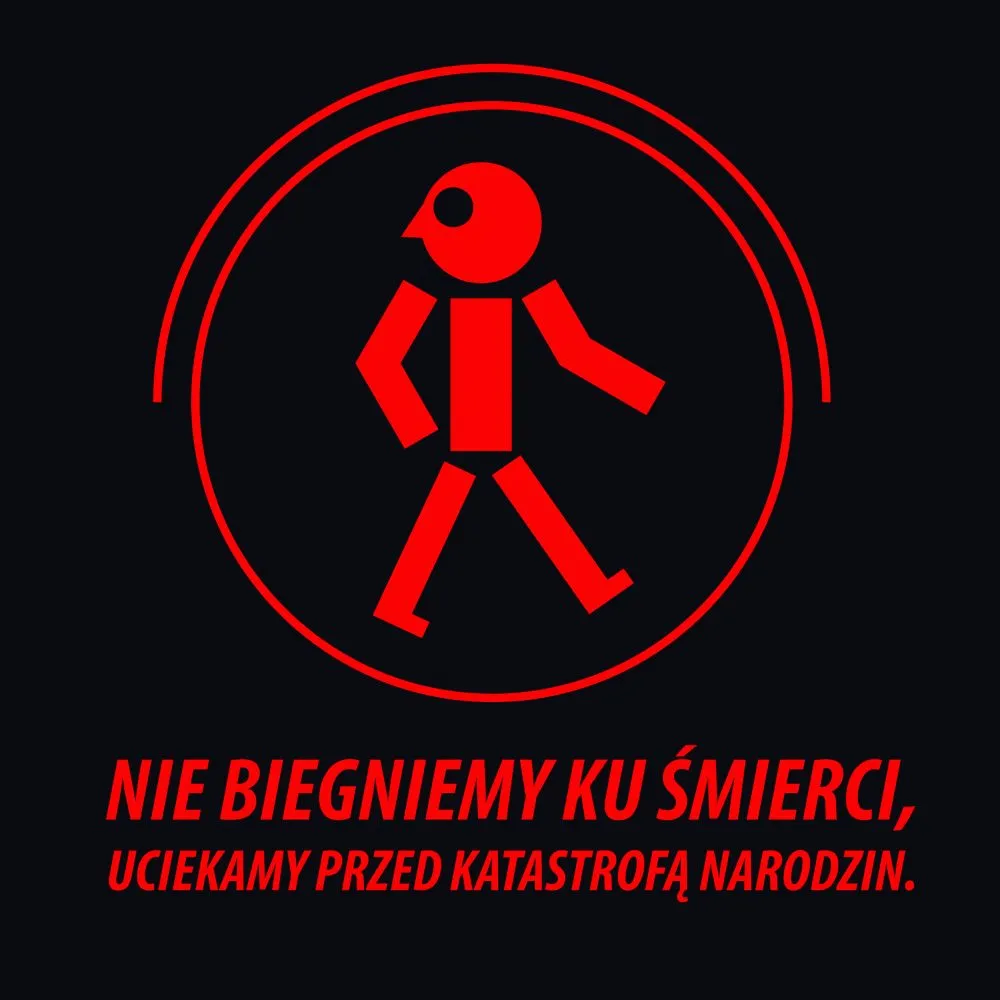
P.K.: Are you trying to disrupt the automatic nature of language?
M.L.: Yes, because certain things are accepted without any difficulty at all. If one examines the grammar and inflection of different languages, one can see differences in the way various forms of persuasion are inscribed within them.
P.K.: Your works always function in a particular context — whether the pages of Gazeta Wyborcza or the wall of a building on Okopowa Street in Warsaw. How important is it in their creation?
M.L.: It is undoubtedly important, but we try not to let it overwhelm them. We try to make our works fit and accord with their surroundings without limiting themselves to a reaction to the immediate environment. In the case of Gazeta, they should not stand in opposition to or agree with its contents. I often notice that illustrators and graphic artists try to ensure their pictures agree with the articles being published. According to this principle, good works are those consistent with the newspaper’s editorial line. Only satire is permitted to do a little more than the author of the adjacent article. In fact, the journalist and artist say the same thing: the first in a common-sense pseudo-language, while the second can sometimes let someone have it. In Gazeta, we try to speak about matters absent from its pages or treated superficially.
P.K.: What happens with actions in public space?
M.L.: It varies. In the case of a mural for the Warsaw sanitary authority, a condition was imposed that it should conform to the building’s purpose. The project was universal enough, however, to reach beyond the functions of the institution for which it was created.
P.K.: You undertake some activities in galleries or museums, although you have spoken of your distrust of such spaces.
M.L.: That has not changed.
P.K.: What problems do such places create for you?
M.L.: The fundamental one: every object shown there begins with ten bonus points for artistic status.
P.K.: The place adds meaning and symbolic power?
M.L.: Yes. And highly uneven things are shown there. We prefer to appear in the surroundings of advertising or propaganda. In my view, that is more honest. We receive no bonus that is false, bad and damaging at the same time. It means that art today is, in my opinion, not of a particularly high standard.
P.K.: The bonus confers prestige, but also neutralises. Every work, by virtue of its context, is immediately recognised as art. There is also the specific viewer, who immediately activates the various tools at their disposal. Those tools allow them to domesticate and then neutralise the work shown.
M.L.: And place it in the appropriate context: historical…
P.K.: …or social.
M.L.: That is the second problem with showing in a gallery or museum. The viewer is predictable there. A mural or billboard is different.
P.K.: How, then, do you deal with such a proposal?
M.L.: As a rule, we say that we want to make a mural. Often we succeed: most of our murals came about thanks to galleries. We could, after all, use their rooms and show two or three pictures, but we choose a wall.
P.K.: Your works include Herostrates, an extensive project that enters urban space.
M.L.: Yes, the space of advertising, in places where concerts are advertised, although we did not refer to them. We addressed what people carry within themselves: their inner, subcutaneous, small everyday demons. We wanted to speak about the evil of ordinary people. They struggle with it when, for example, they feel like punching someone in the face. They do not, because their mother taught them that one does not do such things and the priest said it was a sin. Herostrates concerns the inner life we all lead.
P.K.: Some of your works caused controversy. To what extent is that a deliberate strategy? I do not mean When Will There Finally Be a War?, which was shown shortly before 11 September and acquired a surprising context from that event.
M.L.: Yes, that was accidental. The work itself concerns boredom: an Armageddon that refuses to arrive. Everyone is waiting for it. They are pleased when another new date appears, bringing with it the unhealthy thrill of awaiting the end of this whole performance. As for provocation, I dislike it and do not use it. Art then seeks solely to provoke in order to become the object of attention for five minutes. Resorting to it does a great deal of harm and means that the audience for contemporary art is smaller than it might be. I mean empty provocations. One need only read the newspapers, find where the current taboo resides and strike it. There is the ready-made recipe. There is also the issue of escalating provocation, which causes increasingly powerful means to be used. In general, I regard it as a fairly destructive process. Of course, new taboos are forming today. They are the favoured children, but raising a hand against them can be dangerous and usually ends badly for the “assailant”. I would leave old taboos alone. They are the security seals of social organisation — not even warranty seals, but something more. Tampering with them borders on a kamikaze action. I believe, for example, that tampering with the taboo of cannibalism would end badly, both medically and culturally.
P.K.: If, however, one uses the word “controversy” rather than “provocation”, the matter looks somewhat different. It is about using a particular image to stimulate or pose a question.
M.L.: It is a matter of sensitivity thresholds. People are constantly bombarded with messages, so their thresholds are already set high. Certain contents have no chance of breaking through unless they are expressed emphatically. As a result, what chiefly reaches viewers is noise. That is why such forceful messages are sometimes made: they alone can be received.
P.K.: You are sometimes placed within socially engaged art concerned with current social or political issues. Yet you once said that you are not a revolutionary but a moralist.
M.L.: Various things have been attributed to us. That is the normal work of art historians, critics and journalists; let them do it. At the same time, we have been linked with currents as extreme as Futurism, Dadaism, Bolshevism, Constructivism and even Surrealism. There is no point worrying about it. If someone needs all those affiliations, let them make them.
P.K.: All right, but you work regularly with Krytyka Polityczna, for example, and they declare their views explicitly.
M.L.: All right, you are correct, but on the other hand we have worked with the Warsaw Rising Museum. How can the two be reconciled? One can say that we work with everyone and conclude that we lack a moral and political backbone. But there is another answer: we work actively with those who want to act and make things that have sense and significance. When we receive an invitation to collaborate, we look for points at which our activity intersects with that of the group or institution. If we can find common ground, we make something together. If not, we decline.