
Painting’s Sunrises and Sunsets
Marta Skłodowska
Finally someone let me out of my cage
Now, time for me is nothing
cos I’m counting no age
Now I couldn’t be there
Now you shouldn’t be scared I’m good at repairs
Feelings, sensations
that you thought were dead
No squealing, remember
That it’s all in your head.
Gorillaz, Clint Eastwood
‘Stop painting’ – such an injunction addressed to oneself is a good point of departure for an uncompromising examination of the purpose of painting further pictures, the artist’s role, the meaning of art and the significance of painting as a form of expression in the modern world. That is precisely what Jörg Immendorff did when, in 1966, he struck through a half-finished work in vivid red and placed the declaration ‘Hört auf zu malen!’ on it.
As one might expect, both the fact that Jörg Immendorff and Markus Lüpertz belong – alongside Gerhard Richter, Georg Baselitz, Sigmar Polke, Rosemarie Trockel, Anselm Kiefer and Martin Kippenberger – among the most important figures in German art, and this exhibition of their work from the Kunstsammlungen Chemnitz, attest that although they re-evaluated tradition, they were unable to abandon painting. Their work may offer another compelling context for discussion of this medium’s contemporary character, its exhaustion and the new strength entering it, its risings and settings – both German artists belong to the generation that contributed to its renewal.
Before the explosion of painting in the 1980s satisfied the ‘hunger for images’ generated by the Minimal Art and Conceptualism of the 1970s, they were among the pioneers searching for a different language. It proved to be Neo-Expressionism, whose principal centre was initially the Hochschule für Bildende Kunst in Berlin. The strong influence of Georg Baselitz gave direction to the artists’ explorations (Markus Lüpertz among them). Baselitz succeeded in moving from the Academy of Fine Arts in East Berlin to the institution nearby, but on the other side of the Iron Curtain, in West Berlin. His experience of life in two countries separated not by a language barrier but by the wall of a political system allows us to view his brutally expressive figures not only as a response to the intellectual trends dominant in the art of the time, but also as a means of escaping the rigid framework of the system.
The process initiated in Berlin resulted in a new wave of painting that came to prominence during the 1980s through artists born in the 1950s, known as the Neue Wilde (New Wild Ones). Their influence was not confined to Germany: the Transavanguardia emerged in Italy and, in Poland, groups including the Poznań-based Gruppa. The name took shape on the occasion of the group exhibition Les Nouveaux Fauves in Aachen in the spring of 19801. Its title clearly emphasised the new tendency’s kinship not only with Expressionism but also with Fauvism.
Spontaneous gestures became more important than technical perfection. Paint conveyed the energy of creative impatience – which can also be seen as an influence of Art Informel. The pictures clamoured for attention: their frequently vivid, even neon colours made them difficult to overlook, while an iconosphere of graffiti and comics emerged from the underground, and titles grew elaborate and absurd. Their impact was intensified by large formats and the textures of image-objects that appealed directly to the senses. This contrasted with trivial subject matter that proved to be a disillusioned reflection on the condition of society and humanity. Immendorff and Lüpertz were among those who prepared the ground for this re-evaluation by directing attention to the possibilities of a traditional medium.

The work of the former demonstrates that the search for inspiration at art’s sources, a primordial faith in the possibility of finding and transmitting forces dormant within humanity, also influenced the formation of this tendency. In 1963 Lüpertz created the first paintings through which he defined himself as a painter of dithyrambs, ancient ‘goat songs’ sung in honour of Dionysus in ancient Greece. Lyricism mingled with pathos in them, suffering with ecstatic joy.
‘The dithyramb that I invented makes the enchantment of this age visible’, the painter-poet insisted. Dionysian means instinctive, beyond reason, dark like Picture with Bones of 1980, in which the perceptible (audible?) rhythmic rattle and abstract pulsation of bones becomes a visual analogue of primeval music: bones as dancers, bones immersed in a fiery red glow or bearing traces of blood. In place of this ferocity, the paintings in the Rückenakte series introduce antiquity as known from ancient sculpture. Although the figures seen from behind in a mythological landscape have classical proportions, they are created with an unclassical impatience that entails the risk of disorder and imperfection. Figuration here does not mean correct anatomy, nor a capacity for perfect imitation with which the painter might impress. When painting, Lüpertz follows his own advice: ‘Take care, when you paint, not to learn how to do it.’ This is precisely his attempt to expand painting’s formula – not through revolution but through absolute autonomy; not rebellion but… the serene disregard of rules. The continually recurring types of representation belong to the canon, yet are vigorously transformed so that they can become personal statements. Lüpertz repeatedly returns to portraits, among other subjects – from early paraphrases of Disney’s Donald Duck, through Prisoners, Cyclopes, Self-Portraits and the mysterious Mycenaean Smiles.
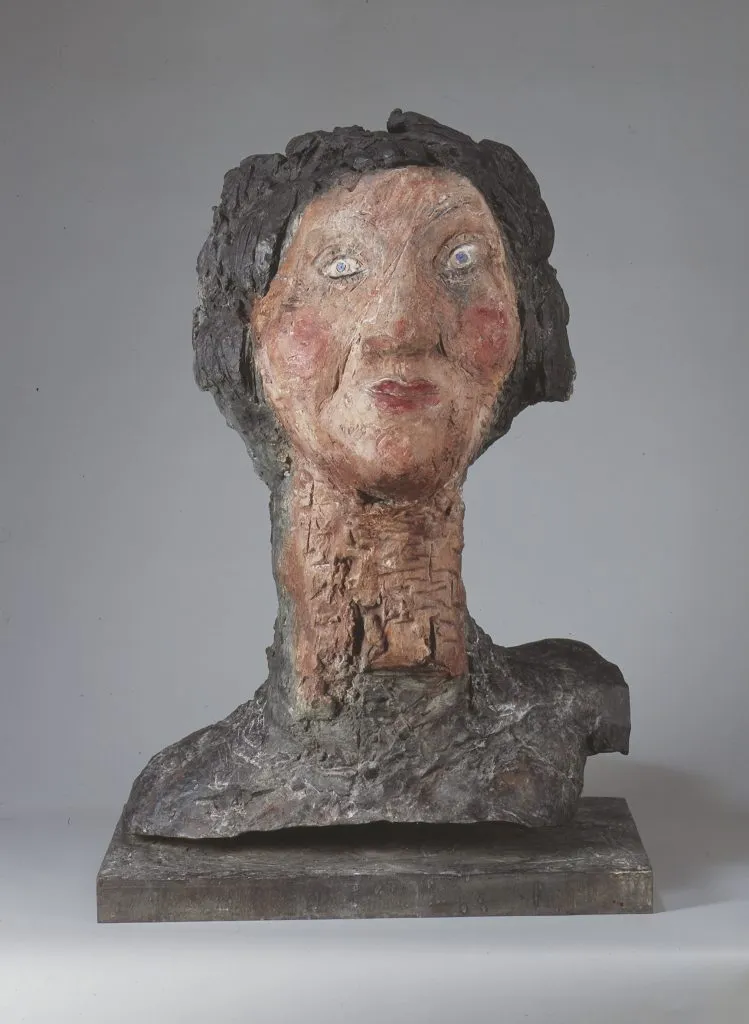
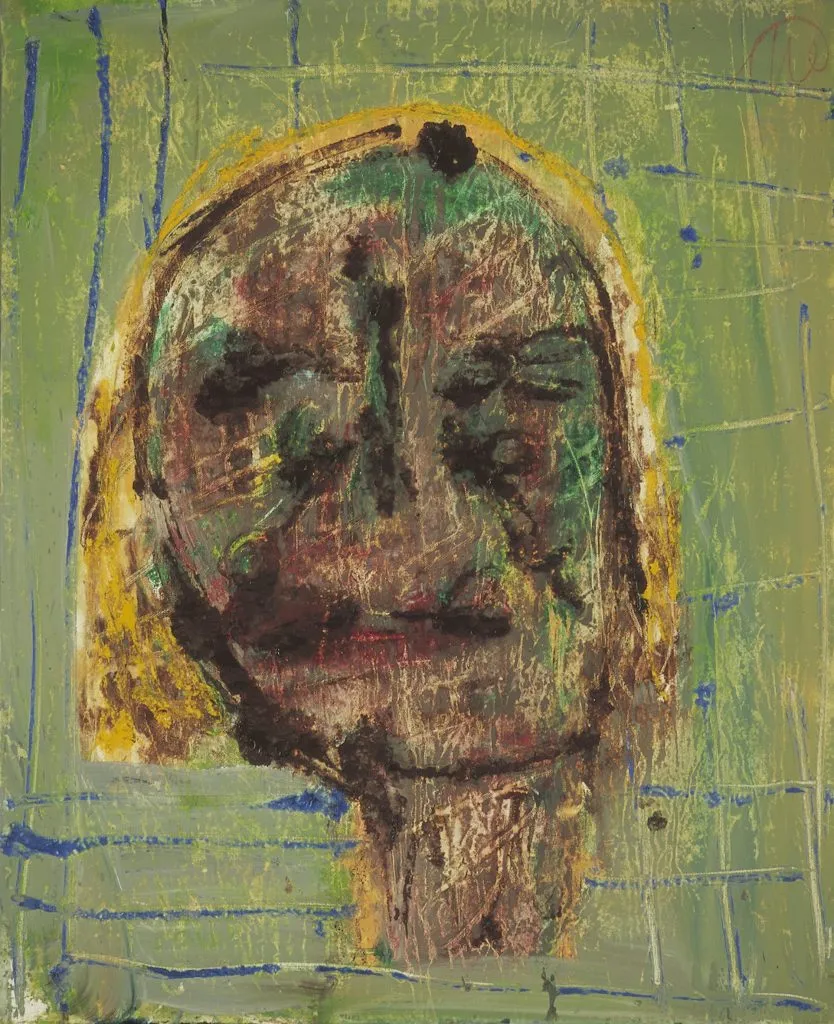
The face often becomes a field of play on which the central problem of Lüpertz’s art is clearly visible: the struggle between the experience of abstraction and representation. In the totemic heads of the Parsifal – Männer ohne Frauen cycle, encompassing paintings, drawings and gouaches, Lüpertz reveals what is organic, raw, primordial, rough and devoid of perfection (the strong significance of working with material extends to sculpture: it is visible in the scratched and scored surface of Judith, which repeats the motif from a large figurative sculpture; the head alone of the heroic woman who beheaded Holofernes gently prompts reflection on the irony of fate). Rhythmic sequences of signs disrupt the conventional order of representation, while references to representation preclude complete abstraction. Lüpertz takes neither side. What we find here is not the rhythm of bone structure but the pulsation of internal rhythms, unease. External likeness is unimportant; inner individuality and emotions matter more. The emergent geometric structure therefore resembles tribal incisions rather than the rationalism of Constructivism.
Yet reflection on the medium of painting itself, whose role was emphasised by his artist’s statement, ‘I paint pictures about painting’, concerns more than the formal aspects of the pictures in this cycle. Although its titular protagonist is Parsifal, one of the knights appearing in Arthurian legend (Richard Wagner composed an opera about him in 1882), he remains merely the ‘mask’ of the true protagonist and simultaneously ‘lyrical subject’: the Artist-Painter. Not only because, like the Holy Grail, he seeks the meaning of art. The second part of the title – Men without Women – reminds us that Parsifal gained both the sacred chalice and the love of Lady Blanchefleur because he resisted the temptations awaiting him on his journey and preserved the purity of his heart. The character therefore prompted Lüpertz to ask questions about the connections between sexuality and morality and their influence on creativity: whether art should be understood in Freudian terms as sublimation, and whether the creative act should be compared with the sexual act.
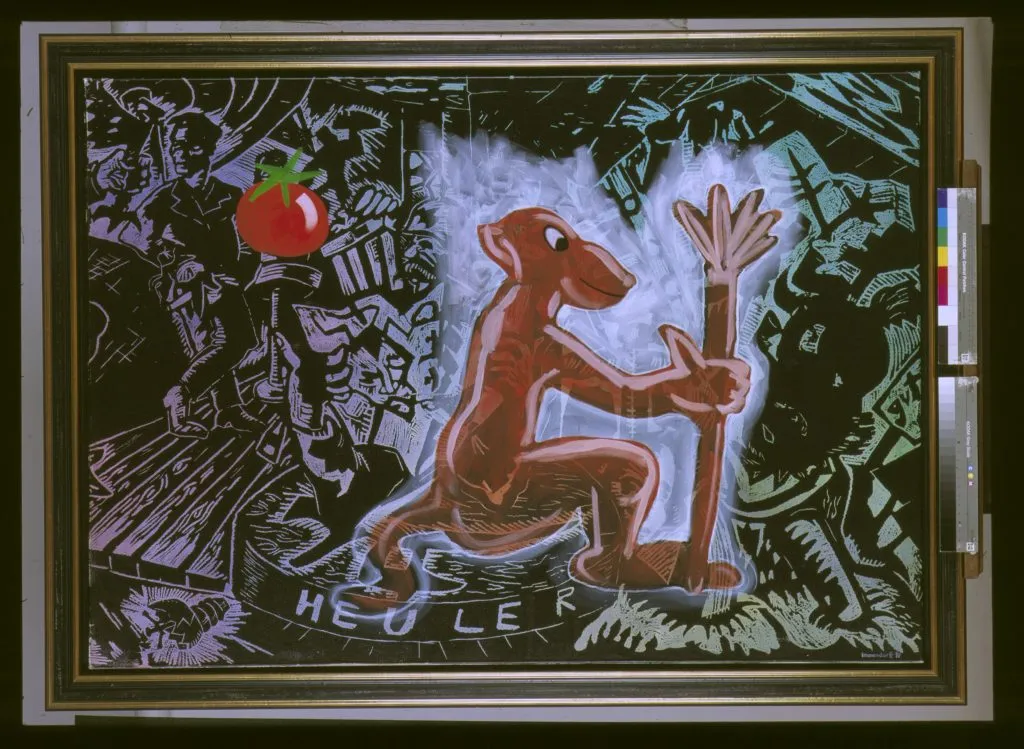
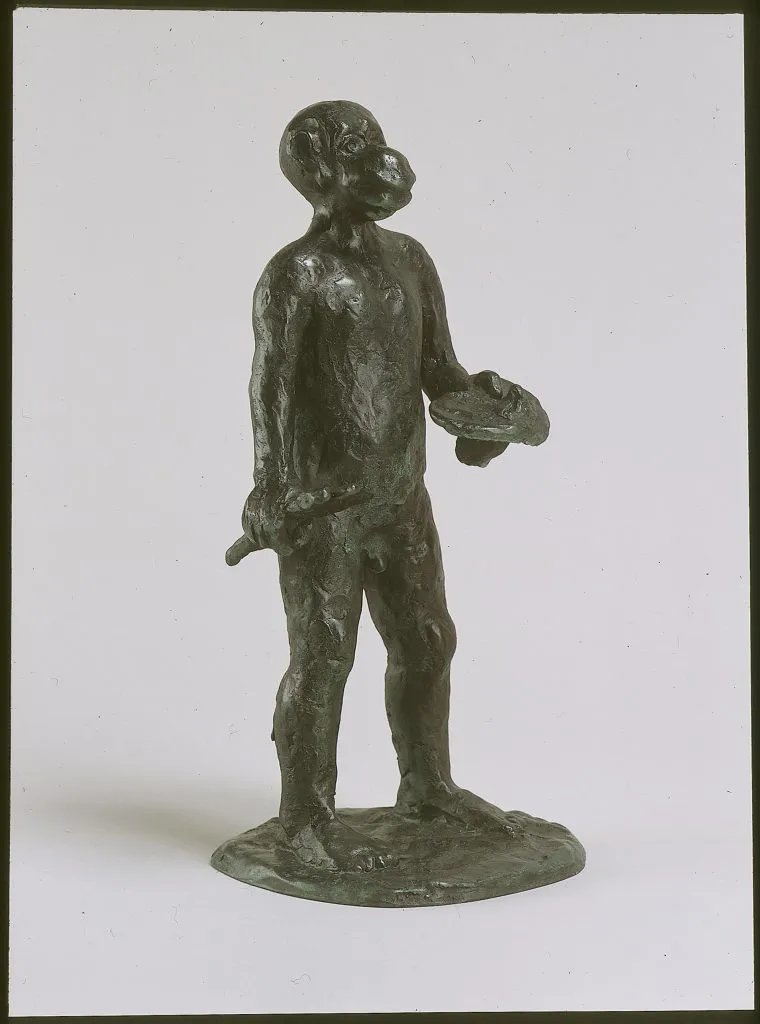
Jörg Immendorff likewise asked himself who the artist was, eventually observing with self-irony that he looked at the world through the eyes of an ape. The ape became one of the most characteristic motifs in the personal iconography of a painter who, until the end of his life, continued to rediscover, rework and decontextualise symbols appearing in earlier works. He repeated it almost obsessively in every magnitude, size, position and dimension: two-dimensional on the surface of a picture, three-dimensional as sculpture. Inquisitive, sensual, untamed and ambiguous (in Christian art a symbol of evil, in the Far East of wisdom, as in the sambikizaru, the three monkeys covering their sensory organs against evil according to the words ‘see no evil, hear no evil, speak no evil’), it proved to be the animal within Immendorff, surprising even to himself and for that very reason so interesting. ‘For me, the ape was simply my other self. A symbol of the ambivalence of artistic existence, of certainty and self-doubt. It is at once clumsy and wise, a symbol of opposites’, he explained. Another aspect of his artistic personality was the Malerbiene, the industrious ‘painter bee’ appearing in many works, which also referred to beeswax, one of the most important materials used by Joseph Beuys.
Besides, the artist can after all ‘ape’ brilliantly, and ‘imitation’ can be exposed in precisely this way. Malerstamm is a series of eighteen bronze apes (whose predecessors included the twelve golden apes in Friends of the Academy of 2002 and apes sculpted for his daughter Ida). Like children playing at being adults observed in various everyday situations, they read a newspaper, carry a heavy stone like Sisyphus, run, attempt to touch a bird in flight, speak from a lectern, hide a glass of wine behind their backs, play with a locomotive and hold painting utensils. They peer upwards and point. It is not only the ape with a palette that turns out to be an artist. Art history connected the titles or names of the individual figures with its greatest artistic names: Hans (Arp?), Constantin (Brancusi?), Caspar (David Friedrich?), Kurt (Schwitters?), Otto (Dix?), Baldung (Grien?), Max (Beckmann?), Anselm (Kiefer?). In still other works the ape appeared with a brush, not coincidentally resembling a broom. It was precisely through brush and paint that Immendorff was able to comment on social and political orders, debate and criticise.
Joseph Beuys, professor at the Academy of Fine Arts in Düsseldorf, encouraged his students – Immendorff among them – to abandon obsolete and conventional media such as painting and sculpture and replace them with, for example, social sculpture: the creation of changes in social consciousness. Nonetheless, Immendorff succeeded in following his path while rebelling at the same time. Through the Café Deutschland series, which unorthodoxly summed up the situation in divided Germany, he sought to prove to Beuys that painting too could be a social and political art. The tension between master and pupil is emphasised in the Double Portrait painted by Immendorff, in which the figure splits into Jörg Beuys, wearing the inevitable hat and fisherman’s vest, and Joseph Immendorff, wearing a Maoist black peaked cap.
The linocut Café Deutschland – Heuler (Maleraffe mit Tomate), 1978/1992, is one of the works accompanying nineteen large paintings made between 1978 and 1982. The works in this cycle transport the viewer into a symbolically charged space on the German–German border. Here the successive stations along a path of political transformation unfold. Snow and ice become references to the Cold War; swastikas, black eagles, national flags and the demolished Brandenburg Gate are equally legible. BRD and DDR become Ddrrrr and Brrrrd (in Café Deutschland of 1976); artists and intellectuals such as Bertolt Brecht, Marcel Duchamp, Andy Warhol and Joseph Beuys debate, while politicians appear as negative figures. The wooden planks of the café floor become a stage on which perspectives – public and private – intermingle, and the current social situation encounters the painter’s position in society.
Immendorff demonstrated how entire stories could be staged – it is no coincidence that he studied not only fine art but also stage design for a time. He also introduced a narrative drawn from comics, as if denying that painting is fundamentally illiterate and motionless. His compositions can be not only viewed but read.
A meeting in Berlin with the Dresden-based painter A. R. Penck provided the impulse for the entire series. A border divided the two artists, who were friends; despite this (or perhaps because of it?) they formed a collective and wrote a manifesto. In their paintings they could shake hands across the wall, sit at a café table and paint a trapdoor enabling them to escape from a world divided by the Iron Curtain.
At this point, the two artists presented in the exhibition meet once again – Markus Lüpertz was fond of saying that ‘to paint means to triumph’. They did more than belong to a generation that shaped the trends prevailing in contemporary painting for a long time: through their explorations, they were able to give it new energy. They discovered that it could be an almost organic activity and that the image possessed power – although the nature of that power is difficult to convey in words; perhaps Joseph Beuys came closest to the truth when explaining pictures to a dead hare.
1. Similar tendencies were presented at the same time in the exhibitions Heftige Malerei in West Berlin and Mülheimer Freiheit und andere interessante Bilder aus Deutschland at Paul Maenz’s gallery in Cologne, bringing Neo-Expressionism to audiences.