
SAWICKA SAWICKA
Tomasz Załuski
Whenever I look at Jadwiga Sawicka’s works, they seem to demand an interpretation in which the problem of repetition plays a privileged role. Noticing this necessity is nothing new; it is difficult, however, to claim absolute precedence or originality in a matter such as repetition. This text—written for Sawicka’s exhibition Attracts and Repels at Atlas Sztuki—is a collection of observations that occurred to me when I tried to relate the problem of repetition consistently to the artist’s works. Every other issue discussed here is connected with repetition in one way or another, remains in a variety of relationships with it, and sometimes even proves to be one of its metamorphoses. One might therefore also say that this text concerns a kind of ‘plasticity’ of repetition in Sawicka’s practice.
*
Jadwiga Sawicka repeats herself. Above all, she does so through the very form of her practice. This concerns, first, the repetition of a particular creative procedure, certain ‘gestures’ or ‘devices’, the repetitive nature of her way of working itself. Put in the broadest terms, for several years—roughly since 1997—the artist has repeatedly placed bold black letters against a uniform, in the great majority of cases flesh-coloured, background, and made photographs, in collaboration with Marek Horwat, of clothes likewise placed against backgrounds of a uniform colour. Although her work is not confined to these two ‘devices’, they constitute its most distinctive feature: they are Sawicka’s artistic idiom, a kind of artistic ‘proper name’.
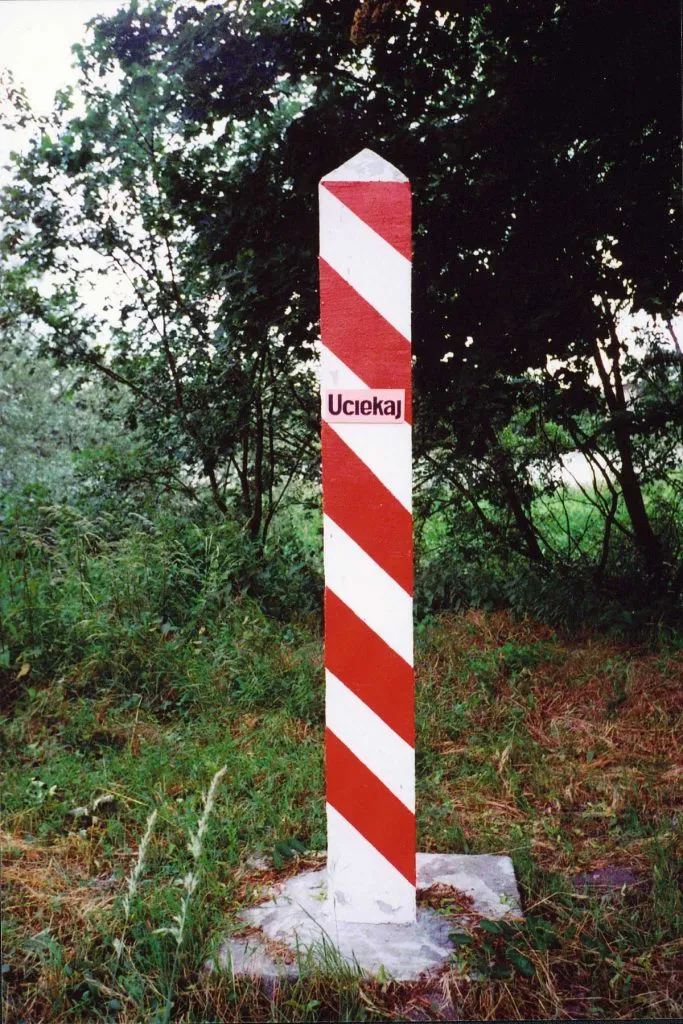
This operational and formal dimension of repetition is further expressed in the multiplication of elements within a single work. It may have begun with an event that, according to the artist, consisted in the unconscious repetition of one of her earlier works: painting the same oil picture with the words KILLS AGAIN twice, each time with the same enthusiasm of discovery. Perhaps this event suggested the idea of repeating the same word within one picture, as in the oil paintings THIEF THIEF and BRUTES BRUTES. In a somewhat longer perspective, it may also have produced the idea of multiplying these paintings as paper prints, presented in the exhibition Bloody at Foksal Gallery in Warsaw, and ultimately led to the artist’s radical openness to the possibilities offered by mechanical reproduction. The use of prints allows Sawicka to create distinctive ‘wallpapers’, made by pasting many reproductions of the same single inscription beside one another on a wall. It hardly needs adding that the very idea of ‘wallpaper’ necessarily refers to repetition, while each instance of it, each particular and self-contained ‘wallpaper’, is simultaneously a suggestion or sketch of the infinity of repetitions. Among the many examples of such ‘wallpapering’, one worth mentioning is the spectacular covering of the entire display window of the Gallery of the House of the Visual Artist in Warsaw in 2002—several metres high and more than ten metres wide—with reproductions of a poster bearing the words PLAGUE PLAGUE. Another is the more discreet, though perhaps conceptually more interesting, work HOW ARE PEOPLE SUPPOSED TO LIVE, placed on five columns of the University of Warsaw Library in 2000. Repeated four times on the poster, the inscription ran around the column so that its end met its beginning, suggesting the need to read it again and potentially multiplying the single inscription in the viewer’s reception.
*
The inscriptions appearing in Sawicka’s works are also repetitions in an entirely different sense. They repeat fragments of reality—most often elements of the world of mediated mass pop culture: isolated, principally aggressive words; frequently used colloquial phrases; the television schedule for a particular day; summaries of long-running series taken from television guides; information from wall calendars; newspaper headlines or slogans from television news; numbers specifying the scale—usually in human terms—of various more or less tragic events; a fragment of a cigarette advertisement… The artist does not, however, impose repetition upon these elements—whether the one-off repetition involved in transferring a particular element into the context of art or its repeated multiplication within a single work. Rather, she seeks elements that repeat, as it were, of their own accord and exist in their ‘natural’, real environment only as an endless series of returns. One might therefore say that she repeats entire ‘environments of repeatability’.
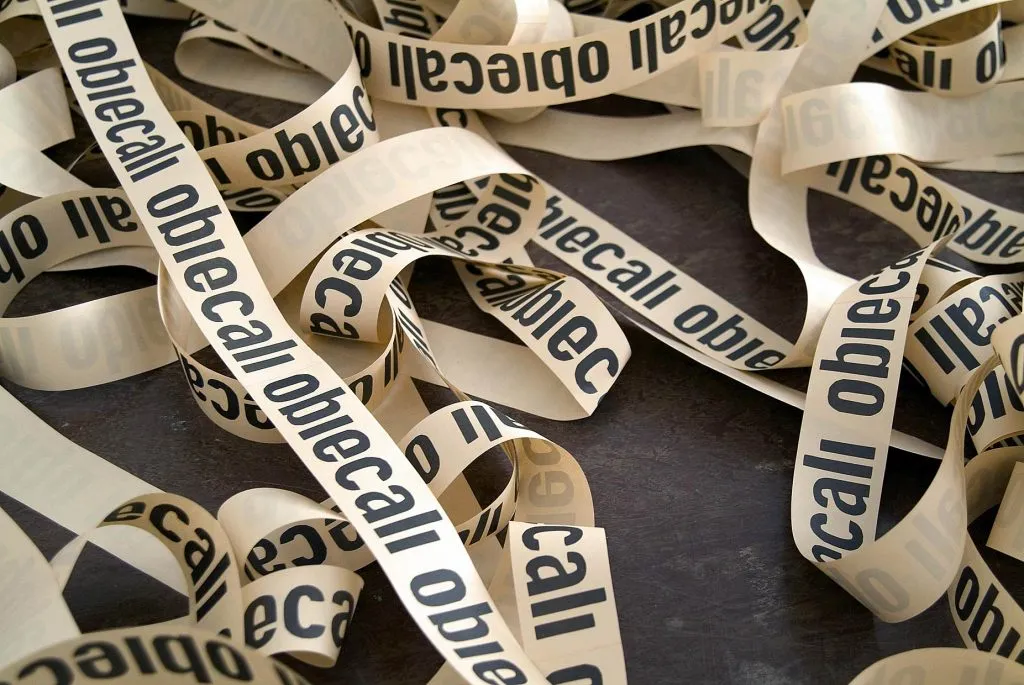
An excellent example is an installation consisting of a paper ribbon lying on the floor, its coils displaying the maddeningly repeated word THEY PROMISED THEY PROMISED THEY PROMISED THEY PROMISED… At its most fundamental semantic level, this work refers fairly obviously to countless acts of protest—collective or solitary, loud or silent, violent or powerless, and so forth—against recurring situations in which promises are not kept. Another example is the covering of the windows of Foksal Gallery with flesh-red tape bearing the repeated inscription BUREAUCRACY—an allusion to the English phrase red tape, likewise meaning bureaucracy?—a work that brings to mind the sterile, and at times positively dangerous, empty repetition of the bureaucratic machine’s procedures. In another work, presented at Bunkier Sztuki, Sawicka used the words JESUS MARY and CHRIST ALMIGHTY. Once again at the most fundamental semantic level, this work combines a reference to the repetition inscribed within the very structure of prayer with acts of repeating these words in numerous everyday contexts as empty exclamations uttered by believers and non-believers alike, as well as by those who are ‘believing but non-practising’.

*
All these aspects of repetition can be found in the works prepared for Attracts and Repels. Once again the artist uses photographs of clothes pictured against a chromatically neutral background, alienated and detached from their function while retaining certain signs of wear. Unlike earlier works of this kind, however, the photographs have been digitally manipulated, making the clothes appear extraordinarily, indeed absurdly, narrow.
The second work on display is a ‘wallpaper’ placed in the corner of a room, created through the confrontation, on adjoining walls, of repetitions of the wording of ‘male’ and ‘female’ lonely-hearts advertisements. Once again we are dealing with the repetition of a fragment of reality that, on account of its codification and resulting conventionality, itself constitutes a veritable ‘environment of repeatability’; one need only glance at the newspapers to confirm it. As for the formal aspect of the work, the prints bearing the advertisements repeat Sawicka’s existing style, although to emphasise the fact of confrontation the artist this time uses a juxtaposition of two colours: women’s advertisements are placed against a flesh-coloured ground, while men’s appear against the lilac background familiar from her early work. Reproductions of the inscriptions cover the wall from floor to ceiling, with a thickening at eye level, around four or five centimetres deep, produced by pasting numerous copies of the prints on top of one another. Together with traces of prints being torn away here and there, this thickening gives the whole the character of a repetition of a fragment of a building’s external wall, covered with street posters and notices pasted one on top of another. What is more, the work evokes connotations connected with the advertisements’ ‘matrimonial purpose’ by acting upon the sense of smell as well: it emits the fairly intense, distinctive scent of a cheap and not particularly sophisticated ‘fragrance’.
The final and most complex work in the exhibition is an installation that I would be inclined to call a dark room. It is a white structure reaching to the ceiling, concealing a square interior measuring 3.5 × 3.5 metres, which one enters through a tunnel running along three of the structure’s walls. The interiors of both the tunnel and the room itself are painted black and contain no lighting. The same machinery is suspended on each wall of this ‘dark room’. It consists of vertical rails along which two horizontal rails move up and down at a random pace. Along the latter, in turn, light boxes move horizontally—also at a random pace—their orange-flesh light, the room’s only source of illumination, revealing black letters forming the inscription I HATE YOU. In its eight repetitions and the computer-generated randomness of its movement, the inscription circulates around the walls, surrounding the viewer on every side. In its formal dimension, this constantly changing installation can be treated as a kind of ‘moving wallpaper’. Instead of covering the surface with reproductions of an inscription placed beside one another, the artist suggests the very process of multiplication by means of an inscription that, as it moves, continually seems to multiply through its successive positions on the wall. All the machinery described above therefore makes it possible to create, in a completely different way from ‘wallpapers’ pasted onto a wall, an impression of the infinite process of repetition.
*
Sawicka’s artistic practice indicates her interest in repetition, but not abstract, pure repetition, repetition as such, grasped in its conceptual neutrality and presumed identity. The artist is interested in actualised repetitions—multiple, concrete and individual each time, within which ‘repetition itself’ is subjected to more or less discreet modifications. Sawicka therefore exposes repetition to the transformations inevitably brought by specific fragments of reality, together with all the richness or poverty of their connotations, which ‘imprint’ themselves upon it as upon some flesh-like matter. Even when using the concept of repetition itself in the title of one of her exhibitions—Repetition and Consolidation of Material—she reaches for a specific form of repetition: a phrase from educational jargon, a formula for the topic once (?) entered dozens or even hundreds of times into school registers. In this way, the repetitions constituted by her works differ from one another; each remains inaugural, distinct and revelatory in its own, perhaps only ‘microscopically’ individual manner.
It is not only the difference between repeated elements: the very form of the works is also modified, more or less perceptibly. To illustrate this thread, it is enough to mention details from several ‘wallpaper’ works made over recent months. In TRAGEDY, the prints pasted to the wall were scratched with a sharp implement; prints bearing the words LOST INNOCENCE were covered with chocolate; while the wallpaper with lonely-hearts advertisements prepared for the present exhibition, Attracts and Repels, emits a scent. With each individual repetition, the artist’s practice undergoes a small but consistent evolution.
The fact that, ultimately, we encounter concrete repetitions, or even repeated elements of actual situations, may give rise to the following objection: does Sawicka genuinely practise a ‘Protean’, plastic and metamorphic repetition that exists only as a multiplicity of repetitions of individual fragments of the world, or is she simply interested in those fragments of the world themselves? Both propositions are equally justified, although they are undoubtedly impossible to reconcile. The point, however, is not to reconcile them, but to acknowledge both their difference and their ‘equal validity’. Their juxtaposition makes it possible to articulate the irreducible tension apparent in the artist’s works and to indicate their oscillation between the abstract quality of metamorphic repetition and the concreteness of the discrete elements of the world being repeated.
*
Sources of inspiration for Sawicka’s practice have previously been sought in the work of such American artists as Jenny Holzer and Barbara Kruger. From the perspective of the problem of repetition considered here, one might venture to indicate an entirely different—perhaps apparently absurd at first—source of ‘inspiration’ or ‘influence’, which naturally does not exclude those mentioned above. I mean Nowosielski’s art. I do not know how Sawicka herself, who completed her diploma precisely in Nowosielski’s studio at the Academy of Fine Arts in Kraków, would respond to this hypothesis—and the claim is, and will remain, radically hypothetical. Nevertheless, there is something intriguing in it. Perhaps it was this artist’s work and her artistic education under him that helped shape the structure of Sawicka’s distinctive ‘workshop of repetition’: her characteristic way of thinking about the picture, or rather about image-making. Surely no one needs much persuading that repetition actually occurs in Nowosielski’s art. Yet when we read the artist’s self-commentaries closely, repetition proves to be one of the fundamental problems of his art, in both the neutral and negative senses of the word. It plays an ambivalent role there: it is both necessary and inadmissible from the point of view of the undertaking to create a painterly form that would constitute a distinctive ‘vessel’ for the sacred. In turn, it may be possible to relate Sawicka’s idea of an empty form, as though awaiting fulfilment, to this idea of form ‘filled’ with the sacred, as a structural and reinterpretative reference.
*
Writing about the possibility of using repetition to challenge ‘law’—to call particular behaviours or principles of conduct into question—Gilles Deleuze lists several examples of practices capable of achieving this aim: proof by absurdity, ‘certain masochistic behaviours that mock through submission’, and the work-to-rule strike. Sawicka’s activity displays certain analogies with all these mutually connected practices, although in its specificity it cannot be reduced to any of them. Taking into account both this specificity and the analogies just mentioned, one can speak of a distinctive artistic ‘Sawicka strike’.
As is well known, a work-to-rule strike consists in exaggeratedly scrupulous observance of every rule applicable to a given profession, in meticulous and ostentatious submission to particular rules of action which, by slowing the pace of work and reducing efficiency, may completely paralyse a given sphere of life. In activities of this kind, individual actions or procedures lose their normal meaning and function, becoming a perverse instrument in a practice of silent protest and resistance. Let us now assume that Sawicka is ‘on strike’ as an individual functioning within the sphere of ‘mediated pop culture’. Let us also assume that this sphere’s existence requires its mechanisms to be constantly reproduced, through identification, by the individuals participating in it. This allows us to see that in Sawicka’s practice, selected elements of the cultural landscape, as well as identificatory repetition as a mechanism of culture itself, are subjected to an ostentatious repetition, perverse in its excessive concentration on mutually detached fragments torn from their normal functional context. Deprived of their ordinary effectiveness, these elements become non-functional and hermetic. This hermetic quality is further constructed by Sawicka’s self-commentaries, a consistent practice of saying nothing that might enable viewers or critics to identify the meaning of the works too easily. Isolated against backgrounds of uniform colour, they more or less discreetly flaunt their concreteness and impenetrable materiality; the latter can be felt particularly in works where the arrangement of repeated elements acquires a strange decorative or ornamental quality. Seen hundreds of times in their normal contexts, the letters of inscriptions such as TRAGEDY TRAGEDY become autonomous and aestheticised. This creates an impression of the uncanny: it is impossible to bridge the gulf that appears between the appearance of the letters and the event to which the word they form would normally refer.
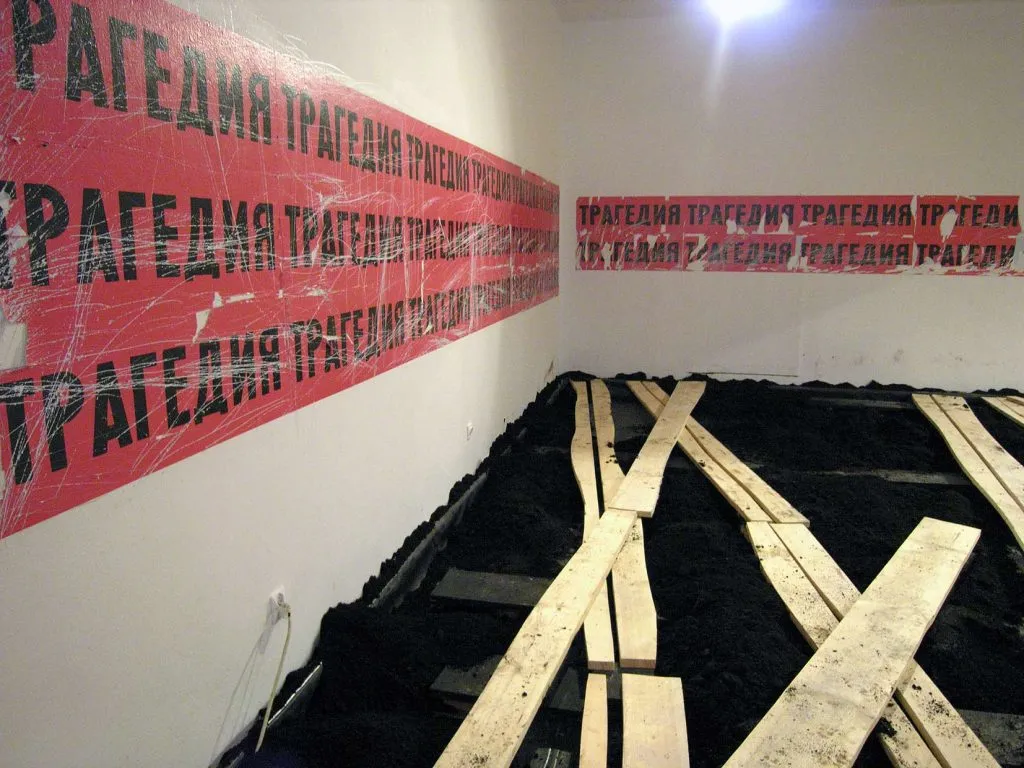
Paradoxically, the gulf just mentioned ultimately plays a positive role. By repeating different words and phrases, Sawicka seems in her own way to indicate that their actual repeatability, and the resulting ‘wear’, may desensitise us and even make us bored with the events to which they are meant to refer, while being unable to convey their singularity on each occasion. Yet the emphasis placed on this gulf in the artist’s repetitions also makes it possible, indirectly, to mark the singularity of the events described. A striking example was the work Numbers. The inscriptions illuminated in fifty-five light boxes formed an absurd sequence of numbers taken from brief reports in newspapers or on radio and television news. These figures increased from ‘1 person killed 2 injured’, through ‘at least 41 people died in ferry disaster off the coast of Senegal’ and ‘100 thousand doctors and nurses are on strike’, to ‘a billion without work’. The absurdity and incommensurability of these repetitions—modified each time—in relation to the events and people to which they are meant to refer make it possible to realise, and become sensitive to, the singularity of those events and people on each occasion.
The question of the identificatory reproduction of mass-culture mechanisms mentioned above is complicated, however, insofar as this reproduction does not occur entirely unconsciously. It is a banal truism that we know pop culture shapes us and imposes forms of existence upon us. This knowledge is already inseparable from pop culture; it is part of it. Pop culture has appropriated it and, to some perhaps considerable degree, neutralised its critical potential. Pop culture possesses a real power to reproduce itself, which, even when one is aware of it, is sometimes impossible to resist.
In Sawicka’s art, this problem appears as an experience of the ambivalent character of repetitive practice. Ostentatious repetition, taking pop-culture mechanisms to their absurd consequences, is inevitably connected with at least a partial reproduction of those same mechanisms. The latter does not arise solely from the structural necessity of the instrument the artist uses, even perversely. It probably also derives from the discovery that inaugurates each work: a strange, almost pathological fascination with a particular element of the pop-cultural landscape that, for obscure reasons, attracts her, and a compulsion to focus upon and repeat it. The artist marks her works with ambivalence by submitting to this compulsion with a distinctive masochism, most conspicuous in works containing repetitions of words that are aggressive, sensationalistic, referring to acts of cruelty or serving as instruments of violence and exclusion: KILLS AGAIN, EVIL, BLOODY, UNWANTED, BRUTES, CONVERTING TAMING TRAINING. Although there are works by Sawicka in relation to which it seems justified to speak of a strictly ‘ridiculing’ effect of masochistic submission—I mean, for example, the wallpaper bearing the inscription A DOG’S FAITHFUL HEART—the artist’s ‘masochistic’ works fundamentally remain fairly ‘raw’ in expression, thanks to their absurd methodicalness.
*
The ‘masochistic’ aspect of Sawicka’s practice already seems to make itself heard in the title of the present exhibition, Attracts and Repels. The already mentioned ‘dark room’ offers the most intense experience of this ambivalence. The viewer enters a structure promising an experience of something fascinating, only to be attacked inside by absurd machinery whose sole justification seems to be the purposeless movement of repetitions of the aggressive formula I HATE YOU. The installation encourages the viewer masochistically to remain inside the structure, attracting through the complexity and ingenuity of the technology employed while simultaneously repelling with a violent message that seems to have no author and to be addressed directly to each individual viewer. It is a veritable allegory of the mechanisms of mass culture according to Sawicka.
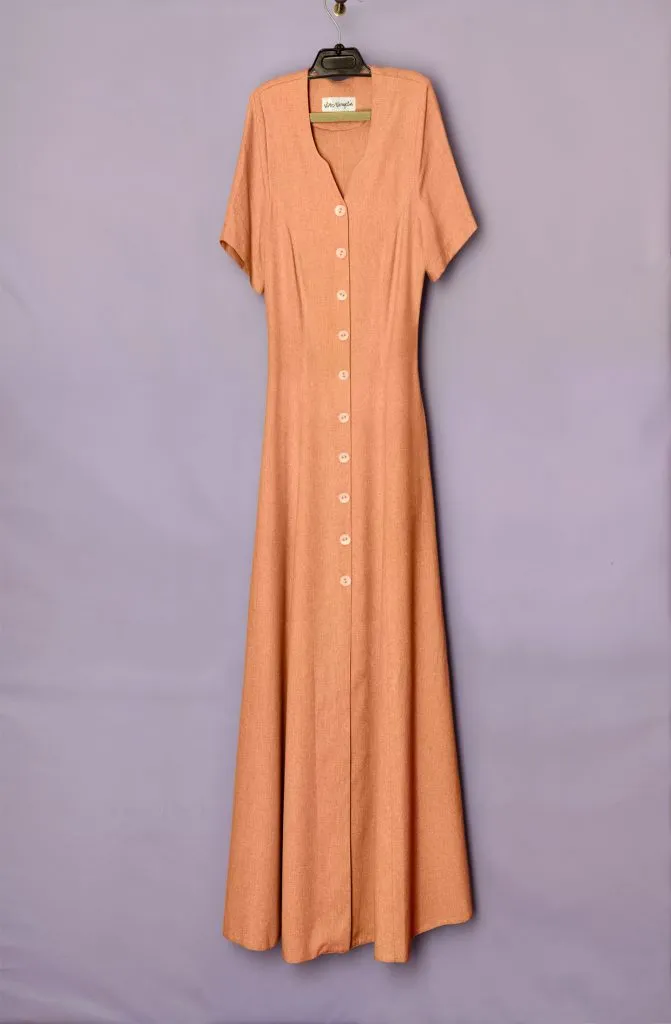


A distinctive ‘proof by absurdity’ is supplied by the photographs of clothes presented in the exhibition. Digital processing has narrowed them to an almost unbelievable degree, making them suitable, perhaps, only for the extraordinarily slender figures of Japanese animation, whose head-to-body proportions are 1:12. Incidentally, I know that when certain fashion designers draw their designs, they dress just such lofty, slender beings in them. The human-height photographs show specific garments bearing certain signs of wear and perhaps marked by individual histories. At the most fundamental semantic level, they may be read as variations on the formative role of slenderness in the imagination and mass culture. Yet the exaggerated narrowing and its application to clothes that cannot be classified as fashionable deprive the distortion of its functional meaning and leave the viewer with a feeling of unsettling uncanniness before the presentation of an individual object that, because it is difficult to know what to do with it, becomes mildly repellent.
*
The artistic ‘Sawicka strike’ undoubtedly does not produce any wider ‘paralysis’ in the functioning of pop-culture mechanisms. Yet the following observation suggests itself. The fact of existing within a gallery usually neutralises art, isolating it and reducing it to the ‘aesthetic’ dimension. One might wonder to what extent, in this artist’s work, the works’ existence in a gallery not only fails to have a neutralising effect but is used to intensify the impression of tense non-functionality and hermeticism so crucial to them.
Sawicka’s practice is based on repeating elements of the ‘language’ of contemporary mass culture—the ‘shared idiom’ of many contemporary artists. Each member of this internally diverse community testifies in a different way that by reproducing elements of this culture, it is simultaneously possible, through the ‘plasticity’ of repetition itself, to modify the identity of the repeated elements and thereby mark the individual resistance of one’s existence.