
Roger Ballen—Lines and Marks of the Psyche
Roger Ballen in conversation with Peggy Sue Amison
Peggy Sue Amison: Your latest work is Asylum of the Birds. Could you say a few words about it?
Roger Ballen: Asylum has two fundamental meanings in the English language. In the first, it is a place of madness; in the second, it is a place of refuge. In a sense, these meanings are opposites. In Asylum of the Birds, the asylum is a place where animals and people live together, away from the outside world. It is a very claustrophobic, surreal and strange place, yet what happens there is also abnormal: it comes from deeper layers of the subconscious, but I would not call it madness.
P.S.A.: Over the years, you have moved from collaborating with your subjects to make portraits towards your current way of working on Asylum of the Birds, which seems to reflect your own psyche directly. Your focus appears to have changed: you are interested in portraits of animals and in drawing marks, revealing your own psyche through the process. How did this change occur?
R.B.: It did not begin now; the process evolved and continued for years. I reached what you see today in small steps over twenty or thirty years. My recent exhibition at the Smithsonian Museum in Washington, entitled Lines, Marks and Drawings: Through the Lens of Roger Ballen [Polish title: Linie, znaki i rysunki. W obiektywie Rogera Ballena], shows my development and how I reached my present point, which took more than forty years. The catalogue produced for the exhibition illustrates this development. The change became visible around 2003, when I stopped portraying people in the traditional way and instead made more portraits of animals. Viewers and critics seem to notice only the people in my work, but the animals are just as important. My photographic practice has taught me that if human faces are present in a picture, viewers direct their gaze towards them first and compare their own faces with those they are looking at. If the audience sees no human face on which to focus, the photograph as a whole becomes much more significant. By 2003, I genuinely felt that I had said everything I wanted to say in that way and began moving in this other direction. I started using drawing and painting, involved more animals, and the photographs became more complex in their own way. I think this was when I truly began following my own path as an artist. If you look at my earlier work, such as the series Platteland or Outland, for example, you will probably see various influences in it, from Diane Arbus to Ralph Eugene Meatyard. When you look at my work now, there is really nothing there from outside it. I feel I have found my own space, which at last is the space of my own interior. One must also bear in mind that people look at a photograph as a reality they might encounter. They experience it as an external reality and, only to a small degree, as an inner reality. This perception operates differently in painting. If you paint a surrealist picture, people make no prior assumptions; they experience and accept what is represented as part of the artist’s imagination. When they see a photograph, they feel there is something absolute about it.
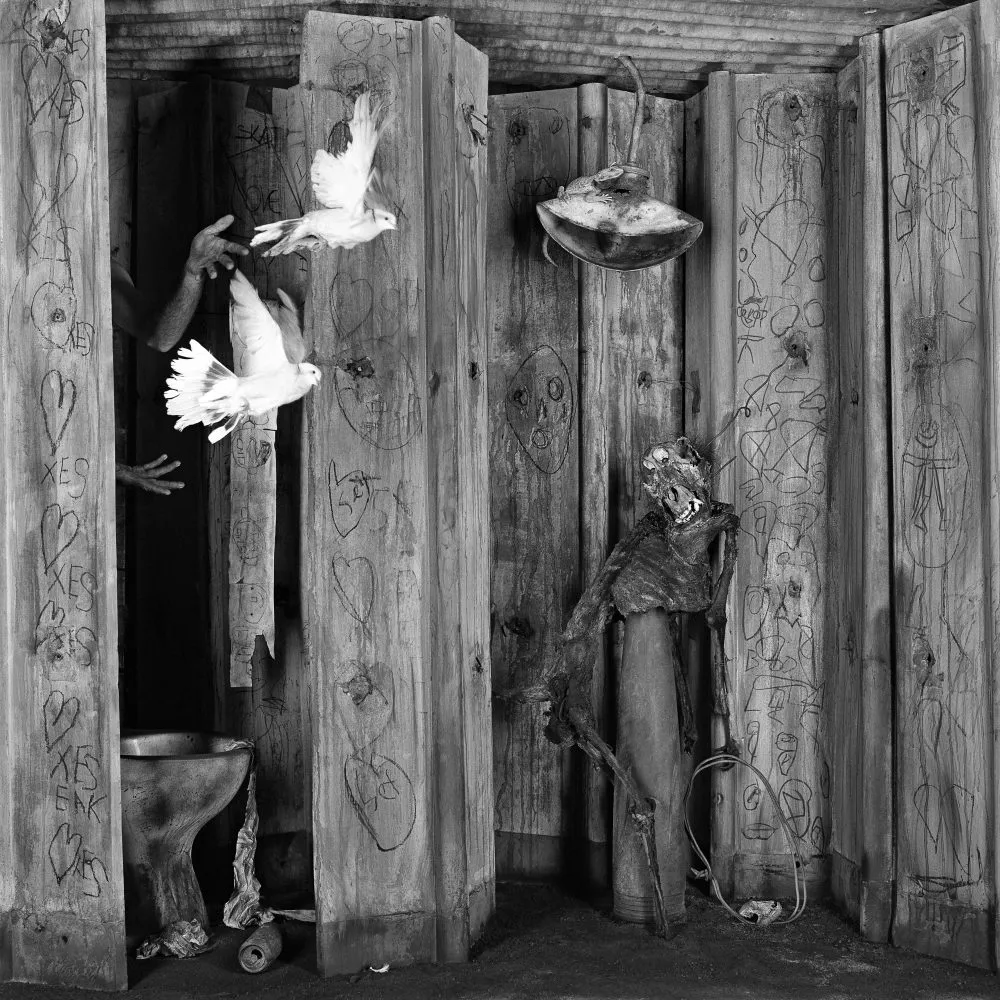
P.S.A.: You mentioned the idea of authenticity in photography earlier. Could you discuss its significance and how authenticity manifests itself in your new work?
R.B.: When an audience looks at a photograph, they should feel that the moment represented existed in time: in other words, that it is authentic. In my new work, the moment is also authentic, but in a different way. These new photographs are more a reality connected with the inner mind, through which, in one way or another, viewers are struck by a reality they have repressed.
P.S.A.: Do you think the drawn mark speaks to your audience as a different kind of visual language, more subconsciously than what they are accustomed to seeing in photography?
R.B.: Yes.
P.S.A.: Some people find your photographs provocative. Many may have very different definitions of what photography is, and for that reason they dislike or disagree with your work. Yet even if they disagree with it or do not understand it on one level, on another it remains very deeply embedded in their memory. It simply moves them. Do you think they react this way because they receive your photographs in a new way?
R.B.: You are touching on a very important issue that I encountered while making the series Platteland and Outland. The more the audience disliked those photographs, spoke badly about my work or felt hostile towards me, the more deeply they penetrated them. It is almost like a grain of sand that enters an oyster shell: viewers simply try to find a way to rid themselves of my photographs. The images have lodged in their memory and they do not know what to do; they appeal to the mechanism of repression in their psyche.
P.S.A.: They continue to think about them even though they do not want to work through them?
R.B.: Exactly.
P.S.A.: Returning to your marks and their language, both formally within your compositions and in relation to your development as an artist: the change you have discussed is interesting because I do not think that at the beginning, earlier in your career, you considered yourself a photographer or an artist. Is that right?
R.B.: I did not consider myself—well, I was a kind of photographer. It was not a profession, but I did not consider myself an artist. Certainly not.
P.S.A.: But you grew up in a highly artistic environment. Your mother worked for Magnum and, I believe, had a gallery?
R.B.: Yes, of course, but at that time no photographer would even have dared call themselves an artist. They were a photographer, perhaps a serious photographer, but not an artist.
P.S.A.: And that continued for a long time, did it not? Personally, I do not remember photographers calling themselves artists until around the 1980s.
R.B.: No, it began in the mid-1990s, at the same time as large colour photographs. Artists began making large colour photographs and selling them on the art market not as photographs but as works of art.
P.S.A.: And when did you begin calling yourself an artist?
R.B.: I have a very good answer to that question because it was clear to me when it happened. It was around 1997, during the Outland series. Outland was very different from Platteland, because Platteland was traditional portrait photography. I portrayed people in their homes in the way Diane Arbus might have done, while making the photographs for Outland I began interacting with people in a highly theatrical and absurd manner. In 1997, when entering South Africa, one had to complete a form and state one’s profession. For many years I wrote ‘businessman’, because that was the easiest description and I did not want any trouble because of it; and indeed, I was a ‘businessman/geologist’. Later, for a short time, I wrote ‘businessman/photographer’. Then came the moment in 1997 when I wrote—and I shall never forget it—‘photographer/artist’. That was when I began to regard myself as more than a photographer in the traditional sense.
P.S.A.: Drawn marks are visible on the walls and backgrounds of your early photographs. Were those marks already there, or did you work with your subjects to create them?
R.B.: No, I was not actively involved in making the marks, lines and drawings; that came later. Through interacting with the people I photographed in those places and positioning them beside walls bearing marks they had drawn in their homes, however, I began to understand that this was an interesting idea. I became curious about how I might expand the meaning of my work by making drawn marks. I did not tell them to draw those marks; I simply encountered them during visits to their homes and they interested me. That is how the idea arose. It took years before I began actively participating in making graffiti, asking them to make more drawings, or before I began adding them myself.
P.S.A.: I know that you exercise tight control over composition in your work. When did you begin controlling the drawing more closely?
R.B.: Well, I always controlled it. I am obsessive about the formal aspect of the work, so even if drawings covered an entire wall, I would control it, because the drawings would be part of a photograph that had to be coherent with the next photograph. It was in 2003, however, that I began telling people to draw or began developing what I saw in different places. That was when I started participating in the making of graffiti. If I liked a drawing on one side but it needed something on the other, I asked the subject to add something: a bird or a face resembling the one on the opposite side. Or I added something on that other side myself, taking care that it worked with the rest of the drawing. I do not claim to know everything about the history of photography, but if you look, for example, at Brassaï’s photographs and at the history of what has been done with the kinds of drawings I photograph or now use as a basis for my work, most of those people stopped at straightforward documentation. Both Brassaï and Aaron Siskind photographed graffiti, but for me the graffiti already present on a wall, or that I create myself, is merely the first step towards a more complete photograph. The drawings in my photographs—sometimes on walls, sometimes on people, sometimes on objects—are all connected with other elements in the image. I therefore think the complexity of my work is much greater and closer to that found in a work of art than to photographic documentation as traditionally understood.
P.S.A.: How much preparation does your work require from you now?
R.B.: I never think about photographs before I arrive to make them. It does not help at all, because I cannot predict how all the elements will come together, so I never have ideas before I go to photograph. Every photograph has a different beginning. Sometimes it begins with a drawing on the wall and I build something around it; sometimes it begins with a subject saying, ‘Look what I’m doing!’ It simply never begins in the same way twice, so it cannot really be generalised. Sometimes something happens on location that becomes the photograph’s guiding idea, and I then begin adding a drawing, a sculpture, an installation or something else that helps expand the meaning of what already exists. For example, I was recently working on a photograph and the last thing added to it was the drawing. First, I had to think through the composition with the people, and only later did I add the drawing. The drawing was already there and I had to add something around it to try to incorporate it into the photograph. It really never happens all at once. You must always use your imagination to take the next step—not one step or ten, but actually hundreds of steps, just as a painting consists of thousands of brushstrokes. Many steps separate the beginning of a session from the moment when I bring the photograph together.
P.S.A.: It seems to me that you now make compositions more like a painter than a photographer.
R.B.: Yes, but it is very important that the photograph be completed through photographic seeing. It is like the decisive moment, which captures an instant, and it is in this respect that my works remain photographic. I think that if you set aside this quality of the instant, the photographs no longer have such great power.
P.S.A.: You have begun including installations in some of your museum exhibitions. Could you say a few words about them and describe how this came about?
R.B.: It began around three or four years ago, when I had an exhibition at the Het Domein museum in Sittard in the Netherlands. I was speaking with the curator in London. I remember us discussing the exhibition, and I said, ‘Listen, I have never done this before, but I think it would be genuinely interesting for me to come to the museum, find things in Sittard and create an installation.’ He thought it was a wonderful idea, and the museum had an additional room where I could place the installation, so that is what I did. The installation expanded the meaning of my work. It is creative, and I enjoy searching a place and finding things for an installation. It is a little boring to travel all the way from South Africa merely to give a lecture at a museum or gallery. Besides, I do not like becoming too involved in hanging works, because for me it is not really a creative process. I am more interested in developing my work in other directions. Since that exhibition, I have made seven or eight installations of this kind. I created a large installation at MONA, the Museum of Old and New Art, in Hobart, Tasmania, last November. I am quite excited about it because it is a very interesting museum. I think MONA is truly one of the most exceptional museums in the world and they do extraordinary things there. These installations give people a more three-dimensional sense of what I do, and I think this creates another reality on the other side of the photographs. Photographs are two-dimensional, while installations allow the audience to enter a space that bears certain similarities to them and adds depth to the experience.
P.S.A.: You consider yourself one of the few photographers working exclusively in black and white. Why did you choose this palette?
R.B.: I really do not like colour! Colour is false to me. Photographic colour carries an illusion that imitates the colour perceived by the brain. It is photographic colour, not the colour I experience in the surrounding world, so for me there is always a cognitive opposition: colour pretending to be one thing while it is something else, and therefore it does not affect me in the same way. Painting is principally about imagination, so colour in painting does not pretend in the way it does in photography. Black and white is minimalist, like my work, and abstract, like my work, and it is what I grew up with. I cannot separate my artistic vision from black and white. It is part of what I have done throughout all these years, and at present I have no impulse to change. I mean, it is not as though photography offers ten different paths, as sculpture does, where one may move from marble to granite, steel, foam and so on. In photography, there is colour and there is black and white, and that is all. I dislike the former and love the latter. It suits the way I see, and I continue to develop it. For as long as I can continue developing it, I shall stay with it, because that is important. I have come a very long way and it is interesting. I feel that through my methods I am experiencing things that neither I nor others have explored before, so I really do not want to go back to what is ordinary and begin again. I have been on a long journey, I like the point I have now reached, and I think there is still room to go farther. I have no doubt about that. I think about the work I shall continue adding to over the next few years. There is a project I have been working on that you can see in the book Lines, Marks and Drawings. It is a project I have developed over the past seven or eight years. In many respects, those photographs resemble drawings made through black and white.
P.S.A.: Your collaboration with Die Antwoord on the music video ‘I Fink U Freeky’ attracted a great deal of attention. You have just completed a video for your own Asylum of the Birds project. Could you say a few words about the different experiences you had while shooting these videos?
R.B.: The differences between shooting the two videos were quite significant. First, Asylum of the Birds is primarily a documentary about me. It was filmed in the actual location and involved people with whom I had worked for years. A very small team was involved in making the video, namely Ben Crossman and Marguerite Rossouw. Its purpose was to explore my aesthetic and the world in which I photograph. The video for I Fink U Freeky was the result of a collaboration with Die Antwoord; in the film, my aesthetic was combined with the band’s music. Producing the film required a large crew and was intended more to promote the song I Fink U Freeky than to present my world. In any event, the video revealed many aspects of my art, from drawings and installations to a certain type of person who appears in my photographs.
P.S.A.: Do you think your explorations in video have developed your work as a photographer and artist?
R.B.: The production of videos certainly helped disseminate my aesthetic among viewers who otherwise would never have encountered my work. The audience watching video online is clearly larger than the audience looking at photography. The number of viewers aware of my work grew more quickly than I could have predicted. I am convinced that making art in one medium develops one’s ability to make forceful statements in another.
P.S.A.: Do you think these videos may also become part of your exhibitions?
R.B.: I think so. I am not really all that motivated to make videos that have nothing to do with the still image.
P.S.A.: Will you make more music videos?
R.B.: No, I am not really engaged with young people’s music. I do not know whether I shall ultimately make another video.
P.S.A.: Did the experience of working with Die Antwoord push your practice in another direction? I do not mean whether you intend to make more music videos, but whether you now use video.
R.B.: I saw the power of video. What I mean is that I do not think I shall ever achieve forty million views again. I shall be happy if I reach forty thousand, but it truly showed me what I was dealing with and that the desire to watch video is far more widespread than the desire to look at art photography. Video is an excellent way to reach viewers with an artistic aesthetic, because the market is so much larger. It is like comparing sport with museum openings: when Manchester United play, there are eighty thousand people in the stadium and eight million viewers glued to their televisions; at a museum exhibition opening, you will be fortunate if four hundred people attend. The scale of the performance is what makes the difference—the spectacularity.
P.S.A.: When I look through the body of your work, I experience your development as an artist. Do you think photographers develop in the age of digital photography and the Internet?
R.B.: When I was growing up, there were a few serious photographers in the photographic field and the rest were really amateurs. Now the field contains such an abundance of photographs. There is truly no comparable surplus anywhere else. One has to wade through an immense number of pictures to find something of value; that is the result of the Internet and digital imaging. To be a good artist, you need life experience—unless you are a genius at the age of twenty, but then, first, you will not have very much to say and, second, you still need time to develop an aesthetic that belongs to you alone. Otherwise, you are simply repeating what has already been said. You are who you are and you do what you do, and you evolve. Some people evolve in interesting directions; most fail. The mind is like the immune system: if it sees the same thing more than once, it usually has no effect. It is like a virus. The viruses that make you ill are those you have not encountered before, and the same is true of photography or art. It must be something different, something capable of entering more deeply into people’s minds and psyches. How can that be achieved? I genuinely do not know. Very few of the photographs I see today reach that level. A large proportion of work creates an appearance of rising to it, but very little actually does. I still very much like photography from the 1930s, my favourite period in photography. It possessed simplicity and complexity simultaneously. I have taught workshops at colleges, and it was absolute madness: many students who have studied photography for five years do not understand the fundamental principles of composition. Photography is too easy to make; therein lies the difficulty. When it comes to making sculpture in stone, one may find only ten artists in any country who make interesting work. Today, everyone has a camera and that is the problem. Making great photographs is complicated, very complicated. When you look at my photographs, it is very important to realise that they have an impact because I understand photography. It took me fifty years to arrive at this point, fifty years of making pictures to be able to integrate drawing, photography and installation. Someone who has been involved with photography for six months and buys an iPad or a camera and thinks they can reach the same level of practice—well, that is impossible. You must first have a certain foundation.
P.S.A.: You found the people you photographed in your early series while working as a geologist. Do you still work with the same people?
R.B.: I knew some of those people for more than thirty years, but that does not necessarily mean I still work with them; they live in different places. The photographs for Dorps and Platteland were made between 1982 and 1994 in rural towns in South Africa. I have not photographed in the South African countryside since 1994. I do not work with those people because I no longer work in those places. I work in Johannesburg on various projects and in several different locations. The series Shadow Chamber , for example, was made in the Shadow Chamber Building, a former mine building. Boarding House was made in a former warehouse. Asylum of the Birds [Polish title: Azyl ptaków] is situated in another place where I formed relationships with people. In a sense, these places became my studio, but they are full of non-artists who have no idea what art is, as in art brut. These people may be mentally ill, prisoners or homeless; they may be people without money who have nowhere else to go, or people who like where they live. Simply a mixture of people, people from the streets.
P.S.A.: How do you find these places?
R.B.: People tell me about them. I learnt about some places while working on other projects, so I went there and met the people living in them. But it takes a long, very long time to deepen trust and relationships. You cannot simply walk in and begin taking photographs. If you are careless, it can end badly. There are many people in need there, and they are not necessarily emotionally stable, so you must come to an understanding with everyone step by step: from the most violent to those unable to get out of bed. You must be able to deal with all of them and keep them calm and relaxed; otherwise, you may never leave.
P.S.A.: Do you work alone in these places?
R.B.: No, I have an assistant.
P.S.A.: And do you still use flash frequently?
R.B.: I use flash in all my photographs. In Asylum, where we use a much larger flash, the photographs contain far more detail. Until 2007 or 2008, I used only a flash mounted on the camera. Around 2008, I began using larger flash units because I needed to bring out more detail in the drawings; technically, that was the right path.
P.S.A.: Have you ever encountered a problem when photographing with flash? You say that some of the people may be emotionally unstable. Has the flash ever caused difficulties?
R.B.: You do not reach for the camera when the situation is tense. You must proceed in such a way that people are relaxed and content. It has to be important to them in some way: for example, they may like having attention focused on them, or know that there will be an exchange after the photograph. I always try to help these people with money, food or other things.
P.S.A.: Your way of working seems more like a conversation between you and the people you work with than a traditional model-photographer relationship.
R.B.: It is like a theatre of the absurd, with me as the director, although sometimes they direct themselves. I currently have an exhibition at Fotografiska in Stockholm entitled Roger Ballen: Theatre of the Absurd [Polish title: Roger Ballen: Teatr absurdu]. Curated by Ellen K. Willis and Anette Skuggedal of PUG, a gallery in Oslo, it focuses on photographs of mine containing elements of absurdity. This is an important exhibition for me because people have never seen the absurdity in my work. They thought of the people posing for me as poor, mad, strange or surreal. They describe my work as depressing and gloomy because my photographs force them to confront the side of themselves they have repressed. These are the most liberating. The negative reactions I encounter are often caused by viewers’ fear of themselves. This is the world in which we live. People cannot cope with their own psyche.
*Peggy Sue Amison is an American curator, producer and author of exhibition strategies for emerging and established photographers. She is currently artistic director of East Wing in Dubai. Previously, for thirteen years, she was a curator at Sirius Arts Centre in Ireland, where she led the artistic programme. She has curated exhibitions in Ireland, Germany, China and Poland. In 2011, she prepared Alexey Titarenko’s solo exhibition at Atlas Sztuki.