
A Flash in the Darkness
Adam Mazur
Until quite recently, Roger Ballen was known only to diehard enthusiasts of South African photography. Successive publications and exhibitions in galleries around the world brought him recognition. Yet he earned the status of a pop-culture icon only recently, when the members of Die Antwoord, fascinated by Ballen, approached the master for help in creating sets and later also directing their videos. The peculiar mixture of rap-rave music and an aesthetic drawn from staged black-and-white photography proved explosive. After the Enter the Ninja video, a generation of twenty-year-olds discovered Ballen. Since I Fink U Freeky, made less than a year ago, everyone knows him.
Roger Ballen’s photography has evolved from photojournalism, documentary and portrait photography (Dorps, 1986, and Platteland, 1994) towards increasingly staged photography in which people appear in a defamiliarised context (Outland, 2001, and Shadow Chamber, 2005). As Jörg Colberg rightly notes, Ballen’s latest works are closer to painting and to visual art understood as the production of installations, environments or sculptures which are then photographed (Boarding House, 2009). Roger Ballen connects the shift of emphasis from social reality towards his own imagination and sensitivity with artistic maturation and a growing aversion to literalness. In 2003, the photographer shifted his emphasis away from photographing people’s faces, seeking possibilities for expression through form rather than the image’s content. Critics connect the photographs’ formalism with their maker’s existentialism, emotionally charged experiences and inner imaginative world. Such are Roger Ballen’s latest, moving and unsettling photographs (Asylum of the Birds, 2014).
Towards Documentary
Roger Ballen, born in the United States in 1950, encountered photography as a child. This was hardly difficult, since his mother, Adrienne Ballen, worked as a photo editor at the New York office of the Magnum photographic agency and at one point opened a well-known photography gallery in the city. The names of masters crucial to the history of twentieth-century photography—Henri Cartier-Bresson, André Kertész, Edward Steichen, Paul Strand, Diane Arbus, Elliott Erwitt and Walker Evans—were not abstract concepts for the adolescent but left a real mark on the future artist. Today, Ballen recalls buying his first camera at the age of thirteen; he published Boyhood, a book of black-and-white photographs influenced by Elliott Erwitt and Walker Evans, before he turned thirty (1979). At that time, Ballen still did not see himself as a professional and was developing his career in a field as remote from photography as geology.
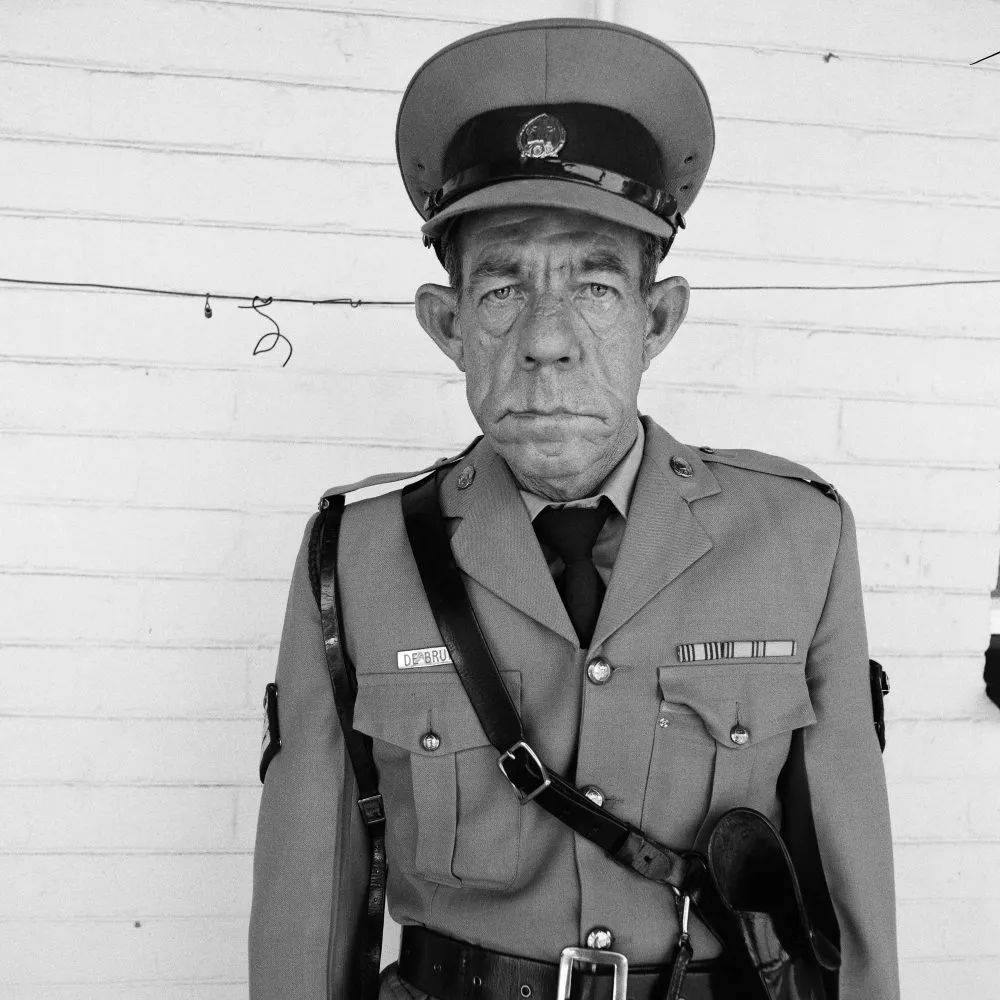
After youthful journeys to remote regions of the world, in the early 1980s the artist decided to settle permanently in the Republic of South Africa, specifically Johannesburg. During numerous geological expeditions into the continent’s interior and the South African provinces, the ambitious New Yorker discovered a world previously unknown to him: complex racial relationships, the culture of local tribes, and settlers who had arrived from Europe over the centuries. The pictures he began making in the early 1980s would form the series and publication central to Roger Ballen’s oeuvre, Dorps. In South Africa, dorps are small provincial towns scattered across the African interior. Ballen’s documentary photographs and portraits of communities small in comparison with conurbations such as Johannesburg—in the documentary style that would become characteristic of his mature practice in the 1990s—broke taboos of political correctness (Platteland, 1994). The photographer recalls his fascination with the human types he encountered and recorded on film during visits to homes, unexpected conversations and daily observations. ‘Dorps is my most important book,’ Ballen says. ‘This was where I first used the square film format, entered people’s homes and lives in both a physical and psychological sense, where I first used flash and first became interested in drawings on the walls of houses.’ While working on Dorps, Ballen shaped his mature language of expression and visual vocabulary, which he would consistently develop over the next thirty years. ‘In that series I crossed the river beyond which a photograph turns into a work of art,’ the photographer says, adding that ‘it still happens that the river sweeps me up and casts me back onto the bank I came from, but once I have reached the other side, I know I can return.’ The documentary style and way of presenting the world found in Dorps underwent further transformation and became more pronounced in Platteland (1994). Published in the same year that the apartheid system collapsed, the photobook was received negatively by critics and readers. It is hardly surprising that Afrikaner elites rejected the image of the country offered by Ballen. Photographs such as Man Shaving on Verandah (1986) and Man and Maid (1991) unambiguously challenged the carefully constructed image of white people under racial segregation. Rather than power, dignity and beauty, the brutally documentary photographs revealed alienation, anxiety and eccentricity. ‘After the book was published, not only did the art world turn its back on me,’ Ballen recalls. ‘I lost many friends, but the worst of it all were the death threats made against me.’ Threatening Ballen with death revealed the level of emotion hidden beneath the cloak of political correctness. By touching a sensitive point and provoking outrage in South Africa, the photographer had become aware that, willingly or not, his status as a significant, though controversial, artist on the Afrikaner scene had been accepted. Moreover, pictures from this black-and-white documentary series, exceptionally stark in both formal and social terms—such as Dresie and Casie, Twins (1993) and Sergeant F. de Bruin (1992)—became icons of Ballen’s photography and continue to appear in practically every important exhibition of his work. The photographs possess a distinctive atmosphere, situating Ballen somewhere between the fascination with outsiders characteristic of Tod Browning or Diane Arbus and the documentary impulse of Walker Evans, then admired by the artist, or even David Goldblatt, the South African master of social documentary usually contrasted with Ballen. Nevertheless, the photographs from the 1980s and 1990s still fit Ballen’s later, heavily staged productions, which may demonstrate the surprising continuity of his artistic path. Gradually, however, relatively simple posing for portraits that emphasised the strangeness of a situation ceased to satisfy Ballen, and his photographs became increasingly Surrealist in atmosphere, detached from reality and staged. This does not mean that the artist lost contact with reality; rather, as he says himself, he wished to process and sublimate it, ultimately seeking to eliminate chance from his art.

During the 1990s, particularly in the second half of the decade as Ballen worked on Outland (2001), the search for allegory and for otherness—an eccentricity hidden within the figures and situations recorded on film and bordering on deformity—became a distinguishing feature of his photography. Shocking, sometimes exotic motifs in the photographs meant that at the time Ballen was accused—not only by Afrikaners—of abusing power and exploiting his protagonists, both people and animals, to obtain striking, exaggerated images. Serious ethical objections impeded the artist’s career and prompted counterattacks by Ballen against the sanctimonious hypocrites who, in the accused artist’s view, worshipped political correctness.
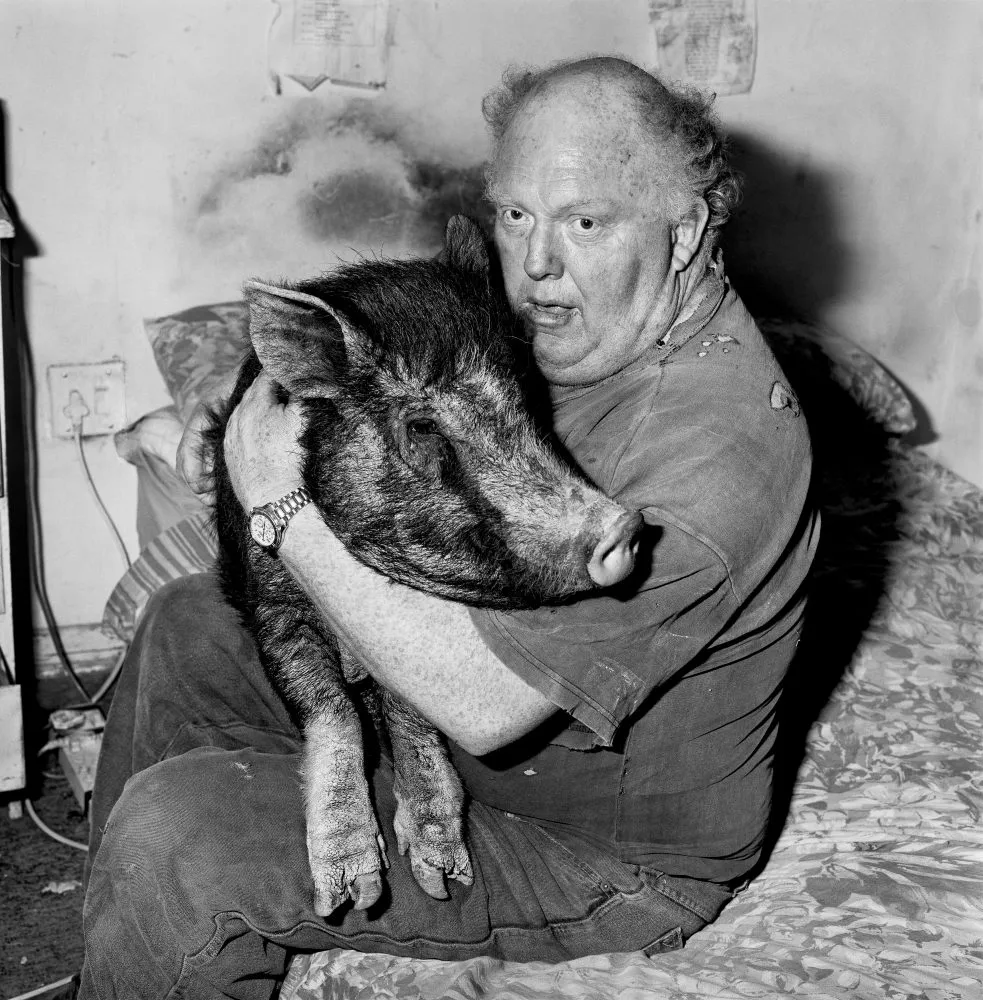
In retrospect, Ballen’s photographs do in fact appear to transgress significantly the standards accepted in a photographer’s work—and this concerns more than the kind of refined distance maintained by documentarians in the Walker Evans tradition. If Dresie and Casie seem like harmless village fools, and Sergeant de Bruin looks as though he has stepped out of a comedy or a Grant Wood painting, later photographs such as Brian with Pet Pig (1998) clearly emphasise the absurdity and monstrosity of the world explored by Ballen. The documentary period in the work of Dorps’s author ends with staged images drawn from his dark imagination and increasingly remote from its humanist beginnings (Outland, 2001). Perhaps disputes about photographic ethics around the turn of the century would not have been so intense had there not been a particular disruption of representational orders in Ballen’s work at the time. In those photographs, the form remains documentary, but the content is already strongly Surrealist.
Social strands clearly present in the early Dorps (1985) and Platteland (1994) series, devoted to the white minority inhabiting South Africa’s provinces, return indirectly in Shadow Chamber (2005). As Ballen acknowledges, it was made in the homes of and in collaboration with white residents, labourers and manual workers who had benefited most from the recently abolished system of racial segregation. Yet this is only a distant echo of the classical, humanist documentary photography that was the starting point of Roger Ballen’s photographic path.
Towards Staging
Accused of manipulating people’s images, abusing his power over his subjects, reproducing class and racial stereotypes and sensationalising difference, the artist took his critics’ words to heart. In 2003, while working on Shadow Chamber (2005), he ceased to present people directly. Instead of distinctive, more or less staged portraits, people became secondary actors in Ballen’s photographs. Reduced to fragments of the body—hands, feet, legs and torsos—they resemble things more than living beings. After 2000, successive series became dominated by austere interiors with walls covered in drawings, simple furniture, installations and compositions made from found objects and things created by the artist. ‘The human face, which had previously dominated my photography, almost disappeared,’ Ballen says. ‘Drawings and sculptural objects moved to the centre of my images in both content and form. The introduction of drawing and graffiti into my photographs enriched their meaning with another dimension; the works increasingly acquired painterly and sculptural qualities.’
Ballen’s images certainly became more metaphorical and, at the same time, more personal, existential and psychological. ‘There is nothing accidental in what I do,’ he tells Bettina Henning. ‘Every image is thought through in detail, and all its component elements are equally important.’ The formal rigour of the images Ballen creates is intensified by the use of black-and-white photosensitive materials. What had until recently been a technical requirement—during Ballen’s youth, analogue colour photography was more difficult for amateurs to master and therefore less accessible—became stylisation and a purely formal gesture in the twenty-first century. Asked about his use of black-and-white materials, Ballen responds directly that after years of working in this way, he simply ‘sees in black and white’. The contrast emphasising tensions in a country dominated by apartheid politics gives way to a tonal range of greys which critics such as Bettina Henning describe as ‘subtly alluring’. At the same time, Ballen’s staged series (Chamber House, 2005; Boarding House, 2009; and Asylum of the Birds, 2014) do not dissolve into tonal subtleties. On the level of individual images and entire series, they refer to art history and to a dark tradition of Expressionist, distorted and decadent art. On the other hand, Ballen’s works are constructed around a factor so essential to photography: artificial light, specifically flash. ‘Flash makes the images seem hyperreal,’ the artist emphasises, adding that with such illumination ‘everything in the photograph, even the smallest detail, is visible and has its own significant place’. The artist deliberately makes the image graphic and flattens it, thereby further disrupting perception (Skin and Bone, 2007). He does not shrink from cruelty (Severed, 2007; Hanging Pig, 2001), the grotesque (Lunch, 2001) or parody (Loner, 2001).
After 2000, the sociopolitical aspect dominant in the documentary series gave way to a clear fascination with psychology. Ballen not only cites his reading of Carl Gustav Jung but speaks directly about his works as emanations of his own psyche. ‘I never thought of myself as a photojournalist or a politically and socially engaged photographer,’ the artist says in a recent interview. ‘In my view, political transformation has its origins in the human psyche, so if my photographs transform someone’s psyche, they also affect that person’s political consciousness.’ It follows that art transformed Ballen himself above all. The need to record South Africa’s rapidly changing reality during the 1980s and 1990s gave way to the work of the imagination. It is hardly surprising that in recent years Ballen has not been afraid to declare that ‘there is no longer any certainty about what is real in this world and what is not’.
Ballen’s photographic and artistic vision does not easily submit to a conventional art-historical analysis, but this still appears more promising than descending into the depths of Jungian psychoanalysis. The artist is conscious of his entanglement in the history of art and photography. ‘At present I spend more time studying art than photography,’ he says, giving examples ranging from Neolithic cave painting to Abstract Expressionism. The photographs of the last decade echo not only gestural painting (Jackson Pollock) and art brut (Jean Dubuffet), but also 1980s New York Expressionism (Jean-Michel Basquiat) and early street art—the motifs on the walls resemble a primitive version of Keith Haring. Ballen adds Francis Bacon and Pablo Picasso to his inspirations. Searching for inspiration in indigenous African art would seem a banality too. The truly Baroque atmosphere, horror vacui and motifs taken from the iconography of old painting mean that some of Ballen’s photographs may evoke fragments of late-medieval altarpieces, particularly scenes of infernal torment; fantastic visions by singular great masters such as Hieronymus Bosch; or Francisco Goya’s pinturas negras. Ballen’s staged visions, however, have been stripped of metaphysics and of any sense of the sacred. It is no accident that religious motifs appear exceptionally rarely in the photographs, as if religion—and not merely Christianity or other monotheistic religions—were fundamentally alien to this world. A crucifix appears in one photograph (Loner, 2001), but it is a kind of parody with a crucified little doll, recalling Martin Kippenberger’s provocation (Zuerst die Füße, 1990). Characteristically, in Ballen’s staged scene the word ‘GOD’ is placed beneath the cross as if to remind us what it means—INRI would presumably have been too illegible. In this sense, Ballen’s photographic stagings are a kind of desublimation, an abandonment of the great iconographic tradition—with which Joel-Peter Witkin, often invoked in this context, wrestled—and an attempt to create an imaginary of his own.
Ballen’s art combines a fascination with the primitive and with subtle beauty concealed in everyday life (Vase and Skull, 2007). At times it loses itself in its eclecticism, only to rediscover itself in a play of opposites and a madness of motifs. The black-and-white photographs are built around opposing pairs: strange/normal, people/animals, motion/stillness, strong/weak, tangled/simple.
The images contain no harmony; instead, they are dominated by a state of continual tension and uncertainty. Absurd juxtapositions emphasise strange and problematic relationships between elements that, in the artist’s view, are equally important. The motifs and things in the photographs also form an original, not to say insane, list. There are snakes, rats, chickens, zebra skins and the skulls of unspecified animals, cats, pigeons, ducks, dogs, body parts—hands, legs, heads—cut wires, tangled ropes and knots. The texture of the walls, the roughness of a table, dirt on the floor, the arrangement of folds in fabrics, unfinished drawings and careless graffiti are important. What is absent from the photographs seems equally significant. Comparison with the master of staging Joel-Peter Witkin clearly reveals the absence of repeated iconographic motifs and parodies of religious symbols, as well as a quietening of sexual undertones. The absence of women from Roger Ballen’s photographs is likewise surprising.
Ballen describes his working method as a photographer-director only briefly. He always emphasises, however, the role of those invited to collaborate. This is not a simple matter of being present on a carefully chosen set. Instead, there is a kind of intense performance for the camera: making things, drawing on walls and interacting with animals and objects. Roger Ballen is an artist today and thus, paradoxically, distances himself somewhat from photography—a medium as simple to use as it is unpredictable in a maker’s hands. In photography, he is now inspired more by Surrealists active between the wars than by documentarians. He responds to his position as a guru with a degree of disbelief and humour. He does not hide his early works in the archive. On the contrary, he shows them alongside the latest series, emphasising that in his view it is precisely these newest photographs that are fully mature, complex and genuinely his own. This is his opinion, though one can also agree with certain critics who fault Chamber House or House of the Birds for insistent stylisation and even pretentiousness. While valuing the ‘early’ Ballen for the acuity and authenticity of his view of apartheid reality, one should not hastily reject the ‘new’ one. Too much, after all, connects document and staging.
The question of what Roger Ballen’s photography is actually like remains, in truth, open. Ultimately, Ballen is somewhat like a Die Antwoord track. Paraphrasing the hit’s words to the rhythm of rapped rave, one might say: what he does is strange, to put it mildly, but everyone likes it very much. I fink he’s freeky and I like him a lot.
*Adam Mazur (b. 1977), critic, art historian and American studies scholar; graduate of the Graduate School for Social Research at the Institute of Philosophy and Sociology of the Polish Academy of Sciences; lecturer at the University of the Arts Poznań. From 2002 to 2013, curator at the Ujazdowski Castle Centre for Contemporary Art (including the exhibitions New Documentarians; Red Eye Effect; Schism: Polish Art of the 1990s; and The Unrepresented World). Author of books including I Love Photography (2009), Histories of Photography in Poland, 1839–2009 (2010) and The Decisive Moment (2012). Editor-in-chief of Obieg from 2004 to 2011. Editor-in-chief of Szum since 2013.