
Space Gives Birth to Light
Robert Rabiega in conversation with Piotr Grobliński
Piotr Grobliński: What is the point of giving every painting the same title? It does not make writing or speaking about them any easier…
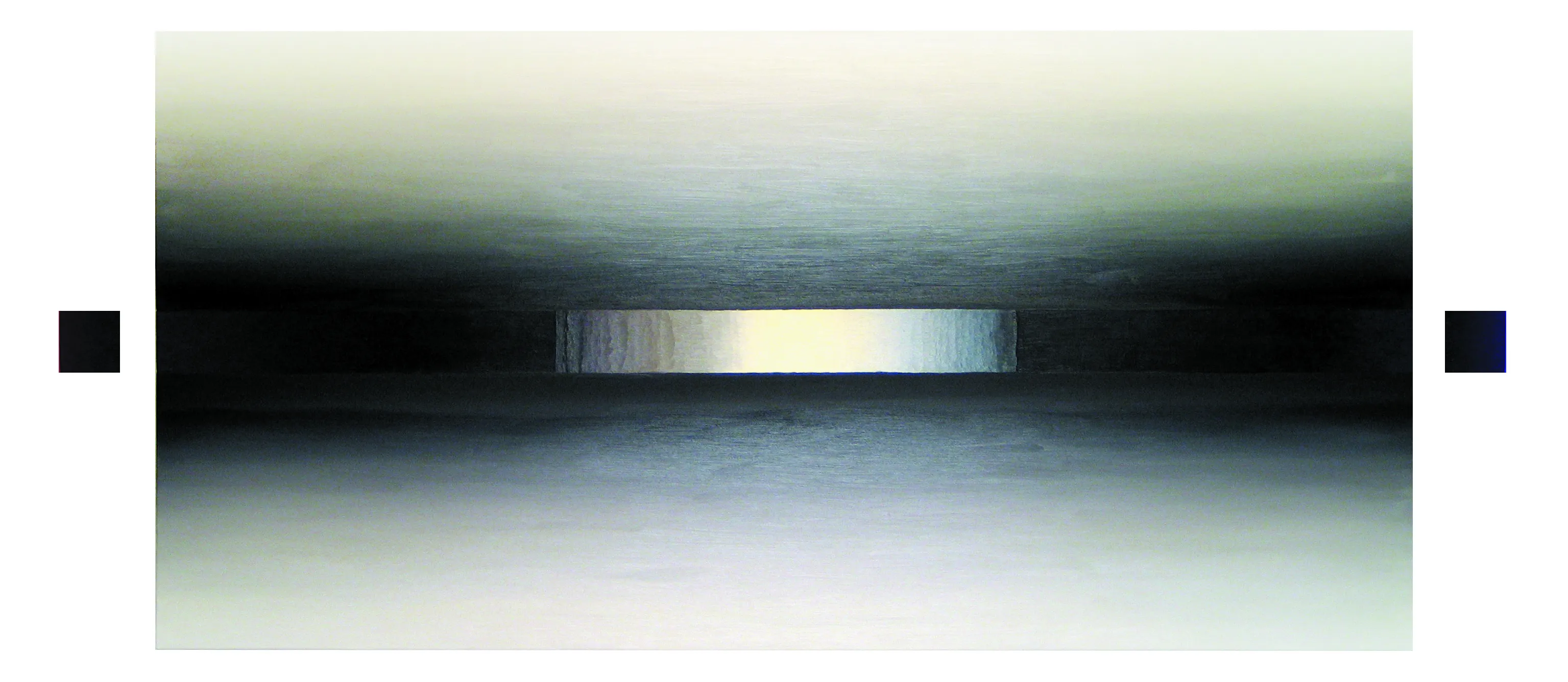
Robert Rabiega: On the contrary, I think it makes it harder… I make studies of space. It is a kind of spiritual search, but also something I would classify as scientific painting, inspired by science and discoveries in astrophysics or cosmology. We always investigate space from the beginning; each time we discover it in some different way and wish to see a different kind of phenomenon. Yet in reality—even though it is always something different—it remains, continually, the same. So it does not matter whether I call the paintings Study of Space 1, 2, 3…, date them, or add terms in brackets, such as the uncertainty principle or the theory of relativity.
P. G.: You said “scientific painting”. Are these studies of the concept of space, or studies of some particular space?
R. R.: There is no such thing as a particular space. There is light and matter, and their inseparable interdependence. And finally—or perhaps above all—there is space, which sometimes, entirely unexpectedly and inexplicably, gives birth to light and matter. Light and matter are elements without which we would have no awareness of space. For me, space is an abstract concept, like a point or zero in mathematics: something with unlimited creative potential.
P. G.: Could one say that these paintings are landscapes? That they depict particular places?
R. R.: Landscapes—yes; particular places—no. I am concerned with phenomena approached from this scientific perspective. Although referring to science is by no means necessary, since I am not an illustrator of physical laws. I paint states of consciousness; they are more like inner landscapes.
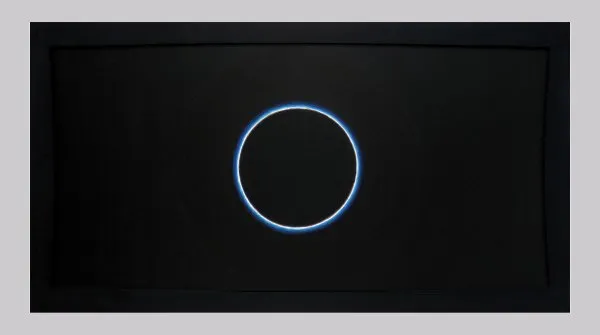
P. G.: Elements of the mandala also appear here, and, on the other hand, mandorlas. Are there two traditions behind your painting?
R. R.: Even three, perhaps four, perhaps ten. Art has been shaping its traditions for millennia. I would not distinguish between Eastern and Western spirituality within religious tradition. I try to absorb the broadest possible spectrum of ideas. The three aspects that can be analysed here are the religious, scientific and artistic. These are three paths of humanity’s spiritual development.
P. G.: Gierowski’s name must have been invoked many times in connection with these paintings. I would see stronger references to Jerzy Nowosielski.
R. R.: I think that I simply address matters and problems similar to Gierowski’s. I investigate them in a similar way, and so the path and the elements in the paintings are similar. I value him as a painter; he is my master. The same is true of Nowosielski and Łobodziński. It is difficult to manage without masters.
P. G.: So in art you favour continuation rather than rupture?
R. R.: I belong to the kind of artists who prefer to work within a canon, to read it and move further. Every canon, whether that of the icon or of abstract painting, offers an artist the opportunity to inscribe themselves within certain principles.
P. G.: But the canon of abstract painting is not as clearly defined as the canon of the icon. Does it provide more freedom?
R. R.: I think every canon has room for creative freedom. Take Rublev: he worked within the canon, yet we can see that it was this artist and no other. Similarly Nowosielski, who also painted icons while also painting abstraction—which is also an icon.
P. G.: Your encounters with masters…
R. R.: Andrzej Łobodziński taught me composition. He is a brilliant artist and teacher. He can speak about complex matters clearly and simply. Even if not all his guidance reaches first- or second-year students immediately, it proves invaluable during the first attempts to find one’s own path. That is when Łobodziński comes back to mind. But for me there are also Malevich, Mondrian, Reinhardt and Stella. You look at what they did and try to find a path towards yourself.
P. G.: To go one step further?
R. R.: Naturally, one cannot begin by looking at Mondrian or Malevich and wanting to do something more. They had already reached the limit.
P. G.: What can be taught in art?
R. R.: The same as in other fields: thinking, constructing one’s own consciousness. After graduating, I began teaching myself; I had an episode of that. I gave it up. I regret it a little, because I think the students liked talking with me.
P. G.: Did leaving the academy give you more time to paint?
R. R.: I stopped painting altogether. For six years I worked in advertising and ran an agency. I made quite a lot of money, but felt that I was beginning to regress, to think in very simple categories.
P. G.: Let us return to your interest in science. To what extent is it serious and professional, and to what extent amateur?
R. R.: When I became interested in astrophysics towards the end of my studies, I had to return to the basics; now I think I am at secondary-school level. I do not need any more. The best physicists, moreover, can speak about extraordinarily complex things in a highly vivid way.
P. G.: Is physics a better language for describing the world than art?
R. R.: It is the same, equally valuable. Physics, religion and art all seek the truth about what existed in the beginning and what will be there at the end. I draw from physics only what overlaps with my interests. It is not the case that I find a subject in a textbook and try to illustrate it.
P. G.: People in the humanities are sometimes seduced by certain names, such as the “uncertainty principle”. They invoke them with little idea of what they mean.
R. R.: There is nothing wrong with allowing oneself to be seduced; entering blind alleys can be creative. What I am about to say may be heresy, but I think a good painting can be built upon a false understanding. Sometimes a single sentence of inspiration is enough; one can add the rest oneself.
P. G.: That is a little like a child’s confabulation.
R. R.: There is something of the child in an artist.
P. G.: Can things seen in the street also stimulate the imagination?
R. R.: Sometimes, sitting on a bench, we look at something and cannot name it because it is illuminated in such an unusual way. Or after waking, lying with our head upside down, we look at an object that has stood on a shelf for many years and do not know what it is.
P. G.: Do you envisage any particular model for the reception of your paintings?
R. R.: There is no such thing as a model of reception. Some people already know something about art and a certain kind of painting reaches them. Others possess a similar sensitivity and receive abstraction intuitively. Still others have stopped at the stage of landscapes—you can naturally translate abstract painting into a language they understand, show them the verticals and horizontals and prove that there is no fundamental difference.
P. G.: Does it convey a different kind of knowledge?
R. R.: In the first case, we describe the sensory reception of phenomena; in the second, what shapes them.
P. G.: But why not picturesque views? The unprepared would have something for themselves, while the better educated would see the principle anyway.
R. R.: But I paint neither for the better prepared nor for the less prepared. For me, the time of picturesque views is over. I learnt to paint them with an ape’s dexterity and wanted to go further.
P. G.: Does painting trees and the sun interfere with showing what constructs them?
R. R.: It can interfere with reception, because we see only the trees and not what is concealed behind them. Besides, we have photography and film; we see a realistic image of nature on television.
P. G.: And in abstraction one can penetrate to the essence of things?
R. R.: One can try.
P. G.: You say that rather timidly…
R. R.: Of course timidly. I am not so conceited as to claim I have succeeded in revealing the world of Ideas.
P. G.: But does the world of Ideas exist? Are ideal patterns concealed behind things?
R. R.: Of course. Except that by believing in them, we fall into a kind of determinism: the world is as it is and will not be otherwise; we can only discover it.
P. G.: That seems a difficult conception for artists to accept, especially avant-garde artists.
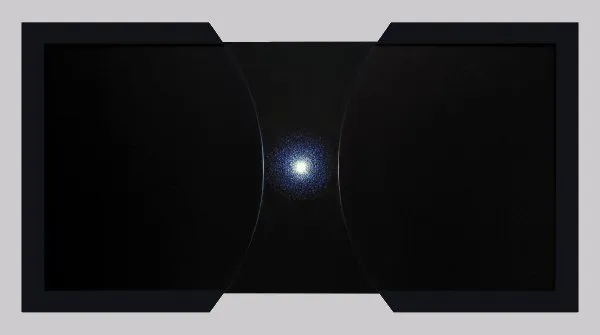
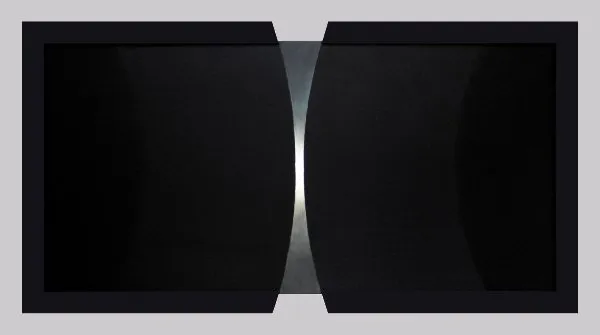
R. R.: No. Anyone who considers themselves a creator is mistaken. The avant-garde tradition fits neatly here—we discover the construction of the world, but do not create it. Although according to Heisenberg’s principle, things come into being when they are observed; they begin to exist at the moment of measurement. In describing the world, in a certain sense we create it. In my paintings, light appears from nowhere and suddenly disappears for no reason, or refracts for no reason. Who said one cannot construct space in this way—even an impossible space like Escher’s, only in relation to light?
P. G.: The avant-garde tradition is also connected with a certain social programme.
R. R.: Indeed; we live in Cubist blocks.
P. G.: Does encountering this art change anything in a person? In their surroundings?
R. R.: It spiritualises. But I am far removed from what I call socio-art. That is the media’s role, and they do it a hundred times better. When an artist begins addressing what the media address, they descend to the media’s level.
P. G.: Descend—so are they normally higher?
R. R.: They are higher if others have placed them there. If they place themselves there, that is bad. Being an artist consists, among other things, in being higher—although one should not say so too loudly. We are perceived as vain megalomaniacs anyway.
P. G.: Artists are to stand higher and… tell us what it is like up there?
R. R.: That too. It is difficult to speak about…
P. G.: Let us try.
R. R.: The danger is vanity and pride.
P. G.: Is modesty a virtue in an artist?
R. R.: As in every person. Why should we think of ourselves as chosen?
P. G.: Does thinking in this way destroy the person or the art?
R. R.: The person. Nothing is capable of destroying art.
P. G.: If someone believes they are excellent, will they stop developing?
R. R.: Art is a constant striving and self-improvement. It cannot be invention, but discovery.
P. G.: Of new forms or new languages?
R. R.: Both new forms and new languages. The possibilities are unlimited.
P. G.: And decoration?
R. R.: It is necessary in life, not in art. When I worked as an advertising designer, I designed packaging or wine labels. As a rule, I had to persuade clients, who earnestly wanted to ruin everything, to let me make it attractive. People simply feel better among attractive objects. It is a natural need to embellish…
P. G.: If it is natural, your painting has lost something natural.
R. R.: But my paintings are decorative.
P. G.: Incidentally?
R. R.: We are discussing aesthetic categories—something can be pretty or beautiful on two levels. Finding truth in a painting is beautiful; the unity of work and world within it is beautiful. But there is also another level—a well-chosen colour, purely painterly decisions…
P. G.: And what is the force of purely painterly decisions?
R. R.: Among painters there is an expression, “painterly flesh”. It concerns what Rembrandt, Monet, Renoir—all the greats—possessed. What it consists of is difficult to say. I think at this point we return to the concept of truth. The emotional perception of nature and colour must coincide in the painting.
P. G.: Is painting colour?
R. R.: Malevich showed that it is not necessarily so.
P. G.: Where, then, does painting’s irreducible essence lie?
R. R.: The essence of painting is its history. There are no revolutionary upheavals in painting; even Malevich grew out of the icon tradition. He was able to contain everything he knew about painting within that white square.
P. G.: Does this not become art for graduates of the Academy of Fine Arts?
R. R.: It can always be explained. Every painter should at least be able to explain to themselves what they are doing—that is, simply be a conscious artist. Ideally, they would be able to explain it to others. But there is no obligation, and besides, erudite artists are rare. After periods of isolation and confinement in the studio, I sometimes find it difficult to verbalise my thoughts. The quantity of impressions and information I would like to communicate is so great that I either fall into chaotic babble or excessive pathos once I get going.
P. G.: Is that where the role of criticism appears?
R. R.: Critics, including people who interview artists, have precisely this task: to reveal the value of a work, if any exists.
P. G.: What is your working rhythm?
R. R.: I get up at six and paint. I sit before the canvas every day; sometimes I only sit and look, and sometimes I paint. I do not set myself an amount of time to devote to painting.
P. G.: And when a day comes when you do not feel like it?
R. R.: Most people have a boss at work who motivates them. No one imposes any discipline on me, so I have to keep an eye on myself.
P. G.: What helps when you paint?
R. R.: Listening to music is very important, especially music that enables concentration. I listen to Bach and the Minimalists. Reich, for example, is a kind of mantra: the same sounds over and over for eleven minutes, except that they build up and loop.
P. G.: Do different paintings arise depending on the music you listen to?
R. R.: It is the other way round: my mood demands particular music. It may be Bach, or it may be hard rock.
P. G.: Or perhaps, in painting space, you are painting Bach or Reich? Subconsciously.
R. R.: The point is for everything with which we surround ourselves, the way we live, to allow us to find the right rhythm.
P. G.: Do we construct this rhythm, or does it construct us?
R. R.: At a certain point, it begins working in both directions. Harmony has to be preserved.
P. G.: Does that mean that if you hear cheerful birds during your morning walk, you play sad music when you return?
R. R.: I do not think that way; I do not rationalise it.
P. G.: Or perhaps you think: I cannot watch that film, although I want to, because it will poison my mind and disturb the harmony?
R. R.: There are many temptations, many things one must deny oneself.
P. G.: In order to paint well?
R. R.: In order to paint at all.
P. G.: So what must an artist give up?
R. R.: Everything that gets in the way. However pathetic it may sound, when one feels a vocation one should reject everything that distracts us. We mature on different planes and, unfortunately, not on all of them in parallel. Hence many mistakes—ordinary ones connected with life. There are casualties. In my case it was my family. As a husband—the so-called head of the family—I do not think I passed the test. As a father, I try. My daughter will give me my report card one day. It will be issued by all the casualties of my need for peace and quiet. I do not claim that family interferes with creative work; I am far from such generalisations. It was I who failed. What else? I do not stare mindlessly at television, I do not read newspapers and I have a very limited social life. It is a vocation, like that of a priest or doctor.
P. G.: Is that why the studio is a little like a hermitage?
R. R.: Well… supposedly people create the atmosphere of the places where they live. If that is how you perceive it, perhaps there is something in it.
P. G.: Elements of a frame superimposed upon the image appear in your paintings. Does this frame have a symbolic meaning? Does it function as a sign?
R. R.: As an element of the same space that exists within and beyond the painting. It is an element of the same structure, allowing me additionally to define compositional directions, to close some places in the painting and open others.
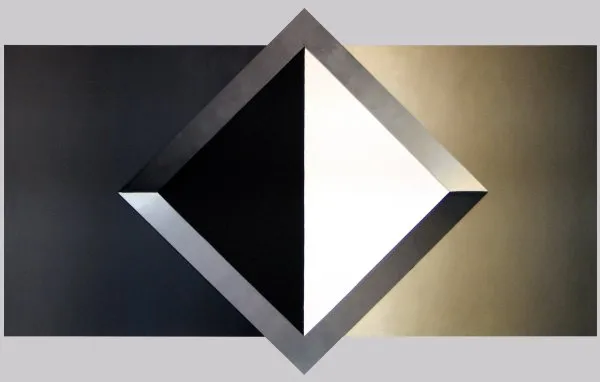
P. G.: Yet in reception it remains a piece of frame; the traditional meaning stays somewhere in the background.
R. R.: Yes, the traditional frame is invoked here, except that it separates and connects simultaneously. Tension is constructed at the frame.
P. G.: Every cut emphasises the unity of what is cut. Like borders.
R. R.: My painting on frames reveals the artificiality of borders. The boundaries of paintings are conventional, like national borders.
P. G.: Or perhaps, in wishing to study space, you should have taken up sculpture?
R. R.: There will be two large paintings at the exhibition, displayed by being suspended in such a way as to show how much they have in common with sculpture. It is a kind of painting-out of space. Kobro’s works are called sculptures, but they might be called spatial paintings.
P. G.: Does the concept of the visual arts still make sense? Actions, installations, films…
R. R.: I have not yet seen a good action. I saw several and gave up. For me it is socio-art: an inept, and increasingly often foolish, attempt at self-presentation. “Artists” operating in these areas try to persuade us—or perhaps more themselves—that they reveal weighty problems of this world, that they care or worry about the human condition. I would rather spend the time reading Dostoevsky.
P. G.: Or perhaps painting is an archaic discipline? Some say that it has had its day, that everything in painting has already been said.
R. R.: That means they know nothing about painting. Although—as some claim—everything has already been said, everything can still be said.
P. G.: When painting abstractions, you face the necessity of maintaining absolute perfection of shape and purity of colour. That seems also to have been Malevich’s problem, because a yellow square on a grey ground would already be a failure according to his premises.
R. R.: Yes, precision matters; it is important. My geometric forms are even and precisely defined. As far as colour is concerned, I leave my gesture. Something is simmering within that form, and through it energy is born. But time takes its toll and works against these paintings more strongly than, for example, against a portrait. Moreover, technologically speaking, we paint rather primitively today. Rembrandt’s paintings darken only a little; Malevich has crumbled.
P. G.: Inferior paints?
R. R.: No, we are simply in too much of a hurry. The pace of life affects us in this way, as do exhibition deadlines. I now have a large solo exhibition, and I have also been invited to take part in a group exhibition. But I know I shall not manage to paint new works for both. On the other hand, I would like to make a living from this…
P. G.: Do you smoke more before an exhibition?
R. R.: Always the same amount. Since I was eighteen, two packets a day. But when I paint, the cigarettes burn themselves down, so in a sense I smoke less.
P. G.: So the more exhibitions, the healthier one becomes…