

OK, a Visualisation — a Flat Preview for Now, but at the Right Scale and in a Specific Place.
Another picture, and already a bit of concrete. Just on the corner, also a little at the crossroads: nostalgia, one's own strengthlessness and an overseas mirage. It can be an argument for the fact that sometimes the middle of even such short streets runs Way of life.
Hopper has made up the pub in such a way that whether we want it or not, we will endlessly wonder what flavor the americano from the jug serves inside (night). After all, this is not espresso, cappuccino, marocchino or granita. You can feel the stinginess of what the future offers in this painted drink. And the nearest - even before dawn - hours and the next years, maybe decades, do not tempt with a range of impressions. As in the real American, colour rather than taste keeps us on our feet, strengthens, gives a moment to gather thoughts; what next?
Hopper painted the picture in such a way that everything is a little too little in it. Too little traffic to pay off, too little life to be stuck in this (that) city. Not enough details for the detective sitting behind to be able to say anything about the past and future of this place.
What will happen to him, what will happen on this corner, let's say, in eighty years?
Come on, it's one turn too late if we think about such nonsense, instead of focusing on the sharp profile of this red shadow. Why is there no ring, wedding ring, necklace, not even a brooch. If we sit here for the next two queues, a bizarre, alien thought will come to mind that the whole corner, which is ripples and wobbles more and more slowly, will begin to drift towards Europe. On the way, you don't know how he will overcome an incomparable distance. When the ark finally settles in the middle of nowhere (i.e. if you believe Alfred Jarry in the middle of e.g. Polish). It will be somewhere around next Friday, before midnight. There it will wave even more and turn into an afterlife, neon spectacle of urban life "madeinchikago".
Let's order another queue and change the subject. Professional art historians supposedly have irrefutable evidence that Hopper did not paint icons. I wonder where they got them from? They probably looked through the personal folders, and these, as you know, are neatly arranged according to their geographical location. There is no need to look for Hopper's folder: Orthodox East, Finnish Africae Or Monster ex oriente. The Russians won't confirm it either, they don't care about a Yankee painter. Well, but like burying deeper, regretting, taking two days off and wasting them on this corner, on sterile observation of only this one place. As if to sit here until the end, staring at the thin, like americano painted details. So thin that you can feel the coldness of nothingness underneath. Seasonality and horror of the whole city. Exactly, what if Hopper was dipping his fingers in the illegal painting of icons of nothing? It can make a good pate. If the French find out about it, they are ready to start chatting about simulacras, disneylands, deepfakes right away. North is right, it must be stopped before it grows. Who needs it here Maladie française? Who orders doubt, at this time?
Let's not order anymore, let's just take a cigar at the end, no, not for 5 cents. It is supposed to help us see something that still escapes us. The habit of looking at images through smoke is terribly old and strong. As if you could notice something in the smoke itself. Already after midnight? Which one do we have today: 2022? It flew away. Let's go out to smoke on the street, it's terribly healthy to live in cities now. On the other hand, the dark side of the street can be seen better. You can see that we are looking at a few separate solitudes in a well-lit void. You can see it on every other corner of the city. Here, however, maybe through the smoke we look at the window of the pub, and loneliness as if Captain Nemo with his hands folded stood on the bridge of the unreal Łódź underwater and looked at the Southern Cross. We remember, we remember.
Half of the books at that time had black and white lithographic illustrations by Gustav Dore. There were no comics yet. These were probably pictures, on one Nemo, turned backwards, looked through a large panoramic illuminator at some deep-sea monster winding behind the armored glass. On the second, just like a worker on the famous poster of Włodzimierz Zakrzewski from 1968, he held a large steering wheel and looked straight into the glow flowing through the round bulay. I mean captain, yet lonely. What was the name of this book? Twenty thousand miles of submarine navigation I guess?
Well, that's what we have in front of us until the end of this street.
Are we sailing?
Full immersion in the night.
The first, maybe the last. Yes, definitely the last because it's corner, on the right side going from Kilińskiego Street. Ghanter tenement house, beautiful. It was from it that seventeen-year-old Wojtek Faryczny left in 1937. He went to New York, of course, he wanted to be a sailor. He was one of the few Poles to sail to the Hawaiian island of OʻahuNa. Two days before the attack on Pearl Harbor, he was shot on land and returned to America. The bullet got stuck in the skull and did not allow Wojtek to watch the world in full sun. He worked as a bartender, but only at night. He was the first to talk about the attack. Josephine Hopper meticulously notes a dictator with an eagle nose of a detective looking around for Hawaiian girls. Is it really so hard to believe? It may be in one detective in the whole city, who under the influence of conversations with a friendly editor Chicago Daily News Thomas Sterling North, instead of reading more and more popular comics like most (North said they were growing like a "poisonous mushroom"), he decided to pick up a French piano teacher, fascinated by Parisian freaks from artistic bohemia? Is it easier to believe in a culture that globally excites itself with batman scraps between the skyscrapers of Gotham City?
Is there supposed to be a reproduction of the painting outside the tenement house? Applied to Hopper's streamlined rounded corner glass.
From the outside, great, the visualization of the feathers too!
But what's inside, which is supposed to make people from Singapore, Wellington, Irkutsk, Barcelona, Seoul or Orsha during their short European vacations want to walk between the Long Market and AUSCHWITZWIELICZKA M. Balki, or Zlaté uličky in Prague Hrad spend the evening on this very corner, resting after a day in the "Łódź movie"?
What will be seen only inside, only on this corner, in this pub?
Details.
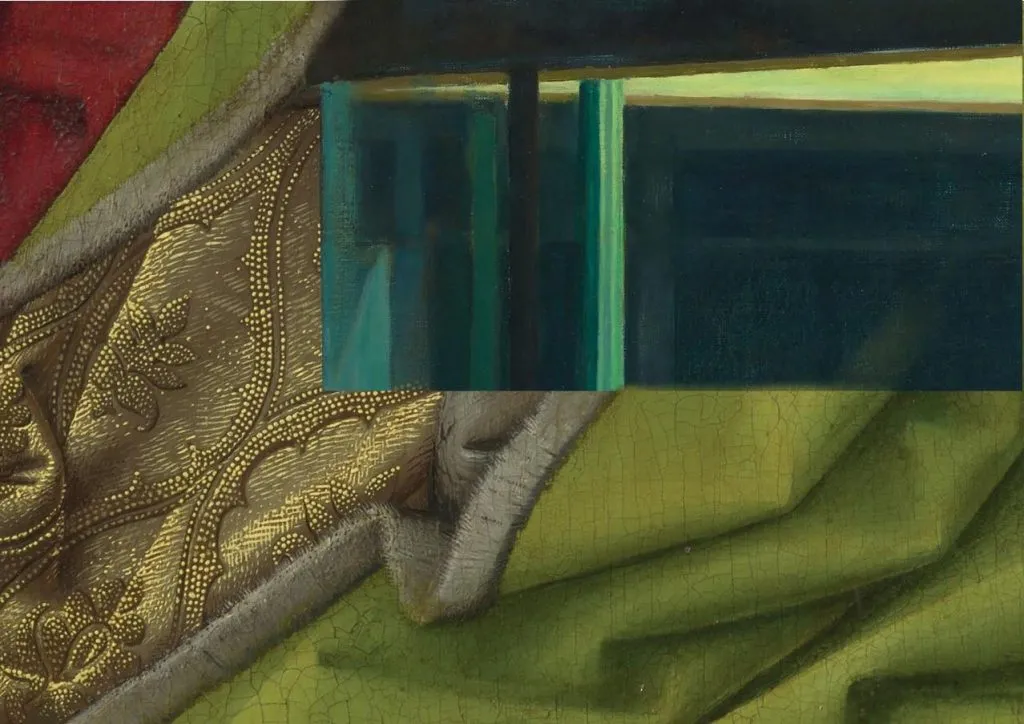
Huge as a sheet of site magnification moving, every evening different. In such an enlargement in which they cannot be seen anywhere else. Details of what? Like what: paintings, after all, this whole situation is straight out of the picture.
The operator/owner of the premises, in addition to serving americano coffee and cigars, must have signed a long-term contract with many collections and museums, with those who have the rights to reproduce the paintings. Always in detail, in detail, in the frame leading the gaze through these places that Barthes would call Punctum. Places that, seen clearly, up close explain and explain why this picture is so famous, so important. Details that keep the world in one piece, because they can tune and sharpen our perception.
In the pub, the gaze smoothly leads the sound. You can't do without wallpaper. And it should be a good taper, let's say such as Lutosławski playing in the capital's premises while Hopper paints this picture. Or even two (the other one like Panufnik playing with Lutosławski in "Lyra" or "Aria"). You come to such a pub to see and listen to how the improvised sound pulls the look through the nooks and crannies we had no idea existed. It is certainly worth starting with the jazz piano students (they are just around the corner) at the Academy of Łódź. Sometimes (e.g. in Advent) some stage beast, such as Waldemar Malicki, "Polish pianist (living)".
Paintings, sculptures, stained glass windows, sumacs, old and new. It could be Lascaux, it could be Pollock. It could be Stwosz, it could be Mueck. There may be Fang masks, Innuite and Chukchi sculptures, there may be Inca gold. Everything will be possible on Włókiennicza.
And when we get almost the whole evening with crackers Black square, what will you hear then? What Andrè Malraux invented in the late 1940s, and what comes back endlessly in museological (spookly ICOM) discussions about exposure, attractiveness, viewers, commercialization, etc., will be in this pub, on this corner. In the middle of this picture of Hopper. Thanks to this, we will avoid the French lament over the Disneylandization of museums, which was started by Jean Claire. Thanks to the plaster of americano and smoke for 5 cents and thanks to the signature of the most invented (Self made) of the image of the city of "film" we will cleverly escape the twin ghosts of elitism and egalitarianism.
So what is this Hopper tenement house? Business license for display, mounting, close-ups, close-ups.
You enter the pub on the corner and reality disappears. Only the images and music remain. If you start with this, you are unlikely to go to the next day, because you have already seen the most interesting things. It is known that you had to not go to the pub, like in the morning to the museum.
A city, every city is an assembly of desires and illusions. This, not 5 cent cigars, is the subject of Hopper's painting.
You can imagine this place as a fully professional record label that carefully selects the repertoire, signs contracts with performers, carefully records and then presses one copy of the album and plays in only one place. Do you think no one would review such records? This hopper's first copy was immediately, without a fair, bought for the whole 3 thousand dollars by some cultural institution in the city of Chikago.
There should be something inside from Enchanted districts, from a world where we feel more important than on the street, and at the same time we know that the rules are always the same here, for everyone. It's not about the waiters, but about the show, only for us, only this evening. For the first time in a long time, a show without politics. Visits to such premises should be financed by some justice among the nations fund for the spread of democracy. Because whoever once spent a day, half a day in a big museum (we don't wish anyone badly), who got tired there, honestly pissed me off, but even once he will vote differently from now on. Because otherwise he will see the world for a while. If something changes us, it's such unplanned gaps, such details (and not doctrinal Theories of vision). This is the whole educational role of Western culture. It must be a moment of private relief and rather pleasant surprise, and not a programmatic one like the area-like revitalization of "working on yourself" and "catching up with the rich".
Where is it supposed to be displayed? If technically possible, on the same big glass, only from the inside. Then we have a situation in which from the outside we see people inside watching something we can't see. Various kinds of visualizations are circulating the nets Smart glasses, the eyes of screens, etc. If it is technologically impossible to do this (it is worth trying, technological fetish is a strong attraction) you can, for example, contact prof. On. Kutner from IChF PAN, who a few years ago dealt with chiral polymers (based on thiophene).
Technically, it comes down to a local image projection system. This is important not only on this corner, but also on a few others. By dealing with street architecture in terms of: signal, frame editing, projection, it allows you to move the centre of gravity to an area whose technologies and infrastructure Łódź has well mastered, in the area of image production.
Instead of pouring concrete, you need to send a self-assembled image to the key points of the downtown revitalization project. Thus, two corners can be connected. The one with the pub and the one "on the corner of Jaracz". I think it's time for someone to tell (so far hardly anyone knows) what these points are supposed to do?
Even if the pandemic should make enthusiasts of increasing "office space" and real building realize that whether we like it or not, European cities in a decade, two will be a projection system to a much greater extent. The sooner we start learning such an assembly on an urban scale, the better we will do it.