
On Absence, Living Abroad, Memory and Romantic Brutalism
Wojtek Wieteska in conversation with Barbara Piwowarska
Barbara Piwowarska: We met a long time ago, in Warsaw in the 1990s, but I have the impression that until around 2000 you spent half your life outside Poland: Paris, Berlin, New York, Tokyo. At least you were not here during the communist period and your childhood… So you began photographing Poland after returning from abroad, following many years of emigration?
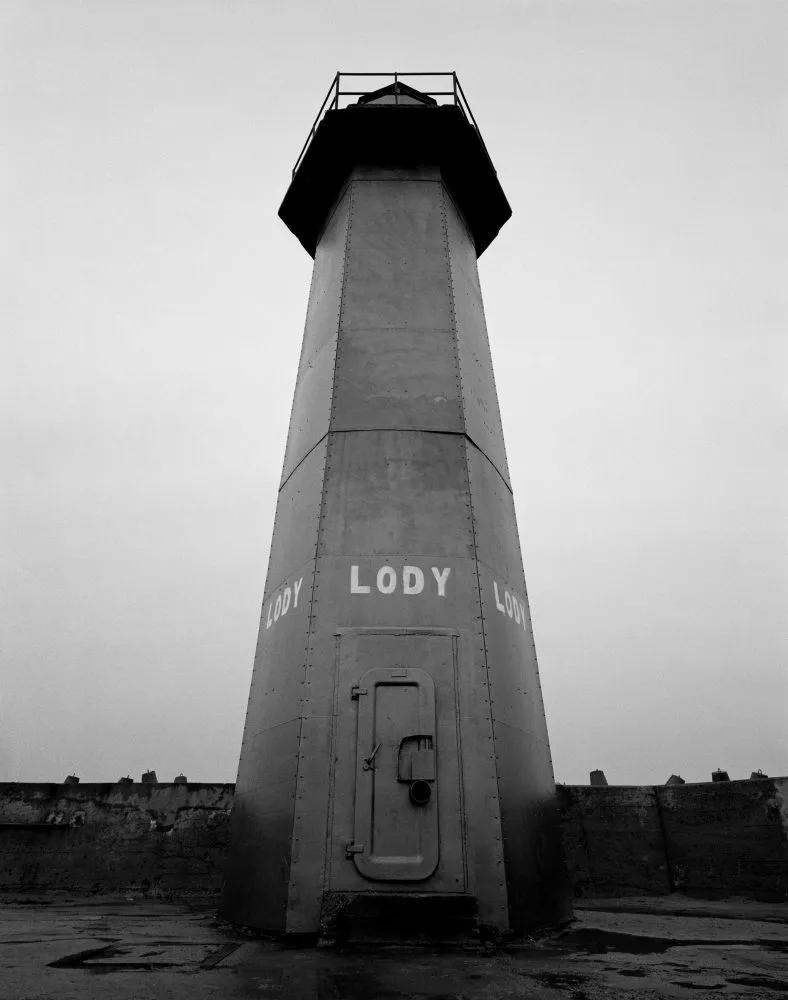
Wojtek Wieteska: Yes, I was away for much of the 1970s and 1980s. I returned to Warsaw from Paris in 1985. When I began photographing Poland in 1986, I was twenty-two and had spent thirteen years abroad: eleven years, with intervals, in Paris and two in East Berlin. And these were the most important stages of life: starting school, learning, secondary school, final examinations and university. I arrived with a powerful memory of Berlin, where we had lived twenty metres from the Wall. I still remember the grey view from the window; everything remains in my memory in black and white. Berlin, not Warsaw, was my immediate point of reference for the reality of the Eastern Bloc. That was my perspective and the context in which I photographed Poland after 1986: I return, I feel foreign, I think in French.
B.P.: Exactly — so you did not know this Poland at all. You were a visitor from the West. It must have been a shock, completely exotic.
W.W.: Yes, it was exotic, a culture shock. So much so that when I landed at Okęcie in the autumn of 1985, on the way back from the airport I had the impression that Warsaw was a dead city after an atomic explosion, only just beginning to recover and return to life. Remember that gaps in the urban fabric were still architecturally visible then. To someone like me, they were extremely conspicuous and drew the eye. Plac Trzech Krzyży, for example, practically did not exist along a third of its perimeter; in the 1980s, all the buildings that now enclose it were absent.
B.P.: Am I right in thinking that the first photograph in the exhibition is one of the first you made after returning, in 1986? It contains products that probably have not existed for years — Pollena nettle shampoo…
W.W.: And Przemysławka. Yes, it was the first photograph after my return: a still life with a window, windowsill, spectacles and my grandfather’s belongings, made in the village of Niemgłowy Colony, twenty kilometres from Rawa Mazowiecka, where my grandparents had a house. So that was the leap: from Paris to the Polish countryside. Looking back, I see that these apparently contradictory strands or “leaps” intertwine and are always preserved in memory as black-and-white afterimages. My first remembered view of Paris as a child is a street market and a small white Peugeot squeezing through it with a huge pig loaded across its bonnet. The later motif of pigs, cats, abattoirs and butcher’s shops is really a reminiscence, an afterimage of that scene in Paris. I think this is crucial: in images from Poland I discovered the memory of images from entirely different, radically dissimilar places. These are motifs I choose subconsciously; one might say they reveal the operation of my memory, from the inside out.
B.P.: Precisely. And the photographs from the streets of Warsaw, Kraków and Łódź resemble your New York pictures: they have a similar light, and the figures and details are framed in a similar way.
W.W.: Yes, although similar urban motifs, fragments and details actually appear as early as the Tokyo series. They could all be juxtaposed. Everything permeates and overlaps. Between 1986 and 1989 I stayed in New York periodically and spent every summer there, and in 1990 I worked there for a year. After Paris, then, I was discovering New York at the same time as I was learning about Poland.
B.P.: In New York you had a rather unusual working relationship. You were a painter in the studio of Mark Kostabi, an artist who was very popular at the time.
W.W.: I painted pictures for him and photographed him, as well as his surroundings, exhibition openings and New York’s art scene. I had to learn to paint like him: assistants painted the pictures and he signed them. It was a very strange and interesting experience, somewhere on the border between art, kitsch and commerce.
B.P.: Yet the crucial period in the formation of your vision and artistic awareness probably came mainly during your life in France. You spent your childhood there, studied there and began working with photography there.
W.W.: In France I went through every standard stage of education, from primary school to university. When I arrived I entered the third form, but I did not know French, so someone had the brilliant idea that I should also attend the first form until midday, where children learned their letters and wrote in chalk on small slates.
And got their knuckles struck with bamboo switches. Really: children were punished for misbehaviour not with a ruler but with bamboo, and during breaks we played marbles outside — just as in the film Amélie. It is true that what matters is that I learned photography and developed my artistic taste in France. My father wanted us to document our stay, so he bought a camera. By seventeen, I had my own darkroom and was teaching myself everything: enlarging, developing prints and so on. Then I photographed beautiful, romantic Parisian scenes beside the Seine on a grand scale, like most young photographers, because Paris itself invites it.
B.P.: So you remembered absolutely nothing of martial law or the fact that there was nothing to buy in the shops?
W.W.: Exactly. I was immersed in Paris; it shaped me. I took no part whatsoever in what was happening in Poland. Nor was I affected by the trauma of the period, and I did not respond to that reality in any way. Quite the opposite: those photographs from the early 1980s were stylised in the manner I used at the time, highly classical, and could just as readily have come from the 1940s. I photographed Paris and was interested chiefly in the celebrated photographers who had portrayed it, but also in the problem of truth and falsehood in photography — itself a classic question. I tried to see how photography misrepresents reality. The characteristic couples beside the Seine, for example, whom I also photographed, were portrayed by every twentieth-century French photographer, from Cartier-Bresson, Atget and Brassaï to Man Ray. This group interested me because I could directly observe the reality they had photographed, visit the same places and alleyways. I could buy a postcard with Bresson’s photograph of a kissing couple, then moments later see the same scene and take a picture myself. It was an experience of essence — both the city’s and photography’s — of a gesture at once repeatable and unrepeatable. It was a Romantic experience.
B.P.: I think that experience is also reflected in your Polish photographs. In the 1980s, you photographed Poland as romantically as you did Paris. Only the alleyways were different, the reality brutal and the scenes more exotic, at least for you. There is a similar concentration on the object and the detail…
W.W.: Yes. In Poland I was fascinated, for example, by pyramidal arrangements of jars of pickled cucumbers in grocery-shop windows. Detail appeared with my first visit to Tokyo in 1991; over the following four years I returned there for extended stays. I had the impression that the reality I encountered was fifty years ahead, a futuristic vision filled with a million lights and objects unfamiliar to me. So much was happening that I began to isolate and “cut out” details in black and white. Detail became my tool of interpretation, the only way I could experience and attempt to understand this reality. Contrary to appearances, this was not stylisation. The clamour of Tokyo forced me to focus on detail, which is why the series is exceptionally true. None of the photographs was staged; all date from the 1990s. I was already applying experience gained at the Film School, where I studied in the Cinematography Department and encountered film and the methods of exposing negatives characteristic of cinematic techniques. The same negative anyone can buy in a shop may be interpreted differently by each person before the film is developed. That is what my professors, including Witold Sobociński and Jerzy Wójcik, taught us: conscious exposure, our own interpretation of the negative and its ranges, the possibilities of exposure from so-called low to high key. I returned to Tokyo especially in 2008, intending after many years to provide a coda to that experience, this time in colour.
B.P.: Are you concerned with truth and falsehood in photography? Is it similar to what the Israeli photographer Alex Levac does in his series from Tel Aviv, Jerusalem and Hebron? Do you remember that there was once an idea for a joint exhibition of your work? To me, this type of photograph is analogous to your Romantic brutalism and to the Polish cycle as a whole, made across different years. We cannot tell to what extent the photographs are staged and to what extent they genuinely record a reality encountered.
W.W.: I think what I do is completely different from Levac. I like it when we are not entirely certain what a photograph shows. I dislike photography that explains too much. Photographic misrepresentation has always interested me. Photography is, in fact, something untrue, unreal. Unlike photography, no other medium “stops”. Everything in film flows forwards; painting changes under the influence of light and pulses. In one flat hangs a small painting by Leon Tarasewicz and a black-and-white photograph by Bogdan Dziworski. Observing their relationship and their differences is fascinating. The painting is different every day: it changes, it is sensual. The photograph is constant, stable, mental. It stands still. It is only a mediating medium; everything else happens in our heads. What I try to do in photography is to move as far as possible from the possibility of translating it into verbal language. I do not want it to be translatable into other languages.
B.P.: So “this is not a pipe”? Photography is neither a language nor a grammar?
W.W.: Exactly, it is a problem of that order. Ed Ruscha, the photographer and Conceptual artist who demonstrated the grammar of photographic language most thoroughly, is extraordinarily important to me. Ruscha searches for grammatical structures in photography, for narrative and linguistic codes. I want the opposite: to move away from this kind of analytical language and free myself from it. I do not want it in the foreground. It should be transparent to every thought and association we have while looking at a photograph.