
I’m from Poland. Which Is Where, Exactly?
Krzysztof Varga
I am from Poland — easily said. Yet after a moment’s reasonably deep reflection on the meaning of such an emphatic declaration and the associations it carries, the air suddenly becomes close, bloody sweat covers the body and, if not sadness or depression, then certainly an unpleasant thought descends upon us: a heavy, Vistula-bred variety of melancholy. To define oneself in this way requires a measure of courage and self-denial. It is far more difficult than it appears, because one must say: yes, I am from this strange country, inhabited by a nation convinced that the world does not understand it even though it is a chosen nation; a nation that at the same time nurses endless grievances against itself and cordially detests itself; a nation entangled in a cocoon of megalomania and inferiority complex at once. To say “I am from Poland” is, unfortunately — for me, at least — to say: I come from a country obsessed with its own history, which delights in flaunting the beauty of its soul and the bloody shreds of its heroic heart, yet has a basic, fundamental and strangely metaphysical problem with spatial order, architecture and the beauty of every successive metre and kilometre we travel each day. But we will not discuss our unfortunate history here, because we are dealing not with history painting or battle scenes, but with contemporary photography that is artistic and documentary at once. The point, perhaps, is that when one’s heart and soul are in disarray, one cannot impose order around oneself or manage one’s surroundings. Chaos in the mind must become chaos in space.
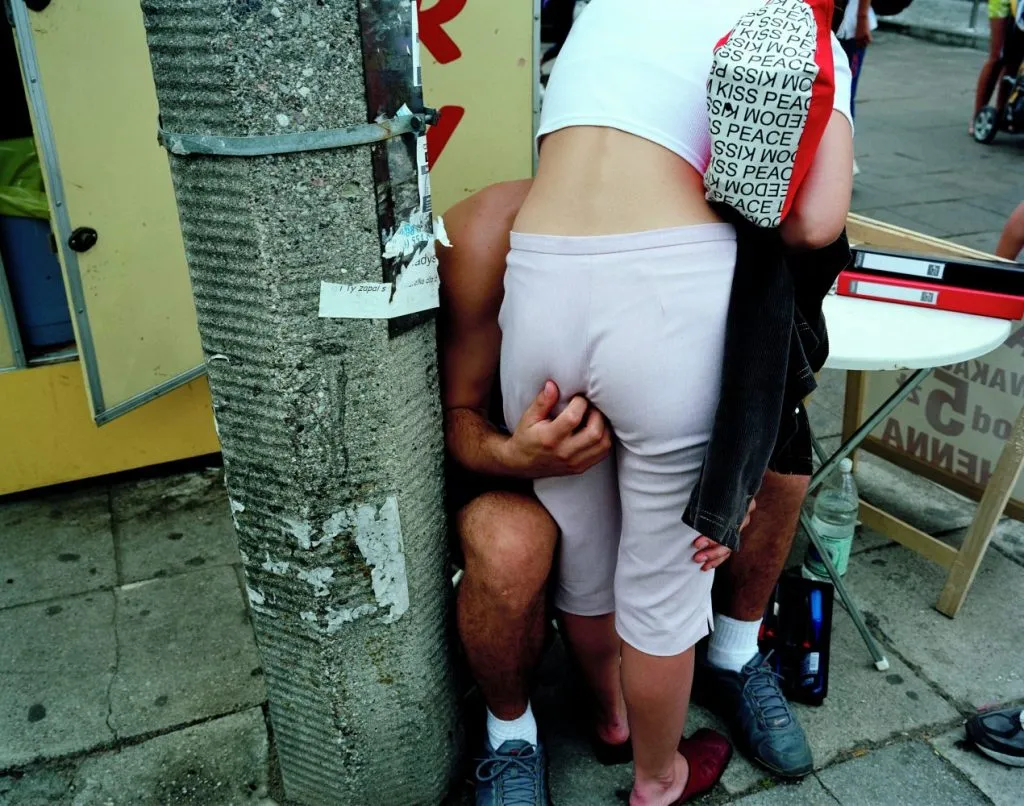
I have no doubt that, as a mass, we Poles have no feeling whatsoever for aesthetics — or rather, that our aesthetic taste has strange, mysterious and menacing origins. Anyone who has travelled a little in Europe will readily notice that something is amiss with space here, that we understand spatial order and architecture differently from other nations, and frame views in a different way. Space terrifies us, and in our pagan, popular manner we try to tame and disarm it, to dress it in the ugliness in which we feel safe. Foreign armies, partitioning powers and occupiers failed to enslave us, but nor have the aesthetic principles of spatial composition. Waging a perpetual battle for a separate identity, we conduct a continuous war against the rules someone is trying to impose. Our disorder, the perpetual bigos we create around ourselves, gives us a sense of freedom and simultaneously reveals our defiant individualism, manifest in the near impossibility of finding any shared order in Polish space. We often boast that we are a nation of individualists capable of uniting only when threatened. The good news, then, is that there is no threat; the bad news is that our individualism takes advantage of the fact and verges on madness.
Curiously, this chaos has deepened and expanded since we gained complete freedom. The past quarter-century has been a triumph of unrestrained creative invention in damaging and disfiguring space, both privately and publicly — bravura and untamed.
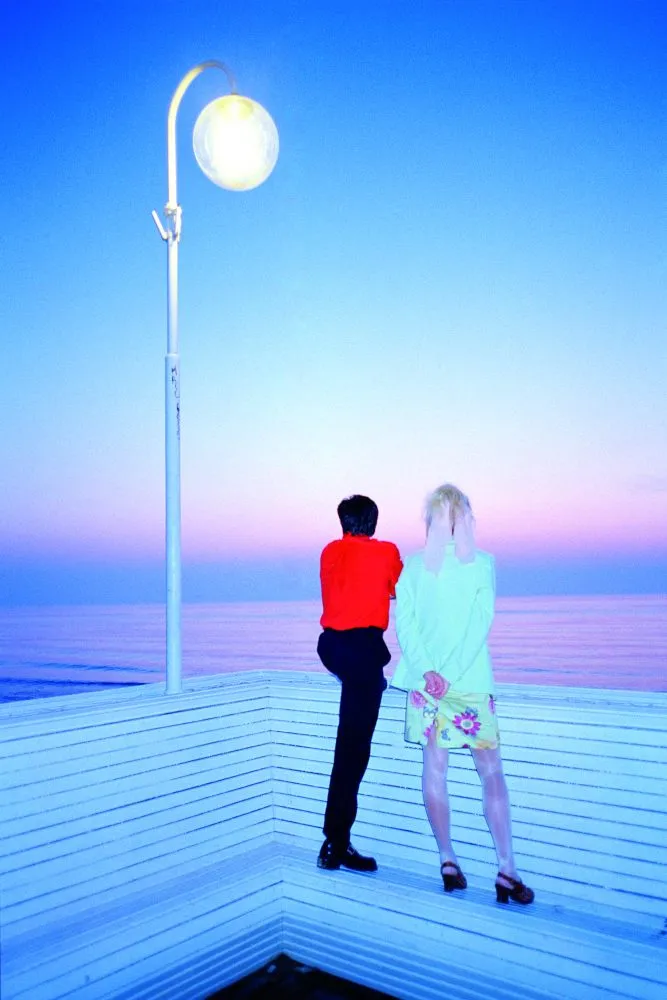
Wojtek Wieteska, Sopot, 1996
In principle, these photographs might have been made anywhere. Wojtek Wieteska could have called the exhibition I Am from Everywhere or I Am from Elsewhere. Yet he decided to admit openly: I Am from Poland. I therefore carry the hump of Polishness on my back. It chafes, but I will carry no other hump now; I am condemned to this particular burden — that is how it turned out. Yet these fascinating photographs could not in fact have been made anywhere other than Poland, and upon this rests the strange paradox of the art. We might travesty the subtitle of Alfred Jarry’s famous play: “The action takes place in Poland — that is to say, nowhere.” Wojtek Wieteska’s photographs tell us at the same time: “The action takes place in Poland — that is to say, everywhere.” Poland is not its borders, emblems and flags. Poland is a certain state of mind, a state of tranquil collective madness. Poland is a particular view of the world, a crooked perception of reality and an eccentric, mystical and pagan construction of it. There is, undeniably, something touchingly beautiful in this.
Wieteska approaches this world with tenderness — precisely that, tenderness. He is not searching for ugliness that will sell attractively. Ugliness, as we know, is photogenic; it always looks better in pictures than things that are obviously beautiful. At the same time, he avoids explicitly identifying Polishness through its emblems, since that would be too easy. We will therefore find no grand processions, eagles, banners, surges of national feeling, crosses, monuments or any of the other things associated at first glance with Polishness and Poland — all of which would amount to formulaic thinking, too easy and obvious. The distinctiveness of this artistic project also lies in the virtual absence — fortunately! — of any political context. Although supplied with dates, the world Wieteska captures functions outside events and outside time. He accepts this Poland and likes it, and I understand him because, looking at these photographs, I accept the world seen through his eyes. It is a tranquil Poland.
Tranquillity, above all, emerges from these images. In a country perpetually agitated, which must forever live in tension and tremor, Wieteska has found genuine oases of calm. There is contemplation, tragedy and death — although in the form of a dead pig and a fallen horse — but above all there is a strange, timeless tranquillity. And now I will say something dreadful: the people in these photographs carry the potential for happiness. I do not know whether they are happy, but I know that they could be — and in our country that is a truly revolutionary vision.
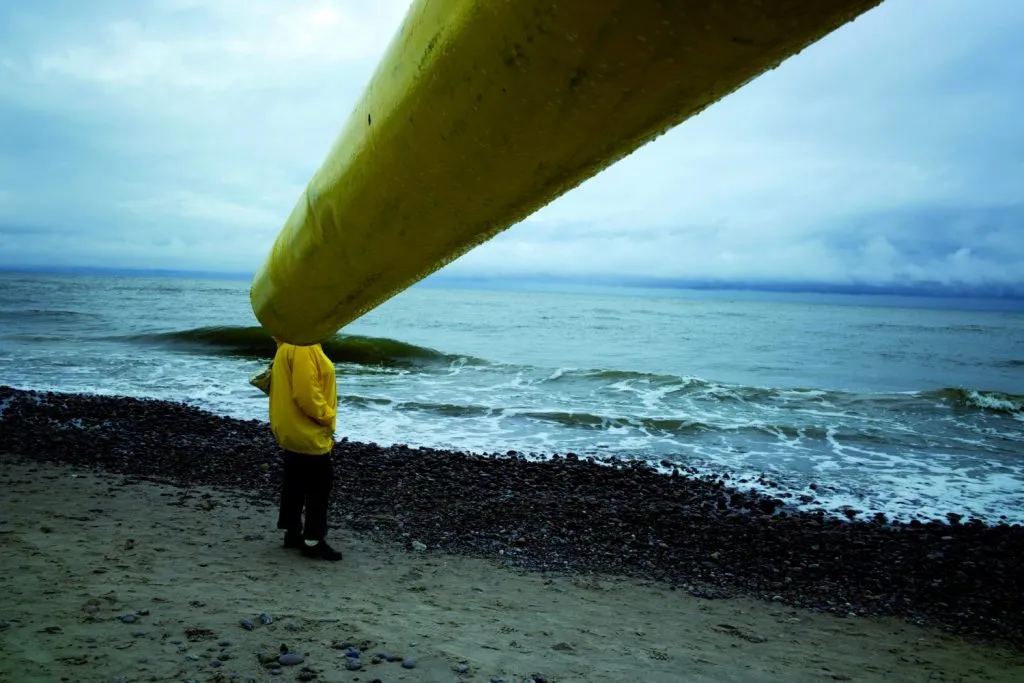
This book says to its reader: here is a collection of fragments; assemble your own Poland from these pieces. Everyone can create a personal image from the elements Wieteska provides, and each will be different in some way. The book could even be published as loose photographs so that every viewer could arrange them independently, forming an individual image and entering into dialogue with Wieteska. His book is intensely personal, and everyone who sees it should have the opportunity to experience it personally and subjectively too.
Wojtek Wieteska photographed Poland patiently from 1986 to the present — patiently and calmly — throughout a great era of change in which the country metamorphosed from a grey, sad larva into a colourful, drug-addled butterfly, from homespun real socialism into a frenzied, gaudy and wild Slavic capitalism. And yet, looking at these photographs, we are astonished that in truth nothing has changed, that if a revolution occurred it altered only the façade; in its deepest essence, Poland did not become another country.
As I looked through Wieteska’s book, I kept thinking that something did not fit, that it ought to look different. Too much time had passed between the first photographs of 1986 and the most recent ones for a great change in the country to remain invisible. And indeed, close inspection reveals change, but only in details hidden somewhere in the background. Wieteska resisted the tempting shortcut of showing how the Polish street changed: from camp beds piled with underwear and joints of meat sold in the street from tables set up beside Nysa vans to glass office towers occupied by major corporations and the windows of elegant boutiques selling fashionable clothing brands. That would have been too easy and hopelessly banal; such things obscure an image more than they explain it.
Wieteska shows instead that only the detail changes while the overall picture remains the same. It is like an old tenement house: the façade smartened up in pink, but mould, fungus and cobwebs in the courtyard — and it is the courtyard, not the façade, that is real. To look at Poland, it is not enough to glance at the façade. One must enter the courtyard and contemplate truth there. This is perhaps unwelcome news for those who believe Poland has changed fundamentally during the past quarter-century and is now, in truth, an entirely different country. It is not. The overall staffage has changed, but the country remains the same, because countries do not change from one year to the next; they change over long decades and centuries. I am not insisting on Poland’s ugliness, which would also be too simple. I am trying only to say that a photographer who wishes to present a complete image of the world must do so through detail. Photographs that demand no personal interpretation from the viewer are uninteresting and quickly forgotten. The point is not to look through the pictures in this book, nod one’s head and consider the matter settled. Looking at them is only the beginning of the work. That was my experience of Wieteska’s book. First I looked quickly; I liked the images and finished viewing them. Then I thought: just a moment — it is only now that thinking about these photographs begins. And now I think about them even when I am not looking.
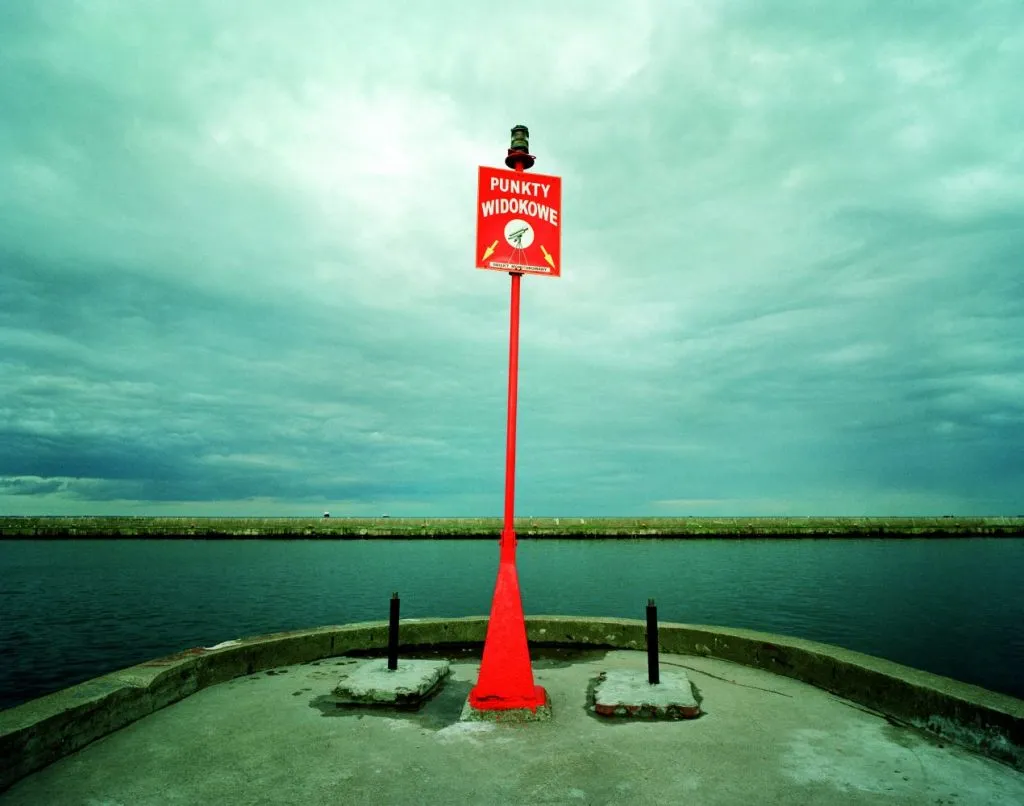
It is almost shocking how many of the photographs were made in Warsaw. Shocking because, as a Varsovian, I do not recognise the city in most of them. They shatter my image of Warsaw — and not only mine — while speaking simultaneously about what is immutable and deeply rooted within it. I mean its peculiar and distinctive metropolitan provincialism. However many skyscrapers and hotels, banks, advertising agencies and boutiques of celebrated fashion designers we build here, Warsaw will always carry the powerful provinciality of a city on the border between East and West. It derives its identity precisely from this transitional state, from being a frontier post between two civilisations, belonging fully to neither, although ashamed of one and aspiring to the other. Warsaw is a city on shifting sands, constantly moving and offering no permanence. Yet Wieteska’s photographs bring order to this chaos. In a strange way, everything returns to its place and is where it should be. This is Poland, and there will be no other.
Krzysztof Varga was born in Warsaw in 1968. A writer and columnist, he has published the novels Boys Don’t Cry (1996), Mortality (1998), Tequila (2001; a finalist for the 2002 Nike Literary Award), Karolina (2003) and Terrazzo Tombstone (2007). The last received the 2006/2007 Book of the Winter Award. In 2008 he published Goulash from the Turul, which won the readers’ Nike Award in 2009. His novel Independence Avenue appeared in 2010, followed by Sawdust in 2012.