
‘I Can’t See…’
Maria Poprzęcka
Four nine-minute films shot with a stationary camera positioned in the middle of a street. Two films are black and white, two are in colour. What do we see in them?
Not much, actually.
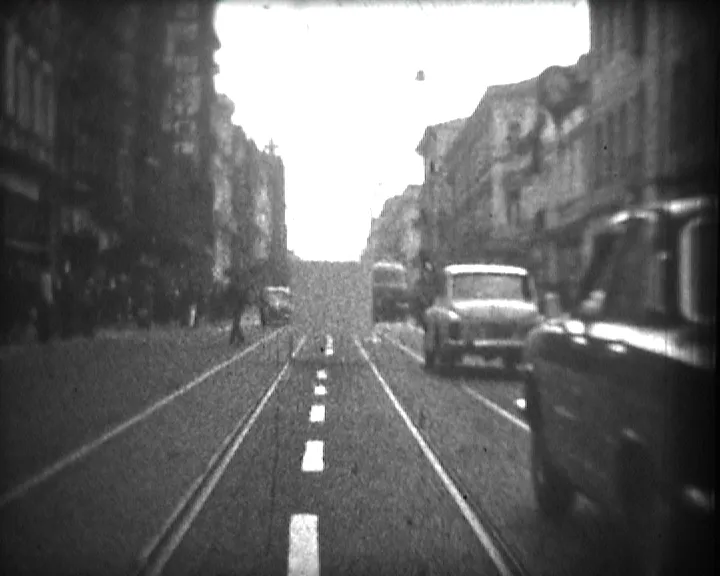
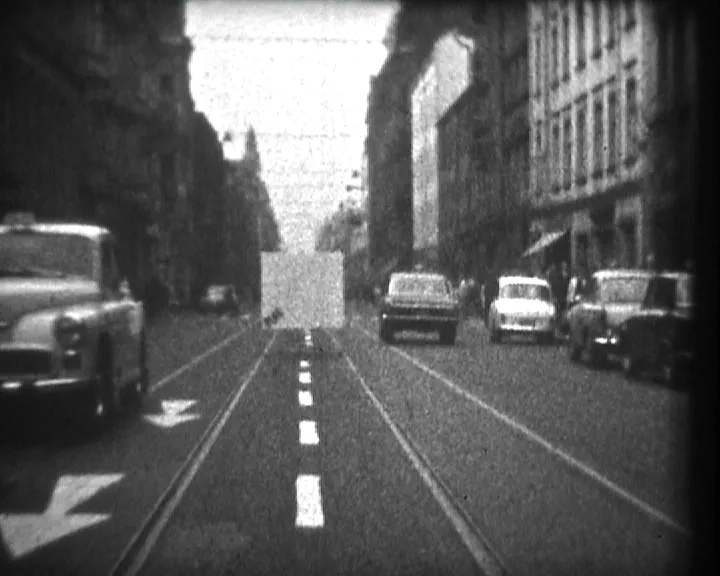
Film one: a street. Someone from Łódź will recognise Piotrkowska Street, but to an outside observer it is simply an average urban street lined continuously with buildings of several storeys, none very tall. Neither attractive nor ugly. Indeterminate. Besides, little can be seen; the quality of the film leaves much to be desired. The left-hand side of the street disappears into shadow, while the right is more visible, although lit by a diffuse, wan light. Tram tracks run down the middle. White traffic lines lie between the gleaming rails. Broken lines, so they may be crossed. But nobody crosses them. The traffic is rather sluggish: no jams or congestion, no reason to overtake. The sight may move those nostalgic for the Polish People’s Republic: Syrenas and Warszawas glide along the street, including the old, streamlined models based on the Pobeda, along with large Polish Fiats now known as ‘boxy Fiats’, their fraternal Wartburgs and Trabants, Żuk vans, and cucumber-shaped buses, some of them articulated. There are no lorries; presumably they are prohibited. The modest repertoire of familiar car makes is enlivened by an exotic Zaporozhets darting past the camera. The absence of Maluchs is puzzling. But that, too, dates the image. Are we in the early Gierek era?
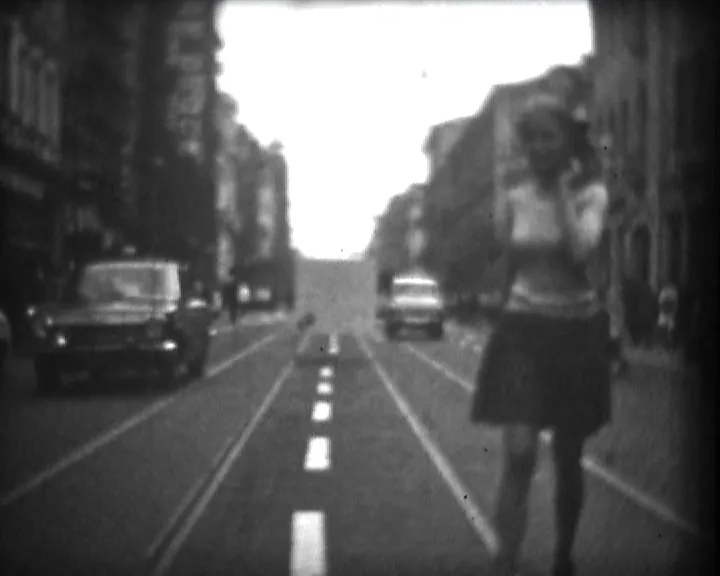
There are people in the street too. Ordinary passers-by, their outlines indistinct and their faces invisible. They walk along pavements that are fairly full but not crowded. Most pedestrians cross the road properly, using the zebra crossings. People cross in groups at varying intervals, since there are evidently no traffic lights to impose a regular rhythm on the street. There are also undisciplined citizens who cut across the road as they please, diagonally, taking shortcuts wherever they wish. Sometimes someone passes directly in front of the camera. An obese woman slowly crosses the tracks with a heavy tread. The day is grey and, judging by people’s clothes, cool. Everything appears to be seen through a dirty window, the dirty window of a bus about which Stanisław Barańczak once wrote. The film is silent; only the camera’s rattle can be heard.
Film two: essentially the same. The same street—someone from Łódź knows that it is the same Piotrkowska Street, merely seen in the opposite direction. The image is somewhat darker, visibility poorer, perhaps the weather is worse. The same cars, sometimes more, sometimes fewer. People on the pavements, an occasional figure moving in front of the lens. Apart from that, nothing. Nothing happens in the street.
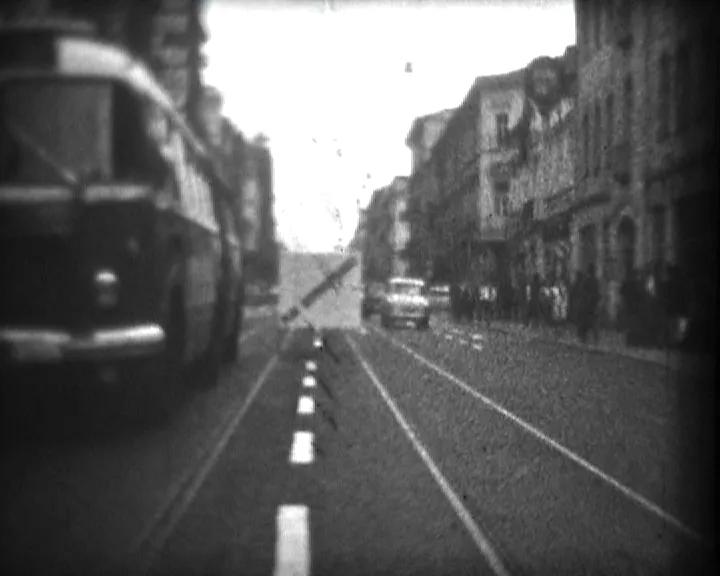
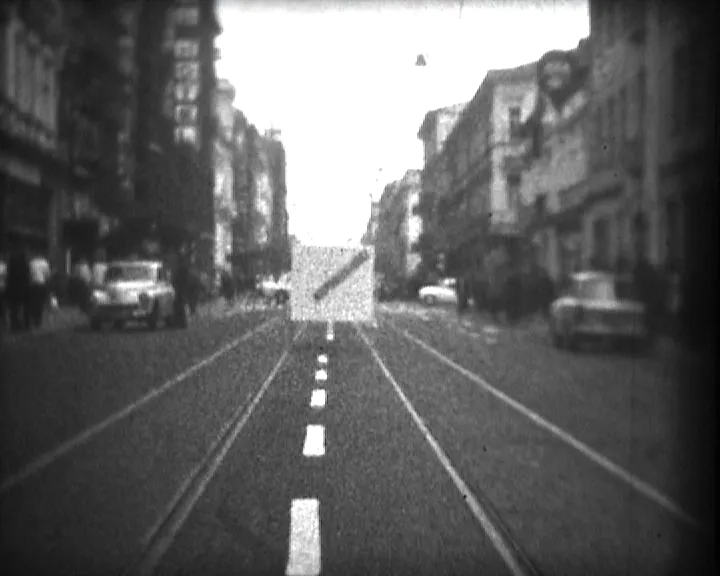
Nothing happens, although something could. For something disrupts this non-happening. A white screen has been placed in the middle of the road, between the tram rails. It is quite large, perhaps three metres wide and two metres high. In the first film, after one minute of projection, the word SQUARE appears diagonally across it; after three minutes, FREEDOM; several minutes later, SQUARE disappears, leaving only FREEDOM. In the second film, according to the same timing, the letters form the words INDEPENDENCE SQUARE. The inscriptions correspond to the topography of the site, indicating the directions in which the street leads. Yet none of the passers-by notices either the substantial white rectangle or the words written on it. Over eighteen minutes of projection, we observe no reaction: not a single glance, no slowing of pace, no stopping. ‘I can’t see, I can’t hear’ was how Czesław Wycech, Speaker of the Sejm during the Polish People’s Republic, would dismiss the absence of parliamentary objections. It is the only saying by which the nation now remembers him.
Film three: a marked change. The street is the same—we remember several characteristic details of the buildings—but how much more accomplished the filming technique has become. Everything can be seen far better. The picture is in colour and the lens renders forms sharply. The weather also favours a high-quality image: the sun shines brightly. And there is sound. It is merely a recording of street noise, fragments of random remarks and isolated words, but evidently the amateur 16 mm camera has been replaced by digital equipment, which allows anyone to record everything.
The street has changed as well. A no-entry sign tells us that motor traffic has been withdrawn, turning the roadway into a pedestrian precinct in the city centre. The tracks and lines that once marked out the street’s grey perspective have been removed. It is a beautiful summer day. In the sunshine, the façades of the buildings look pleasant and fresh. There is a new surface, the tracks are gone, and advertisements absent before have appeared, along with a colourful advertising column and various coloured structures; a banner hangs across the street. A restaurant terrace can be seen in the distance. Cycle rickshaws are another novelty. They are quite numerous, evidently finding customers and naturally adorned with advertising slogans. There are many cyclists and some pedestrians. Tanned girls. Cars, in a wide range of makes and colours, can be seen only when they are forced to turn aside or cross at an intersection. At one point, a white van bearing the words ‘Parcel logistic express’ slowly turns around directly in front of the camera. An irritated woman in an olive-green Opel Corsa can be heard saying: ‘They need to put up a no-entry sign here. How is anyone supposed to fit through…?’ We are therefore in the present-day city.
Film four, the last: the manoeuvre from the second film is repeated. We look in the opposite direction along the street. This time we face into the sun, and the strong contrast of light and shade restricts our vision. Dark human silhouettes casting sharp shadows move through a space flooded with glare. Car windows flare dazzlingly. Later, as the filming continues, the sun shifts; it no longer dazzles so strongly and everything becomes more visible. Buildings, cycle rickshaws, people, bicycles. A powerfully built street sweeper passes the camera—a Black man in an orange high-visibility vest. The police drive past in a Volkswagen. Yes, this is taking place today.
Thus years have passed and much has changed: the appearance of people, the appearance of the city, the technical possibilities for recording image and sound. Yet one thing in the film has not changed. The strange, absurd screen still stands in the middle of the street, displaying, to the same rhythm of several minutes, the inscriptions FREEDOM SQUARE and INDEPENDENCE SQUARE. And one other thing remains unchanged: nobody notices it.
Why? It would seem that, both amid the greyness of a street in the Polish People’s Republic and in today’s ‘capitalist’ urban iconosphere, this substantial white surface should attract attention. Its whiteness stands out against both the formerly drab and the presently motley background. It is a large, pristine patch that has strayed from the immaculate world of geometry into the city’s visual chaos. It stands in the middle of the street, obstructing the way and blocking the view. It is different, alien—so why does it go unnoticed?
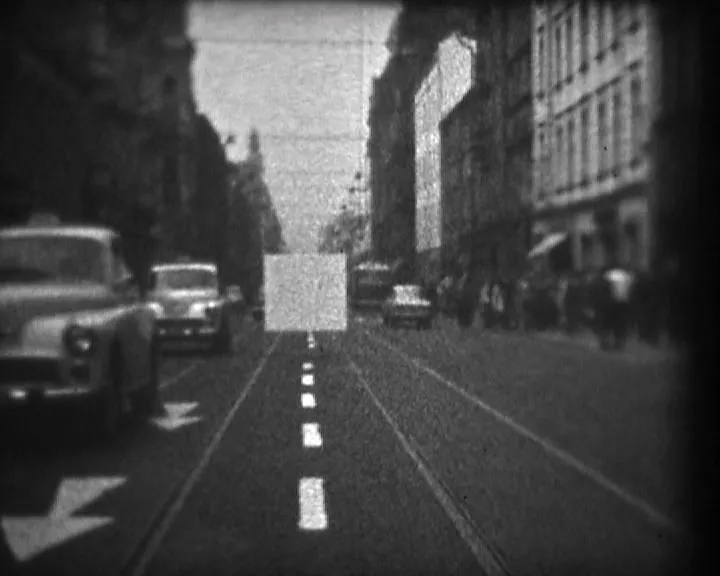
Moreover, the white screen is not an empty form. Although it bears no resemblance to a municipal wayfinding system, it marks directions and indicates the squares towards which the street actually leads. Most importantly, the names of those squares are not neutral. They bear the names of the most precious national values: FREEDOM and INDEPENDENCE.
At first, this opens a political and sociological path of interpretation. After all, this is a particular time, a particular street and a particular city. What, then, do these films say about those periods, the city and its inhabitants? That they were indifferent to these values and remain so? That they did not notice the absence of FREEDOM and INDEPENDENCE, and now fail to notice their recovery? Or that FREEDOM and INDEPENDENCE are merely the names of city squares to them, which might just as well have been called Market Square and Station Square? That the road towards FREEDOM and INDEPENDENCE is simply the road to the shops, pharmacy or hairdresser? Perhaps the political transformation did not change their lives, but merely altered the appearance of the city’s principal street? After all, Łódź is not only the smartened-up Piotrkowska Street; it is also deserted factories, unemployment, degraded housing estates and the crumbling fabric of a nineteenth-century city. What have FREEDOM and INDEPENDENCE given its inhabitants? Or perhaps these films simply speak of exhaustion and haste, which kill curiosity about anything that might break with the daily grind? Of a life in which one becomes indifferent to everything, regardless of the political system? Who cared, or cares, about FREEDOM and INDEPENDENCE? Did the women weavers of Łódź care when they worked three shifts? Do they care now, when there is no work?
The films can be read in this way, but it certainly does not exhaust the questions they provoke. One might wonder, for example, whether words that were not noble and lofty but vulgar or obscene would meet with similar indifference. Or words containing an exciting proposition, promising money or sex? Or what if the screens showed a gay couple, like the billboards vandalised not long ago? Yet here a doubt arises: does framing the matter in this way not push us towards simplistic journalism, if not outright populist demagoguery?
The events described here, taking place in the middle of the city’s main street, constitute an action of the kind now commonly termed ‘art in public space’, although the earlier action predated this classification. ‘Art in public space’ is another interpretative context in which one can attempt to view the FREEDOM SQUARE and INDEPENDENCE SQUARE action. What is new in Poland is not so much the phenomenon of ‘art in public space’ itself—after all, such art had been created and had functioned for centuries before being enclosed within specialised museum and gallery spaces—as the very concept of ‘public space’, which is relatively recent and has not accumulated commonplace meanings. Meanwhile, since at least the early 1980s, the concept of public ‘space’ or the public ‘sphere’ has been the subject of lively debates conducted in widely differing circles. This is not so much an artistic discussion as an academic one—highly ideologised and antagonistic, and above all political1.
As the authors of an extensive anthology on the problems of public art, published in New York in 1992, write: ‘Public art, with its built-in social orientation, would appear to be an ideal genre for democracy.’ Support for it therefore usually stems from the conviction that it promotes the preservation and development of democratic culture, reinforces a general spirit of egalitarianism, reduces art’s ‘elitism’, broadens participation in culture, and so on. Yet, as the quoted authors go on to state: ‘Since its inception, however, the problems associated with it—concerning appropriate form, location and funding—have made public art more a subject of dispute than of consensus and celebration’2.
The removal of Richard Serra’s Tilted Arc from Federal Plaza in New York has become the most famous, by now almost historical, example of a conflict provoked by an object of public art. Serra’s enormous wall divided the square, impeding pedestrian movement. No arguments of a strictly political, moral or similar nature were therefore involved. Nor was it a question of artistic issues: Serra’s other works, whether installed in gallery spaces or natural settings, had not aroused objections. It concerned only the convenience of passers-by, who were forced to walk around the metal wall blocking their way across the square. The Arc was removed by court order. Yet the sculpture’s defenders, testifying during the hearing, also invoked democracy, citing the artist’s right to freedom of expression or presenting the hearing itself as having a destructive effect on democratic processes3. Similar controversies can arise anywhere. In Warsaw today, there is a dispute over noise barriers erected along the Home Army Route at residents’ request, which at the same time obscure the monument to the ‘Defenders of the Homeland’ installed there, prompting objections from veterans in turn. Both sides have their reasons.
‘The very concept of public art, defined in any meaningful way, presupposes a wholly homogeneous public sphere and a language of art that speaks to everyone,’ write the authors already quoted. The conflicts generated by public art indicate that this assumption is mistaken or, at any rate, utopian. The public sphere is not only far from uniform; on the contrary, it is a field of innumerable and often conflicting interests. Nor does the ‘language of art’ speak to everyone, as more than enough examples demonstrate.
Through public space and art’s presence within it, artistic questions have entered the extraordinarily broad field of debates concerning democracy itself. Claude Lefort, one of the advocates of the ‘new theory of democracy’, points out that the core of democracy is troublesome. Power derives from the people, but belongs to nobody. Democracy abolishes the external constitution of power, linking it to society itself. Public space is a product of democracy. According to Lefort, however, public space is a social space in which, in the absence of foundations—democracy’s own underlying grounds—social unity and social meanings are continually negotiated: simultaneously established and exposed to the risk of challenge. Every debate over legitimacy refers to declarations of rights that, in a democracy, have no unconditional or absolute sources. The essence of democratic rights arises from their declaration rather than from simple possession4. This is precisely why antagonists in disputes generated by public space or the art created within it can invoke the same rights: declared human rights that extend to all people. Yet people differ. Treating the public sphere and public art as universal realms situated above the conflictual reality of atomised individuals, purely private differences and particular interests is therefore an illusion, if not hypocrisy.
The conflicts generated by art in public space form part of the conflicts whose arena that space constitutes. Public space is above all urban space. Its transformations are regarded as beneficial when justified by their basis in absolute foundations, such as timeless human needs, the organic form and evolution of cities, inevitable technological development, the requirements of modernisation, a natural social order, or moral and aesthetic values. Changes made in the name of ‘improving the quality of urban life’ assume the existence of a universal city dweller identified with the ‘general public’. Programmes for revitalising historic urban space in particular, undertaken in the name of preserving historical continuity and cultural tradition, beautifying the city and increasing its aesthetic and commercial appeal, generally invoke a sense of social unity founded either on tradition or on other factors shaping identity. We must answer the question of whether conflicts, divisions and instability ruin the democratic public sphere, or whether they are a condition of its existence.
But let us return to public art, which is acknowledged to be difficult to define. First, the question is asked whether the concept itself is internally contradictory. ‘We join two words whose meanings are in some sense opposed. We understand art—in the twentieth century—as the individual inquiry of a painter or sculptor, a condensation of self-affirmation. The word “public”, meanwhile, refers to community, social order and a negation of the self. How, then, can we combine the private and the public within a single concept or object and expect coherence and integrity from them?’ wrote Jerry Allen5. In everyday thinking, including not infrequently that of artists themselves, the modernist conception of the artist as an autonomous individual and of art as an expression of that individual’s personality prevails. Such an understanding entrenches a rigid opposition between ‘art’ and the ‘public’, between the individual and society, and between the private and public spheres. This image is linked to a rigid public/private dichotomy that relegates differences to the private sphere and shapes the public sphere as universal and founded on consensus. On the other hand, many programmes treat art and the public sphere as universal realms harmonised by the very essence of humanity. Experience, however, indicates that one cannot hope for public art to express values precious to everyone, because the social context in which it functions is broad, incoherent and largely unpredictable. Seeking to define the conditions for ‘art that becomes public’, Jerry Allen argues that its purpose should be to serve a unified, even if multiple, public, which may emerge if the artist suppresses the individual ego and consults the people directly affected by the project, the groups each defined by some shared identification6.
This simple prescription sometimes works. Four years ago in Warsaw, it proved possible to create a model work of public and fully democratic art: Paweł Althamer’s action Bródno 2000. In one of the most degraded urban spaces, the largest housing estate on Warsaw’s right bank, the artist, aided by volunteers, managed to mobilise the inhabitants of a gigantic tower block to switch the lights in their flats on or off so that the building’s façade shone with the enormous numerals ‘2000’. It worked.
The disintegrated, anonymous community of residents was successfully united around the project. The action became a local festival. Crowds gathered, bands played and pea soup was served. Perhaps only briefly, people felt that they formed a community. For it was the residents, not the artist who had ‘suppressed his individual ego’, who were the authors and protagonists of the event.
How, then, does the FREEDOM and INDEPENDENCE action, taking place in public space in the city centre, relate to these problems? It is at once ephemeral and historical in scale, because it extends between two eras.
What is striking here is how different the situation is from everything that remains present
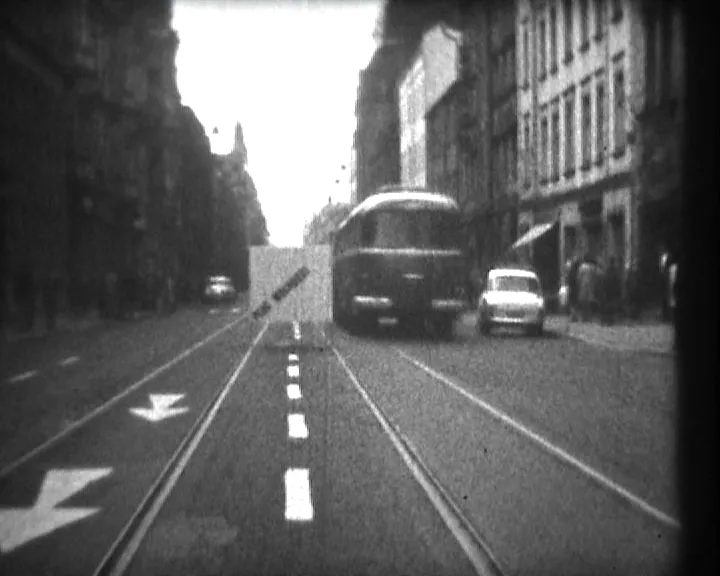
in the discourse on art in public space. First, the film record shows that the action did not cause any dispute or conflict. But neither did it become an object of ‘unanimous celebration’. This was so despite its introduction into the sphere of pedestrian and motor traffic, into the very centre of a city that undoubtedly constituted a ‘field of innumerable, often conflicting interests’. Moreover, we are dealing here with two different social and political situations. The first time, the screen stood in the middle of a neglected street devoid of attractions, immersed in the proverbial ugliness and blandness of the Polish People’s Republic. Today, it occupies a site undergoing revitalisation in the name of ‘improving the quality of urban life’ and enhancing the city’s appeal—efforts that also, after all, include artistic activities. In both such different situations, the screen placed across the street bothered nobody, even though people had to detour around it. One might explain that, unlike the massive lead structure of Serra’s Tilted Arc in Federal Plaza, which initiated the discussion of public art, this object was temporary and makeshift—hence the lack of any reaction, positive, negative or otherwise. It did not succeed in moving or integrating the street public, even around some protest or destructive action, which is relatively easy to provoke. FREEDOM and INDEPENDENCE—values capable of inflaming the most fervent ideological disputes—provoked nobody here to act and did not provide a basis for any shared identification. The same action, referring to fundamental political meanings and values, was originally realised under the ‘people’s democracy’ of the Polish People’s Republic and repeated in the supposedly democratic Third Polish Republic, yet proved equally unnoticeable. It must also be acknowledged that, in invoking lofty values ‘precious to everyone’—FREEDOM and INDEPENDENCE—the artist ‘suppressed his individual ego’, offering something devoid of individual expression, ascetic in form, visible and maximally legible, yet he received no response. Without illusions, he addressed not some ‘universal’ city dweller, but precisely an incoherent, atomised and often antagonistic collection of individuals who happened to be traversing the heterogeneous sphere of Piotrkowska Street. It is true that he did not fulfil the condition of ‘consulting the people directly affected by the project’, but the project itself was intended as a kind of social consultation—or rather, a test. Its creator did not engage them in collaboration because it was their very capacity for engagement that he was testing. The test produced the result: complete indifference. Could this be the only possibility of democratic consensus? By way of consolation, one can only cite the well-known neoconservative Samuel P. Huntington: ‘Democratic societies cannot function when citizens are not passive.’ It offers scant consolation, whether or not one shares Huntington’s views. And passivity is certainly not the response expected by artists whose work enters public space.
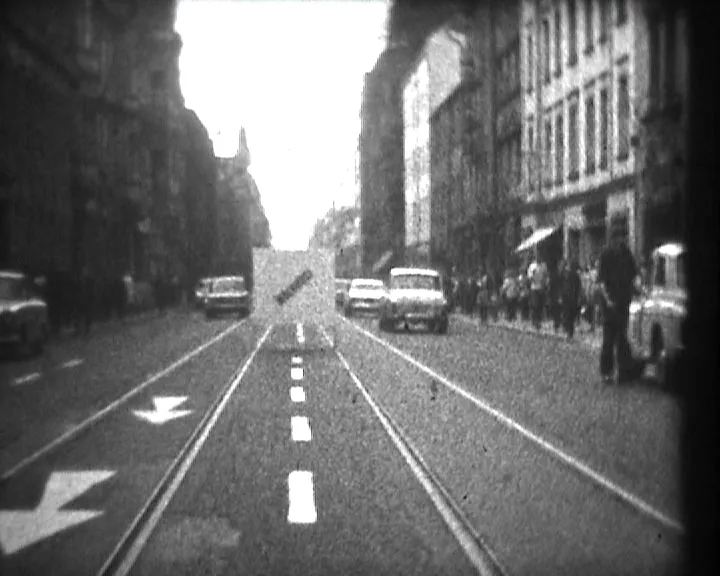
There is, however, one more explanation for the lack of reaction among passers-by on Piotrkowska Street: people walking along the street appear not to see this extraordinary intrusion into their ordinary, everyday landscape. Simply not to see it. Such impaired vision is not confined to passers-by on the main street of Łódź. Last year, at Zachęta in Warsaw, we saw works by the Korean artist Kimsooja7. One of her video-recorded performances, entitled A Needle Woman, was strikingly similar despite being devoid of any political or ideological subtext. Here too, a stationary camera recorded the appearance of a crowded metropolitan street. But the action was not restricted to a single place. On the contrary, it was global in scope: Tokyo, Shanghai, Delhi, New York, Mexico City, Cairo, Lagos and London. The recordings were made between 1999 and 2001. Everywhere, we saw the same thing: the figure of a woman—the artist herself—placed symmetrically in the middle of the frame. The woman is inconspicuous. She stands motionless, wearing a grey top, her long, straight hair tied at the nape and flowing down her back. This is all we see, because the woman stands with her back to us and faces the street crowd. The crowd flows around her like a turbulent stream, passing as though she were a lamppost, without noticing or reacting. This is all the more affecting because the object going unnoticed is not an inanimate screen but a living human being. A street in Lagos is the exception, where Black children are clearly amused by this curious figure. They laugh at the camera, wave towards us and gesture. Does seeing, then, require the ‘innocent eye’ dreamed of by the Romantics?
By invoking this performance by a Korean artist, seemingly so remote from the setting in Łódź, we arrive at the most general reflections prompted by the FREEDOM and INDEPENDENCE action. They are far removed from the immediate conclusions it suggests, whether concerning political indifference independent of the current situation, or the complications and surprises entailed when art enters public space. These reflections confirm the phenomenon of widespread ‘impaired vision’, which appears to be the reverse of contemporary civilisation’s supposed visuality: literally and metaphorically, its ‘dark side’. Sight, after all, has always been valued as the most important and noble of the senses. Deceptive and sinful, yet also a path to all knowledge. This is neither the time nor place to enter this vast question, so let one quotation, taken from the writings of an artist who knew how to look more keenly than anyone else, serve to make us aware of it.
‘Do you not see, then, that the eye embraces the beauty of the whole world?’ asks Leonardo. He continues: ‘It guides the astrologers; cosmography is its work; it assists and corrects all the arts of humankind; it leads people to different parts of the world; it is the prince of mathematics and its knowledge is most certain; it has measured the height and magnitude of the stars; it has discovered the elements and their habitations; it gave rise to architecture, perspective and divine painting. O most excellent of all things created by God! What praise could express your nobility? What peoples, what tongues could fully express your essential action?’
What have we done with our eyes? We, in turn, may ask—or repeat the Gospel question: ‘Having eyes, do you not see?’8 And if so, where does this ‘impaired vision’ come from? Is it an unconscious abandonment of the gift of sight? Or perhaps a defence against the contemporary ‘tyranny of visuality’?
Yet if anything can restore the lost ability to see, it is art. Finally, let us invoke the authority of an old, recently deceased philosopher, who spoke of the task ‘that the art of all ages and the art of today sets before each of us. It consists in learning to hear what it wishes to tell us; we shall have to admit that the aim of learning to hear is above all to escape the all-levelling impaired vision and hearing spread by a civilisation operating with ever more powerful stimuli’9.
1. See the collection of statements in Public Space for Art? Öffentlicher Raum für Kunst?, ed. Maria Anna Potocka, Kraków/Vienna, 2002. An extensive, though highly partisan, presentation appears in Rosalyn Deutsche, ‘Agoraphobia’, translated into Polish by P. Leszkowicz, Artium Quaestiones, XIII, Poznań, 2002.
2. H.F. Senie and S. Webster, eds, Critical Issues in Public Art: Content, Context and Controversy, New York, 1992, p. xi.
3. Quoted after Deutsche, op. cit., p. 297.
4. Claude Lefort, ‘The Question of Democracy’, in Democracy and Political Theory, Minneapolis, 1988; discussed here after the article by Deutsche cited above.
5. J. Allen, ‘How Art Becomes Public’, 1985, reprinted in Going Public: A Field Guide to Developments in Art in Public Places, Art Extension Service and the Visual Arts Program of the National Endowment for the Arts, 1988.
6. J. Allen, p. 246.
7. Kimsooja, Zachęta National Gallery of Art, 2003.
8. Mark 8:18.
9. Hans-Georg Gadamer, The Relevance of the Beautiful: Art as Play, Symbol and Festival, translated into Polish by K. Krzemieniowa, Warsaw, 1993, p. 49.