
Art in Earnest
Maria Poprzęcka

Kraków's Starmach Gallery is presenting a fragment of its collection at Atlas Sztuki in Łódź. From the perspective of Polish artistic life and the collecting of contemporary art, an undertaking of this kind is a heartening testament to cooperation between the two galleries—something that cannot be taken for granted in relations between collectors and galleries. This is not the first exhibition Atlas Sztuki has organised around the holdings of a friendly gallery: one need only recall last year's presentation of works from the Hoffmann Collection, rich in internationally renowned names. The selection on that occasion was made personally by the owner, Erika Hoffmann-Koenige, as the exhibition's title emphasised: My Choice for Atlas Sztuki.
There are various ways of composing an exhibition of this kind. When two galleries collaborate, the exhibition emerges as a product of both parties' collecting and curatorial strategies, and at the same time as the outcome of negotiation. The programmes, interests and prestige of those involved must be reconciled. Collections that make their holdings available, however, understandably do not wish to be treated as lending libraries supplying objects for curatorial projects. They defend their integrity and distinctiveness. In the light of anthropological and historical research into collecting, collections are rightly understood as values in their own right, rather than merely the sum of the values of their constituent works. A collection is not a warehouse inventory. Works removed from it fundamentally change their status. One might say they are repurposed, becoming the building blocks of another whole. By subordinating them to curatorial concepts, a new exhibition context may completely transform their identity. This, indeed, is the source of anxieties about so-called ‘curatorial art’. Contrary to appearances, selecting a group of works from a rich collection for a separate exhibition is no easy task. A coherent rather than random section must be detached from an integral body of work and given autonomous meaning.
There are many possibilities. Most simply, an exhibition may present the collection's best of, serving as its showcase. It may be a kind of abstract or synthesis of the collection, a representation of it: a promotion and an invitation to discover the whole. It may foreground an exclusive collecting concept or, conversely, reveal eclectic diversity and openness to various ‘fields of play’. It may emphasise the collection's coherence or make no attempt to conceal its deliberate incoherence. With a retrospective collection, one can boast an outstanding representation of a particular artist, movement or period. Finally, one may aspire not merely to show part of a collection but, through a considered selection, to say something important about the condition of art today, or even about our own condition in the contemporary world. This is the intention behind the presentation of the Starmach collection at Atlas Sztuki.
Starmach Gallery has collaborated with Atlas Sztuki before. In 2015, the Łódź gallery hosted an exhibition of paintings by Jerzy Nowosielski, organised with Andrzej Starmach and the Nowosielski Foundation. It was a monographic presentation of one of the classics of Polish modernism—perhaps its most recognisable and widely known painter. The exhibition also had a local purpose: to remind Łódź audiences that the artist, associated above all with Kraków, had lived and worked in Łódź for twelve years. Given the popularity of Nowosielski's art, one could colloquially say that exhibition was a safe bet. The present one is a risk, like everything difficult and unobvious.
The exhibition's title is as intriguing as it is enigmatic: 283 × 100 × 27, 12 × 6 × 5. It is the title of a spatial work by Mirosław Bałka. Quite often, instead of titles the artist gives the numerical data of the elements making up an installation (as in 21°15’00’’E 52°06’17’’N—the geographical coordinates of his family home—or 36.6 and 37.1—normal and elevated body temperatures). The titular installation was made between 1993 and 1996 and, alongside works by Marek Chlanda, is among the most recent exhibits in the show. With the exception of a painting by Tomasz Ciecierski, there are no objects made after 2000. This is therefore not an exhibition of the very latest art. Its chronological boundaries are removed from the present but broadly drawn—from the early 1960s (a painting by Teresa Rudowicz; Andrzej Pawłowski's Forms) to the 1990s. Nor, then, is this a presentation of a particular segment of Polish art history. The lack of generational unity is striking: two generations separate Kantor, born in 1915, from Bałka, born in 1958. The presentation is also decidedly heterogeneous in terms of its artistic genres and techniques. There is painting—if the term can still be applied to Mikołaj Smoczyński's technologically destructive Paintings or Teresa Rudowicz's scraps of fabric. The term ‘sculpture’, sometimes invoked for spatial works and installations (Bałka, Chlanda), is no more adequate than the uninformative ‘mixed media’. Finally, there are objects made from readymades: a shelving unit lined with rows of alarm clocks (Stanisław Dróżdż's Clocks); a metal barrel suspended on chains (Tadeusz Kantor's Open in 1984); a coil of rope stiffened with steel (Edward Krasiński's Rope); and a wooden casket by Andrzej Szewczyk. Viewed in terms of artistic genres, the exhibition testifies to their disintegration—something we have known for a long time. Any stylistic commonality is out of the question.
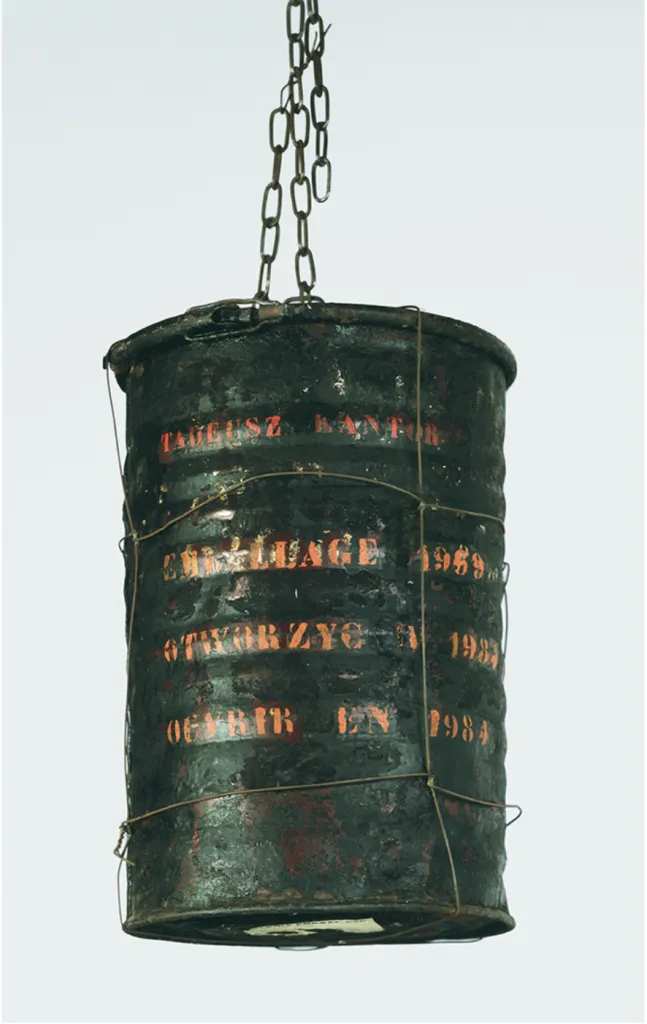
What is it, then, despite the chronological, generational, generic and technological inconsistency, that makes us perceive the selection from the Starmach collection as a cohesive, convincing whole? Why do we intuitively sense a bond between the works? However subjective the experience may be, the exhibition is united above all by the existential pessimism emanating from the art gathered here—a pessimism that reaches deeper and further, beyond the horizon of the present. Kantor's well-known work, which in 1969 instructed that a soldered and wired-shut barrel be Opened in 1984, does more than invite contemporary readings of Orwellian prophecies. We lived through ‘1984’ long ago, and it might have seemed that totalitarian designs no longer threatened us. Yet the barrel, with its unknown contents trapped inside, still hangs over us like the ominous mene, tekel, peres. Appearing above the heads of the feasting Babylonians, that inscription—an Old Testament threat present in culture for centuries—has always foretold an end and destruction, irrespective of its many interpretations.
All Kantor's art, cobbled together ‘from the debris and remnants of a disintegrating world’, is permeated in all its recurrences, repetitions and negations by existential fear. What is telling in this exhibition, however, is that unexpected fear also peers out from works by artists otherwise far removed from catastrophism, artists reluctant to pick at traumatic memory and who do not reach for an expressive language. Hence perhaps the exhibition's most surprising object is Edward Krasiński's Rope (1968)—a coil of steel-stiffened rope, as menacing as a cobra poised to strike. From its serpentine twist rises a coiled knot like a reptile's head stained blood-red. We know Krasiński as a conceptual artist of penetrating intelligence and a mocking sense of humour, an artist who unceremoniously appropriated the world with his blue line—office adhesive tape extended at an unchanging height of 130 cm, both along the Champs-Élysées in Paris and across Matejko's Battle of Grunwald. Was it the events of 1968 that made Krasiński reach not for the innocent blue Scotch tape that appeared in his art at precisely that time, but for a rope unleashing a torrent of terrible associations? Or is it our memory and experience that make us feel Rope in this way? It must immediately be stressed that such doubts do not amount to doubting art. On the contrary, its ability to absorb new meanings and awaken new feelings is its strength, proof of its vitality. Artists leave us their works immersed in the stream of time and subject to its currents. The stream's waves sometimes erode them and sometimes saturate them with new meanings and values. Layers accumulated over the years reveal themselves to viewers who arrive from another time, carrying different stores of memories and associations. What is it—a piece of twisted rope? Yet this apparently ordinary object conceals radically contradictory values. A rope can be a lifeline or a hangman's noose. It can secure and lift, but it can also bind and strangle. The rope that seems to threaten us like a writhing snake is far removed from the established image of Krasiński's art—that of an ironic minimalist. All the more powerfully, Rope demonstrates the force of works open to meanings carried by time.
As has been said, the disintegration of traditional artistic genres visible in the exhibition is nothing new. But it is not left without comment. Painting—quite simply—is the title of two works by Mikołaj Smoczyński, both from as far back as 1985. Identical in size, they show the backs of paintings: conventional canvases stretched over wooden frames. The roles have been reversed—the reverse has become the obverse. We are nevertheless far from Cornelis Gijsbrechts's celebrated seventeenth-century trompe-l'œil, an illusionistic game with the viewer in which the back of a picture was shown in place of the picture itself. Thus we see not the image of which a painting is the vehicle, but the painting as object. According to Victor Stoichita, in his analysis of ‘the self-aware image’, Gijsbrechts's astonishing painting closes one era in the history of pictorial representation but inaugurates another. Smoczyński's Paintings can likewise be seen as a dividing line. We look at the back of a painting down which trickles of dirty liquid (paint?) flow, as if spilling over from the obverse invisible to the viewer—as though painting could not be contained within the surface intended for it. Yet it has not exploded powerfully beyond that surface (as in the work of Leon Tarasewicz), but merely leaks past its boundaries onto the back, which is not meant to be seen. Deprived of its representational functions, tasks and purposes, painting becomes nothing more than a liquid absurdly soiling the canvas and stretcher. We do not savour the ‘kitchen of painting’ revealed to curious eyes by the backs of pictures, but see waste water seeping away. A negation of painting? The death of painting? Does this dividing line merely close something, or does it open up other prospects? The canvases' imposing dimensions testify to the gravity of the artist's intention. But we stand before meaninglessness and destruction, which promise no new beginning.
The action of time is the leitmotif of the entire exhibition. Its emblematic work is, of course, Clocks by Stanisław Dróżdż, an artist obsessed with transience. His hourglass, showing will be pouring into was, the unstoppable transformation of the future into the past, acquired a monumental format several years ago when it covered the façade of the bunker housing Wrocław Contemporary Museum. The 1978 work Clocks does not yet employ Dróżdż's characteristic concrete-poetry ‘concept-shapes’. The passage of time is shown in the most literal manner, narrated in the language of everyday life. Simple wooden shelves display—as though they were a precious collection—neat rows of cheap alarm clocks. Each shows a different hour, a different time. On the last, bottom shelf only one clock remains: a ruined object without hands. The motif of time escaping—tempus fugit—trails behind it a centuries-old visual tradition rich in skeletons, Grim Reapers, hourglasses and venerable old men with scythes. Yet a broken East German alarm clock is enough. Finis.
There is a great deal of rust in the exhibition. ‘Given sufficient time, oxygen and water, any mass of iron will eventually convert entirely to rust and disintegrate,’ an encyclopaedia tells us. A tragic paradox is embedded in this definition: life-giving oxygen and water, allied with time, lead to annihilation. Mirosław Bałka's two works are arrangements of solid steel forms covered in rust. Their functions are unclear, as are the associations they arouse. Bałka never reaches for ‘readymades’; he has his own ‘vocabulary of metaphorical materials’: ash, concrete, damaged wood, water, salt and metal. Although the artist can provide compelling commentary on his own works and attaches great importance to exhibition titles, he always shies away from literalness or unambiguity (at the risk that they will be read contrary to his intentions). ‘I try not to spell everything out,’ he says. Here the completion is left to rust. It has not yet revealed its destructive power—a light bloom covers the thick plates, neither weakening their strong shapes nor chipping their sharp edges. But it is there, quietly carrying out its work of destruction. The maximal simplicity and expressive restraint of both installations are entirely appropriate to the way Mirosław Bałka approaches ultimate subjects, the ‘unimaginable’. His art always oscillates between being and non-being. It reminds us that all existence is perpetually under threat, despite its apparent durability.
It is easy to succumb to the sombre, vanitas-laden message emanating from the works in the exhibition. Yet—given the diversity emphasised at the outset—we must ask to what extent we ourselves contribute these dispiriting readings. To what extent do works extracted from the Starmach collection, made decades ago by very different artists, actually resonate with our attitudes and expectations of art? Should we seek out their original intentions, or are we entitled to experience them in a purely subjective way? Is it our present-day sensibility that makes us see Pawłowski's Naturally Shaped Forms as a futile attempt to break through towards freedom, towards visibility? That makes us feel fear before Sztwiertnia's Wheelchair, which, if it moved, would maim everything in its path? That makes us experience as a threat not only Kantor's Orwellian barrel, but also Jończyk's avian Cage, crushing the twisted shapes within it?
These are the questions provoked by any art that moves us. One thing is beyond doubt: far removed from overexpression and from flaunting violence or ugliness, the art assembled in the exhibition is deeply affecting. In all its diversity, it is united by the old academic category of genre sérieux—serious art, art in earnest. It is art convinced of its important vocation. It need not please. It does not entertain. It offers neither respite nor delight to the eye. It is not a remedy for immediate pains, but it offers support by sharing with us its reflection on the time we have been given.
Maria Poprzęcka is an art historian and critic, and a full professor in the Faculty of Artes Liberales at the University of Warsaw. Her principal interests include modern art, the migration of images, their ‘long duration’, and the relationships between the visual arts and other fields of creative practice. She is the author of numerous books, including Uczta bogiń. Kobiety, życie i sztuka (The Feast of the Goddesses: Women, Life and Art, 2012) and Inne obrazy. Oko – widzenie – sztuka. Od Albertiego do Duchampa (Other Images: Eye—Vision—Art. From Alberti to Duchamp, 2008). She is a recipient of the Gdynia Literary Prize in the essay category.