
What Is Everything Tending Towards?
Anda Rottenberg
The social, economic and political convulsions preceding the First World War, supported by national-liberation movements and new ideologies, burst apart the order founded on the achievements of early capitalism. The edifice of principles governing every domain, including culture, collapsed. When the twentieth century is considered in terms of the breakdown of the norms that had regulated the functioning of social contracts, the violent change in the language of art that occurred at the very beginning of the century appears self-evident. After 1914, employing noble techniques and materials to create the illusion of a world that no longer existed could only intensify the sense of absurdity in the face of experiences brought back from battlefields shrouded in mustard gas and from fighting conducted in the name of obscure aims. Absurdity itself became the category driving the imagination of artists seeking refuge from the war at Cabaret Voltaire in neutral Zurich. Dada was born there.
Naturally, Duchamp’s gesture was too radical to be repeated. Paintings continued to be painted, sculptures carved and cast, and prints engraved, but this was done with an awareness of the semantic charge carried by the chosen technique and material. ‘Found’ materials were also used with increasing frequency to emphasise art’s formal and substantial connections with non-art. All the most outstanding artists in Europe and the United States addressed this aspect of creative work. The First World War had not yet ended when the artists of De Stijl were already designing houses, interiors and furniture conceived as a homogeneous whole, a Gesamtkunstwerk intended for habitation. In 1923, Kurt Schwitters began constructing his Merzbau in Hanover, conceived as a ‘dwelling-sculpture’ in an entirely different, Dadaist spirit. Before Władysław Strzemiński left Russia and devised his Unism in painting, he made collages composed of the refuse of civilisation bound together with paint; several years later, Katarzyna Kobro proposed building nurseries in the form of spatial sculptures. The German Pavilion designed by Mies van der Rohe for the 1929 Barcelona International Exposition was likewise spatial and focused on highlighting the properties of its materials. These are, of course, only selected examples, testifying to art’s opening onto a new reality not merely in order to reflect it, but to respond to its challenges. Whatever the artists’ intentions and motivations, however, their imagination began to encompass areas omitted by the art of previous centuries, in which techniques and substances were catalogued and generally served as the basis for defining the specialisation of a particular artist or artisan more closely: woodcarving, for example; encaustic, or painting with beeswax; and cabinetmaking, the production of refined furniture from precious woods. Yet these were not considered means of communicating the work’s message. It was therefore only the painful reality of the twentieth century that persuaded artists to recognise the visual appeal, persuasive force and symbolism of objects and substances previously unconnected with art. This expanded visual capacity produced, for example, Pablo Picasso’s Bull’s Head, constructed from bicycle handlebars and a saddle in 1943, and perhaps also some sculptures by Alina Szapocznikow made using car parts, such as Machine en chair (1964) and Goldfinger (1965), which may echo the artist’s forced labour in the armaments works at Pölten. These latter examples date from the Second World War or refer to it indirectly. Since then, the world has grown so accustomed to every possible means of appropriating into art objects, things and materials originally intended for non-artistic purposes that, in certain situations, art and non-art have merged and can be distinguished only by the artist’s decision, exactly as occurred in Marcel Duchamp’s memorable gestures.
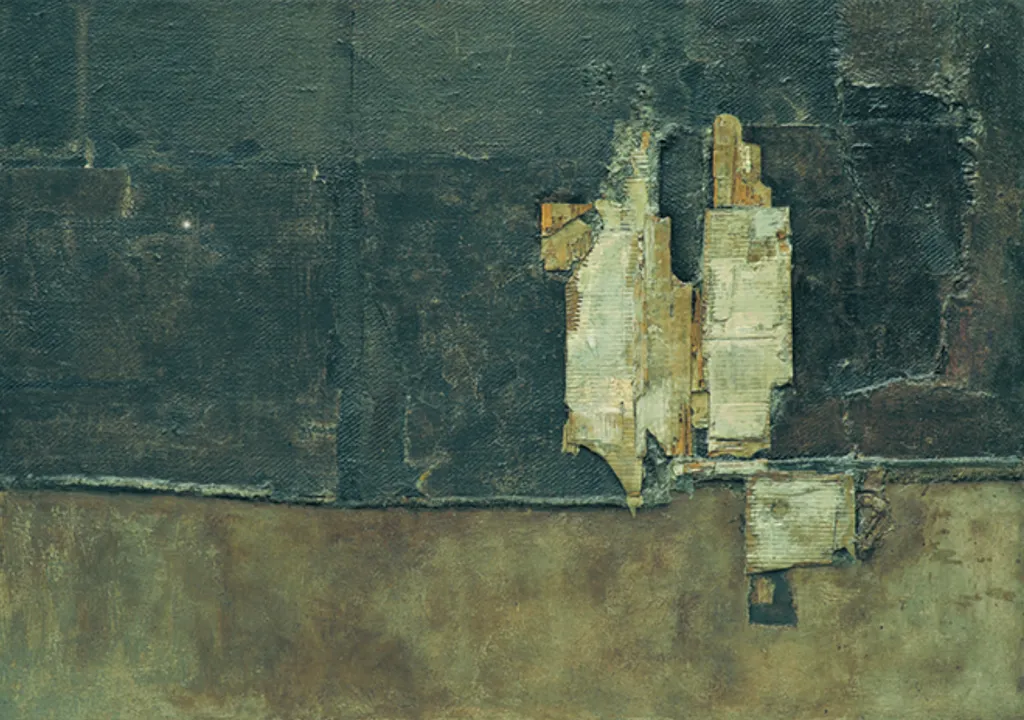
A classic Polish example of the post-war tendency to display non-painterly matter within the picture frame is the still insufficiently researched work of Teresa Rudowicz, an artist associated with the Kraków Group. In the 1950s, like Tadeusz Kantor, she was fascinated by Tachisme. At the end of the decade, Kantor turned towards a ‘formless’ variant of this painting, while Rudowicz, inspired by a stay in Italy, began creating distinctive collages, incorporating various kinds of paper, cardboard, canvas and old photographs into the face of her paintings, as well as fragments of old manuscripts, lace, elements of jewellery and plaster plaques. Some of her works from this period, including the austere and restrained painting 61/12 of 1961, resemble Robert Rauschenberg’s Combine paintings, made from the late 1950s onwards. It is worth recalling, however, that Rudowicz’s painting was created before Rauschenberg received the award at the Venice Biennale in 1964 and became known in Europe as a Pop artist.
The exhibition at Atlas Sztuki presents works selected from the private collection of Teresa and Andrzej Starmach, who collect post-war Polish art with particular attention to Kraków, their home city. We are therefore dealing with a kind of pars pro toto for what has taken place in this field in the art world over the past several decades, but one bearing a particular local designation arising from the historical specificity and the Polish, and Kraków, artistic tradition marked by the legend of the First Exhibition of Modern Art in 1948, the activities of the first and second, post-war, Kraków Group and its associated Cricot 2 theatre, and the particular understanding of the concept of the avant-garde developed in Tadeusz Kantor’s circle—of which Teresa Rudowicz’s work is an emphatic example. What united the Kraków milieu was not a preference for any single aesthetic or style, but an avowed fidelity to art and its imperatives, including such categories as autonomy from incidental phenomena and thus from politics or other extra-artistic factors that might divert creative work from its ‘natural’ or logical course. This was the source of the milieu’s conflict with Andrzej Wróblewski, who returned to figuration in order to give his work persuasive force within a purely social discourse. The discourse itself, despite the contempt Tadeusz Kantor showed for the matter, was not a factor that invalidated someone’s work in the eyes of the Kraków avant-garde; Jerzy Bereś, for example, pursued it almost until the end of his life. What mattered more was the position from which it was conducted.
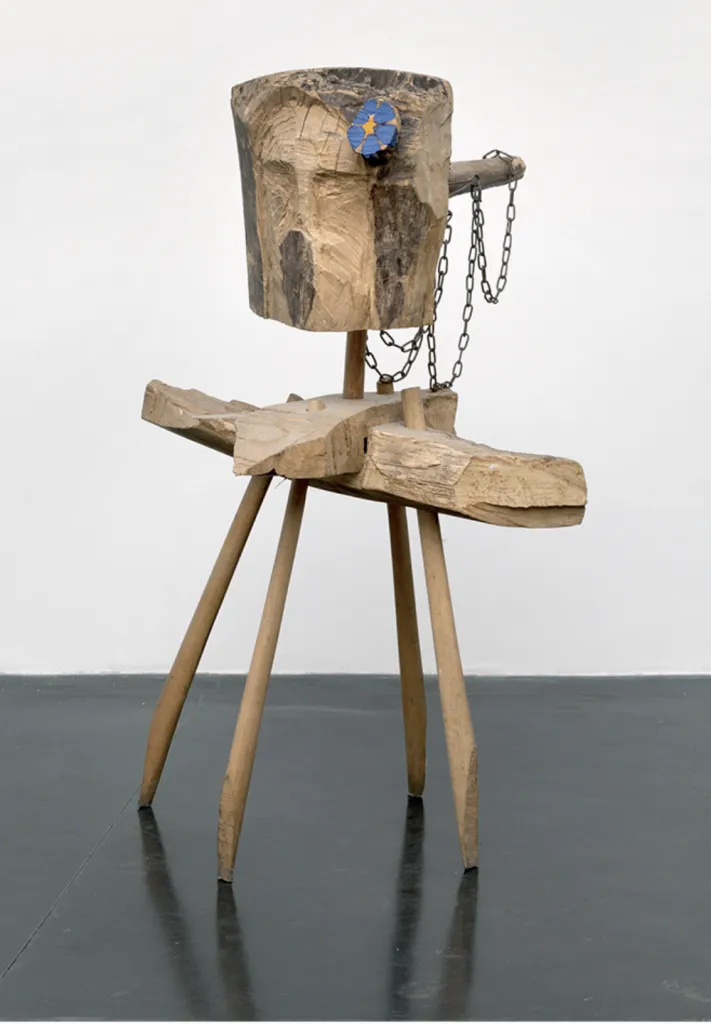
Bereś opposed the system and expressed this both in his sculptures, which incidentally drew on a folk style somewhat reminiscent of roadside saints, and in elaborate performative actions. His Apparitions, Clappers, Altars and Prophecies resembled pagan wooden totems. Anka Ptaszkowska wrote that they attacked the most essential distinction between a work of art and a utilitarian object, and that their form was not the realisation of a predetermined assumption but arose under the natural pressure of the material. These are precisely the qualities of his Svetovid of 1973, dating from a period when the artist also incorporated his own body into many compositions, thereby emphasising the dual function in which he appeared as both subject and object of the work.
Tadeusz Kantor played a somewhat different role in his happenings and performances. Always present within the events, he adopted the position of the agent, sometimes acting ‘upon’ matter, including human matter, as in his Anatomy Lesson, but most often present within the fabric of the work as a formally alien, ‘external’ element that discreetly yet significantly directed the course of events. This was a kind of game that conceptualised the notion of theatre and emphasised its conventional character, a game the artist also played with concepts such as creative work and the artwork. His concept of the ‘poor object’, with origins in the Italian arte povera, was introduced into theatre as a performing prop, an ‘object-actor’, but also defined the aesthetic choices made outside theatre. One such object elevated to the status of a work of art is a metal barrel wrapped in wire and suspended from a thick chain. Old, perhaps even additionally ‘aged’, it bears the stencilled inscription:
TADEUSZ KANTOR
EMBALLAGE 1969
OPEN IN 1984
OUVRIR EN 1984
Kantor did not become involved in Socialist Realism, a gesture requiring considerable courage during the Stalinist period, and later deliberately distanced himself from current politics. From this perspective, the old barrel is an exceptional work. It was made one year after the events of March in Poland and May 1968 in Western Europe, following Cricot 2’s journeys to Florence and Nuremberg, and while work was under way on successive versions of Anatomy Lesson. It looks like something made in passing, on the margins of the artist’s principal concerns at the time. Yet only in this way, precisely on the margins of art’s true tasks, could Kantor register his anxiety about the future of the world. The instruction to open the barrel in the Orwellian year 1984 changes the work’s connotations: it ceases to be an object in a purely conceptual game with art and becomes a prophetic ‘Pandora’s box’ with terrifying contents. In 1984, Poland was under General Jaruzelski’s military regime.
Edward Krasiński’s rope is likewise a ‘found’ object. Krasiński participated in and was one of the principal protagonists of Kantor’s early happenings, serving as the ‘conductor of waves’ in the 1967 Sea Happening. Yet Krasiński played his own games with art. For a period, he was occupied by material that was intrinsically formless and, by its nature, impossible to shape permanently, such as soft plastic cords, tubes and thick ropes. The futile effort to master such materials became the subject of several actions, one of which, bearing the French title J’ai perdu la fin, was recorded by Eustachy Kossakowski in twelve photographs in 1969. A sculpture formed from stiffened rope is a relic of earlier actions. A loop tied at one end is emphasised in red. Yet the loop is not the most important element here; rather, it is the gesture of marking itself, because this is identical with the act of extracting a utilitarian object from the sphere of the everyday and elevating it to the status of a work of art, in a manner similar to the way the artist extracted from that sphere, and ‘took possession’ of, fragments of artistic and non-artistic reality by marking them with a strip of blue Scotch tape.
Julian Jończyk also worked with light, turning in this direction in the early 1970s after a period of fascination with matter painting, common to many artists in the 1960s. His interests focused on the phenomenon of gases glowing in fluorescent tubes. In them, light is condensed and reduced to a form bounded by the shape of a glass tube; it is also portable and can be considered an object. The artist experimented with fluorescent tubes above all during his performative actions, in which he highlighted their various aspects: energy, ephemerality and illusiveness. Before entering this expanded sphere of action, however, he composed luminous sculptures. One of them marks the boundary at which the artist’s fascination with the material object ends and his adventure with pure light begins. A birdcage interwoven with two-coloured neon tubes remains marked by sentiment for the worn-out object ‘of the lowest rank’, yet already announces a journey towards conceptual reflections on the ambiguity of the concept of light.
The Wrocław-based artist Stanisław Dróżdż pursued classically conceptual reflections on time and space, working primarily in visual poetry whose essence lay in the tautological agreement of the meaning of words with the way they were written. Works such as Between, a spatial development of the qualities of contingency and indeterminacy contained in the concept, and the celebrated Forgetting, which loses successive letters, have entered history. His Clocks of 1978 comprises twenty-seven green alarm clocks ‘displayed’ on a small shelving unit. They are wound ‘backwards’; each shows a different time and therefore ‘turns back its time’ in a different, individual manner. The relativity of the rate at which time moves backwards, emphasised in this composition, is an obvious reversal of the intuitive relativity of its passage, which each of us experiences equally irregularly and subjectively. The absurdity of the concepts of time ‘moving backwards’ and ‘passing’, measured by a simple instrument such as a clock, was highlighted by adding a dismantled, ‘stopped’ alarm clock symbolising ‘time arrested’, as conventional as ‘time regained’ or ‘time lost’, the subject of Marcel Proust’s seven-volume novel.
The particular relationships between time and space also interested Andrzej Szewczyk, an artist who settled in Kaczyce Dolne in Cieszyn Silesia and emphasised his environmental separateness from Poland’s defined artistic circles. His The Space Is Always the Same, Whether It Grows or Diminishes consists of thousands of pencil and crayon shavings that formed a colourful picture completely filling the floor of Galeria Foksal in 1981. Yet this visual interpretation of a poem by Stéphane Mallarmé could also fill a space of another shape. What mattered was the condensation of effort involved in obtaining a pile of coloured shavings, in producing a material from what is usually waste. The time-consuming preparatory activities thus became a creative process directed towards the production of a work capable of assuming any form. Szewczyk understood space as a volume with an amorphous structure corresponding to Umberto Eco’s concept of the open work. He also treated shaved pencils and crayons as a transfiguration of letters that anyone could read, because the alphabet they employed was universal. He claimed that poetry is made with the hands. He filled wooden surfaces, often concealed inside closed caskets, with stanzas of such poetry. Each of these ‘poems’ has a different character and thus a different appearance. Some ‘pages’ undulate with dense writing, bristle with the sharp tips of ‘letters’ and swell with pulsating protrusions. Others, with an unsettling rhythm, dissolve into unevenly applied colour. Each bears the trace of the painstaking effort invested in visualising what the artist called ‘quarks of the spirit’.
The category of process, which appeared in Polish art in the 1960s, to some extent on the margins of happening and performative practices, developed over subsequent decades. The creative process understood as an open work was the point of departure for the artistic activities of Mikołaj Smoczyński, who experimented with matter and photography. The artist often intervened in reality only during the initial phase and, entrusting himself to the work of matter itself, allowed the process to unfold independently. The final form of a work conceived in this way was thus the result of an interweaving of various factors that were not entirely controlled. An excellent example of such ‘operations on reality’ is Picture of 1985, dating from the early period of his work. In it, he pointed to the relativity of the concepts associated with the titular object. We do not know whether the picture is what was originally painted on the old canvas, what resulted from Smoczyński’s intervention, or, finally, the two-sided, three-dimensional, streak-covered object composed of canvas and wooden frames that we conventionally call a picture. His 2008 diptych entitled Multiplied Form is similarly ambiguous. The multiplication concerns both the wooden clothes hangers placed in the face of the pictures and the circles constructed from them. The hangers’ metal hooks resemble question marks; some are reversed ‘as in a mirror’. Everything is relative.
Tomasz Ciecierski’s enormous untitled panel also refers to the creative process. It is composed of photographs depicting the artist’s painting studio: squeezed-out tubes of paint and the bowls used to mix them. Each frame is dominated by a different hue, visible to the naked eye but additionally emphasised by the colour names on the tubes’ packaging. This particular diary records the process by which paintings are made through an indication of the waste left behind: what was used up and discarded once the proper material—commonly regarded as the building matter of art—had been squeezed out. At the turn of the 1960s and 1970s, at the height of conceptual reflections on the language of art and its lexical equivalents, Włodzimierz Borowski called such waste ‘fubki tarb’. In Tomasz Ciecierski’s work—he encountered these reflections during his studies but never abandoned painting—the practice of revealing the secrets of the studio by recording the ‘by-products and effects’ generated during work, including series of photographs recording the colour of water left after washing brushes, is a form of self-reflection. It marks the artist’s distance from the very concept of the picture as a product crowning the process of painting, because he also incorporates within art what accompanies its creation.
In the post-Conceptual period, the role played in art by utilitarian or found objects changed. Marek Chlanda, for example, does not challenge their identity, poeticise them or mythologise them, as Kantor did when speaking of the ‘plank of last resort’. On the contrary, he points to their evident, original designation so that it will not be lost within the field of art, while simultaneously depriving the selected object of its utilitarian functions. The seat of a stool crowning a ‘mountain’ formed from a fragment of an irregular cone stiffened with wax is the stage on which an act of confession is performed. A head whispering its sins—or rather, a human mask attached to the stool with a carpenter’s vice—is the same size as a tiny toy confessional. The disruption of scale and the juxtaposition of traditional techniques with ready-made objects constructs, while simultaneously undermining, the ‘theatrical’ conventionality of the scene and thus its credibility. The sense of suspension between the object’s reality and art’s fiction shifts our thinking towards the ethical and religious conflict between the need for confession and disbelief in its efficacy, for example. In fact, we do not know exactly what the artist wishes to depict. Nor are we certain of the reasons that prompted him to draw, at a scale of 1:1, the place from which a stream begins: its source. The attempt to fix on a sheet of paper something whose essence is movement is an act of ‘killing’ resemblance and simultaneously a confession of impotence, very close to what is expressed by the sculpture Drive Abstractions Away described above. This awareness of impotence, the sense of the futility of struggling with matter, is also perceptible in Krasiński’s actions and Szewczyk’s ‘labours’; Chlanda was friends with the latter. Each speaks in his own way of the artist’s imperative to undertake creative effort continually anew, a particular condemnation to roll the Sisyphean boulder uphill without end. Their art is the trace of traversing this difficult road—or rather roads, because each looks different.
A different approach to material, and therefore a different message, characterises the works of the youngest artists in the exhibition, although both are now fully mature: Mirosław Bałka and Grzegorz Sztwiertnia.
The group of works by Mirosław Bałka is representative of the second phase of the artist’s practice. This phase is characterised by the abandonment of both figurative forms and the extensive range of substances typical of the preceding period. In order to achieve restraint of expression, the artist renounces materials he had used earlier that carried broad semantic references, such as worn wood, linoleum and terrazzo, and gradually withdraws from displaying organic substances—salt, ash and soap—charged with symbolic meaning. During this period, his compositions acquire a great coherence and austerity, already foreshadowed by his solo exhibition in Duisburg in 1991 but not fully resonant until How It Is, realised in Tate Modern’s Turbine Hall in London in 2009. The 1991 composition synthetically refers to the subject of his diploma work of 1985 and several later projects concerning childhood fears and the traumas of adolescence, such as When You Wet the Bed (1987), Boy and Eagle (1988) and Good God (1990). Unlike all those compositions, no direct references to object or figure remain here, although both are suggested by the forms—a cylindrical ‘container’ or ‘gutters’ triangular in cross-section, for example—and the objects’ dimensions. A visually related group from 1996 is another example of the consistency with which the artist investigates the ‘language of forms’ and their persuasiveness. Thus, a horizontal form with the characteristic shape of a sarcophagus and a coded anthropometric record of the artist’s dimensions—or, in other words, the encoded memory of an absent figure—is intended to suggest its presumed presence, additionally attested by apertures cut in the steel walls that admit air and light and ‘drain’ potential fluids. The vertical form, a negative of the vestibule in his grandparents’ house and of the artist’s studio at the time, belongs to the family of works exhibited at the Venice Biennale in 1993. Only their juxtaposition and supplementation with small elements of great semantic charge, such as ‘knee supports’ or their ‘negatives’, creates a mature whole referring to human suffering, one of the principal subjects of all this artist’s works.
The objects and situations realised by Grzegorz Sztwiertnia also refer to suffering, illness and disability. Yet while Bałka’s works are charged with an intention to empathise with those who suffer, Sztwiertnia’s works instead emphasise the instruments and systems used to inflict pain and reveal areas in which its heightened presence is concealed from public view. A pneumatic wheelchair from the early period of his work, made in 1994, brings to mind the treacherous instruments and furniture in Kantor’s theatre, such as the camera that shoots and the trap bed. Sztwiertnia studied in Kraków, a city saturated with the atmosphere of Cricot, but his interests resonated more closely with Warsaw’s critical art, at least in terms of penetrating areas of social hypocrisy shrouded in silence. In his case, however, this penetration produced different results. The young artist did not limit himself to placing the suffering of others before the viewer’s eyes. His quasi-medical instruments and devices were charged with sadistic connotations arising from the very appearance of the ‘therapeutic’ objects. One need only replace the ordinary wheels of a wheelchair with cogwheels and connect the whole to a power supply to obtain an instrument of torture evocative of terrifying places of isolation in which the individual is subjected to repression.
Thus, regardless of their relationship with prevailing paradigms of art, all these apparently hermetic works can provide a point of departure for elaborate narratives concerning various aspects of human life.
From this perspective, each can become the subject of a separate story or—as the exhibition’s authors suggest—can prompt deeper reflection connected with areas remote from artistic life, linked to art only by the ‘non-artistic’ material taken from them and placed within the works, a material assimilated and tamed over the past century by artists and audiences alike. Today, one hundred years after Duchamp exhibited Fountain, after two world wars and hundreds of local conflicts, when we use instantaneous information carriers every day and can gain insight into the intimate life of anyone who uses a mobile telephone, when neither colour images of viruses nor Martian landscapes surprise us and when the virtual world seems more real than the tangible one, handmade objects that display the narrative potential of material acquire Romantic characteristics. Gathering them in an exhibition precisely now is important because we are entering a historical period of further global turbulence and conflict whose outcome is not yet known. We therefore do not know what everything is tending towards. For the moment, we feel only the fearful uncertainty of what lies within the ‘Pandora’s box’ hanging above our heads, sealed almost half a century ago by the artist Tadeusz Kantor.
Anda Rottenberg, art historian, critic and curator of numerous exhibitions in Poland and abroad. A graduate in art history from the University of Warsaw, she conducted research at the Institute of Art of the Polish Academy of Sciences from 1973 to 1986. From 1993 to 2001, she was director of Zachęta National Gallery of Art in Warsaw. She is the author of numerous articles and books, including Art in Poland 1945–2005, Draft: Texts on Polish Art of the 1980s, the autobiography Here You Are, and the book-length interview Rottenberg: It’s Difficult Now, as well as the curator of numerous exhibitions, including The Unknown Europe (Kraków, 1991); Where Is Abel, Your Brother? (Warsaw, 1995); Postindustrial Sorrow (Wiesbaden, 2000); Forgetting (Bremen, 2000); Grey in Colour 1956–1970 (Warsaw, 2000); Polonia–Polonia (Warsaw, 2000); Warsaw/Moscow–Moscow/Warsaw (Warsaw/Moscow, 2004–05); Continental Breakfast (Belgrade, 2004); Side by Side: Poland–Germany, 1,000 Years of Art and History (Berlin, 2011); VOID (Nowy Sącz, 2012); UNI/JA–UNI/ON (Lublin, 2013); and Progress and Hygiene (Warsaw, 2014). She has curated Polish presentations at the Venice and São Paulo biennials, among others. Since 2013, she has hosted the regular radio programme Andymateria on TOK FM. The recipient of numerous awards, she has been decorated with the Commander’s Cross of the Order of Polonia Restituta and the Gold Medal for Merit to Culture—Gloria Artis.