
Madagascar in a Suitcase
Łukasz Guzek*
For Poles, Madagascar is a legendary land—far more so than the ‘wild fields’, because here, in Madagascar, our imagination is supported by a considerable number of specifics and facts. Madagascar is pure imagination. First there was Beniowski—or rather Maurycy August Beniowski, Móric Benyovszky, Maurice Auguste de Benyowsky, for he was Slovak, Hungarian, Polish or, by birth, Austrian. In joining the Bar Confederation, he sided with the Polish–Lithuanian Commonwealth against Russia, although he joined it principally to defend the Roman Catholic faith in the manner of medieval crusaders. From then on, his life story became very ‘Polish’: exiled to Siberia, he organised a revolt of deportees in Kamchatka and escaped through Chinese Macau to France, where, like many Poles, he served the French king as well as the nascent America (France supported the revolt of the North American colonies against Great Britain). Beniowski encountered Madagascar as an envoy of the French king to the colonies. He offered Madagascar to Benjamin Franklin, proposing the creation of a base—a military port. Beniowski knew what pirates and boys reading adventure stories had long known: Madagascar was an excellent base for operations against British ships travelling from the colonies in Asia and Australia and, above all, from India, the ‘jewel in the crown’. Franklin and the Founding Fathers, however, displayed insufficient imagination and did not ‘buy’ Madagascar from Beniowski as they would later buy Alaska. Look at the map: would terrorists feel quite so at home in Kenya and Somalia today if Madagascar were American? Yet Beniowski was offering them what America practises today—a strategic game on a global scale. For Beniowski, thinking globally was natural and self-evident. People like him are called ‘citizens of the world’, because the world belonged to him too; it was there to be conquered. In our consciousness, Beniowski is part of the Romantic legend, thanks to Słowacki's poem but also to Wacław Sieroszewski's Young Poland novel The Story of Travels and Extraordinary Adventures… (Beniowski had earlier written his own story, since it fascinated everyone, including the king of France). Słowacki does not present our hero in the best light; he is rather an embodiment of the vices of the Polish nobility. Another trait is Beniowski's fervent Catholicism, while Słowacki (and Mickiewicz in Kordian) propagated the concept of Poland's liberation through the papacy, close to John Paul II's ‘renewal of this land’. The problem with Beniowski's supposed faults, such as extreme individualism and faith in himself and his ideas, is that they are also virtues. Since they met with no understanding, Beniowski decided to realise the dream of his Great Madagascar alone, without the support of the world's powerful. He returned to Madagascar in 1785. But the winds of great politics had changed: the United States of America had come into being in 1783, while rebellion against the king and monarchy was growing in France. Beniowski attempted independently to wrest control of Madagascar from France. He died in 1786 in a skirmish with the French. In 1789 the Revolution began in France, while the Constitution, adopted in 1787, came into force in the United States. Had Beniowski waited only a few years for the emergence of the new world order, his private mission would have acquired a different context…
Madagascar returned to Poland's collective imagination in the interwar period. The Maritime and Colonial League, a non-governmental organisation supported by the state, pursued the idea of obtaining colonies for Poland through the division of defeated Germany's possessions. Poland was to acquire colonies in South America, Liberia and Guinea, and even in Antarctica, or detach Mozambique from Portugal. Misunderstandings connected with Polish colonial ambitions almost led to a Polish–Brazilian war… There was also an idea to invoke Beniowski in order to acquire Madagascar, but the French would not hear of it. The Maritime and Colonial League was an organisation that acted upon the mass imagination of Poles. In 1939 it had almost a million members. The nationalist and chauvinist views of National Democracy, alive in the society of the time, found expression there. It was there that the idea of resettling Polish Jews in Madagascar was born (a commission including a rabbi even travelled there to investigate conditions for such settlement). The slogan ‘Jews to Madagascar’, a testament to Poland's national shame, was treated with complete seriousness! On the other hand, public collections funded the construction of ships, including the modern submarine Orzeł, and extensive educational activity was carried out. Polish vices and virtues became mixed once again.
Today, those spectres of National Democracy—antisemitism and nationalism—are returning on the Polish right. As then, a language that falsifies reality and signals a Polish inferiority complex is used today. It is no coincidence that, at precisely this political moment, a Polish artist decides to embark upon a mission to Madagascar. Once again his aim will be to turn Polish vices into virtues—to make a work of contemporary art from empty rhetoric and pompous, ideologised history. Janek Simon is travelling to organise a Polish Year in Madagascar.
Simon's project consisted of two parts. The first involved research into Madagascar's presence in the Polish collective imagination. The purpose was not only to gather knowledge and organise historical facts, but also to collect documents, editions, publications and articles relating both to literature and to the activities of the Maritime and Colonial League.
The second part was the organisation of a Polish Year in Madagascar. If the first part can be treated as a survey of bibliographic sources and documents, the second was an experiment conducted in the field, on a living organism. The research objective was to discover how the real present-day Madagascar would receive contemporary art from the country in which its myth arose. How would the imagined Madagascar withstand confrontation with the real Madagascar? In keeping with Beniowski's cosmopolitan spirit, the selection of artists whose works were presented in Madagascar represented ‘his’ Europe—the countries of Central Europe today. Beniowski was a globalist. Contemporary art now functions globally. Janek Simon's project likewise took on a global character.
In practice the exhibition was quite modest. The limited capacity of the luggage meant that the works had to be small. The selection of invited artists was also rather haphazard and based on the artist's social contacts rather than a considered curatorial research strategy. This was a certain weakness of the project—the Polish Year, or rather Central European Year, in Madagascar was not a particularly serious exhibition venture. On the other hand, from the project's inception the exhibition had a more symbolic meaning. It was one structural element within the project as a whole, rather than an end in itself.

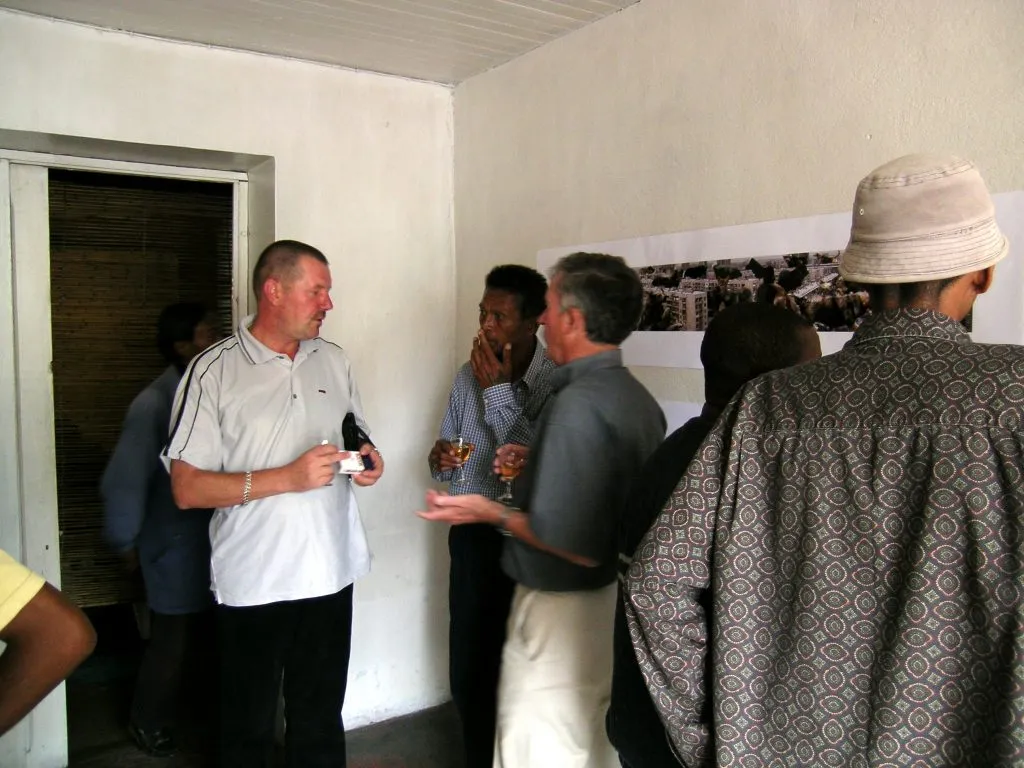
As it turned out, moreover, the island has no gallery designed to present large exhibitions. The Polish Year took place in the only regional cultural institution, the Centre for Art and Archaeology—or rather in a small room renovated by the artist, albeit one situated on the main street of Antananarivo, Madagascar's capital. The display lasted three days. According to the artist's estimate, around fifty people saw it. Simon spent the rest of his month in Madagascar learning about the country and attempting to make contact with local people—including Poles. The documentation to be presented in the exhibition at Atlas Sztuki bears witness to his investigative activity in Madagascar.
The exhibition at Atlas Sztuki presents the works shown in Madagascar, documents collected about the ‘Polish’ history of Madagascar, and documentation of the project Polish Year in Madagascar. At first glance the film footage is quite banal—one might say conventionally touristic. It looks a little like amateur video documenting couples' trips, shown on dating programmes for a sponsor's satisfaction. Even the opening of the exhibition in Antananarivo has this ‘souvenir’ character. The report's protagonist, greater than the art, is a small lizard found on the gallery wall, interesting because of the dramatic circumstances in which it came to be there: it climbed onto a freshly painted wall, stuck fast and dried out. Yet one video sequence attracts particular attention. It could easily be dismissed as a domestic family recording, but the historical context in which the project as a whole is realised changes how the image is perceived. It shows private moments of a Polish priest and nuns at a mission station. They play and dance carefree. The recollection of Beniowski's fanatical Catholicism and National Democracy's religious nationalism transforms their dance into the dance of somnambulists, the straw-man dance, as though Polish demons that nurtured Madagascar in our national imagination for generations were dancing. Contemporary art is to exorcise them—the project is a shamanic séance. The shaman is the artist, because he possesses the power to create a work of art whose form and artistic content change the meaning of history, reinterpret it, demystify the myths governing it and demythologise ‘Polish’ Madagascar. An apparently touristic exhibition and its equally touristic video documentation acquire critical qualities.
The exhibition at Atlas Sztuki may be regarded as another part of the project, although it is also a separate, autonomous artistic work. Its concept gives it the character of a post-conceptual work, adopting the quasi-academic formula of presenting research findings. The ‘research’ formula of the exhibition is not itself new. One need only recall Joseph Kosuth's ‘classic’ conceptual works from the Investigation series, works by Douglas Huebler and Dan Graham from the same period, the collections of Marcel Broodthaers, Gerhard Richter and Ilya Kabakov, or, more recently, the archives assembled by Allan Sekula and Oliver Ressler. Many other artists could be named, but the point is to identify a situation in which the concept of collecting and the resulting collection are combined with a critical approach to the material gathered. The attempt is therefore not merely to give the things themselves a voice and let them speak through the effect of accumulation, but to build certain structures of thought above them—intellectual, discursive or purely imaginary, intuitive and emotional—so that within ourselves, for our own internal purposes, we can reach decisions on the questions invoked in the collected facts, accounts and images.
Janek Simon placed himself in a dual, not to say ambiguous, role here. On the one hand, he realised the project as an artist and the information gathered was material from which a work of art emerged; on the other, he himself is not a passive, detached external observer. On the contrary, he is one element of the extraordinary jigsaw puzzle called ‘Polish Madagascar’, which he attempts to assemble into the coherent whole of a project-work of art. He is at once object and subject. This reveals the work's multiple levels and complexity. Yet it is precisely as an artist that Jan Simon possesses art, an excellent tool for creating distance, allowing him to erect that critical superstructure above the knowledge and representations connecting Poland with Madagascar. The result is to furnish history with a contemporary commentary. Together with the artist, and thanks to him, we move through historical eras in the project, but also—equally importantly—through artistic disciplines. We travel through political history and art history combined, all in order to recontextualise both. The artist selected a project formula based on so-called participant or field research, transforming an anthropological method into an artistic one and working like Bronisław Malinowski in the Trobriand Islands (The Sexual Life of Savages) or Claude Lévi-Strauss among the Nambikwara (Tristes Tropiques). He redefines the conceptual artistic method, connecting actionism with the creation of a database—historical and artistic. He uses them to encode information. Information and its distribution form another level on which the project unfolds. During the project Jan Simon kept a blog (www.rokpolskinamadagaskarze.blog.pl). Robert Kuśmirowski had used a blog before him, reporting online on his project-action, a walk from Łódź to Paris (www.spam.art.pl). Current information about the project becomes testimony and one element of the documentation. Documentation that at first glance—but only at first glance—seems unspectacular and banal proves to contain significant information. As Professor Porębski taught us in Art and Information, there is always enough information, and it is everywhere. A contemporary artist always has sufficient available material at hand from which to build a work of art. In this, the artist resembles another model figure from anthropology: the bricoleur, creating from whatever lies at hand (Lévi-Strauss, The Savage Mind).
The material gathered by Janek Simon during the project and presented at Atlas Sztuki allows several interpretations that situate his work in a contemporary context. Recalling the ‘Polish’ history of Madagascar today, especially its interwar chapter, helps to name contemporary politics, including so-called ‘historical policy’, and compare it with pre-war National Democracy. This association, perhaps forgotten today, allows us to assess from a distance the words and deeds of contemporary right-wing politicians and activists, and to connect today's nationalism and diseased patriotism with roots embedded in Romanticism. The project retrieves those spectres from oblivion and is critical in this sense. Critical art—a term many writers regard with suspicion, accusing it of vagueness and a lack of definition—proves exceptionally apt here, because art in Janek Simon's project performs that critical role towards the ‘Polish myth of Madagascar’ functioning in our collective imagination. It exposes it or, in another language, deconstructs it. Art displays its critical power!
Another critical dimension of the project is the ‘Polish Year’ itself, or rather the very idea of ‘Polish Years’ organised in different countries by Polish institutes. These are official events, while the genuine cultural benefit—in the form of authentic exchange between artists and entry into the general consciousness of other countries' citizens—is slight. Janek Simon has himself taken part in such events, so his observations can be trusted. His own ‘Polish Year’ points to another path: individual contacts supported by skilful patronage in place of pompous ‘promotion’ arranged by state officials.
Another interpretation may be described as ‘postcolonial’. As the artist discovered on site, the most impressive cultural centres in Madagascar are the Albert Camus French Institute, the Goethe-Institut and, in third place, the American Culture Center. Contemporary culture is still supplied here from the metropolis. There is none of its own, apart from archaeology and ethnography. Appearing in Madagascar with an exhibition, Janek Simon became another ‘coloniser’, on a scale commensurate with how ‘Polish’ Madagascar has been in history. Madagascar's contemporary culture is American and French popular culture. The conclusion: Madagascar is waiting for models. Perhaps they will come from Poland? A promising first step has already been taken! And immediately the myth of Madagascar, just deconstructed and critically assessed, is reborn in our imagination. What had been rationalised escapes once again into the realm of dreams. We have barely managed to distance ourselves from it when imaginary Madagascar returns, now cleansed of Romantic and National Democratic demons. No one is a Pole who does not think of Madagascar and its cultural conquest, for instance through artistic projects. Janek Simon did. He announces another project in Madagascar.
* Dr Łukasz Guzek, art historian and art critic, editor of the website spam.art.pl. Lives and works in Kraków.