
The Anomie of the Pseudo-Avant-Garde: The Amplification of Masters and the Asteism of Zbigniew Libera’s Positives
Kazimierz Piotrowski

The experience of art in the 1970s, against which we should measure our artistic choices, as Libera suggests in the series Masters, crowned a process of deepening anomie—the consequence of the progressive avant-gardisation of aisthesis1. “Look at the trick!”—this instruction by Tatlin, placed at the entrance to his exhibition in 1914, might also serve as Libera’s postulate, for he employs an entire array of rhetorical tricks, of which amplification and asteism are the most common. Modernist trick-mania, which Ozenfant regarded merely as an ancient rhetorical means of attracting attention to oneself rather than an honest Purist search for the law (nomos) of art and being in order to cultivate taste, seemed a great discovery to the Russian Formalists. The fascination to which avant-garde theorists then succumbed was all the more powerful because the devices of the time soon became effective, which, in the economy of rhetoric, is to say invisible—namely, imperceptible amid a revolutionary turmoil that can no longer be experienced today. This absence lays bare the construction of the avant-garde’s abuses. Other forms of amplification must therefore be sought—not tragic, but rather asteistic2.
Amplification3, meaning, among other things, enlargement or elevation—as we know from Pseudo-Longinus—can allay suspicions of deception, conceal the device beneath magnitude and pathos, and dispel all mistrust. Thus the avant-garde, initially suspected of aesthetic illiteracy and later elevated by revolution and the struggle for social justice, was quickly acknowledged as art’s leading form. Why should those who, like Libera, wish to experience a delirium of freedom in public not resort to this means of persuasion today? The extravagance and lawlessness of avant-garde ideas—the wild shamelessness of an unconstrained flaunting of devices that denied the aims of classical persuasion—were, after all, socialised and became a privileged interpretation of the essence of art. The originary rhetorisation of this art, its subjection to militaristic metaphorisation, the aggressive form of revolutionary agitprop, the permanent poetics of impeded reception, the ceaseless destabilisation of law and the anarchic dismantling of perceptual automatisms seduced many people, offering a peculiar intoxication with the singularity of brazenly displayed formal tricks to which, in accordance with the avant-gardists’ suggestion, a salutary, sociomorphic meaning was later ascribed. Yet the person deprived of automatisms developed over centuries fell all the more readily into bondage to the automatisms of new ideologies and utopias. Even so, the successful socialisation of the avant-garde reinforced an impression of this art’s inevitability, accompanied by the diminution—another, relative form of amplification—of classical aesthetics. The domination of modernism, its cunning inventiveness, nevertheless had eventually to be challenged, for it intensified a model of culture that drew vitality from aggression that was more or less controlled (sublimated, suppressed, repressed, rhetorically, aesthetically or ideologically masked). Whether this took the form of the open aggression of avant-garde isms, such as the thoroughly militarised Futurism; the cunning of mutually hostile totalitarian-bureaucratic systems—politico-aestheticising variants of Wagner’s Gesamtkunstwerk, anticipated or even provoked by the avant-garde (as Boris Groys demonstrated4); the unscrupulous guile of capitalism’s free-market competition, which heedlessly and ruthlessly exploits nature and humankind, as well as art, by means of ingenious marketing (advertising), since the market determines the work first and fundamentally, as Ian Burn complained, while creative desires (creative urges) have a voice only in the second instance5; or the hegemony of modern art institutions that most interests Libera in Masters, and which Hans Haacke in particular had challenged since the late 1960s6—this was the insular-tautological spectacle (insular-tautological spectacle) about which Mel Ramsden also wrote in 19757. He charged it with overcoming no opposition and improving nothing: like Conceptualism, it was no revolution, but merely diversified the products of culture. It was a spectacle alienated from social problems and staged in the United States and other Western countries solely for a middle-class elite, Burn added despondently.
Such an avant-garde—stylistic, predictable, commercialised, educated and resocialised—was quickly discredited in the eyes of many artists, including in Poland, where it was not even clear whom this spectacle served: there is still no middle class here, after all, the art market has only recently begun to crawl, and the principal audience for this stunted avant-garde was a host of largely corrupt and bureaucratised critics living at the pleasure of the socialist state—professional idiots whom Partum harried in particular for their self-satisfaction, talent and ignorance. More aware artists therefore chose either to parody this avant-garde and its milieu, as Anastazy Wiśniewski and Leszek Przyjemski did by cynically agreeing with them; to question its autonomy and the absolutisation of its own context, like Jan Świdziński; to establish KwieKulik’s alternative Workshop for Activities, Documentation and Dissemination (PDDiU)—a basis for alternative histories of art—in the face of the failure of official art-archiving institutions; or to proclaim avant-garde silence and recognise in anomie (anomaly, error, nihilism) a positive creative principle and a guarantee of effective resistance to the flood of uniform television culture, which demanded fireworks from art. The punchline might be the attack upon Tadeusz Kantor, then the foremost master of this avant-garde spectacle in the Polish People’s Republic, at whom Jacek Kryszkowski—a representative of the younger generation of the pseudo-avant-garde—finally fired a cap pistol. The point of departure for this crime, this attempted murder of an avant-gardist of distinguished service to culture, which “Trybuna Ludu” unfortunately failed to document objectively, was Kosuth’s avant-garde tautological definition of art. Although it expressed the essentialist (nomothetic, legislative) aspirations of modernism, it ultimately sanctioned and intensified anomie in art. Art began to lose its recent faith in its autonomous grammar (essence), proclaiming the thesis that whatever an artist recognises as a work of art is art. Art is, after all, the definition of art. As a result, every device, every linguistic behaviour, however wild—in other words, every use of the expression art (in accordance with Wittgenstein’s non-denotative conception of meaning), every object and every ephemeral activity within situational aesthetics, with its extreme logic, was permissible in its vast contingency, as Victor Burgin asserted in 1969, once linguistic infrastructure was recognised as capable of generating art objects8. A work of art, Świdziński said in criticism of this radically relativist model that ignored the constraints of social context, might be a glass of water that has been drunk; adding, in a gesture of courteous mockery towards Americans, that it is better to drink it in New York than in Kutno. In communist countries—where the slogan “It’s a free country” was known only from American films—this was obvious and did not need to be learnt from the neo-Marxists of the Frankfurt School. Taking Kosuth’s definition pars pro toto, one must ultimately say that modernism passed into history—and this is presumably the basis of its relative distinctness—as an era of lawlessness, relativism, trick-mania and rhetorical savagery experienced on a scale hitherto unknown in history, most rapidly in those free countries.
The anomie of the pseudo-avant-garde
In Poland, it was unmasked in 1975. The attack—received by many artists as a denunciation to the communist authorities—came from an institutionally well-established centre: Galeria Foksal, one of the strongest links in the modernist lobby of the Polish People’s Republic9. Galeria Foksal and the Muzeum Sztuki in Łódź under Ryszard Stanisławski (a monument to the socialisation of the avant-garde) were, as Zbigniew Warpechowski put it, the bottleneck controlling the promotion of Polish art around the world10. The Theory of Place developed at Foksal emphatically reveals the direction in which the efforts of its art critics were heading11. They made the concept of place the principal category of their poietics, their understanding of production, thereby positioning themselves comfortably within a system for distributing power, which must always be a purifying, disciplinary emplacement—as one learns best from personal experience12. Art that was to arise in a close relationship with the space of Galeria Foksal, forming a formal whole with it, also had to consent to being controlled by the administrators of that space: the Fine Arts Studios or the Warsaw Bureau of Art Exhibitions. This idea—that art in statu nascendi should take account of a specificity of place controlled by the state bureaucracy—quite effectively neutralised every artistic subversion of the bureaucratic system of the sort previously guaranteed by traditional production in a private studio or by an informal initiative adapted ad hoc to public space. At bottom, this was not so much a theory as an ideology of place. The meaning-making efforts of the Foksal circle, immunised against pseudo-avant-garde scandal and anti-government provocation, which included stigmatising the pseudo-avant-garde by amplifying (magnifying) the alleged danger it posed, were an attempt to normalise the art of the time within a predictable avant-garde laboratory that was safe for the authorities. On the basis of precisely such a modernist-bureaucratic genius loci—principally that of Wiesław Borowski—some of the art outside Galeria Foksal was identified as the pseudo-avant-garde: a threat to culture, and hence as matter out of place, to invoke the structuralist pattern of thought that defines all impurity in these terms13.
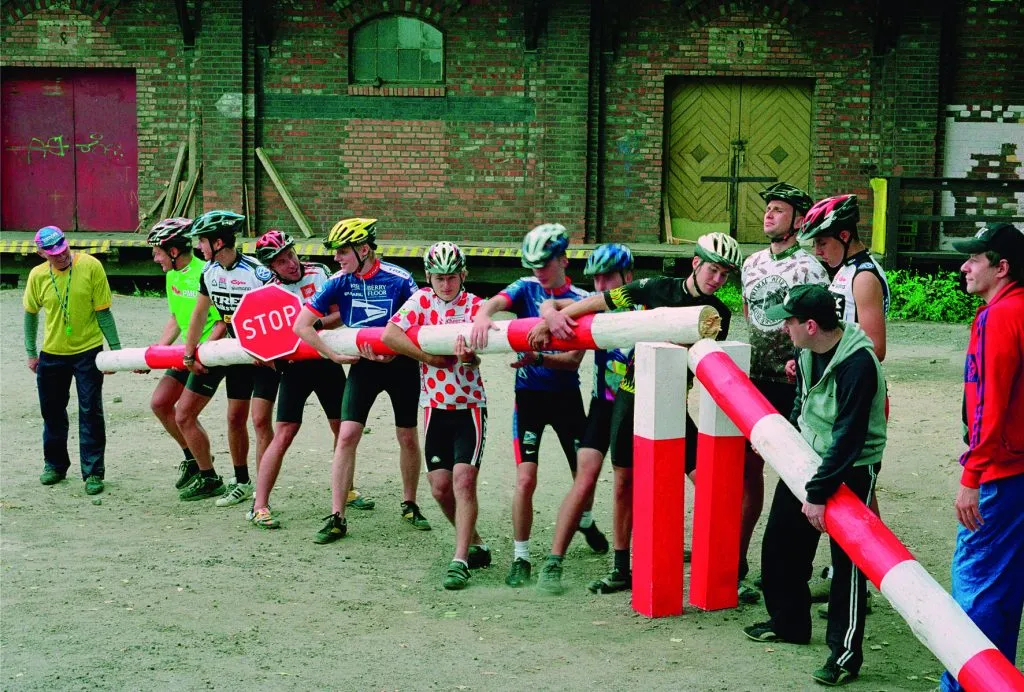
The rhetoric of the pseudo-avant-garde. An alternative history of art according to Libera
Galeria Foksal, of course, not only failed to strengthen its own existence and saw no improvement, humility or importunate begging for the favour of its place from the pseudo-avant-garde art outside Foksal—unfortunately a complex afflicting many Polish artists and critics—but witnessed the continued development of independent initiatives and the international activity of artistic institutions such as Partum’s Poetry Bureau. In 1976, it encountered Partum’s Contempt, and in time the successes of the pseudo-avant-garde in the 1990s14, best exemplified by Libera’s work during this decade of scandals, crowned by the Brussels exhibition Irreligia (2001)15. In defining his identity today, Libera does so not only against Foksal’s now almost vestigial presence, but also against the current arrangements at the Centre for Contemporary Art, where, for want of invention, the Foksal tradition is zealously revived and uncritically juxtaposed with his oeuvre, and against the opportunism of the management of the National Museum in Warsaw, which can boast only of its extremely belated acquisition of nothing more than the covers of his Concentration Camp—LEGO (1996). Against these official government agencies of control, which falsify the true political scale of the work, as Haacke would say, he attempts to create an alternative history of art in which the epithet pseudo, even if it does not have an unequivocally positive character, at least delights him through its belonging to the class of indifferent things. His Masters (of the pseudo-avant-garde, of course) are an attempt to redress diminutive and marginalising procedures analogous to the bureaucratic efforts of Galeria Foksal by opposing to them an enlarging amplification: the unlawful emplacement of the pseudo-avant-garde—for example, Franciszek Nurzecki’s panegyric on Partum’s death or extensive interviews with Świdziński or Zofia Kulik—in the Polish media, which may be as hostile to this art as the Foksal circle. This is unquestionably asteism of richer cognitive invention: a wit devoid of the crudity that characterised the attack upon this art published in the contemporary “Kultura” (not the Parisian one) and mindlessly reproduced by other critics and art historians.
The rhetoric in defence of the pseudo-avant-garde can therefore take two forms: either it tries to demonstrate that the pseudo-avant-garde weakens the guile, aggression and anomie proper to the historical, classical avant-garde, moving as pseudo towards the domain of positivity (representation, the socialisation of aggression and anomie); or it advances the argument that the pseudo-avant-garde loosens art’s ties to the political system, overcoming the constraints of bureaucratic control over art and contesting the meaning of the safe avant-garde.

In the context of 1970s art defined in this way, is this charge of pseudo-avant-garde, this malicious impertinence towards art outside Foksal, not risible? For if an attempt was made to defend the true and pure meaning of the avant-garde against the pseudo-avant-garde, what would that meaning be? Would it be the meaning outlined above, which modelled art by means of an originary military metaphor and hence propagated the aggression and anomie proper to that art? And although in Vom Kriege (1832–34), where he set out the concept of the avant-garde, Clausewitz still wrote of moral superiority, martial virtue, the ability of the commander and other merits of the craft of war, he nevertheless identified military rationality above all with cunning (die List). He distinguished der Witz from die List. Both faculties are the opposite of simplicity and directness. The first, whose Polish equivalent might be wit or cleverness, concerns operations upon ideas and representations and is the opposite of direct proof; the domain of the second faculty—cunning—is action that is not direct or straightforward, being founded upon some deception intended to mislead, delude or deceive an adversary. In Clausewitz’s account, cunning (die List) concerns the action itself more than its product. This distinction is not clear, but it nevertheless tells us that Clausewitz attempted to find in human nature the faculty that would be the most proper, perhaps even the exclusive, originator of military strategy, and hence of the avant-garde. For the strategy of war is characterised by its not aiming to create any positive work. Strategy is simply the use of weapons and combat to achieve the purpose of war, while the purpose of war as such is to disarm the adversary and subject him to one’s own will. Military inventions are not ends in themselves, but, like any stratagems, possess a purely instrumental character. Transferring military strategy into the field of art necessarily also implied an instrumental conception of the work in avant-garde art, which in Russian Formalism would amount only to ceaseless deautomatisation before it was itself subjected to communist automatisation. Was it precisely this meaning of the avant-garde that was defended against the pseudo-avant-garde? And if the Foksal critic sought to defend a different meaning of the avant-garde—what was it? It would have to be some meaning of the safe avant-garde (oriented towards place and product, and hence institutional and stylistic, legal and ultimately controlled by the bureaucratic system of the Polish People’s Republic, since it was, after all, the pseudo-avant-garde that posed a threat to the culture of the time).
Irrespective of the meaning we might identify as proper to the avant-garde, it is clear that the pseudo-avant-garde must introduce into it the potential for weakening and loosening, and thereby lead to a relatively more perfect state—as a positive negation (Anastazy Wiśniewski’s term)—insofar as the avant-garde has been loosened and weakened in its negativity. The rationality of the pseudo-avant-garde is therefore the rationality of wit (Clausewitz’s der Witz—does that not sound better?) rather than sinister cunning (die List). The pseudo-avant-garde, whose relative identity is constituted solely and exclusively in relation to some essence of the avant-garde, is primarily an operation upon ideas or representations as pseudo—as erroneous, abnormal, unlawful, diverging from the principles and aims of the true avant-garde, however we might define it.
There is much to suggest that the pseudo-avant-garde is not an exclusively negative phenomenon—reprehensible and unproductive. There can surely be no doubt that the modernist avant-garde lawlessness it presupposed, despite its negative side effects, had extraordinary powers of creative innovation, notwithstanding its sometimes insane emancipation. Even when, in recent decades, attempts were made to establish a distance from the period in which the destructive mechanisms of depth revealed their lawlessness most forcefully, and to dismiss the ethos of modernism, which unfortunately invented Auschwitz in the process (although der Witz was not its creator!), namely a distance under the name postmodernism, it nevertheless proved impossible to abandon that fascinating creative aggressiveness entirely. Once more, painstaking attempts were made to submit it to further processes of ennoblement—within the philosophy of difference—even though the words difference, heterogeneity and pluralism, as well as competition, which Nietzsche had already identified as a condition of cultural progress, cannot effectively mask the aggression and anomie concealed behind them. The pseudo-avant-garde is one such attempt to refine (another term for amplification) the avant-garde, and Libera’s alternative history of art is another.
Asteism and the amplification of anomie

The fear of conflict, lawlessness and the disintegration of meaning, especially under the influence of the Holocaust, as well as the progress of consumerism and an aestheticisation (beautification) that degrades the heroism of people unwilling to confront anomie directly, is so great that every seemingly inevitable and productive violence and drastic quality of cultural expression, every inventive provocation, is systematically pushed to the margins in a rationalised world ruled by priests, politicians, bureaucrats, editors and managers—including the directors of cultural institutions—where everything ought by law to have its predetermined place. This is understandable, for people who experience anomie—all manner of horrors and crimes, the cruel deeds of their enemies, as victims of unprecedented racist persecution and national wars, dictatorships, neocolonial exploitation, imperial arrogance and bureaucratic violence—lose their sense of well-being and eventually their reason, while fear or anger suppresses their sensitivity and robs them of acuity. This acuity must therefore be cultivated elsewhere—preferably in the world of mass media, where, however, it quickly grows lazy. Now safe as viewers, we contemplate these not-so-terrible things with pleasure and immeasurably expand the range of our experiences, although in fact we fear and hate them, even though—as Gorgias had already pointed out—nothing has changed in their aesthetic endowment.
This paradox of perception, this ambivalence in imitating acts of persecution, is an issue that also interests Libera in his Positives. He points in particular to the paradoxical nature of demoliberal consumer culture, which, although it so ardently desires peace, lawfulness and happiness, achieved by ceaselessly repressing and combating anomie18, at the same time cultivates lawlessness with stubborn perversity in the form of mediated, virtual anomie. This is a strange, incomprehensible desire to imitate and thereby experience a more sophisticated, refined and enriched aggression19. For even the simplest mediation is already a vestigial amplification that potentially carries with it—as we have long known, irrespective of the mode of imitation involved—not only originary fear20, but also addictive pleasure21.

Positives is not a frontal attack by Libera upon this aesthetic, mediated anomie, upon its hypnotic violence. When Krzysztof Wodiczko, a former Foksal artist who does not seem a master to Libera, directly attacked the repressive order of the façades of public buildings and monuments in his Public Projections, seeking to overcome their violence and halt this aesthetic-ideological ritual, Libera adopted a fundamentally different procedure. Above all, he remembers the basic mechanism known to the rhetoric of visual communication: juxtaposing opposing things, different images, automatically compels the viewer to choose between them, to classify one as better and the other as worse. This must ultimately be the effect of Wodiczko’s public projection: “Only a physical, public projection of the myth,” he argued in defence of his method, “onto its physical body (a projection of myth upon myth) can lead to the effective demythologisation of the myth”22. This kind of projection from outside onto a particular place, with the intention of deconstructing it, is ideological and aggressive by definition, because viewers are automatically expected to identify with what is projected and carry out an amplification that enlarges the projection while diminishing that upon which it is cast. This, after all, is the principal intention of Wodiczko, who wishes to overcome the repressive effects of the building’s aesthetic-ideological order. Wodiczko therefore placed himself at the outset in the role of a victim afraid of architecture, repaying supposed violence with violence against giant state buildings and monuments, like Rousseau’s savage terrified by his own delusions. As the weaker party, presumably as a newcomer possessed by resentment (an immigrant complex, perhaps?), Wodiczko resorted to subterfuge and acted by surprise: “The attack must therefore be unexpected and frontal. It must come at night, when the building is asleep, freed from its daytime functions.” Yet such a projection is ineffective, although it undoubtedly carries greater cognitive and persuasive possibilities than Christo’s wrapping of a building. The viewer, who must choose between the hypnotic order of the ground (the building) and the hypnosis of the projected figure, automatically chooses the persuasion of the figure in accordance with the privilege conferred by the rhetoric of projection. “Public projection,” Wodiczko finally concedes, “can turn into a group aesthetic counter-ritual.” He must therefore save himself by concluding with Walter Benjamin’s claim that “there is no better starting point for thought than laughter”, which is merely a wish with no possibility of fulfilment in his guileless method of projection.
This limitation to empty words does not impose itself in Libera’s Positives or Masters, because his asteisms are witticisms devoid of the importunate crudity of Wodiczko’s symbolic attack, which ultimately becomes mired in a kind of ritual aestheticism, just as on another occasion it became mired in a late-modernist functionalism that stabilised the marginalisation of various social groups (homeless people, for example)23. In his Positives, Libera does not decide the primacy of the background being deconstructed or the figure that deconstructs it, only then to assign them respectively to an act of violence and an act of liberation. In Positives, in their endowment, there is no evident differentiation, as in Wodiczko’s projections, between background and projected figure, deconstructed myth and deconstructing myth. Above all, we encounter a certain image that may seem self-sufficient and obvious to some viewers (in Masters the illusion of a coherent media presentation is perhaps carried furthest by precisely imitated typographic layouts and typefaces—perhaps stolen?—together with specially selected forms of visual persuasion and negotiated advertisements). They will enjoy the aesthetic endowment of these images; something attractive is happening in them, and that will suffice. For other viewers, however, the positive may intrigue from the outset, as though it were the spectre of something already known, a mime, a re-enactment—sometimes mocking—of a situation they have seen before. For them, though not necessarily for others, the spectre of a background, or rather a paradigm, then manifests itself in the given figure and—provided a particular apperception of the original’s negativity arises and the asteism is recognised—causes the positive to explode. There is therefore no danger here of anything being appropriated, as the projected image might be appropriated by a building as its decoration—a possibility against which Wodiczko, reducing the matter to absurdity, laughingly warned. Still less can this happen because the importunate structural division between background and figure that constitutes Wodiczko’s public projection is not self-evident here. In tracing the meanings of Positives, which intrigue us with their sometimes amusing and ostentatious optimism, their positive thinking, we may nevertheless grow irritated by their illusion (as in the trick founded upon the onomatopoeia Niepal–Nepal–Napalm). Instead of contemplating the image, we experience its explosion, ultimately realising that we have encountered charientism: a suspiciously polite mitigation of images of lawlessness that are painful to us, as though some hyper-law of continuity existed between law and lawlessness. The asteism here lies in the fact that we ourselves are to blame, that we are in a sense the unconscious criminals who cause the optimistic image of the reality of Positives to explode, as the originators of anomie. These are images of lawlessness within us, attempting to fill a place in our imagination with fear and disturb the pure pleasure of looking (imitating), because that is simply the nature of memory, of our reactivity and of matter in general. Does this mean that, by taking an interest in this trope of irony (Lat. illusio, irrisio, explosio), Libera threatens the culture of the Holocaust or other hallowed martyrological narratives that live in collective—national, class and ecclesiastical—memory as images made by mass hysteria into cult icons of humanity, so that they may be feared and at the same time yield pleasure? And although their sanctifying amplification appears to have a positive meaning, building a human bond (religio), perhaps the very act of looking in that direction—towards anomie, towards matter itself—even when in mimesis it has been bound by the bonds of pleasure, beauty (or at least comedy), moral rightness, faith, love and hope, or some other interest, namely as an object of compensation given as a result of amplification (expansion, enrichment, ennoblement, elevation), is an inevitable and often unconscious depravity already known to the Greeks? It was in the Judeo-Christian tradition in particular that anomie was regarded as a synonym for sin: an act of rejecting the law, or a state of spirit produced by transgression against divine law (hamartia). Yet religion, which places these images of anomie in the domain of negativity, guards their inviolability and turns away from them in disgust, at the same time subjects them to amplification in accordance with the words of the convert from Tarsus: “The Law came in, unfortunately, so that the transgression might increase. But where sin increased, grace abounded all the more, so that, just as sin marked its reign through death, grace might also manifest its reign through righteousness leading to eternal life through Jesus Christ our Lord” (Rom 1, 5, 20–21). This religious or political power, which on the one hand wishes to preserve in collective memory naked, realistic images of lawlessness (sin, crime, execution and someone’s suffering—Christ’s, or today the Holocaust), in order to understand and exclude them from the legal system, must at the same time absorb and manipulate them in a metasystemic amplification, enlarging them to inspire terror and diminishing them to demonstrate its dominion over them—that is, falsifying them, because these falsehoods legitimise it precisely as power. Is this not perhaps the greatest, often unconscious, involuntary and most pleasurable depravity?

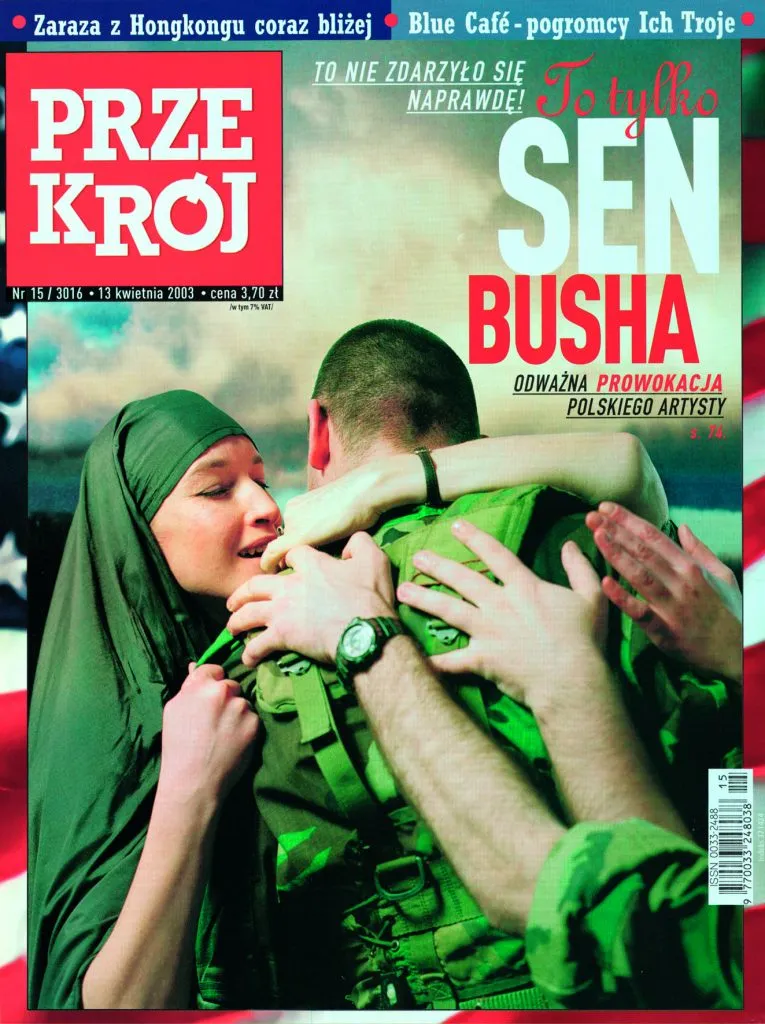
In Masters, Libera does amplify the anomie of the pseudo-avant-garde, but at the same time makes it the subject of his asteism, placing its spectre in influential media such as “Gazeta Wyborcza”. Just as in the positive Che (The Next Frame), where the famous left-wing Latin American fighter, resembling Mantegna’s Christ but miraculously resurrected as Che-Christ, is offered tobacco by his fascistic tormentors, the Polish media, generally hostile to the pseudo-avant-garde, here grant it their pages as though on their own initiative. More important than this amplification of the pseudo-avant-garde is asteism—as perhaps the only effective way of dealing with anomie. For asteism, as one of the tropes of irony, makes amplification its subject here and, as wit, is an explosion of amplification that both enlarges and diminishes anomie. By annihilating the amplification that enlarges lawlessness—through the Foksal circle’s hyperbole, the magnification and exaggeration of the threat from the pseudo-avant-garde—which intensifies the fear of lawlessness and restricts acuity when fear turns to terror, giving rise to paralysis and incapacitation, asteism counteracts passive submission to the power of a religion, the ideology of a group or coterie—this or that public projection. Asteism can, in turn, also counteract the amplification that diminishes anomie, served by litotes through the false mitigation and minimisation of lawlessness, which leads its manifestations to be disregarded, as happens in an aesthetic, media-induced hypnosis that makes our sensitivity lazy and demobilises it. Acuity is lulled to sleep in this way, and the phenomenon’s originary character vanishes in media amplification, because it was, after all, published by the powerful, influential “Gazeta Wyborcza”, automatically branding the pseudo-avant-garde as a valuable, legal and credible product, even though it will never actually submit to any valorisation, just like Partum’s Stink, exhibited at Galeria Repassage in 1977. Asteism, as a form of ironic, witty distance or balance, equalises by operating between different types of amplification, and thereby cultivates or regenerates our acuity.
An outline of an irreligious aesthetics
In Masters and Positives, however, the issue is not so much our good as the mastery of art itself, liberating itself from every form of amplification through asteism, in the paroxysm of aisthesis, the incalculability of sensibility, the impulsiveness of the body and, finally, the explosiveness of matter itself, once described as a beggar woman importunately demanding the right to a place, only finally to seize it unlawfully—with cunning, and sometimes with wit—as in Partum’s poem Literary Error:
slowly it emerges
from the deposits
of a sick imagination
with provocative tissue
and sets up camp
in her sandals
the only waiting room
absolutely within her
simply
so that there is
anything to preserve
(Frequencies from the Description, 1961)
Those unfortunate, involuntary falsehoods that are an explosion of what had passed for truth, like this charge of pseudo-avant-garde; those brazen acts of aversion, like Partum’s Contempt; all these manifestations of anomie are not marginal, are no pseudo, but arise from the originary experience of aesthetics. Yet not the aesthetics thematised objectively (nomothetically), already subjected to religious, political, moral and bureaucratic (Foksal) regulation, upon which the lust for power has imprinted its mark of public projection. What is at issue is aesthetics experienced at its source, unlike the discipline of desire (disciplina voluntatis, as Nietzsche defined religion). The concern is, rather, a subjective thematisation, continually in motion, irreducible to an object of law and incapable of being disciplined in its desire—it concerns the term aisthetiküs, which means sensitive.

We bring you here, by day and in full light, not at night when power sleeps, a breakneck freedom that many preachers call pseudo-freedom, tirelessly forcing art into the Procrustean bed of virtue. Let the term aisthetiküs—which also means acute—direct your attention to the discussion crucial to the period of the Sophistic Enlightenment, an enlightenment also indispensable in our country, where artists and critics are persecuted; where, in the name of so-called good law (eunomia), the alleged threat from the godless is magnified out of a primitive fear of the other or for the pleasure of power, and they are stigmatised and mocked in sklerozakonnej criticism, deprived of their place of work, summoned before prosecutors and brought before criminal tribunals, while at the same time merciful prayers are offered for the irregulares, or they are granted compassion—the cheapest of sentiments. Is this amplification of anomie, perpetrated by our populist authorities in broad daylight to the applause of wide circles, not a crime worthy of contempt? Struggling to keep our anger in check, we find support in this Platonic dialogue, long regarded as pseudo because of its heterodoxy, for our perhaps futile attempt to situate the pseudo-avant-garde within something, for this desire to ground somewhere its asteistic, irreligious, originary aesthetics, which—to be witty—we would today like to call ours together with Libera, even though it cares nothing for our happiness: “Those who harm and injure people, deceive them and break the law deliberately rather than involuntarily seem to me better than those who do so involuntarily. Yet at other times it seems to me quite the opposite, and so I wander on this point, evidently because I have no knowledge. But now, at this moment, something seems to have seized me, and deliberate wrongdoers appear to me in some respect better than the involuntary”24.
1 Kazimierz Piotrowski, The Avant-Garde on the Defensive: On the Avant-Gardisation of Aisthesis, “Kultura Współczesna” 3 (25) 2000, pp. 19–39.
2. From the Greek asteidzomai —to be witty.
3 From the Latin amplificatio—enlargement, multiplication; amplifico —to expand, spread, elevate, intensify, raise, place in a brighter light, distinguish.
4 Boris Groys, Gesamtkunstwerk Stalin, Munich 1988.
5 Ian Burn, The Art Market: Affluence and Degradation, “Artforum” IV 1975, pp. 34–37.
6 Hans Haacke, Statement, [in:] Art into Society, Society into Art, Institute of Contemporary Arts, London 1974, p. 63.
7 Mel Ramsden, On Practice, “The Fox”, New York, IV 1975.
8 Victor Burgin, Situational Aesthetics, “Studio International” X 1969, vol. 178, no. 915.
9 Wiesław Borowski, Pseudo-Avant-Garde, “Kultura”, 23 March 1975.
10 Zbigniew Warpechowski, The Lift, Jerusalem–Rome–Sandomierz 2001, p. 420.
11 The Theory of Place was set out in a publication by Galeria Foksal containing the Programme of Galeria Foksal PSP; see also: Wiesław Borowski, Anna Ptaszkowska and Mariusz Tchorek, Introduction to a General Theory of Place, [in:] Tadeusz Kantor in the Galeria Foksal Archive, ed. M. Jurkiewicz, J. Mytkowska and A. Przywara, Galeria Foksal SBWA, Warsaw 1998.
12 See the end of note 15.
13 This recalls Strzemiński’s critique of pseudo-modernism in the 1930s.
14 K. Piotrowski, The Victory of the Pseudo-Avant-Garde: Sociomorphic Aspects of Art and Criticism in the 1990s, [in:] Art of the 1990s, Seminaria Orońskie, vol. V, Orońsko 2003, pp. 19–28.
15 The exhibition IRRELIGIA. The Morphology of the Non-Sacred in Twentieth-Century Polish Art, which included selected artists of the pseudo-avant-garde (Partum, KwieKulik, Zofia Kulik, Jacek Kryszkowski, Jerzy Truszkowski, Łódź Kaliska and Libera, among many other restless spirits), was organised on Włodek Majewski’s initiative at Atelier 340 Muzeum in Brussels (October 2001–January 2002). The exhibition provoked hysteria in Poland, particularly in national-Catholic circles, but also among many experts surprised that the author of these words had taken up a godless theme (it came as no surprise that among the avant-garde opponents of the exhibition, even during the preparatory phase, was the head of Galeria Foksal, Wiesław Borowski, extending his dubious protection over the late Andrzej Szewczyk, who ultimately withdrew; Mirosław Bałka—another Foksal artist—refused to discuss the subject at all, although in the 1980s he sculpted the so-called black pope). The media erupted in a debate about the limits of artistic freedom and tolerance, while outraged Catholic right-wing deputies demanded in parliament that the left-wing government repress the exhibition’s authors and intervene officially to have the Brussels authorities, which had supported the project from the outset, close the exhibition. Not since Przybyszewski had the amplification in Polish culture of artists’ lawlessness towards God, Honour and Fatherland reached such heights of presumed criminality that it was decided to celebrate expiatory prayers on our behalf. The epilogue to this campaign was the trial for offending religious sensibilities brought shortly afterwards, in 2002, against Dorota Nieznalska, one of the exhibition’s participants. There is still hope that an appeal to a higher court will overturn the conviction already handed down in 2003, which provoked a wave of protest (see my commentary, Irreligia Before and After Nieznalska’s Trial, on her website). Of my own adventures, I shall mention only that my photographic portrait made by Libera, who often visited me during my exile in a barred little room in the Podchorążówka, where after my dismissal as curator of Królikarnia the museum authorities represented by director Ferdynand Ruszczyc emplaced me, will remain a precious memento. As a political prisoner in the 1980s, Libera well understood the charms of my situation. I do not, however, wish to demonise this aberration of museum bureaucracy. On the contrary, I would gladly diminish this bureaucratic pettiness, were it not for the difficulty that in this instance the contest is in any case with someone already so small. Nor need one exaggerate and immediately reach for Partum’s Contempt. Rather, young people in Poland should be taught originary aesthetics, and we should be glad that there are still museum directors in this country, such as Professor Wojciech Suchocki, with whom collaboration is possible—for evidence, see K. Piotrowski, The Irreligia of Revolt: The Genesis and Morphology of the Poznań Apostasy, [in the exhibition catalogue:] REVOLT: Poznań Expressionism 1917–1925, ed. G. Hałasa and A. Salamon, Muzeum Narodowe w Poznaniu, November 2003–January 2004, pp. 119–139.
16 Libera’s de-Foksalisation of art history in Poland belongs to the postmodern current of remaking history, although its motives and tools vary; see Remaking History: DIA Art Foundation Discussions in Contemporary Culture, no. 4, ed. B. Kruger and P. Mariani, Seattle 1989.
17 Carl von Clausewitz, Vom Kriege, ed. C. Höckner, Dresden 1885, pp. 143–144.
18 A good example of this civilising mission is the ironic positive Bush’s Dream, based on diasyrm (Latin elevatio), that is, on the mocking evocation and anticipation of desires harboured by many Americans; its venom was intensified by the very fact that it was published in “Przekrój” on the day Baghdad was captured.
19 Does this desire not also, in some measure, legitimise the need for the pseudo-avant-garde to exist as an ennobled form of avant-garde aggression under conditions of social peace and prosperity?
20 Derrida quotes Rousseau: “On meeting other men, a savage was initially terrified. His fear made him see these men as larger and stronger than himself; he gave them the name giants. After many experiences, he recognised that these supposed giants were neither larger nor stronger than himself, and that their stature bore no relation to the idea he had initially connected with the word ‘giant’. He therefore invented another name common to them and to himself, such as man, and left the name giant to the false object that had caused his delusion. This is how the figurative word arises before the proper word, when passion enthrals our eyes and the first idea it presents to us is not the idea of truth”; see J. Derrida, Of Grammatology [1967], trans. B. Banasiak, Warsaw 1999, pp. 361–362. It seems that all the effort and invention of culture tends towards replacing the sinister word anomie with one more proper.
21 What the Greeks called térpsis is today an overpowering pleasure, because mediation is intensified by the electronic desubstantialisation and deterritorialisation of the impression (the possibility of its multiple repetition, framing and staging, and of two-way—enlarging and diminishing—amplification). Aristotle had already noted the pleasure afforded by imitation itself.
22 Krzysztof Wodiczko, Public Projection, “Canadian Journal of Political and Social Theory” 1983, vol. 7, nos. 1–2, pp. 184–187; [reprinted in:] Krzysztof Wodiczko: Public Art, ed. P. Rypson, CSW, Warsaw 1995, pp. 112–115, p. 114.
23 K. Piotrowski, Prospects for the Design of the Future: From Aesthetics to Anaesthetics, [in:] Forms of Aestheticisation of Public Space, ed. J. S. Wojciechowski and A. Zeidler-Janiszewska, Instytut Kultury, Warsaw 1998, pp. 145–173 (including a comparison of Wodiczko’s and Libera’s designs).
24 Plato, Hippias Minor, D 372, trans. W. Witwicki. “Unmoralisch geredet, eine Schlauheit? – Nietzsche asked with his characteristic acuity – Oh Sokrates, Sokrates, war das vielleicht dein Geheimnis? Oh geheimnisvoller Ironiker, war dies vielleicht deine – Ironie?”.