

Joseph Is Finally Coming Back. The Ox Knows Its Master, and the Donkey Its Owner’s Manger
It was quite a feminine Christmas. The guys could play Józef, and he (as we know from medieval scenes) at a critical moment was sent by the Girl for a - useless - candle so that he would not disturb and panic.
From a post-Christmas, everyday perspective, let's ask a question that is certainly of interest to the viewers of the best breakfast TVs on the veranda. Was the Blessed Virgin the prototype of WAGS? Yes, but not right away. Only when the spectacle of the manor, the spectacle full of cold glances dominated the surroundings. Somewhere at the dawn of modernity, the first such appear Dazzlingly perfect Images. Every smallest detail, like in a TV studio, is edited and supervised by a separate guardian angel. Everyone knows their place.
Right wing Diptych Melun By Jean Fouquet painted by Étienne Chevalier, who was Controller of the general account of finances At the court of Charles VII.
In the role of the Young Lady Dame de Beauté Agnès Sorel Around 1450-1452. Authentic pearls, the rest not necessarily.
What couldn't be shown on TV?
Holiday as unexpected Event Smashes everything. He doesn't count with anything, he mixes up daily cleaning.
Unfortunately, the holiday as another celebration is already a cliché and boredom. After, slightly counting, more than two thousand repetitions and anniversaries there is no madness.
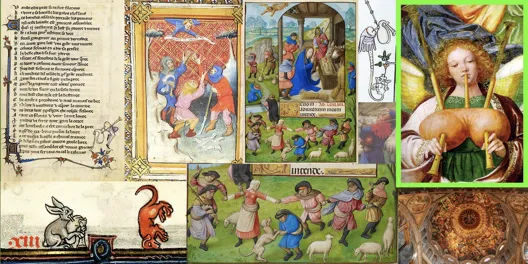
Code from northern France or Belgium (Tournai?), ca. 1350, Morgan Library & Museum, MS G.24 fol. 136v
Gaudenzio Ferrari Gloria – angelic choirs, Nave dome W Santa Maria dei Miracoli in Saronno, 1534
Hours of Spinola, Ms. Ludwig IX 18 (83. ML.114), fol. 125v, Ghent, ca. 1510-1520, J. Paul Getty Museum
Hours of Sforza, Milan, ca. 1490, British Library, Add. MS 3429
Let's see how Authentic The holiday works. How he puts normality upside down. It acts like a sound, loud, not at all pleasant, urges for meaningless dances and jumps. Does anyone like that every day? And at the Holiday you have to.
One instrument in particular catches the eye. Dudy is a pastoral archaism, titled like a sheep's kierdel, straight out of "immaculate nature". It is supposed to be bouncy and loud, no finesse. The paradox of the holiday lies in the suspension of cultural conventions that bind the order of day and night, in the compulsion to return to nature on the physiological level of the portek falling in the dance.
A moment, at the feast, you can spend looking at the consonance of shepherd bagpipes with the inconceivable, heavenly singing. Quite asexual angels, when it comes to perform them Gloria in excelsis Deo On bagpipes they gain surprisingly human qualities.
On the margins of medieval codices, further from the sacred, newly revealed order, bagpipes were painted schematically, with all the simplicity of the anatomical context.
To understand the holiday, to clearly hear the angelic message with the other ear, you need to cut it vigilantly like a shepherd dog wriggled out in a dance with a lamb.
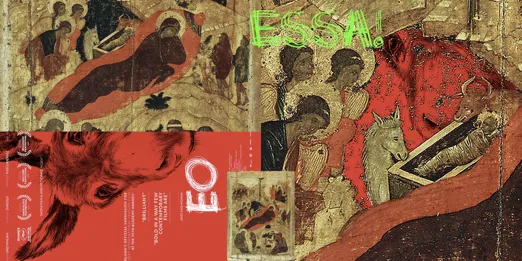
The centre of the icon from the Błagowieszczeński Council in Moscow is marked by the head protruding from the barrel.
In this place, an anonymous painter somewhere at the turn of the 14th and 15th centuries had to drive a skewer to mark the circle on which the square (62 x 62 cm) was described, which contains everything important in this story. From the bottom, a belt was added for episodes without meaning: Joseph talking to the old man Zosimus, women bathing a child (the motif directly copied from the iconography of little Dionysus, hence the Greek tiaras on the hair).
The stage is full of voices of surprise, surprise, and joy coming from different directions. Christmas in a grotto, in the black abyss in the middle of a solid rock. It is no longer possible to reveal what it means: Incarnation. Incarnation in matter, in stone, in animal, in man. The latter is quite risky, foreshadowing serious trouble in advance. It is easy to determine what was, according to the canonical story, closest to the incarnating Incomprehensible. In addition to darkness and rock, an ox and a donkey. This is a representation of the words of Isaiah, who eight hundred years earlier whined as usual:
The ox recognizes its master
And a donkey the manger of its owner,
Israel knows nothing,
My people don't understand anything (Iz 1,3)
Old history, it's time for something fairly modern (we'll probably agree here): let's choose a donkey.
The donkey is the animal of Bacchus, he trampled in the crazy procession of the god probably already in the time of Isaiah. He saw more than one up close. He rubbed himself with the afterlife oddities. The episode in Bethlehem did not surprise him. After the episode in Jerusalem, he became a significant animal for Christianity. Saint Francis said to his body: brother donkey.
If the donkey had an absolute memory and wanted to talk about it, he would have trouble like the first better poet: by what miracle, with what words? After many attempts, he chose a seemingly monotonous donkey: Ioo, Iooo, and he continues with him. It's hard to write it down, people have to complicate everything, they write: Io, They write: Eo, They write: Ih-Ah, Or: Iа – iaaaaaa! Judging by the Gospels, the faithful record of what is happening "really" is not particularly successful.
We don't really understand what prolonged doubling of sounds mean. We treat such words as a contentless ornament, as a record of emotions that do not explain anything. In the end, it may turn out that what philosophers have been chasing for thousands of years: pure affirmative Logos Fits in a similar sound. Glory in excelsis! Essa! Iooo!