
If the World Is to Change, You Must Change. The World Has Your Face
Siegward Sprotte
Let us learn to look.
Let us learn to recognise.
In North Africa I look at a carpet dyed in natural colours and feel its direct force and the language that offers us such a magnificent palette. Since learning to read and write, we have increasingly lost eye-to-eye contact in human relations. At the same time, we are losing the ability to apprehend the world as a whole. Today we live in a colourful world of illiteracy while remaining attuned to the black-and-white image. We find chromatic nuances more difficult to perceive. Those who receive the world in black and white, and those who think differently, fear chromaticity. They are afraid of losing themselves in colourful diversity and multiplicity; they fear colours because they cannot comprehend them. Children in the civilised countries of today find learning to read and write more difficult than earlier generations did. No one seems to have drawn conclusions from this. Vision is restricted. People fight over upper- and lower-case letters, fragment things and lose sight of the whole. They become entangled in party politics — for how much longer? Sectarianism thrives. A comprehensive view appears to have been displaced from today’s politics and science more thoroughly than ever before. Our contemporary political education of children, whether by methods of the left or the right, is rapidly teaching them to unlearn a colourful perception of the world. Yet we have colour television and colourful clothes, while laboriously learning to read and write. American attempts to use colour in writing and lettering were intended to counteract the wearisome reception of black-and-white repetition. Poland became famous around the world for colourful graphic design, especially the poster, which permits an attentive observer to ask whether commercial designers introduce colour with greater awareness and care than so-called independent painters.
In the painting of our century — beginning with Van Gogh in the previous one — a small number of painters sought to bring about a breakthrough through chromatic perception. As usual, however, reactionary tendencies prevail, and it seems that these bold, pioneering works by individual masters and their experiments may leave behind no more than a coloured spark in a black-and-white vault that reaches back thousands of years in the history of the mind. The colour television image prevents us from apprehending and comprehending in colour the world’s creative possibilities. No one can receive poisoned colours for long without destroying their productivity and the eye’s sensitivity to chromatic nuance. The eye is not merely an instrument of perception; it exerts a particular influence on our consciousness. There is a danger that consciousness will retreat into long-surpassed patterns of black-and-white perception, as though thousands of years of development, momentum and preparation had been wasted. We risk squandering our sole opportunity and undoing within a few decades an evolution that has taken millennia. For those who refuse to submit to this reactionary rush, it may therefore be more important than ever to reaffirm the striving for chromatic perception in conjunction with conscious human existence. I have Goethe’s theory of colour in mind.
Goethe writes of the “sensuous and moral” effect of colours on the human being. Chromatic perception consequently develops consciousness. Only those who command their awareness in the present moment, whose thoughts do not run ahead into past and future, are able to see the world in colour. In other words, we feel colours through the senses, not through thought. The further we stray into the realm of thought, the more we lose the ability to perceive colour with full awareness. The entire activity of thinking is a parasitic enterprise. Thinkers who do not reflect on the process of thinking defend themselves by every means available, including force, against becoming aware of this. Culturally and anthropologically, chromatic perception and black-and-white thought oppose one another. Anyone who reads books or newspapers feeds their language in black and white. It is no surprise that bookworms become black-and-white bureaucrats and adherents of black-and-white perception, interpreting white and black as opposites in the manner of bureaucrats. Beginners and those accomplished in writing alike inhabit a world of black-and-white contrasts. They believe they will go further by thinking and speaking in black-and-white patterns than by looking and perceiving nuances — a mode that, amid the full variety of chromatic phenomena, requires no contrast to direct consciousness. But more is at stake than the recognition of colours. Colours are behaviours. Colours are not objects. One can think in black and white, but not look in black and white. Colours can only be seen; they cannot be thought about. They can be brought forth only by looking at them.
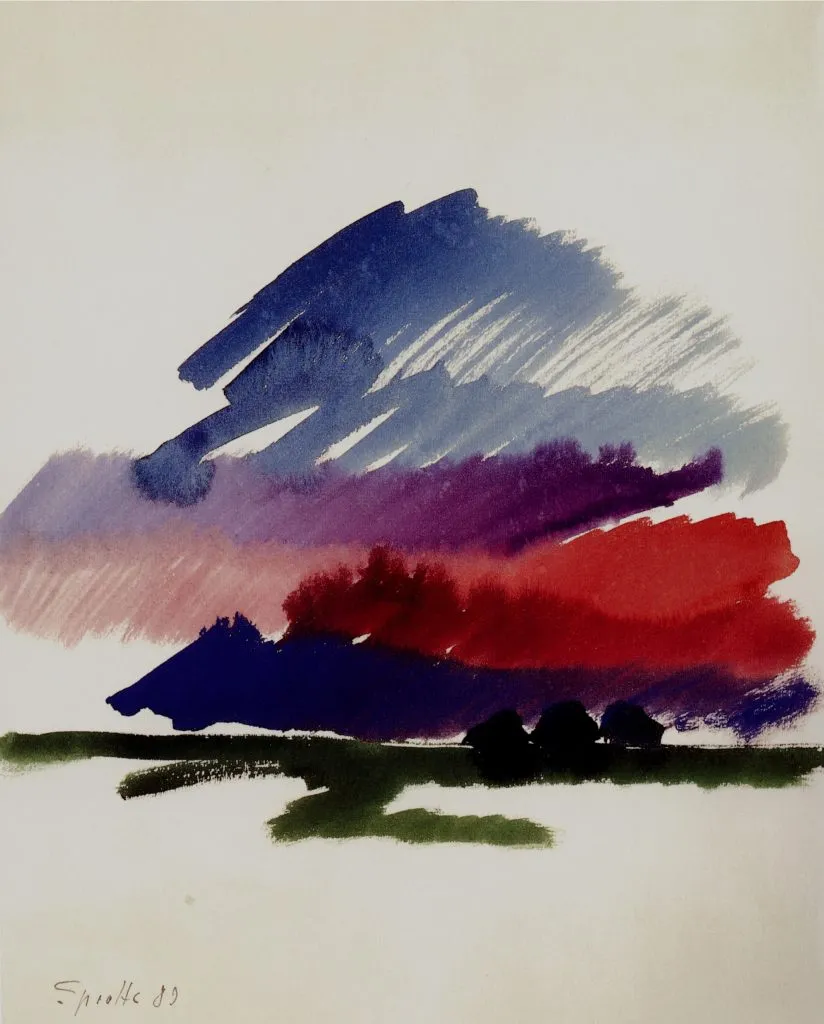
Face to face with chromatic phenomena, knowledge awakens within the human being, and with it the strength to unite creatively with a timeless present. We speak a great deal about our so-called free time, yet we have still not managed to become free of time during it. We cannot escape thought. “Idleness is the source of every vice,” say the worker, intellectual, bureaucrat and learned scholar. “Inactivity is the beginning of knowledge,” says the one who knows.
Whoever seeks to shape their reality in colour sees. They do not read what they see; by looking, they bring it into the world. In looking, they participate in everything that appears to them. They do not reduce their senses to vestigial organs, but allow them to recreate the human face, creativity and consciousness.
Sensory reception is the foundation of thought. Sensory capacities, and our surrender to them, are the foundation of all knowledge. Thought feeds on capacity; cognition multiplies and intensifies it. To bestow the senses upon oneself is to expect that they desire reverie more than sobriety. Reverie is cognition. If cognition is not followed by thought, or giving by taking, then whoever does not interweave giving and taking only gives and gives. Whoever transforms taking-and-giving into giving intensifies their abilities. Their cognition does not cause the same atrophy of capacity as their consumed, depleted and consuming thought; their cognition multiplies capacity. It contributes to the development of an original, conscious attitude. They create while creating, without using up creativity. Their cognition increases creativity. Cognition is creative for them. They recognise themselves in action. They create by being creative. They practise the art of creativity, creation and cognition without separating themselves from temporality, yet time does not restrict them. Creation and cognition occur simultaneously.
translated from German into Polish by Maria Kruk