
Jak przeubrać się na Ament
Ewa Gorządek
“There are affinities between a shopkeeper, a wealthy
libertine
and a devout believer crouching
in anticipation of salvation.
They may even be the same person.”
Georges Bataille, Inner Experience
Sławomir Belina’s work is capricious, underpinned by fiction and mystification, yet always carries a pronounced flavour of the absurd, as befits a former student of Adam Rzepecki’s Private Academy of the Absurd. It grows out of the tradition of nihilistic art represented within the independent Łódź milieu of the 1980s, where the artist made his debut, by groups including Łódź Kaliska, which helped form the broad Pitch-In Culture movement. Józef Robakowski described the phenomenon as follows: “Our art appears invisible and even socially imperceptible, but it certainly functions — we feel it by continually making it happen. (…) New forms of activity emerged, ruthlessly attacking the stereotypes of thought that allow us to live with a sense of independence within culture and political change”1. Belina identified so strongly with the philosophy and artistic strategies embraced by artists in the Łódź Kaliska circle that from 1989 to 1994 he participated in the activities of Łódź Fabryczna, an intermedia group that grew under its wing, together with Małgorzata and Mirosław Łupina and Tadeusz Kieszniewski. At roughly the same time he was also associated with the Łódź Artists’ Museum, founded in 1990 after the first edition of Construction in Process.
Belina expresses himself most readily through photography, although the many forms of his creative activity have also included performance, installation, objects, sculpture, painting, poetry, drama and even knitwear (Go Beliny). During the 1990s he also delighted in compiling absurd guidebooks that offered a caustic parody of publications then appearing en masse in bookshops. Belina advised readers, for example, Jak przebóstwić się na Ament (1995) and How to Dramatise Your Attitude to Life Effectively and Succeed (1996), and offered 33 Ways to Corrupt a Human Being (1996).
The photographic medium Belina employs most frequently is the body, usually a naked male body. The artist very often appears in his own photographs, playing with his image. In staged photographs from the early 1990s, he readily invoked the iconography of classical art while colouring the images with an atmosphere of “ironic decadence”: Sic Transit Gloria Mundi, Pietà, Self-Portrait with a Demon, but be cautious, for from his mouth an Idea resembling a serpent will run towards you. The naked body in Belina’s photographs is an eloquent and meaningful material from which the artist draws erotic, provocative, confessional and fictional potential. He constructs fragments of narratives about what is difficult to articulate. Corporeality is his key to asking questions about an identity inseparably connected with the body and its fantasies, desires, obsessions and fears. This narcissistic expression of his personality consists above all of attempts to investigate the essence of the self. Like a mirror, photographs reveal primarily the body’s physicality; yet, like reflections, they are subject to interpretation and compel us to ask questions and contemplate. This self-absorption may be a cognitive form of looking.
Belina also employs a narcissistic strategy in a more sophisticated and even perverse manner. In the solo exhibition Eight (2000) at Zachęta’s Small Salon, he presented eight photographic portraits of himself made by artists he had invited to participate: Mirosław Bałka, Anna Baumgart, Jacek Foks, Katarzyna Kozyra, Robert Maciejuk, Jadwiga Sawicka, Leon Tarasewicz and Artur Żmijewski. He surrendered the opportunity to appear as the author of the works in favour of becoming the model and protagonist before other artists’ lenses, placing himself at their disposal. Did this result in a multiple or collective portrait of Sławomir Belina? And did the “next attempt to fathom his own psyche — while brushing against someone else’s”, as the artist hoped, succeed? The portraitists approached the task with no less narcissism and egocentrism than its originator, who in most cases became staffage or a prop inscribed within the aesthetics characteristic of their work.
Mirosław Bałka treated the portrait’s protagonist most explicitly as an element of his own studio, photographing the naked Belina among his works. Leon Tarasewicz placed him in the landscape of a green meadow, while Robert Maciejuk set him within an office. Jadwiga Sawicka displayed only Belina’s knees in openings cut into thick red fabric with a tiger pattern. In Anna Baumgart’s photograph, Belina shows his face in a street photographer’s cut-out board. The remaining three portraits refer more or less openly to homosexual eroticism. Jacek Foks portrayed the naked artist at a petrol station, taking a fuel nozzle into his mouth in an erotic gesture. Artur Żmijewski showed Belina on a hospital examination couch while a nurse inserted a proctological crank into his rectum. The staging referred to practices used in concentration camps to collect semen from prisoners, but also recalled the homosexual men imprisoned there. In Katarzyna Kozyra’s photograph, Belina poses nude within the exhibition Grey in Colour. He has his back turned, bends towards the viewer to expose his buttocks, while Douglas Gordon’s work bearing the words “It Is Better Not to Know” occupies the centre of the composition.
The opposite of public nudity, which may ostensibly be understood as the message “I have nothing to hide”, is the adoption of a disguise or mask. This is usually read as a wish to “suspend” one’s identity, to play at being someone else or escape into anonymity. A mania for masquerade arose during the eighteenth century among bored aristocrats in perpetual search of fresh thrills. Masquerade culture reached its apogee in this period, and one of its most common forms of pretence was transvestism: dressing as a member of the opposite sex. Today, dressing up has generally been relegated to childhood memories or the not particularly frequent revelry of carnival. As Mikhail Bakhtin writes: “Proclaiming total freedom and creating through its customs and rituals a peculiar world turned upside down, in which masters played slaves and slaves masters, carnival was directed against every rigid social hierarchy and authority, and against norms, conventions and restrictions on behaviour, all suspended and in a sense degraded for the duration of its revels”2. The celebrated Venice Carnival ends with a frenzied ball in St Mark’s Square.
Sławomir Belina’s new project, an eight-channel video installation titled Norm, appears to refer precisely to rituals of this kind. For play to achieve its effect, however, certain conditions must be met. Yuri Lotman observed that a participant in a game should simultaneously remember that they are taking part in a conventional situation and forget that fact, since “the art of play consists in mastering the habit of two-level behaviour”3.
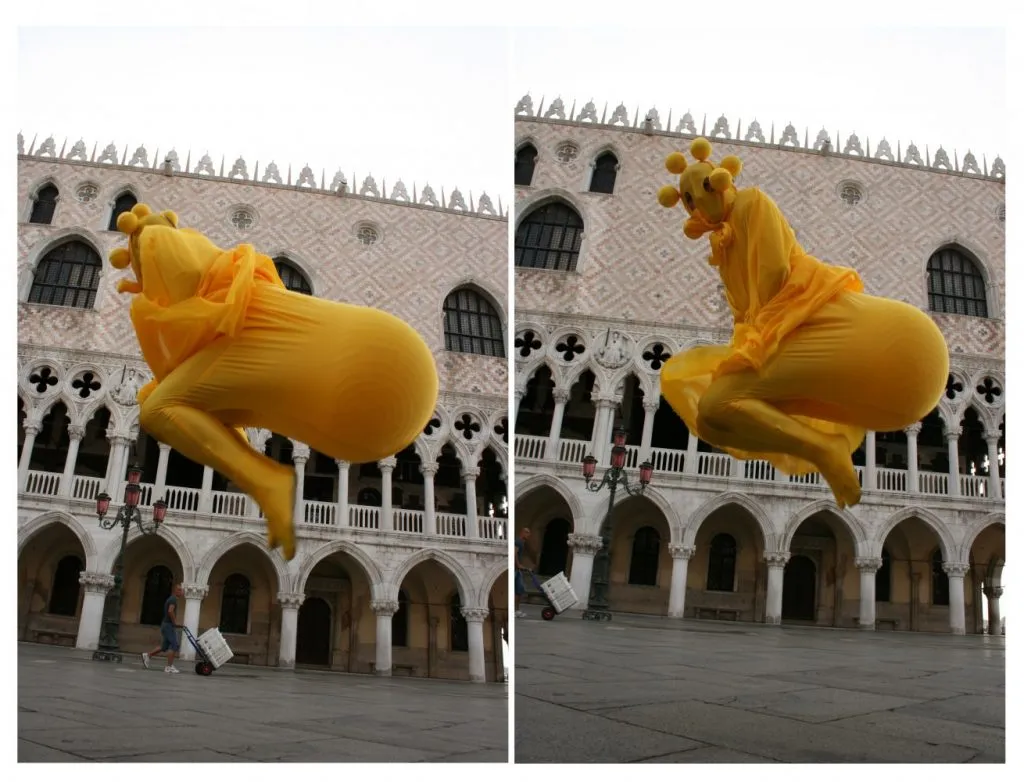
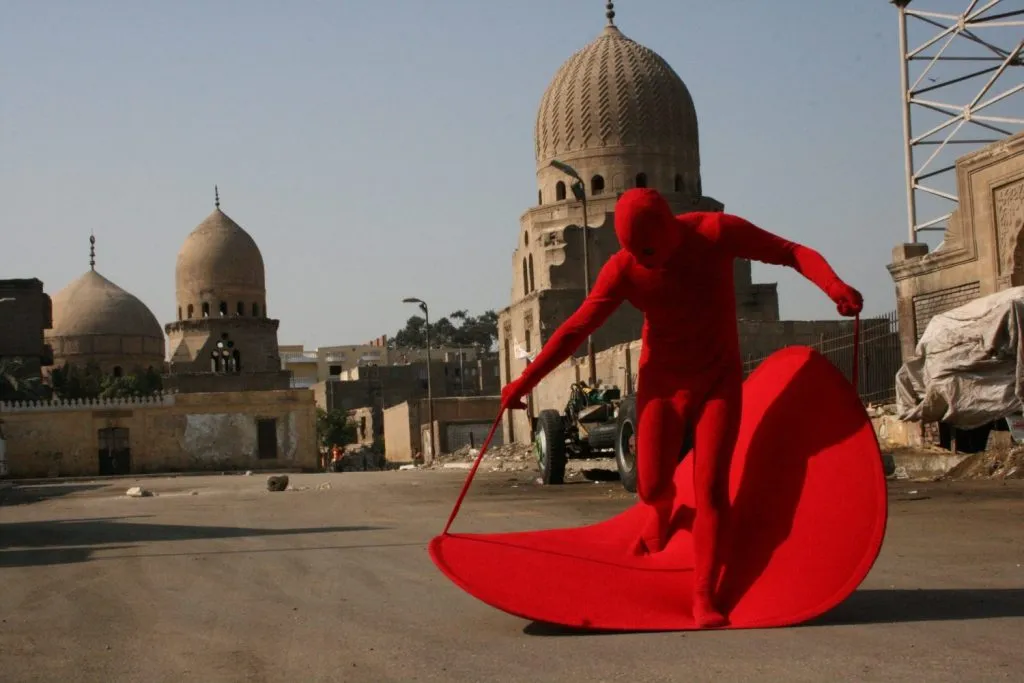
The impulse, or even inspiration, for Norm came from Belina’s participation in “queer festivals” held fairly regularly by Warsaw’s Saturator club. During such events the venue assumed a fashionable “queer” character; besides music, performances, films and other artistic happenings, it also hosted games of “dress-up”. On a small scale, these festivals partially fulfil carnival’s social role: affirming every form of difference, theatricalising personae, providing an outlet for accumulated “ferment” and offering a chance to escape, if only briefly, from the rigid corset of norms. Belina’s slogan for the Praga club — SATUratuj się — eloquently testifies to this understanding of the events. Belina’s Norm continues the play and game with costume, now transferred into the field of art. The artist designed a series of outfits for himself, based on a leotard or a diaphanous veil that concealed the body while remaining highly responsive to its movements. The costumes are masks too, since they also cover the artist’s face and allow him to feel completely anonymous. Belina set out into the world with his disguises, travelling first to St Mark’s Square in Venice, then to New York, Hanoi and Cairo, and finally to Łódź. An anonymous figure in anonymous surroundings. What matters is the costume and the way it enters the space of cities and interiors. To some extent, such clothing imposes its power upon the wearer, dictates movement and suggests ways of behaving. Belina’s costumes — those bulging with rounded forms and those whirling in currents of air — seem in themselves to demand choreography and musical accompaniment. There is none of Narcissus’s empty gesture in this work, but much of a need to exist in a manner more intense and less compromised than the “norm” permits. Looking at fragments of Norm, it is impossible to resist the impression that “as in Fellini’s films, dreams and fantasies of another, more colourful life spill into the streets and squares”.
And the norm? We are all still trying somehow to dress beyond it.
*Ewa Gorządek graduated from the Institute of Art History at the University of Warsaw. She has curated numerous exhibitions and written critical texts on contemporary art. She works at the Ujazdowski Castle Centre for Contemporary Art in Warsaw.
1. J. Robakowski, “Pitch-In Culture”, in The Decade 1980–1990, mimeographed publication, My Archive Gallery, Koszalin, 1990.
2. M. Bakhtin, Problems of Dostoevsky’s Poetics, Warsaw, 1979, p. 194.
3. Y. Lotman, The Structure of the Artistic Text, trans. into Polish by A. Tanalska, Warsaw, 1984.