
A History of Memory: Łódź Kaliska Seen through the Eyes of Its Muses
Adam Mazur in Conversation with Anka Leśniak
Adam Mazur: What is it like to be a Muse of Łódź Kaliska?
Anka Leśniak: I took part in a Łódź Kaliska session once, and it was connected with my studies. At the time, I was writing my master's dissertation on artistic groups in postmodernism. It was a scorching summer. I wanted to show my work to Marek Janiak so that he could check it for factual errors. He told me to come to the architecture studio, because Łódź Kaliska would be holding a session there. Some other girls were meant to come, and there was some sort of scenario for the shoot. I arrived with a stack of printouts and heard: “Show me quickly, because a dozen or so girls will be here in a moment and there will be a huge session.” He read and read, but somehow the girls did not arrive. Eventually, two students appeared who, as I learnt, had posed for the group before. It was obvious that the situation was bad, that this was not how it was meant to be. I felt sorry for Łódź Kaliska, because I know what it is like when you are set on making art and then, for technical or organisational reasons, everything suddenly turns into a complete fiasco. So I decided that I would pose as well. Naturally, this was not without insistent appeals and suggestions from the group along the lines of: “Anka, only two girls have come; if there were at least three, we could come up with something…” I had always been hostile towards commercial or advertising shoots involving undressed women. But then I thought that I criticised such situations although I had never tried to discover what they were really like. And art is, after all, different from show business, so I agreed. It was hot outside and in the studio, and the whole situation felt completely wild. Taking my clothes off under those circumstances seemed entirely appropriate, especially since everyone undressed, including the artists of Łódź Kaliska, so it was a situation of a certain equality before the lens.
A.M.: Was that the session later featured on the cover of Arteon?
A.L.: Yes, but at the time I did not know that the session would be published in a magazine. I never posed again.
A.M.: Am I right that you had already become interested in Łódź Kaliska when you began writing your master's dissertation? How did that happen?
A.L.: It was probably in 2002, a year before I graduated. I had to contact them, and that was how I reached Marek Janiak, the group's informal leader. We met in a pub. It later turned out that I had to begin writing my dissertation by putting Łódź Kaliska's archive in order. I did not know much about them then. I knew the book of texts by Krzysztof Jurecki and Jola Ciesielska, God Envies Us Our Mistakes. I read the articles and thought it might be interesting. Then I sat in the studio on Piotrkowska Street, sorting their materials, while Janiak dropped in between classes and cooked meals. We became friends over time. I no longer remember how I met the rest of the group. Probably during that nude shoot.
A.M.: Which groups besides Łódź Kaliska did you discuss in your master's dissertation?
A.L.: The dissertation set out to analyse the characteristics of a postmodern artistic group. I examined them through the examples of Łódź Kaliska and the Ładnie Group. I became interested in the latter at their exhibition at Galeria Manhattan in Łódź, but I did not meet the members of Ładnie in person. Working with Łódź Kaliska proved extremely absorbing; I admit that I devoted considerably more time and attention to them.
A.M.: Why did you compare those two groups in particular?
A.L.: To write about contemporary group activity, I had to begin somewhere. My starting point was the concept of the avant-garde group. Łódź Kaliska began with avant-garde traditions and ended in postmodernism—or perhaps even initiated postmodern thinking in Poland—whereas the Ładnie Group was already deeply rooted in postmodernism. I was interested both in the generational transition and in how the two understood “groupness” in art. What did they need it for? What does the term “artistic group” mean today? How does it differ from a social circle?
A.M.: It seems interesting to compare not only their approaches to postmodernism and popular culture, or their over-identification with the dominant commercial culture, but also their approaches to Muses. Women also appeared in the Ładnie Group, although perhaps less obviously than in Łódź Kaliska.
A.L.: Yes, for example in Marek Firek's texts, which were exceptionally sexist. In their own way, the artists of Ładnie also cultivated the myth of the artist surrounded by women, a myth that was probably already somewhat outdated. Although in their case it may have been more rooted in popular culture.
•••
A.M.: When did you meet the Muses of Łódź Kaliska?
A.L.: At the same nude shoot where I met Łódź Kaliska. At the time, I was still a very inexperienced artist, and perhaps this acquaintance crystallised my interest in the role of women in art history. Not necessarily women artists, although they mattered too, but models above all.
A.M.: Did your interests find expression in academic writing or in your art?
A.L.: Half and half. It certainly was, and remains, a subject of my art, but I also wrote texts. For example, my second master's dissertation, at the Academy of Fine Arts, was on feminism and cyberfeminism. That, too, was connected with my artistic interests.
A.M.: Why was the film about the Muses made at all?
A.L.: I had the idea for the film a long time ago, but Łódź Kaliska's three-hundredth anniversary and the symposium in Darłowo gave me the impulse to realise it. The idea arose precisely from my interest in women's history and, in particular, the role of women in art history. In both the video about the Muses of Łódź Kaliska and my earlier film Top Models 2009, about the search for the identities of women in paintings by old masters, I am interested in the problem of the anonymity of the so-called model.
A.M.: Feminist art history contains an entire current devoted to seeking women artists, although less often models. But do you treat this in a specifically feminist way, as a form of reading history against the grain, giving agency to women who appear in art as beautiful things subjected to the male gaze? Are your art and your film about the Muses a form of emancipatory, feminist work?
A.L.: Yes. I noticed that whether we are dealing with a past several centuries distant or a situation we have witnessed with our own eyes, the approach to women who participate in making artistic works is similar. We do not know who posed for Titian's Venus of Urbino, but nor is it widely known that one of the participants in Yves Klein's actions was his wife, also an artist—Rotraut Uecker Klein, Günther Uecker's younger sister. My primary aim is to try to determine how the women involved in creating a work of art influenced the final shape or character of the artistic realisation, and I begin by identifying those women. I therefore ask whether the information we possess about the identities of women who contributed to specific works sheds new light on our perception of those works and opens new paths of interpretation.
A.M.: Am I right that, in your view, this information changes our perception of art?
A.L.: Yes. I can admit that, were it not for the variety and originality of the personalities of Łódź Kaliska's Muses, this film would never have been made, and perhaps the idea would never even have arisen. Those women are therefore its co-creators.
A.M.: Could you give some examples?
A.L.: The Muses' accounts can change the way we look at Łódź Kaliska. The artists are usually perceived as a group that makes films or photographs for which naked women pose, but in fact they are a happening group. Ania Krawczyk describes how, during a photo shoot, she had the idea of painting on a moustache and thereby becoming the Mona Lisa. Suddenly, it turns out that the Muses influence the character of the work. The point is not to quarrel over the authorship of Łódź Kaliska's ideas, but to show that this art emerges during meetings shared by the group. Łódź Kaliska creates a situation, a space in which art happens: a space for the artists themselves, but also an invitation to other people, such as the Muses. Without them, everything would be different.
A.M.: So this matters to historians seeking the sources of originality and evidence of the essence and authorship of a work of art. On the other hand, it also expands works' interpretative scope enormously.
A.L.: Yes, and it renews the question of what it means to be an artist today. When most of society, including people connected with art, uses that word, they have in mind an individual, the master-genius who created everything with his own hand and mind. But art has always required the labour of many people. Entire families and artists' pupils worked on the works of old masters. In the context of this conversation, it is worth emphasising that they were often women as well. Today, the “production of a professional exhibition”—I use these terms deliberately—requires the work of a whole team. The artist makes the decision about the work's final form. Locating artistic genius in an individual is an androcentric perspective. The pattern has become established in art history and, despite the research of feminist critics, still appears self-evident. I am greatly amused by artists who conceal that somebody else's work inspired them or take offence when somebody suggests as much. This is precisely the effect of misunderstanding originality and the need to remain in the spotlight. I am not interested in the cult of the individual in art, but in the mechanisms through which a collective operates.
A.M.: It nevertheless seems to me that your action is not entirely feminist, but rather postfeminist. Perhaps this arises from the tone of your works. One does not sense in them a desire for revenge, for bringing women out of the shadows and destroying the men who dominate them. There is no rhetoric of a battle between the sexes; indeed, there is an affirmation of activities by Łódź Kaliska, for example, which feminists regard as the height of male chauvinism. Are you a militant, second-wave feminist, or already a softer postfeminist?
A.L.: I do not like labels of that kind. Let me make a short digression. I remember how, several years ago, Professor Legutko described Agnieszka Graff in some weekly as a “militant feminist”. Then, in the newspaper photograph, I saw an older man with a gloomy, even grimly determined face and, beside him, a friendly-looking young woman. What does “militant feminist” even mean? If it means that I begin my work with a thesis I intend to prove at any price, that is certainly not the case.
A.M.: I think the term “militant feminist” is fairly easy to grasp in the context of interpreting Łódź Kaliska's work, because that art has been criticised by Iza Kowalczyk and the editors of Artmix, Dorota Jarecka in Gazeta Wyborcza, and colleagues from Krytyka Polityczna. It was criticised from explicitly feminist positions as the height of sexism and chauvinism.
A.L.: I am more interested in investigating or creating certain situations than in proving anything to anyone. Since you mentioned Iza Kowalczyk, Dorota Jarecka and other critics, it seems to me that perhaps the situation was somewhat misread. I do not think they realised that Łódź Kaliska is quite specific, and that to understand these artists' intentions and actions one must know them well as people and acquaintances and work with them. Łódź Kaliska makes fun of everyone and everything, depending on the reality in which it operates. Now they ridicule the political correctness being promoted. Only twenty years ago, men unashamedly made contemptuous and humiliating remarks about women “wherever they happened to be”. Today, a statement that somebody “drives like a woman”, for example, provokes assertive responses from women. Łódź Kaliska attacks one of these politically correct subjects, but does not necessarily oppose feminism. In any case, I would rather look at Łódź Kaliska's absurd photographs than listen on public television to Radosław Sikorski, who said that an election could be held once according to the principle of gender parity, but after that he would like things to be “normal” again (!). Now that is a scandal! Łódź Kaliska simply responds to a changing world. It shows those changes in a distorting mirror. It is good that feminism has become important enough in Poland for the group's artists to have to address it in a work that cost them a great deal of effort. And they responded in their characteristic manner. Paradoxically, during Łódź Kaliska's three-hundredth anniversary and the presentation of Let Men Perish, the feminists gave the group excellent publicity. The worst thing that could happen to Łódź Kaliska would be no reaction at all, leaving them alone with the project.
A.M.: Yes, but on the other hand Łódź Kaliska does not make fun of people with intellectual disabilities or Black people; it clearly targets women. The question remains whether these jokes are funny, and to whom. At this point, another anti-establishment and politically incorrect group of postmodern artists occurs to me: The Krasnals.
A.L.: Perhaps it has not made fun of Black people yet, but it has already made Ala the Chinese Woman and Ali the Arab the protagonists of its works. As it has a crowd of identical Chinese people watching an advertisement for Atlas Sztuki. People with intellectual disabilities, meanwhile, are unable to defend themselves or act as partners in a discussion, whereas feminists can. So let us not equate people who are disadvantaged in some way with women in general as a social group. To answer the second part of your question, about The Krasnals: their anti-establishment strategy, as you called it, caused some turmoil in the world of art institutions. It brutally exposed the position in which the artist is placed. I often have the impression that in Polish art institutions the artist exists for the institution, whereas it should be the other way round. Or that state institutions concern themselves excessively with a few artists while ignoring the art of others—not because of its quality, but out of sheer laziness. The Krasnals' jokes are rather heavy-handed for me, however. They do not amuse me; they are more depressing. Łódź Kaliska can make me laugh. Its members really do sometimes behave like children in nursery school and make silly situational jokes at that level in various, often official, circumstances. Historical examples include throwing a pork knuckle towards Andrzej Lachowicz or dropping an apple into the instrument of a well-known musician during a concert. And I catch myself laughing at jokes of that kind, as if I were in nursery school myself. It is very cathartic.
A.M.: Since we are comparing Łódź Kaliska's art, perhaps it would be worth juxtaposing it with the current of critical art.
A.L.: The art of practitioners of that current, such as Katarzyna Kozyra, Artur Żmijewski and Paweł Althamer, contains no humour or bluff.
A.M.: But Zbigniew Libera can be funny… Do you think any critical themes can be found in Łódź Kaliska's art?
A.L.: Perhaps I compared their art with that of the Ładnie Group because both formations share a similar tactic of pseudo-affirmation which, in my view, possesses critical potential, though different from that proposed by critical art. It rests on irony and undertones.
A.M.: What, in your view, does Łódź Kaliska do with women, with the Muses? What does this pseudo-affirmation consist in?
A.L.: My film responds to a certain situation: the fact that we do not know what to do with the female model in art. I am interested in the position of women in the context of art created by men. I do not agree with Zofia when she says that what Łódź Kaliska does is an “affirmation of femininity”. Perhaps that is how they understand it, and some women want to be affirmed in that way. The problem is that women can be affirmed in many ways, for example by kissing their hand. Some regard that gesture as a mark of respect, while others see it as sexist behaviour. I should not like to fall into the trap of speaking for other women. If I want something, that does not mean another woman wants it too. It is about freedom of choice, not judgement. If a woman wants to pose nude for photographs, why should we forbid it or rebuke her? Forcing women to cover themselves completely is equally absurd. Both attitudes can be tools of liberation and repression.
A.M.: That sounds very postfeminist. Perhaps this is the right moment to ask what art means to you in the context of feminist theories.
A.L.: My film can probably be regarded as feminising or feminist, but it is also possible that some feminist will call it sexist. Feminism is like democracy: it contains many political options. Naturally, a general idea unites every feminist current—namely, that women are treated worse and undervalued because of their sex, and that this situation must change. Different feminist factions pursue that aim in different, often opposing ways. My position as an artist towards feminism is clear. The film tells the history of women and prompts us to consider how women function today and how they perceive themselves, their bodies and their actions, but I do not give a simple answer; I merely indicate paths of interpretation. If I gave such an answer, it would turn out to be journalism rather than art. My intention was not to prove something, but rather to “focus” on women and create an opportunity for them to speak. How it is interpreted is a separate matter.
•••
A.M.: Łódź Kaliska's three-hundredth anniversary profoundly polarised the critical milieu—Iza Kowalczyk on one side and Małgorzata Butterwick on the other—but at this point I should like to place you somehow on the map of this dispute about the group's art. Where do you position yourself in these disputes, as an artist and as a theoretician?
A.L.: In my work, theory and art are connected, and it is very important to me not to separate them. In Poland, the possibility of the artist-researcher figure—one to which I feel exceptionally close—is particularly often denied. As for my film, setting feminist theories aside, I wanted to give these women a voice because I felt that, if I did not, who would? I know them well and have worked with the group, so I know the nature of their work; why, then, should I not have done so? At the same time, I knew that if television tried to make such a film—two men with a camera and a sound recordist—they would never reach the information that perhaps I could reach. The Muses would probably have said nothing, and the men would not have known what to ask. In other words, I wanted to provoke a situation in which people are given a voice—people who are not even demanding it, but simply possess one. Somebody who demands a voice will eventually be granted the right to speak, but perhaps somebody does not demand it and nevertheless has something interesting to say. Małgorzata Butterwick entered into a polemic with the critical opinions of the Let Men Perish project. I think, however, that she felt called upon to answer as an artist. Participating in the project carried entirely different consequences for her than for the other Muses. She was not anonymous in the art world; her face was recognised in the photographs. She had to defend her honour and prove that she had not merely been a mindless tool in men's work, personifying their desires. In my view, one cannot, colloquially speaking, put all of Łódź Kaliska's Muses into a single bag in this dispute, because they often say different things, in different ways, and frequently contradict one another. Yet they were treated as a mass and instrumentalised by both sides of the Łódź Kaliska versus feminism dispute, even though both sides claimed to defend women's rights. I think that, in this sense, what I do has more in common with art than theory, because I do not assume there is one correct solution.
A.M.: You do not take either side, but the very fact that you give women a voice places you more firmly in the feminist tradition.
A.L.: My awareness is changing. I am no longer interested in Łódź Kaliska's oeuvre as a whole; I am interested in the women who took part in this art.
A.M.: Yes, but it will be difficult for us to escape Łódź Kaliska. As for the Muses themselves, I understand that you want to show how differently they may view what they do with these artists and why. But perhaps they simply have a “false consciousness” and fail to see how they are being used and manipulated? More than that, patriarchy may have trained them so thoroughly that they even derive pleasure from this oppression. Does your film not show precisely such women, who enjoy posing for these older gentlemen with moustaches?
A.L.: Yes, but why do they not take money for it, as usually happens in such cases? Unless it is some sexual perversion? But perhaps we should leave such speculation to psychoanalysts. Speaking of moustaches, Makary shaved his off about a year ago.
A.M.: Exactly—why? Is it not naive to say that they do it for contact with art and artists?
A.L.: The Muses do it for many different reasons, including social ones—acquaintances from university or work—and professional ones, as Asia Krawczyk, an art historian, argues: to observe the working methods of contemporary artists at close range. And these artists extend such an invitation to women. They also offer the possibility of finding oneself at the centre of art “happening”. Art is participation in a reality other than the real one. That is how the accountants, psychologists and social workers regard their collaboration with the group. They certainly do not speak with a single voice, and each sees her role in the group's history differently. Some feel appreciated, while others indicate that their role was not emphasised sufficiently. All make an important contribution to the life of the group, in which there is probably no clear division between “creators and material” after all. As Zofia Warzyńska-Bartczak says: “without the Muses it would be a completely different Łódź Kaliska”.
•••
A.M.: Let us now discuss some of the technical matters connected with the film, because they too seem quite interesting. Where and when did you shoot it?
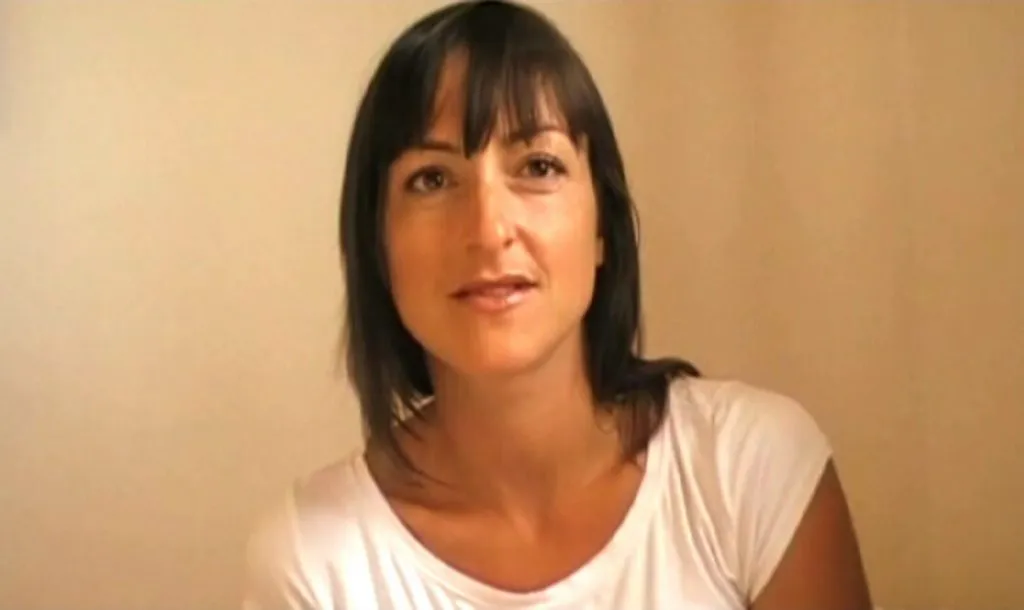
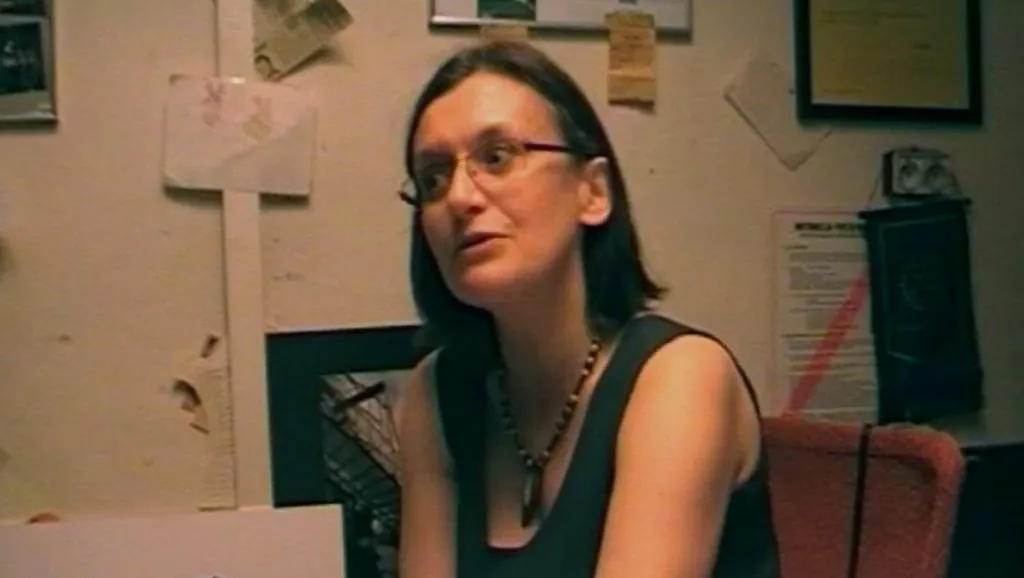
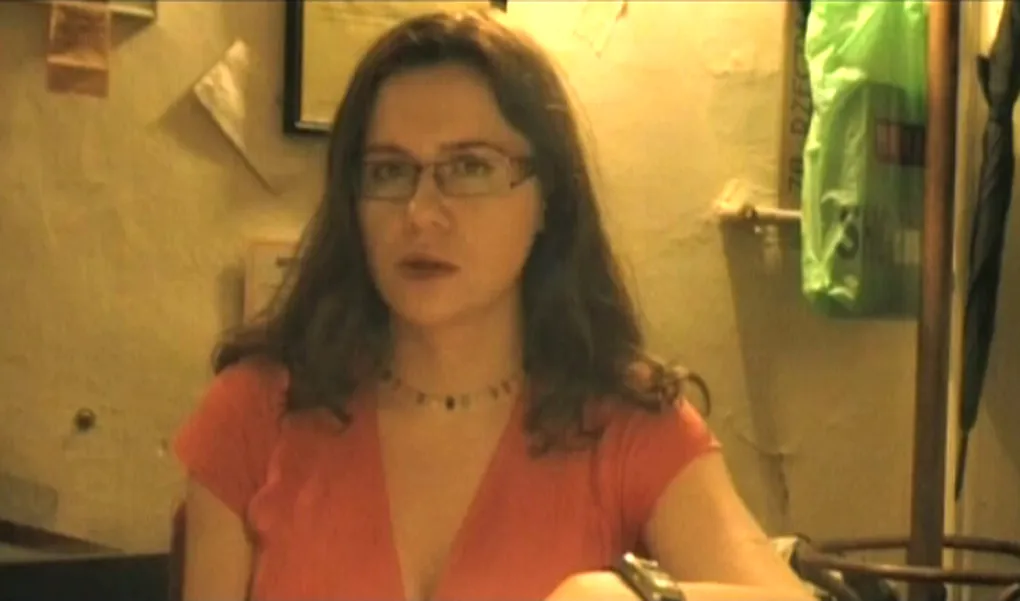
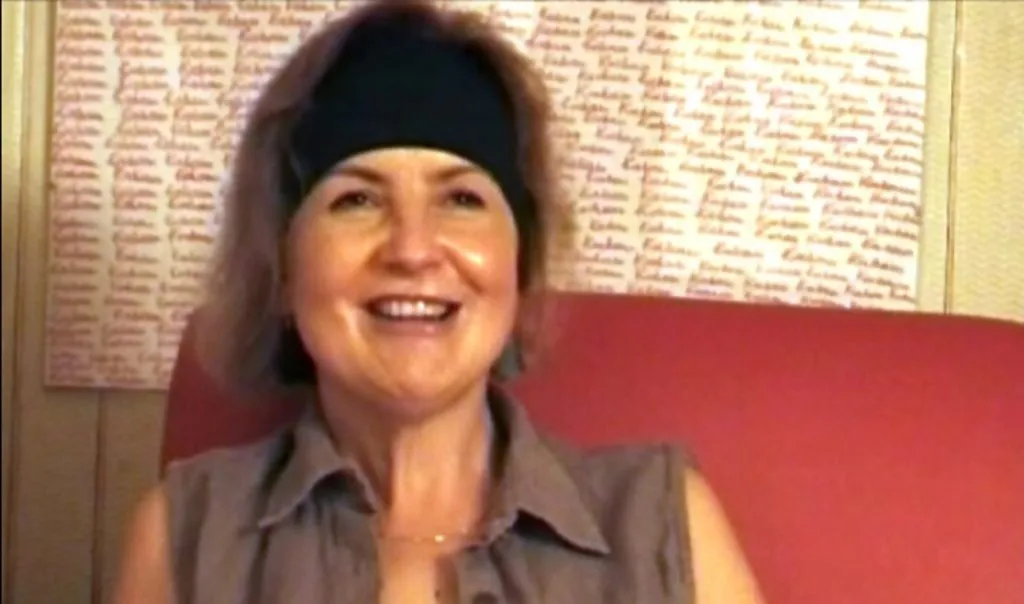
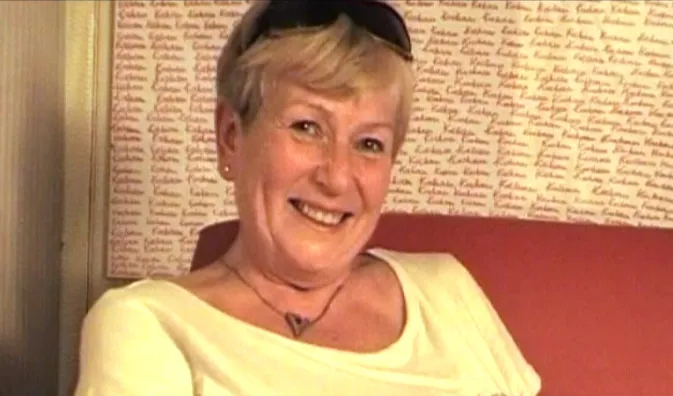
A.L.: I filmed in places convenient for the Muses—at their workplaces and homes, in a studio or in Marek Janiak's studio. That is why the sets are so incidental and hastily arranged. I did not want to create the situation of a professional studio. It mattered more to me that the Muses should speak naturally and without constraint. That is why I spoke to each of them separately. Earlier, I conducted a trial with three of the women together, and they were extremely tense despite knowing me and one another, so professional production values, consistency between sets and the purity of the frames became secondary in this case. In the film I made, I assembled statements by eight Muses who had collaborated with Łódź Kaliska during different periods of the group's work. They were Grażyna Łuczko-Fijałkowska, Iza Bartnicka, Zofia Warzyńska-Bartczak, Agata Prasnowska, Anna Krawczyk, Joanna Krawczyk, Lonia Szymańska and Agnieszka Kasprzyk. I asked all the women the same, as neutral and non-leading as possible, questions, including how they perceived their role in the group's history and what they thought of Łódź Kaliska's art. I tried to resist the temptation to manipulate the film material in order to present an unequivocal image of Łódź Kaliska's Muses. The recorded footage is extensive enough that, by selecting the appropriate threads, one could just as easily prove that the Muses are women who perform service and utilitarian roles in Łódź Kaliska and for whom the mere fact that their images are immortalised in the group's work is enough. By selecting other statements, closer to my personal views, one could present all the Muses as fully conscious co-creators of Łódź Kaliska's artistic achievements. It is worth quoting Old Zofia, Grażyna Łuczko, who says, “We simply worked with them”, and Ania Krawczyk, who describes the work Corset, for which she designed the costumes: “It was our joint project.” The film shows that the relationships between the Muses and Łódź Kaliska elude the simplifications hitherto applied to them. Its purpose is not to define those relationships, but to begin a discussion of the problem.
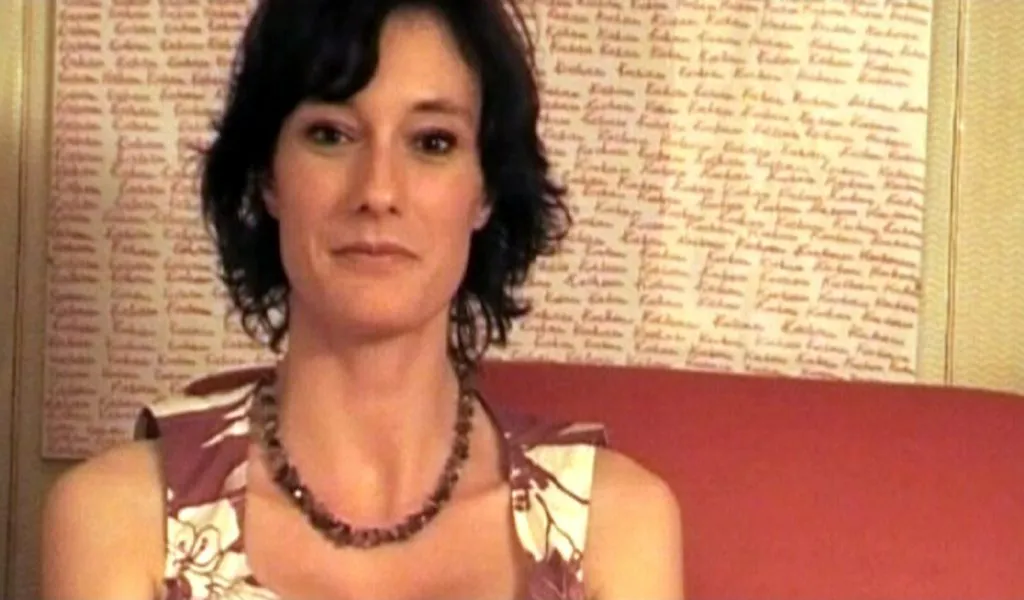
A.M.: Were the Muses tense also because, for the first time, all the attention was focused on them, on their faces and on what they had to say, rather than on the appearance of their buttocks and breasts? Did this transition from object to subject make them tense?
A.L.: I think being placed in a situation that was new to them may have made them tense. I do not know whether you noticed, but the Muses have very different professions. One is a psychologist, another a journalist, so speaking comes more easily to them than to an accountant or social worker. I wanted to create conditions in which they felt at ease and spoke freely. The film is long, although I still cut a great deal of footage, because I wanted to let them have their say. This film is not intended for everyone, but for initiates: those interested in the history of the Łódź Kaliska group or in women's history.
A.M.: For me, the film is not only about the history of women and Łódź Kaliska, but also about memory. What is interesting is how the protagonists speak, how they try to reconstruct events and cannot quite grasp the history—it continually escapes them. Different, often contradictory and inconsistent versions emerge. The Muses look as if they are trying to comprehend and narrate it for the first time. They are troubled by the gaps in their memories, uncertain of what they say and embarrassed by what they have been asked to discuss.
A.L.: That did sometimes happen. Some, such as Old Zofia, initially told me they did not know what to talk about and had nothing to say, then spoke for nearly an hour about their history. This is a history—or perhaps a “herstory”—of memory. An event is reconstructed; sometimes the versions coincide, while at other times each Muse remembers the same event differently.
A.M.: On the other hand, your film is a kind of documentary familiar from television, where we often see “talking heads” recounting the history of important events from the past. When making the film, did you feel like a journalist?
A.L.: I once made a film about men, Polish Guys, for the Ego-Jego exhibition in Toruń. It followed a similar convention, yet it was different. I write about art, run an art website and have interests of this kind, but I would not separate things into the journalistic, the artistic and the theoretical. You never know when art will emerge from an entirely different activity, or when, in making art, you will open paths for other fields. The film is a store of information with which I can continue to work and which I can interpret.
A.M.: Could you say more about “Polish Guys”?
A.L.: It is a film about stereotypes concerning men. Its speakers are Polish men of different ages and with different educational backgrounds. I ask them questions revolving around one key issue: what is their ideal of a real man? After the experience of making that video, I wanted to make what I thought would be a fifteen- to twenty-minute film about the Muses. It turned out that they spoke far more and far more interestingly than the men, and that, despite the similar premises and structure, the film was a project of an entirely different character. That was how I made my longest video to date.
A.M.: The relationship between the “Top Models 2009” project you mentioned earlier and the film about the Muses also seems interesting. Could you briefly describe the relationship between the two works?
A.L.: The film about the Muses of Łódź Kaliska is a kind of docufiction, a video memoir. Top Models consists of a video and seven large-format photographs. It concerns the history of the women in paintings by old masters. They are nudes, such as the Venus of Urbino, the Rokeby Venus and the Nude Maja. I assume the identities of these figures and adopt their not at all easy poses; in one, for example, I lie painted against a white canvas. Speaking in the first person, I try to reconstruct these women's histories and construct their identities. Naturally, it is a compilation of identities from information I obtained from different sources, both more academic ones such as Linda Nead's book or Linda Nochlin's articles, and less reliable ones—notes from the internet and anecdotes. I had no ambition to reach the truth, because that is impossible. I wanted to draw attention to how tawdry and shallow our thinking about these women is. They are generally reduced to the roles of somebody's wives or lovers. I erased the artists' names. It turned out that this simple procedure was enough to make the audience uncertain whether a particular pose really came from a Titian picture and another from a Rembrandt canvas. The circumstances behind this project may also be interesting in the context of our conversation. I asked Andrzej Świetlik to take the photographs accompanying the film. It seemed perverse: a member of a group that depicts women according to male fantasy would have to submit to my female vision. With his professionalism and technical skill, he was the perfect “tool” for making those photographs.
•••
A.M.: Let us return to the Muses. How did the Muses and the artists receive the film?
A.L.: I think the Muses were pleased. It is a film about them and for them. Łódź Kaliska, meanwhile, was somewhat disconcerted. They liked it, but did not quite know how to behave. Łódź Kaliska approached the film with a certain suspicion. Marek Janiak made his studio available to me, but they kept their distance. I think they also scented some sort of trap. They asked the Muses what exactly I was asking them. Perhaps they feared the film would be a form of attack upon them, whereas the Muses speak very warmly about Łódź Kaliska. At the same time, the film shows how important the women are to the group.
A.M.: Exactly—but is it not too warm? Does the film not dissolve excessively into a series of pleasant memories and spicy anecdotes from the lives of an accountant, lingerie designer and psychologist? That is legitimate as a minor history, but it does not really seem to be a critical project of which Łódź Kaliska might genuinely be afraid.
A.L.: The Muses speak about their emotions and feelings, but they also describe how they perceive Łódź Kaliska's art. It turns out that they possess considerable awareness of what they are participating in—some understand it intellectually, others more intuitively—but they are not passive material used by artists. They know they are participating in art, and that matters.
A.M.: The question is how they define art and what Łódź Kaliska's art is. Listening to their accounts, I sometimes had the impression that Łódź Kaliska's “art” could indeed be reduced to a series of more or less amusing gags and party exploits…
A.L.: We cannot speak about all of them together, because every Muse receives and defines this art differently, and participation in these actions meant something different to each. The formula for art proposed by Łódź Kaliska is very open, and they entered it—each with her own experience, emotions and history. Perhaps if Łódź Kaliska invited men, we would be dealing with different art, just as inviting the Muses to take part in activities led by women artists rather than male artists would create a different situation.
A.M.: Were there Muses who did not want to speak with you?
A.L.: Yes. One of the most important Muses, Małgosia Kapczyńska-Dopierała, declined. Her attitude towards Łódź Kaliska is highly ambivalent, but also distinctive. I can understand why she does not want to remember it. I was unable to meet Marzena Rzepczyńska, because she now lives in Spain. I spoke with all the others I wanted to interview.
A.M.: Why did “Pynio” not want to speak?
A.L.: I do not know. Perhaps she was somewhat uncomfortable with the situation of being a Muse. Like Old Zofia, she remembers the time before the Museum of Łódź Kaliska, when the group had not yet made women's participation its artistic strategy. They were not “Muses” then—girls considerably younger than the artists are today—but co-participants in the group's activities and their peers. The situation changes somewhat with successive generations of women collaborating with Łódź Kaliska. They also define femininity differently.
A.M.: So under martial law there was something close to equality, whereas in the 1990s, when women were shut inside Coca-Cola fridges and “made ice cream” with Łódź Kaliska, it was much more hierarchical: the men watched and used the women?
A.L.: I think one can say so in this specific case. Once, these were situations straight from a student hall of residence, where people did various things to escape the greyness of martial law. The group's female companions in the 1990s were guided by different motives. It was also a different kind of relationship between the artists and the Muses. It is worth noting that Łódź Kaliska's earlier activities were highly spontaneous; in recent years the sessions have become more formalised—there are scenarios, castings and all the rest. Naturally it is only an appearance, perhaps a parody, but it nevertheless resembles advertising shoots. The women connected with Łódź Kaliska from different generations really do have different attitudes towards their bodies. One can contrast Old Zofia, whom they never persuaded to participate in a nude shoot, with Iza Bartnicka, who undressed very willingly. This arises from different perceptions of oneself, one's body and one's femininity in the context of social relations. Iza Bartnicka is an example: she knows perfectly well why she undresses and has no problem with it. The women who pose for Łódź Kaliska are not professional models, but rather “natural” women with a strong awareness of themselves and their bodies.
A.M.: But do they not have a need to “be looked at”? Is that not exhibitionistic?
A.L.: I think these are women who perhaps do not want to “make a name for themselves” at any price, as people say now, but rather want to participate in something important and interesting. Ania Krawczyk told me a lovely story about meeting Łódź Kaliska in a pub. Chatting up girls in pubs is typical activity for the group. Andrzej Kwietniewski introduced himself to Ania as a director who wanted her to appear in his film. Later she told her friend: “Listen, Kasia, the director Andrzej Kwietniewski came up to me, and I'm going to be in his film!” She now recounts it with considerable irony, but it shows the mechanism by which girls were “recruited” into the group—perhaps a little underhand, but very amusing. To Ania, a twenty-two-year-old woman who had come from a small town to study in a big city, it seemed exciting that a director had noticed her. Then it turned out that this director was Łódź Kaliska, and so it remained. But if Ania had lacked a sense of humour, Kwietniewski's deception would probably have angered her and she would not have become a Muse.
A.M.: The Muses as aspiring exhibitionists, part carers and companions, part artists…
A.L.: Here we reach the question of how to define Łódź Kaliska's “Muses”. Precisely this reductive approach was the reason I made the film: I wanted to discover who they really were. I hope the film shows that they are important and that they influenced the group, but I still do not think we can define them unambiguously. The film could be edited in several ways, including at least two opposing ones. In one, the Muses would be girls from a casting and Łódź Kaliska's activities would be a “glorification of femininity”. In the other, they would be independent people equal to the artists, for whom being a “Muse” is uncomfortable because they feel themselves to be something more. Here we touch upon the urgent question of what it means to be a woman and a Muse, and how these women assess what they themselves do and what others do. Some may judge posing for Łódź Kaliska as an expression of false consciousness in the service of patriarchy. Somebody else will describe the same thing as a process of emancipation through pleasure, emerging from the shadows and playing a very important role in art. These women certainly elude not only traditional art history. The film draws attention to the problem rather than solving it. The Muses also exceed Łódź Kaliska's definition, which often describes them unequivocally and rather bluntly, after which the media repeat it; in reality, however, the matter is far more complicated, and the relationship between superior and subordinate begins to waver.
A.M.: That is true. If we looked at Łódź Kaliska's art after watching this film, it might turn out that the calculation “Łódź Kaliska minus the Muses” is very unfavourable to the artistic group.
A.L.: Remember that the Muses would not exist without Łódź Kaliska either. They are interested in other things in life, and art is a form of escape for them. That is probably why they have accompanied the artists for so many years. For me, as an artist, it would be impossible. I think Gosia Butterwick has a similar view. Entering the role of Muse in this way would be dangerous to our art and to our existence as women artists, whereas for the Muses who have accompanied the group for a longer time it is a kind of inspiring adventure.
•••
A.M.: Finally, let me ask whether you have considered making a film with them—that is, with the artists? I do not think there is a good film about Łódź Kaliska, so perhaps they were also a little jealous of your film about the Muses…
A.L.: I have considered creating a situation in which they could speak, but that is an idea for the future, and probably for somebody else.