
Guests
Bożena Czubak
‘At the sound of breaking glass, Madame Bovary turned her head and saw peasants in the garden, their faces pressed against the windows as they looked in’1. For Emma Bovary, absorbed in the ball at the Marquis d’Andervilliers’s home, this visual intrusion by uninvited guests was a rather tactless dissonance. At a certain point in Krzysztof Wodiczko’s project, we encounter a similar attempt to disrupt the narcissistic adventure of looking. In a sequence in which all the projections show immigrants cleaning windows, one of them repeatedly brings his face close to the glass, trying unsuccessfully to look inside. Immigrants who, not being at home, remain ‘eternal guests’ are the protagonists named in the title of the entire projection. We watch them talking among themselves or on the telephone, in episodic street scenes, waiting for work and engaged in cleaning or repairing windows. The silhouettes of the latter, moving upwards or downwards, are visible on different levels: some stand behind ‘windows’ at the viewer’s height; others work from the elevation of a ladder or a lifting platform; still others lower themselves on ropes. The slightly misted quality of the projected images limits the legibility of figures and scenes taking place behind frosted panes. Indistinct figures that alternately appear and disappear are difficult to recognise. This play with the immigrants’ visibility—almost ‘within arm’s reach’ yet simultaneously ‘on the other side’, behind windows that blur their images—refers to their ambiguous status, their social invisibility. Yet the impossibility of overcoming the distance, of visually assimilating the image, appears to be an experience shared by both sides, as the scene described above would suggest.
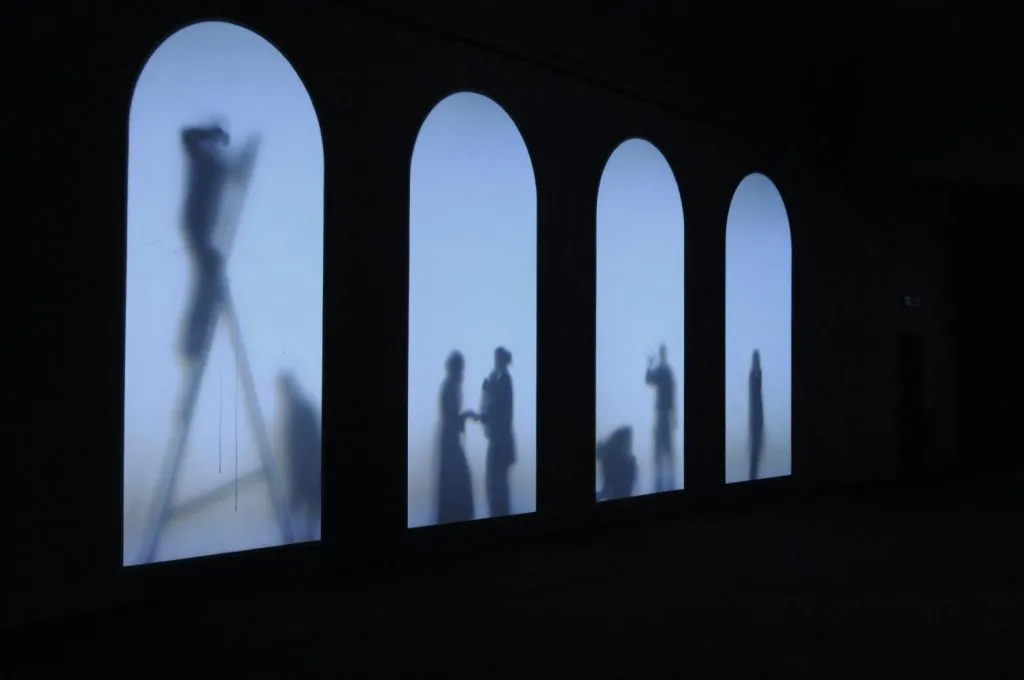
The projections, depicting eight windows and an elongated skylight, open a view onto what is happening outside—beyond windows that simultaneously separate us from what can be discerned behind the milky panes. More useful here than the insistent metaphor of the image as a window is Berger’s metaphor of a safe: ‘not so much a framed window open to the world as a safe in the wall in which the visible has been deposited’2. Wodiczko’s projection is concerned more with the visibility of the invisible, and perhaps still more with seeing itself and therefore, inevitably, with not seeing. On one side are the immigrants behind the windows, their faces disappearing into misty images; on the other is their own inability to see those looking at them. The titular ‘guests’ can be located on either side of the windows, with their ambiguous play of opening and closing, joining and dividing through a boundary that is invisible yet simultaneously impedes vision. The figure of the guest contains a further ambiguity. A guest, a newcomer, arouses ambivalent feelings: curiosity and suspicion. The Greek xenos means a stranger, a foreigner and a guest, but also a host. In Kant’s project for ‘perpetual peace’, the conditions of hospitality constitute the stranger’s right3. ‘Making the stranger no longer strange’ was the fundamental aim of the series of Xenological Instruments, beginning with Alien Staff (1992), followed by Mouthpiece (1993), Aegis (1998) and Dis-Armor (1999). Alien Staff, which doubled the immigrant’s presence—live and on the screen of a small monitor—was conceived as a dialogical instrument. Mouthpiece further developed this philosophy of dialogue by equipping the immigrant with a device for communicating, for ‘speaking through another’s mouth’. Wodiczko, himself an immigrant, used Julia Kristeva to explain the meaning of the instruments through ‘the metaphor of inner foreignness, of this state of being in between […]’4. Through the Freudian das Unheimliche, the foreignness that the celebrated émigré attributed to ‘the stranger within us’ brought together what is and is not ours, the familiar, domestic and native, with the suspect, alien and unsettling5.
In the Venice projection, as in the preceding 2005 installation If You See Something…, the category of foreignness emerges in terms of relations and of the way the Other is understood. The installation at Lelong Gallery in New York, clearly grounded in the context of the Bush administration’s American politics, concerned the reproduction of foreignness through relations of fear and suspicion. Filmed behind frosted panes, immigrants spoke of repression, dramatic experiences and restrictive regulations enforced in the name of fighting terrorism.
Both projections contain narratives that are sometimes highly personal, an individualisation of the immigrant’s ‘fate’ attested by the immigrant’s presence on the other side of the glass. In the New York installation, with its projection onto four tall, narrow windows contrasting with the dark interior, the immigrant figures in the windows’ confined spaces appear much more emphatically ‘on the other side’, in a space of psychosocial alienation. In the Polish Pavilion in Venice, the large expanses of broad windows—projection screens—on three walls and the ceiling create a stronger impression that the interior is opening and that the boundary separating inside from outside has been blurred. A boundary that, in Derridean terms, seems not to exist in itself, yet nevertheless sustains the tension between what it divides. In Guests, this tension is both less clear-cut and more complex, above all because of the polyphonic structure of the entire installation, which draws the viewer in through the multiplicity of actions unfolding alternately or in several windows at once. The image of immigrants that emerges from the projection is free of any stigmatisation. Behind the windows, we see workers performing their jobs efficiently and professionally, a Lebanese intellectual, a Vietnamese poet and young people studying. Alongside accounts of the difficult and sometimes utterly hopeless situation of immigrants—a Chechen refugee suspended in limbo for years, waiting in vain for refugee status—there are scenes of Vietnamese women dancing. Alongside xenophobic behaviour by Polish and Italian young people in street episodes, we hear women involved in organisations providing legal and social assistance to immigrants talking. The entire script resulted from many hours of meetings and conversations with immigrants in Rome and Warsaw, under whose influence the artist revised his initial idea of depicting arrivals from Poland and Eastern Europe working in Italy. Current circumstances—the tensions surrounding migration, restrictive regulations introduced by European Union member states as the Union seals its borders, and the dramatic situation of undocumented immigrants, partly connected with the economic crisis and the rise in anti-immigrant sentiment—directed Wodiczko’s attention towards the experiences of immigrants crossing Europe’s borders. In the end, the Polish Pavilion was transformed, paradoxically and in defiance of its surroundings—the Biennale Gardens with their pronounced division into national presences—into a place offering insight into the situation of the European community in its relationship with arrivals, with guests from outside.
The darkened pavilion interior, with several projections shown simultaneously, forces viewers to move between individual images. A script distributed across several windows, with the shifting dramaturgy of actions and episodes, makes it impossible to perceive the whole from a stationary position. Surrounded by images emerging from different directions, the experience of time and the viewer’s performative involvement acquire significance. Wodiczko had already emphasised the performativity of behaviour in earlier works. In the projection onto the spherical building
of El Centro Cultural in Tijuana (2001), the women participating in the project interrupted their previously recorded statements to respond ‘live’ to the audience’s reactions. In the Venice installation, the simultaneity of several projections incorporates and contextualises the space between them—the space intended for the recipient, who enters a stage previously reserved for the artist.
The darkened interior and moving images of this video installation may refer to the experience of cinema—a place where absorption in the image blurs the boundary between viewer and visual representation, where ‘the viewer experiences himself as the true site of the images’6. In Wodiczko’s installation, despite its immersion in the illusory world of video space, the mechanisms of identification perfected by the masters of the screen encounter resistance from the images themselves. The figures behind the windows are too poorly visible, often unrecognisable. Despite their life-size scale and close proximity—almost within arm’s reach—an insurmountable distance separates them from the viewer. This play with visibility and invisibility, preventing the effect of identification with or domination over the image, had already been used in the artist’s projections. In Hiroshima (1999), the accounts of survivors of the atomic-bomb explosion were accompanied by enlarged images of filmed hands, motionless or gesturing just above the surface of the River Ota at the foot of the ruins of the so-called Atomic Bomb Dome. ‘The removal of the face,’ wrote Rosalyn Deutsche, ‘protected the speakers from the greed of perception through the image, a perception that knows too much and thereby betrays the speaker’7. In one of his most recent works, Veterans’ Flame (2009), presented at Fort Jay on Governors Island off New York, the artist entirely abandoned the veterans’ visual presence, accompanying their voices with an image of a burning candle. He used the opposite device in the Poznań Projection (2008), in which enlarged faces of homeless people emerged above viewers’ heads inside the clock tower. This time, despite the excess of visibility, the superimposition of the simultaneously speaking homeless people’s voices made it impossible to understand their words, providing access neither to empathy nor to the narrativisation of their experiences.
The Venice installation, with its spectacle of cinematic illusions on the walls and ceiling, can also be perceived in the context of cinema’s methods of absorption by the image. Yet the dark spaces of contemporary video installations—the now proverbial black boxes—are contrasted not only with the contemplative spaces of white cubes. The metaphor of the black box also encompasses ‘the return of the repressed’—that which is excluded from the aesthetics of the media and the popular culture of cinema8. This is no longer merely about immersive practices of drawing the viewer into the spectacle, of ‘being someone else or in another place’. Within black boxes, one can develop the psychoanalytic concepts of introjection and projection, which reveal that the other, the stranger, also resides within the ‘self’, while in turn my ‘self’ resides within the Other—a fictional self, because it is the Other’s creation. Following an anthropological interpretation, one can trace in cinematic illusion the interplay between the world of imagination and fiction.
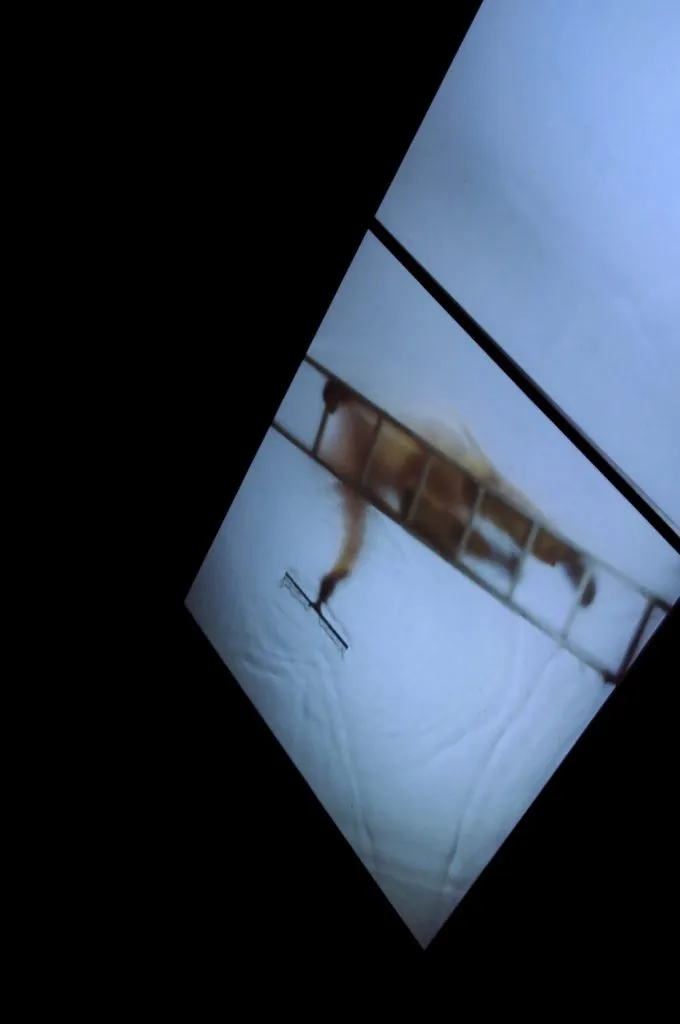
Within video installations that multiply projection screens, however, the experience of time and space—suspended in cinema—makes itself felt, perception becomes participation and, with the recipient’s participation, as Ursula Frohne concludes, the end of illusion begins9.
In Wodiczko’s installation, cinematic illusion has little to do with fiction. The footage is based on documentary recordings; individual scenes are performed by extras or by real immigrants playing themselves, while some of the dialogues and monologues on the soundtrack are recordings of the artist’s conversations with immigrants. The combination of documentary materials with their stagings imposes the question of the relationship between what is documented and what is reconstructed. This is linked, to some extent, to the dialectic of the document itself, in which what constitutes testimony, an actual account, is simultaneously recreated and recounted. Moreover, recourse to the documentary provokes questions about the relationship between the aesthetic and the ethical, about the ethical dimension of aesthetic decisions or, more broadly, of an artistic approach in which the author himself becomes the least desirable figure. The crucial role of ethics in Wodiczko’s work has often been discussed, especially the ethics of humility shaped by the thought of Emmanuel Lévinas, an ‘ethics of the primacy of otherness over selfhood’10. The series of Instruments, serving self-presentation and communication, can be situated within the perspective of an ethics that emerges in relation to the Other. The artist equipped the increasingly technologically sophisticated Instruments with devices that gave Others the possibility of appearing in the public sphere. Outdoor projections using video projectors and loudspeakers provided a kind of instrumentarium for being seen and heard in public space. Beginning with the projection onto the Town Hall Tower in Kraków (1996), they enabled Others who had been marginalised and deprived of a voice to animate public buildings with sound and image, to speak through their architecture and make their own experiences resonate publicly. Subsequent projections always feature the voices of Others, recorded beforehand and edited with their participation, as in the recent projections in Denver (2008) and Liverpool (2009), which used the War Veteran Vehicle and were preceded by months of meetings and conversations with homeless veterans who recorded, transcribed and co-edited their statements. In Tijuana, these earlier recordings of Others were verified by those very people: women who, thanks to a specially designed device, could supplement live what had been recorded previously. In Denver and Liverpool, Wodiczko designed for homeless veterans a vehicle that fired texts and the sounds of their voices. The combat station with a missile launcher at the rear of the Humvee was replaced by a specially designed ‘projection station’, which, placed in the veterans’ hands, became a projector for their statements. Wodiczko, trained as a designer and currently leading the Interrogative Design Group at the Center for Advanced Visual Studies at MIT, develops and supplies tools that enable Others to appear. He speaks neither about nor for them, as was also the case in his earlier Homeless Vehicle (1989): ‘Instead of representing homelessness, giving it an iconic frame, or representing homeless people themselves, appearing or speaking on their behalf, Wodiczko investigates the reasons why people are displaced both physically and socially and offers homeless people a means of survival and self-definition […]’11.
In the Venice installation, this distance from the unreliability of representation is translated into a visual lack of closure, which defers the expectations associated with the document and its claims to truth, testimony and ultimately empathy. Continuing Benjamin’s thought, Boris Groys relates the significance of documentary practices in contemporary art, the ‘art of the biopolitical age’, to questions of topology, the relationship with place and location in history, and to an art that documents what cannot otherwise be shown12.
The biopolitical dimension of Wodiczko’s art, revealing the mechanisms by which ‘bare life’ functions within political and economic space, has already been addressed by Piotr Piotrowski. In particular, he discussed the problem of the contemporary homo sacer formulated in the Instruments: ‘Wodiczko […] sought to reverse the process of alienation, restoring to immigrants their identities, histories and emotions […] to equip immigrants with a language. […] But language is not the only issue; the point is to restore the immigrant’s human status, so that the immigrant is not perceived in terms of “bare life”’13.
A metaphor for the contemporary homo sacer may be discerned in the indistinct figures behind the pavilion’s windows, in misty silhouettes and shifting shadows remaining on the threshold of visibility. The figure of the refugee, so difficult to define politically, is—as Giorgio Agamben writes—‘a limit concept’: ‘breaking the continuity between human being and citizen, between birth and nationality, […] for a moment the refugee brings bare life onto the political stage […] in the person of the refugee, for the first and only time, the “man of rights” truly appears without the mask of the citizen that constantly covers his face’14. If, according to Agamben, ‘refugees represent a disquieting element in the order of the modern nation-state’15, Étienne Balibar locates this disquiet in the ambiguity of the distinction between ‘stranger’ and ‘enemy’: ‘the ambiguous character of the stranger as a potential enemy, but also, conversely, the tendency to identify the enemy with the stranger in general or the cultural stranger’16. This reproduction of strangers, or the making of strangers into enemies in everyday life and in social and legal practices, provided the reference for Wodiczko’s work made in response to the fomenting of anti-immigrant sentiment against foreigners in the name of national security. The title of the installation If You See Something… repeated the words of a media campaign launched in New York in 2002 that called on citizens to share their suspicions: ‘If you see something, say something. Don’t keep it to yourself.’ In both the New York and Venice installations, Others, strangers, are placed outside, beyond the windows. Poorly visible themselves, they are also unable to penetrate with their gaze the frosted panes that prevent access to those inside. The production of strangers is, as Balibar writes, above all a question of borders. The fundamental problem lies not in ‘the relationship between the construction of the stranger and the status of citizen’, but in ‘the reversal of the relationship between border and stranger/foreigner’—the one who is different, a citizen of another country, belonging to another space separated by a border17. Borders determine being a stranger and, despite the dislocations, dispersal and multiplicity of contemporary borders, they retain the power to include and exclude.
The double meaning of the border, in which the global division of space is reflected on a local scale, was shown by the two-part Border Projection, realised by Wodiczko in San Diego and Tijuana in 1988. The United States–Mexico border runs between these cities and at the time was the busiest crossing point for undocumented immigrants from Mexico. On one side of the border, on the façade of the Museum of Man in San Diego, the artist projected hands bearing the attributes of possession, referring to the city’s colonial past; on the other side, in Tijuana, on the dome of the Space Theater, he projected hands clasped behind the neck in the manner typical of those being arrested or searched.
The project presented at the Biennale was created with the participation of immigrants living in Poland and Italy, border countries of the European Union that receive waves of arrivals from the East and South. The people whose accounts and conversations entered the projection’s script were overwhelmingly from outside Europe, or at least outside united Europe, with the exception of Romania, which at the time still lay outside the Schengen Area. The figures behind the pavilion’s windows are not neighbours from within the European Union, but foreigners who have difficulty legalising their stay.
Vietnamese people appear in several scenes. Bringing the group of more than a dozen to the film set required special preparations because, for fear of deportation, they are forced to avoid public transport. Poland is the third most common destination for Vietnamese migrants after France and Germany, and Vietnamese people are also the largest group of foreign nationals in the country. Their population is estimated at between 40,000 and 60,000, but the exact number cannot be determined. Most arrive across the so-called green border and work in the informal economy. Restrictive visa and asylum policies deprive them of the possibility of legalising their stay. Without documents, they cannot leave Poland and, despite their substantial numbers, remain uncountable and ‘invisible’, without defined status. The invisibility of stateless people was the subject of a projection made four years earlier in Basel with undocumented immigrants, commonly known in Switzerland as sans-papiers. The audience saw only their legs dangling from the roof of the Kunstmuseum and heard overlapping fragments of dialogue and songs sung in their native languages. Entitled Sans-Papiers, the projection showed the ‘non-existence’ of people without papers, without faces, deprived of the right to be visible.
The issue of ‘papers’—various documents, residence cards and work permits—recurs in several scenes of the projection. The Plexiglas containers of Alien Staff were filled with passport photographs, visa applications, ‘refusals and permits’. In a rarely discussed work by Wodiczko from 1987, projected onto a column inside New York’s Exit Art gallery, the figure of an immigrant cleaner bends over a dropped green card that glows before him like a mirage. ‘Passports, visas, customs and immigration controls’, which, as Zygmunt Bauman writes, ‘were among the most important inventions in the art of modern government’18, now belong to the extensive apparatus of contemporary ‘border wars’ conducted under the pretext of control, which consists largely in a policy of ‘pulling and repelling’ flows of labour.
The projection shows workers cleaning and repairing windows, as well as scenes of conversations in which the theme of being unable to find work recurs. The indistinct silhouettes moving behind the windows like background figures are above all undocumented immigrants, against whom European Union migration policy is directed—the directive on the expulsion of undocumented third-country nationals—and to whom the gates of Europe are now being closed. As Balibar writes, the emergence into the foreground of a new historical figure, the citizen of Europe, is accompanied by ‘violent processes of exclusion whose principal, though not sole, instrument consists of quasi-militarily maintained borders, thereby reproducing the figure of the stranger as a political enemy’19. Echoes of local xenophobias and hostility towards ethnic or linguistic ‘foreignness’ can be heard in the scenes with immigrants. The mechanism that makes strangers into enemies is activated not only through borders drawn on a map. An appeal to parliamentarians delivered by a Roma man living in Rome ends with the words: ‘if I do not exist, there is no history’. Roma people, like other stateless people deprived of rights and consigned to the ‘waiting room of history’, often fall victim to the projection of national problems. Wodiczko addressed this subject in his 1995 installation Room with a View, in which he replaced the view from the window of Galeria Foksal in Warsaw onto the courtyard of the Zamoyski Palace with a view of the encampment of Romanian Roma by the Vistula, hastily abandoned following an intervention by the municipal police.
Behind the ‘windows’ of the Venice pavilion, immigrants speak of deportations, life in refugee camps, short-term extensions of temporary residence rights, fear of expulsion, detentions under the Dublin Convention—which forces them to remain in the country where the procedure for applying for refugee status began—and the continual experience of social exclusion. Despite crossing geographical borders, they remain separated, not only by the boundaries of procedures but also by prejudices and fears that make them strangers. They themselves are not the challenge here; those invisible boundaries are—the challenge to the audience and to ‘hospitality’, which, according to Jacques Derrida, is ‘an experience of risk and of the boundary between myself and the other’, an experience requiring ‘the deconstruction of the sense of being at home’20. As the installation’s author repeated after Julia Kristeva, the true boundary lies ‘between the real stranger and the fear of one’s own foreignness’21. Kristeva’s ‘confederation of foreignness’ resonates with Kant’s cosmopolitan vision of a hospitable world and a civic community. Distancing himself from the idealism of world citizenship, the advocate of cultural translation connects the possibility of replacing the figure of the ‘stranger as enemy’ with that of the ‘stranger as citizen’ precisely with the question and status of borders22. Within the pavilion interior resounding with different languages, we may speak not only of translation, with its linguistic origins, mediation or participation, but also of a tension that cannot be resolved through consensual rhetoric and in which the ethical dimension of Wodiczko’s art already discussed links the aesthetic with the political.
*Bożena Czubak, art historian and critic, curator of exhibition projects and author of numerous publications on contemporary visual culture. A member of the International Association of Art Critics (AICA), president of Fundacja Profile in Warsaw and curator of Krzysztof Wodiczko’s Guests project.
1. G. Flaubert, Madame Bovary, Warsaw, 1984, p. 56.
2. J. Berger, Ways of Seeing, Poznań, 1997, p. 109.
3. I. Kant, Perpetual Peace: A Philosophical Sketch, Wrocław, 1995.
4. ‘I’d Like to Be of Some Use…’, Hanna Wróblewska in conversation with Krzysztof Wodiczko, in Krzysztof Wodiczko: Monument Therapy, exhibition catalogue, Zachęta National Gallery of Art, Warsaw, 2005, p. 71.
5. See J. Kristeva, Étrangers à nous-mêmes, Paris, 1988, p. 252.
6. See H. Belting, An Anthropology of Images: Picture, Medium, Body, Kraków, 2007, p. 95.
7. R. Deutsche, ‘The Art of Witness: Krzysztof Wodiczko’s Hiroshima Projection’, in Krzysztof Wodiczko: Monument Therapy, op. cit., p. 20.
8. See U. Frohne, ‘Dissolution of the Frame: Immersion and Participation in Video Installations’, in Art and the Moving Image: A Critical Reader, London, 2008, p. 365.
9. Ibid., p. 370.
10. See further R. Deutsche, op. cit.; A. Turowski, ‘Krzysztof Wodiczko’s Displacements and Dialectical Images’, in Krzysztof Wodiczko: Monument Therapy, op. cit.
11. D. Hebdige, ‘Redeemer-Witness: On the Homeless Vehicle Project’, in Krzysztof Wodiczko: Public Art, exhibition catalogue, Ujazdowski Castle Centre for Contemporary Art, Warsaw, 1995, pp. 166–67.
12. B. Groys, ‘Art in the Age of Biopolitics: From Artwork to Art Documentation’, in Documenta 11, Platform 5, exhibition catalogue, Documenta, Museum Fridericianum, Kassel, 2002, pp. 108–14.
13. P. Piotrowski, ‘Biopolitics and Democracy’, in Krzysztof Wodiczko: Honorary Doctorate of the Academy of Fine Arts in Poznań, Poznań, 2007, p. 18.
14. G. Agamben, Homo Sacer: Sovereign Power and Bare Life, Warsaw, 2008, pp. 180–81. 15. Ibid., p. 180.
16. E. Balibar, ‘Strangers as Enemies: Further Reflections on the Aporias of Transnational Citizenship’, https://globalization.mcmaster.ca/research/publications/working-papers/2006/ighc-wps_06-4_balibar.pdf
17. See ibid.
18. Z. Bauman, Society under Siege, Warsaw, 2006, p. 128.
19. E. Balibar, ‘Europe as Borderland’, https://journals.sagepub.com/doi/10.1068/d13008
20. J. Derrida, ‘Infinite Hospitality’, translated into Polish by Paweł Mościcki, Przegląd Filozoficzno-Literacki, no. 3, 2004.
21. See K. Wodiczko, ‘Designing for the City of Strangers’, in The Design Culture Reader, London–New York, 2009, p. 264.
22. See E. Balibar, op. cit.