

Film Is Wonderful. Film Is Terrible.
Before the sunny weekend, on Friday, September 8, at the end of the TVP programme, she decided to remind Channel A. Wajdy.
One can only guess which of the factors decided on the issue. For some marketing reason, the strategists of the united right decided to convince the majority of citizens that in 2023 the war with Germany continues. In a moment, whether we like it or not, we will take part in the decisive battle.
The second, sadder part of the film drags on in a ghostly, stinking maze under the city. The characters are looking for a signpost, a hint, an inscription, a slogan leading to life. There are two subtitles in the film: Wolf I I love Jack. The latter was probably made by the film liaison Daisy pulling the injured cadet Korab through the screen.
If Wajda had not soaked the stench of history with love sentiment, then the success in Cannes in 1957 would probably have been less. The story without love is too muddy, the story somewhere from the east is usually terrible in taste.
Wajda's film tricks in 1956 must have greatly pissed off the Home Army's second lieutenant, insurgent Władysław Bartoszewski, who in the review (““Channel". Is it a film about the Warsaw Uprising?", "Stolica", 1957, no. 23) accused Wajda that the characters are completely unreal, and no commander of the Uprising would make such decisions as a film commander. A film, even a historical one, is not a reconstruction of truth. The film is always a projection of the light shining now, to the "now" leading. If you don't have to watch Channel. It's an outstanding movie, but watching it's not easy. For those who are on the web, this is an archaic film (in Cannes in 1957 it met with Seventh seal Bergman, both ex aequo received the Palme de Silver). The grid under which Daisy tells Korab not to open his eyes, because the sun will blind him is the eighth seal. It's better to forget about it, let it sit in its place if we don't want to go blind.
After 1945, about twenty films related to the Uprising were produced in Poland. Channel Remains the most well-known, perhaps the most messy, mixing Dantean landscapes of memory with sewerage.
The most annoying thing is that this fall a group of anonymous, impudent types quite successfully builds a dense atmosphere of resentment for the election campaign, redirecting not even attention, but emotions to history, since the present turns out to be so problematic for the rulers.
All the more pleasing are such events as the presentation in Łódź to Horst Koehler of the Jan Karski Eagle Award for "building dialogue, understanding and healing wounds in German-Polish and Polish-German relations and outlining the perspective of each other's future in Europe".
"Drawing common perspectives" can give the impression Suckers In its pure form, but when it disappears, we quickly realize that we are stuck in a channel without a way out. Now, not then.
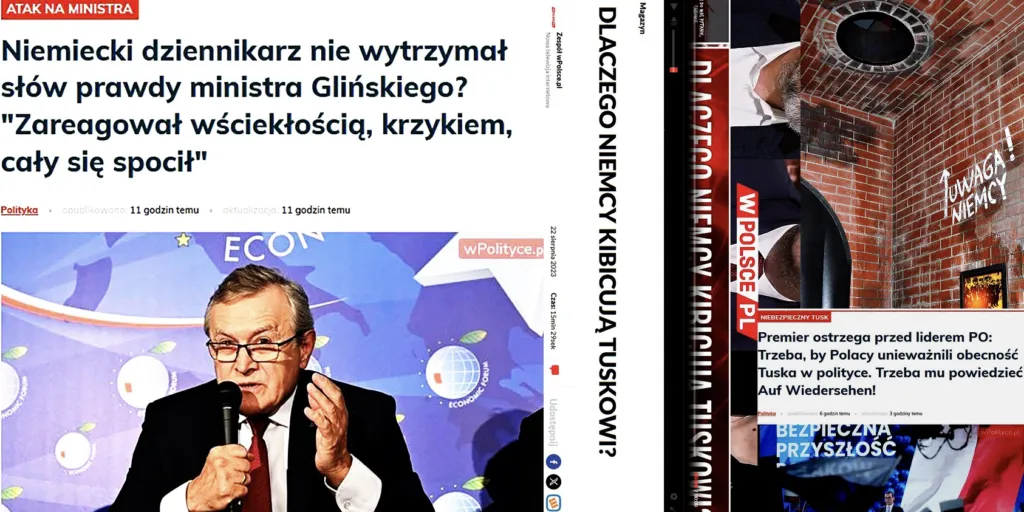
On the left: information about the economic forum in Karpacz, 2023, on the right: a fragment of the permanent exhibition in the Warsaw Uprising Museum with a reconstruction of inscriptions from the insurgent canals in 1944; at the bottom "the latest information" about what Poles must do.
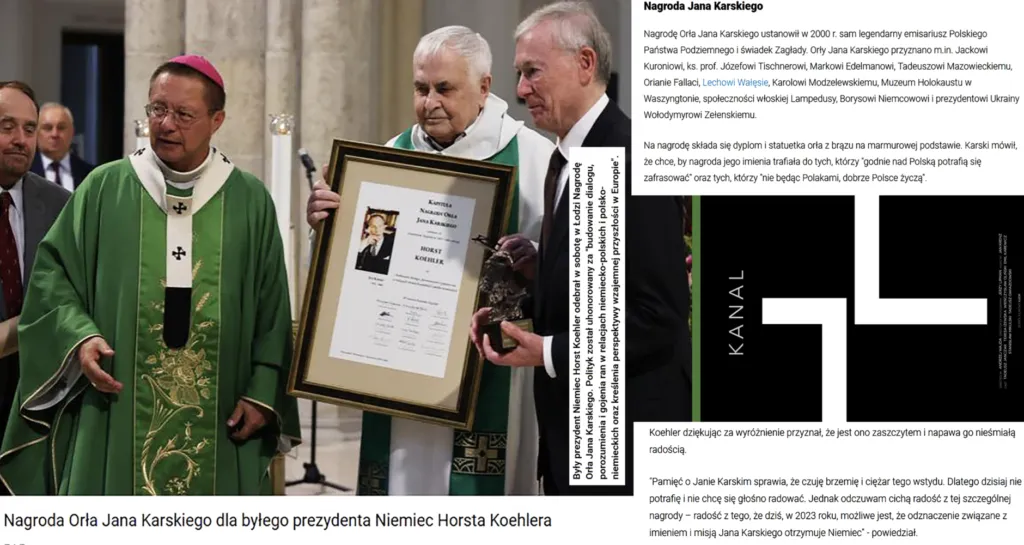
Born in the Zamość region, living for a while as an ossek in Łódź in r. 1944, Horst Koehler receives the Karski Eagle Award in the cathedral in Łódź, next to the Dominican Father Wiśniewski and Cardinal Ryś; on the right, a poster of Tomasz Wójcik from 2016.
•
Main graphics, from the left: Jan Lenica poster, Zygmunt Anczykowski on the right, both from 1957; on the cover of the film Daisy, Korab I Artist, musician, composer, the one who will go crazy in the movie channel and, playing the ocarine, will be knee-deep in excrement, reciting Dante.