
Ecce homini
Magdalena Wicherkiewicz
Notes on Cezary Tkaczyk’s Family Altar
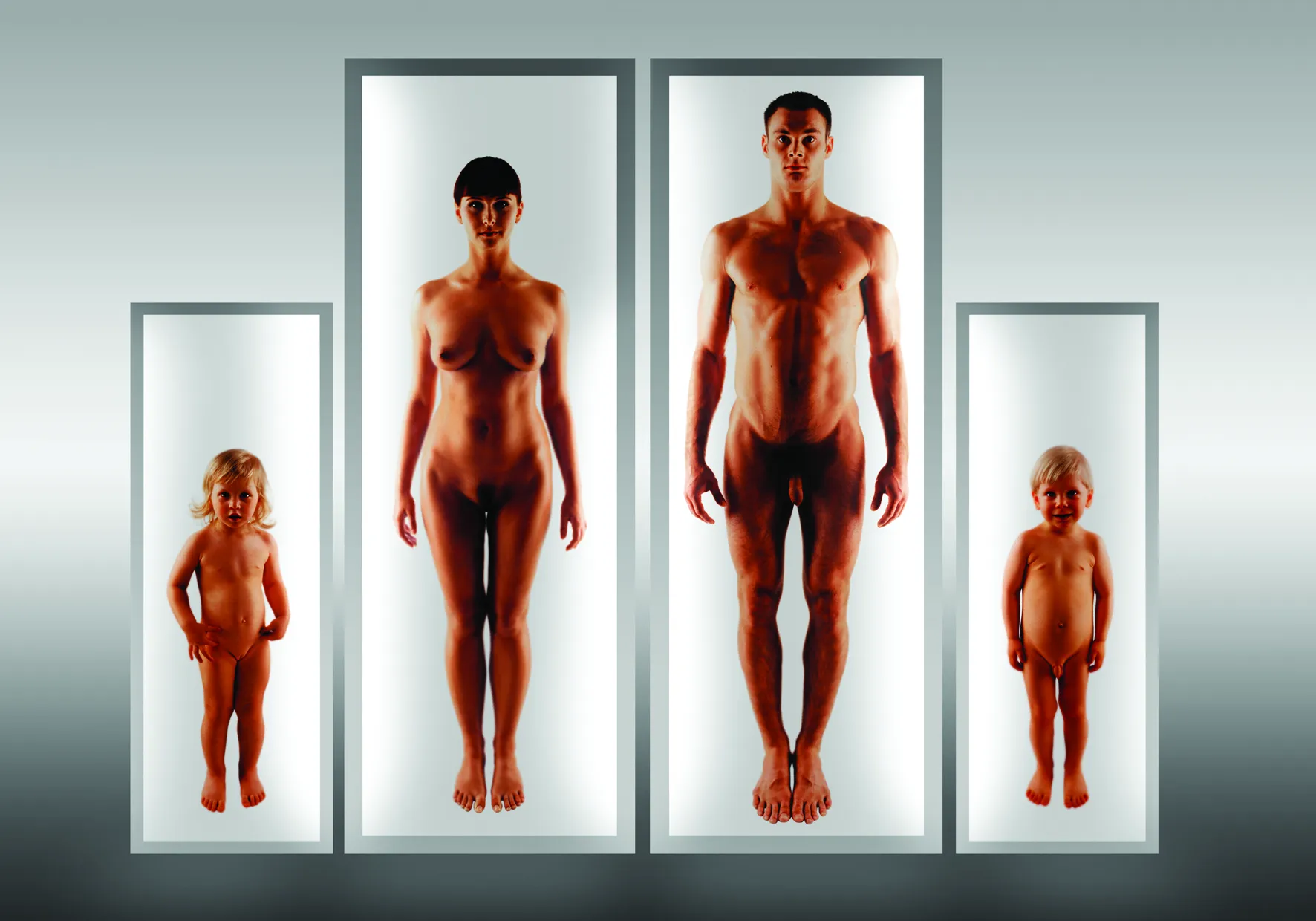
A cuboid photographic object stands in the gallery’s empty, illuminated space like an altar with four wings. Monumental, it draws us towards itself. Each section bears an almost three-dimensional, life-size figure: a woman, a man and two small children, a girl and a boy. The adults stand motionless, the children as though arrested in their natural restlessness. Naked. Looking towards us. At once indifferent and natural. Placed in a timeless, luminous space. Painfully real. They draw our gaze, although it is not beauty that makes us wish to look. There is something of the biological specimen in these luminous cuboids: the figures seem submerged in photographic matter. A dry account stripped of genre, unnecessary attributes and digressions. The essence of the human preserved in the timeless formaldehyde of light. We stand before this peculiar “altar” as before a mirror. The successive layers of the photographic image, like consecutive layers of a mirror, disclose the stages of a mystery one by one. Behold, human beings. Behold, us.
In Our Image
“So God created humankind in his image, in the image of God he created them; male and female he created them” (Genesis 1:27). These words from the Book of Genesis appear an appropriate commentary on Cezary Tkaczyk’s installation. On the level of ideas, it is a contemporary illustration of the biblical story of humanity’s creation. At the same time, it confirms that the cycle repeats, that the myth has its “here and now” and is renewed in every human story, every individual existence. Yet in Cezary Tkaczyk’s interpretation, the biblical order is fundamentally and significantly changed. The adult figures, the parents perhaps, are accompanied by children. The primordial order is disrupted, and not merely formally by varying the composition and enriching it with distinctive tensions. The adults are cool and static, their bodies drawn clearly and darkly against a bright ground. The children are the opposite: emotion shapes their faces and gestures, and the parents’ immobility is alien to them. A family in paradise does more than extend the biblical narrative, continue the story and update it for the present. Above all, it presents another possible version of paradise in which children were also present. It prompts reflection on how different our lives and the shared human experience of existence’s first moments might have been had the first parents produced offspring before leaving the Garden of Eden in guilt and shame.
Leaving the biblical context aside while remaining within the sphere of humanistic reflection, Family Altar becomes an image of humanity in the diversity associated with sex and age. It is a summary description of the human species, of humanity as such, of the unity of existence in the multiplicity of its possible realisations. This conclusion appears confirmed by the arrangement of the figures: logical and symmetrical, as though taken from an anatomical atlas. The composition also reflects the traditional division into male and female spheres. The left side is female and the right male, to use the contemporary interpretation that determines the sides of a composition from the viewer’s perspective1. Such a conventional arrangement would also confirm that the artist intended to present a certain typicality, an anatomical regularity describing human appearance according to sex and the changes that occur with age. Yet despite this descriptive, illustrative approach, the introduction of children — “little people” — is quite unusual. Perhaps, then, these four figures form a family, or more precisely its most “correct” model, expressed as the sum 2+2? Yet they are certainly not a specific group united by blood. We are dealing instead with a representation of typicality, a model or template. There is no emphasis on an emotional bond between those depicted. No gestures or glances construct one. The figures look unmistakably at us — the adults coolly yet intensely, the children with apparent unease. It is with us that they establish contact. No “horizontal” relationships exist.
Beauty
Leaving aside the entire theological interpretation of the myth, the story of Adam and Eve provided artists above all with an impulse to reflect on human corporeality, the beauty of the body and the emotional sphere connected with it. It therefore seems legitimate to consider Cezary Tkaczyk’s installation in the context of a contemporary definition of beauty. The four figures represent four conceptions of the human body’s beauty: male, female and child. Yet this question now lies far outside the centre of artistic and aesthetic interest. Everyday life has taken over this sphere of reflection, if we may call it that; it is everyday life that is aestheticised. It summons standards of beauty into existence and then distances them. Was a wish to reopen reflection on human corporeality therefore important to the creation of Family Altar? Perhaps. Yet looking at the bodies depicted, there is very little we can actually say, beyond observing that they fall within a canon of generally accepted norms. The coolness of the view and its reportorial, anatomical context disperse any potential aura of beauty. If beauty is present, it is elsewhere.
The children’s nudity also appears controversial in this context… Nudity… It was a characteristic feature of representations of humanity’s creation. It was also a natural state, unburdened by guilt or shame. The consequence of tasting the fruit from the tree of knowledge of good and evil was an awareness of one’s own nakedness — more precisely, the experience of it as shameful. Since that moment, the two states have been inseparable. Nudity also has another aspect: exposure, truth, naturalness. To be naked is to confront the truth about oneself. Standing before us, the figures in Cezary Tkaczyk’s photographs reveal not only the truth about themselves but, by analogy with a mirror, the truth about what we are or would like to be. Although the figures look directly towards the viewer, their nakedness does not appear to be placed “on display”. The conventional pose, mask and erotic intention characteristic of the nude are absent. Their nudity is merely a declaration: this is what I am, this is how I look. An informational and documentary context.
Fiat lux!
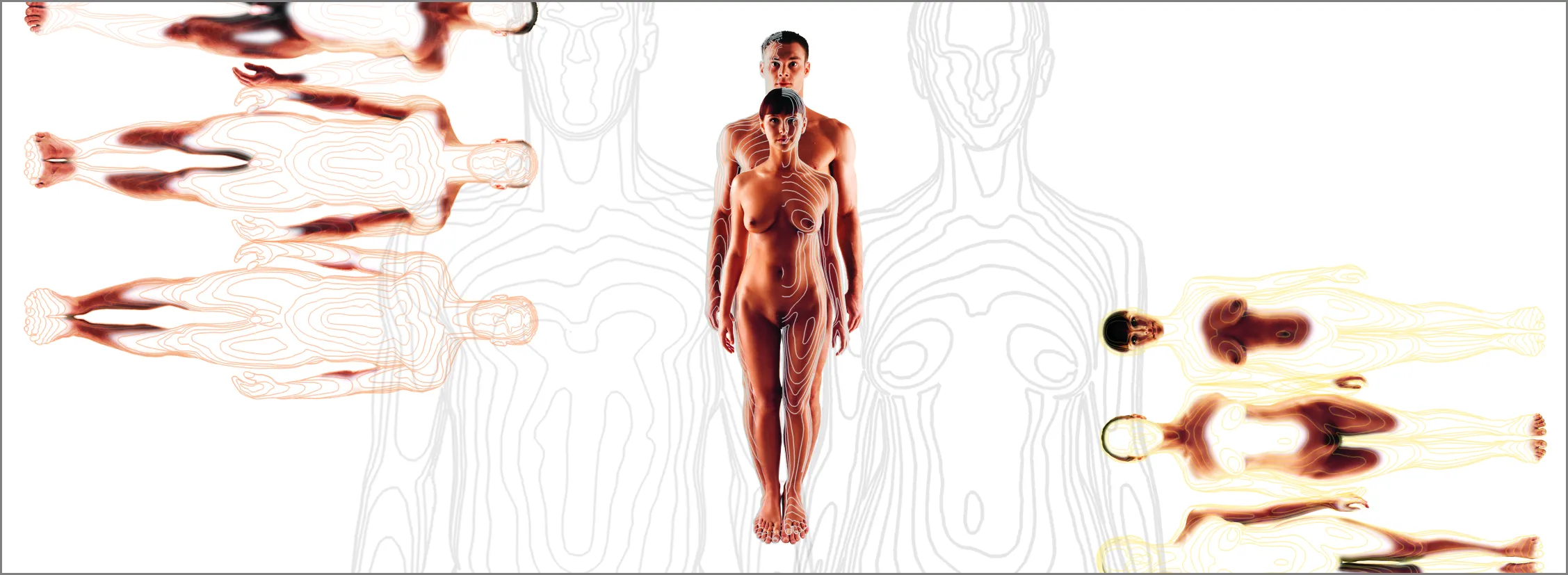
It is worth looking at Family Altar from the perspective of photographic technique. The medium of photography is — or until recently was — light. It materialised the image, fixing it on photosensitive material. Photography means, literally, writing with light2. Cezary Tkaczyk returns to this dimension, photography’s source and etymology. Although a series of computer operations also contributes to the effect of Family Altar, what we see directly in the gallery is produced by light. Without it, the potential inscribed in the individual layers of Plexiglas would not be revealed. The more light there is, the livelier, more real and more three-dimensional the image becomes. Tkaczyk’s technology intensifies the impression of photographic reality. It makes us feel that we are approaching the border where the opposition between reality and its photographic reflection is abolished.
This appears to be a photography focused primarily on technology; even the subject does not diminish that emphasis. The figures of Family Altar stand outside time, within a bright void of light that does not place the moment in history. It is like a pure Barthesian studium, untouched by the punctum of memory. The artist obtains the image’s three-dimensional effect by superimposing successive layers, creating a distinctive photographic installation. At first encounter it seems to have much in common with Krzysztof Cichosz’s work. Yet this resemblance is merely visual and technical. While Cichosz’s division of an image into layers serves to deconstruct myths and cultural or political symbols, Tkaczyk uses it to intensify reality — or rather the illusion of reality. It would perhaps be more appropriate here to use the term “hyperreality”, or simulation, in Baudrillard’s sense. The photographic image impersonates reality. At first everything appears real: we know that actual people were photographed, not computer-generated phantoms, although the entire subsequent process of representing reality occurred in virtual space. Yet the images of human beings are not the essence of the message; that essence lies precisely in the illusion of their reality. As Baudrillard writes, simulation consists in “the generation by models of a real without origin or reality”3, or, put differently, an “overproduction of reality”4. The altar creates the appearance of being reality, even though the division between reality and its reflection has already disappeared. In this sense, it is marked by nostalgia. Alongside an unmistakable technological dimension, Cezary Tkaczyk’s work strives to return to origins: the essence of photography and the essence of humanity. A traditional subject and form — the human being, the altar — and photography’s primordial path — light. A trace of nostalgia combined with Lyotardian novatio.
Where Do We Come From? What Are We?
Where Are We Going?
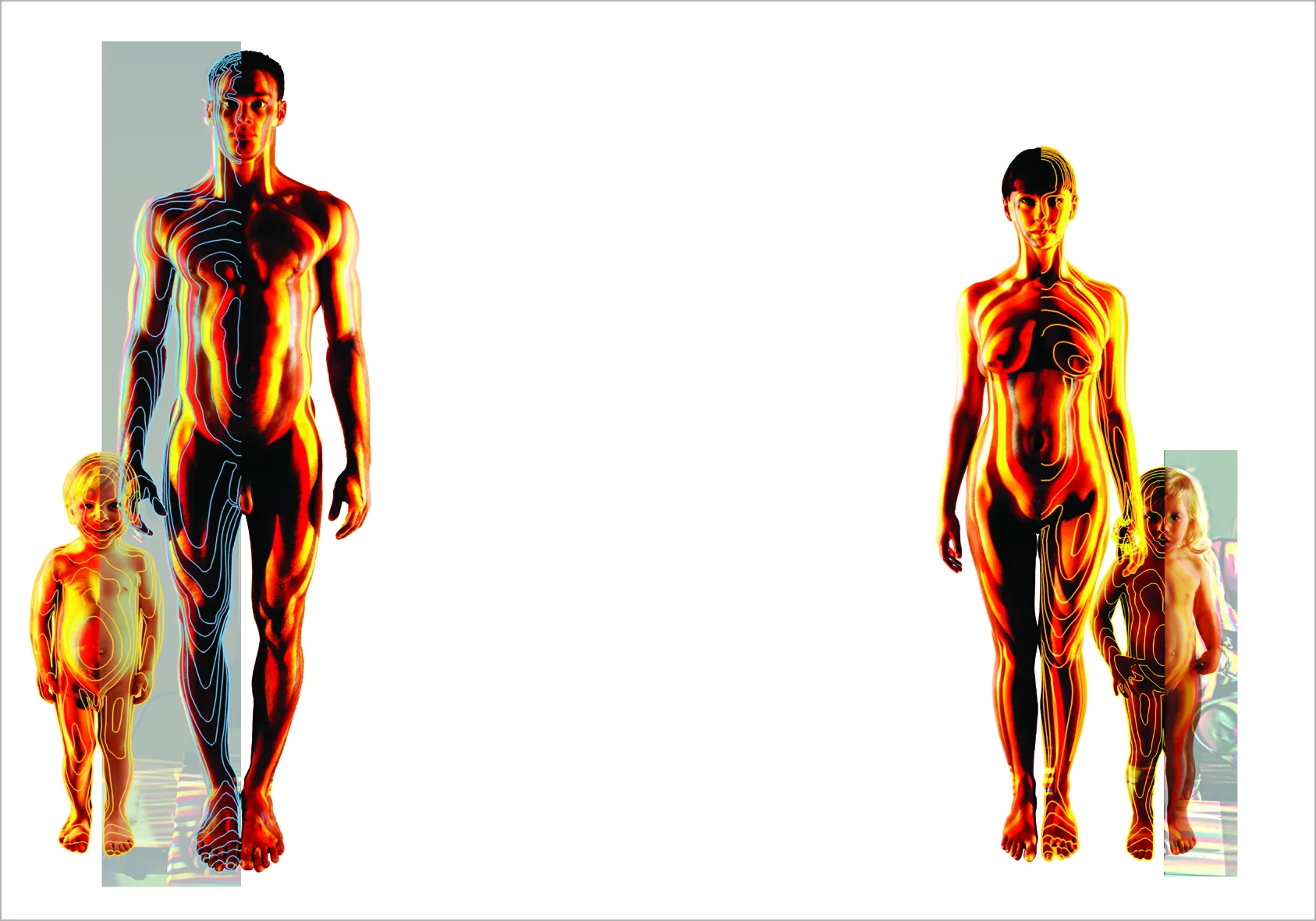
We stand face to face with them, hand to hand. They are like us. They appear to say: “We are what you are.” A contemporary vanitas? But what are we? What is a human being now? Despite everything surrounding us, we are increasingly fragile and our boundaries increasingly elusive. Questions whose answers until recently seemed obvious and clear now remain unanswered or become collections of possibilities and conditions. At what moment does life begin, and when does it end? Where are the boundaries of our body, and is the body alone the condition of our existence? How far may we intervene within it? What is the essence of corporeality? And further: do technological extensions of the body expand the range of existence, or are they the beginning of another path? This is what we are. Or perhaps what we were… Family Altar. A monument, remnant and memento of humanity. In its honour, in its image and likeness. The sphere of the sacrum has absorbed the profanum. The closing of a certain stage in human history, interpreted through corporeality understood as an immanent component of existence — or perhaps a nostalgic attempt to defend what has passed… What will we be now? Where are we going?
1. Compare Dürer’s Adam and Eve and Van Eyck’s Arnolfini Portrait, where the sides were interpreted from within the image, since that was considered the centre.
2. The term “photography” was first used by J. F. W. Herschel in 1839.
3. Jean Baudrillard, “The Precession of Simulacra”, Polish trans. T. Komendant, in Postmodernism: An Anthology of Translations, ed. R. Nycz, Kraków, 1996, p. 176.
4. Ibid., p. 181.