
Will There Be Food?
Maria Poprzęcka
“Vernissage [French vernissage, from vernisser — to varnish]: formerly, the day before an exhibition of paintings opened to the public, when artists applied, among other things, the final coat of varnish to their canvases; today, the ceremonial opening of an exhibition, combined with a press conference and usually intended for invited guests, art critics, journalists, artists and specialists in the field.” So runs the encyclopaedia entry, repeated verbatim in other reference works. Władysław Kopaliński’s invaluable Dictionary of Myths and Traditions of Culture makes no mention of the vernissage. Yet if a dictionary of the myths, traditions and rituals of contemporary culture were compiled, “vernissage” ought to occupy an important place. As practised in Poland today, however, this ritual remains unexamined and undescribed. No scholarly study called, say, “The Vernissage as a Cultural Phenomenon” appears to exist. But who would write it? A sociologist of art? A historian of manners? A critic studying the mechanisms of artistic life? A cultural anthropologist who would set the custom of the vernissage against old and new social rituals, locating it somewhere between the potlatch ceremony, the ritual feast, the artistic salon and the diplomatic banquet?
Let us therefore attempt to describe this custom. At first glance the vernissage seems closest to a theatrical premiere: in both cases, a work is exposed to public judgement for the first time — “thrown to the wolves”. Yet the script of an “opening” turns out to be more elaborate. Moreover, regardless of the scale of the undertaking, the successive points of this script are observed, attesting to the event’s advanced ritualisation. It begins with the guest list, followed by printing and posting invitations — the first expense. A vernissage costs money! The range here is enormous: from a modest circle of friends or family to the state authorities, including the highest office-holders. For the host institution, a VIP opening entails a visit from government security officers, heightened security, more journalists and cameras, the installation of metal detectors and stringent inspection of invitations. “Openings” are therefore closed.
Who are the guests? Every museum and gallery, however small, has its mailing list, supplemented on each occasion by the artist or artists, the exhibition curator and the sponsors. Here lies the first field of conflicts and wounded feelings (“I didn’t get an invitation”; “they don’t invite me there”, and so forth). Polish has no equivalent of “opening-goers”, denoting habitual attendees at vernissages. The habitual attendees themselves certainly exist. Studying their social and professional positions and average age could demonstrate how diverse and mutually alien the circuits of Polish artistic life are. These circuits seem to exclude one another, forming fairly closed circles that mix only at exceptional events capable of drawing crowds. Exhibition institutions clearly have “their own” audiences. Finally, like every public and relatively accessible event — invitations notwithstanding — vernissages have their own rather melancholy folklore in the form of so-called “divers”: uninvited people who come to eat and drink for free. But that belongs to another point in the script: the banquet.
We are still some way from that. First comes the “ceremonial opening”. The expanding script of the vernissage requires an appropriate ceremonial space. Most galleries, and even museums, do not possess one. With varying degrees of success, foyers and staircases take on the role, together with landings where officials can be placed. The public crowds wherever it can. The ceremony consists of speeches. Their number and length again depend on the exhibition’s status, but some kind of address is essential. A short presentation of the exhibition or artist and suitable words of thanks are the absolute minimum. Matters are most difficult with large international exhibitions. Diplomatic protocol requires speeches from the management — including a welcome enumerating the official guests — the minister, the ambassador or ambassadors, the curators, artists and sponsors, all with interpretation. Thanks, flowers, applause. At least an hour. The audience stands throughout. Adding a concert to the programme is a serious risk. But eventually the long-awaited words are spoken: “And now we invite you to view the exhibition.”





And now we stand before art. The study of reception is methodologically very difficult; the study of reception at vernissages especially so. Let us therefore settle for a surface description of the phenomenon. At a VIP opening a procession forms, led by the Important Person, who is shown around by the director, curator or artist. The public follows at an appropriate distance. In other cases, the human stream pours into the rooms without order or hierarchy. It is crowded and noisy — emptiness and silence are the worst things that can happen. The noise erupts as soon as the official section ends, as at school when the bell rings for break. This hubbub is the strongest sensation: people talk a great deal and loudly at openings. Acquaintances, greetings, conversations. Those who need a private, quiet, contemplative encounter with art do not attend openings. Here the experience is public, collective and entertaining. Can one not shut everything out and devote oneself to the art? In theory one can, although it is difficult. Besides, that is not why one came. There are many social obligations, including the indispensable kind words for the exhibition’s artist or artists. One can also settle a host of matters quickly in a single place (“I’m glad I’ve seen you, because I was just about to call… write… send…”). Female reporters roam about requesting “a few words” for the microphone. Camera and lighting crews trail behind them, suddenly flooding some corner of the exhibition with blinding light. Happily, however, the next point in the script arrives: the banquet.
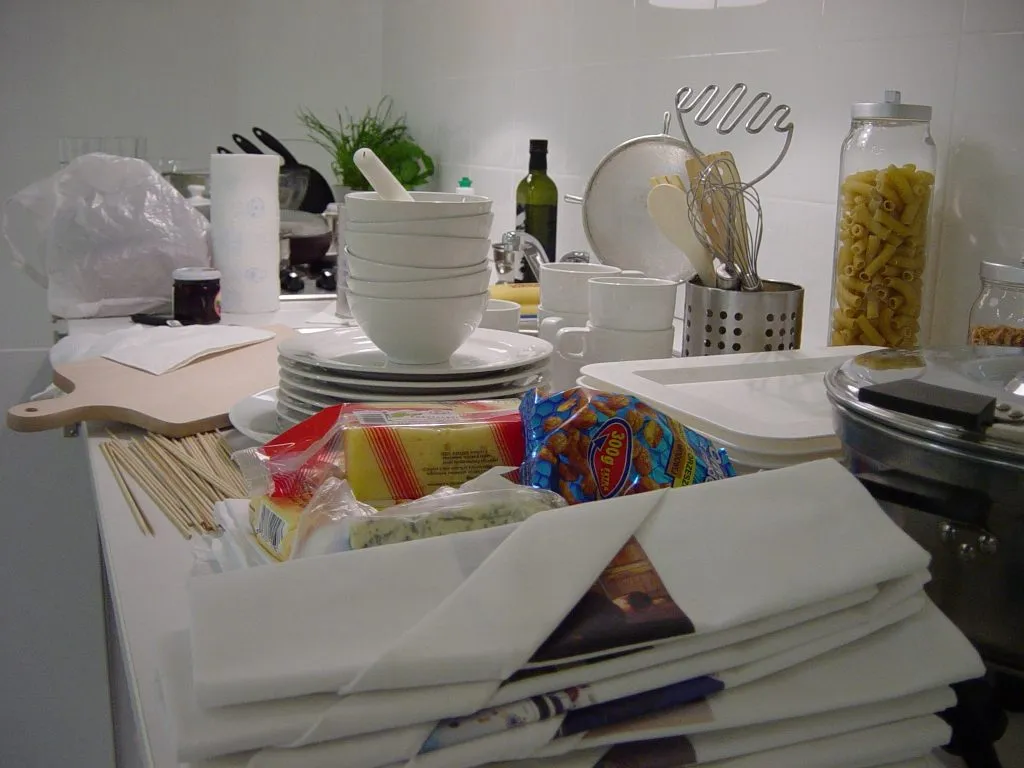
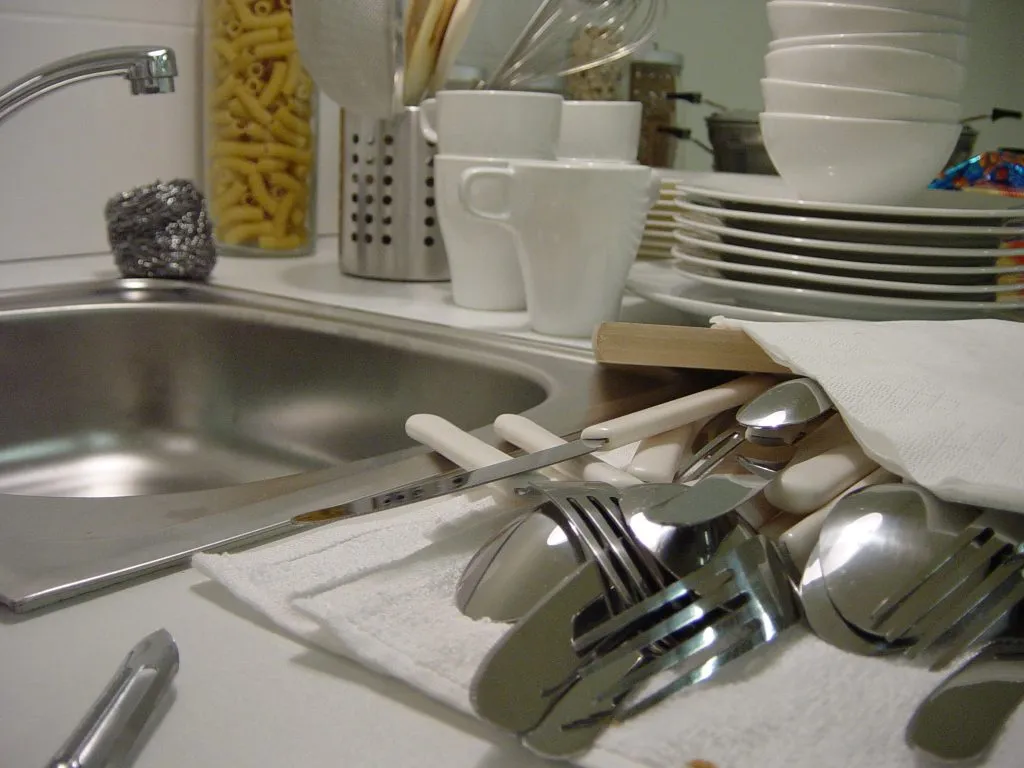
Over the past fifteen years, the range of possibilities has expanded considerably. It stretches from the canonical wine-and-savoury-sticks set, through catering menus at various levels of price and quality, to the full works: a cold buffet, hot dishes in chafing dishes, fruit, cheese, desserts and unlimited alcohol. In the last case, waiters are essential. Disposable tableware is unacceptable. This is where the guests are selected. The better sort receive invitations in advance with a card admitting them to the banquet; during the opening, gallery staff discreetly press into others’ hands a slip authorising entry to the banquet room. Checks are not rigorous, because the “divers” usually slip through.
This description is insipid, but so are vernissages. Their order is familiar, repetitive and entirely predictable. Only the food remains uncertain — an increasingly important component of the ceremony in recent years. One can divine it from the list of sponsors. Blikle? Doughnuts. Palikot? Fruit liqueurs. Polmos? Straight vodka. But one can also ask with old-fashioned solemnity: amid this social and snobbish clamour, in all this distraction and inattention, somewhere between the speeches and the banquet, does art have any chance of making itself felt? Does it become no more than a pretext and setting for a gathering of the milieu combined with consumption? Yet another vanity fair decorated with “art”?
Still, let us not lament, because perhaps the vernissage in its prevailing form is precisely a cruel and effective test. Might a confrontation with adversity offer art the chance to prove itself? Can it defend itself against an audience that arrives preoccupied with its own affairs, distracted, impatient and disinclined to perceive? The vernissage is like a painful initiation rite: will art subjected to it endure all this or not? And perhaps it is precisely its roots in a rite of initiation that ensure the durability of this apparently absurd custom.
Almost no one evades it. It is as though it remained in a protected zone, beyond the reach of rebellion and deconstruction. Rebels who passionately dismantle the institutional forms of artistic life place their heads beneath the yoke. At the official opening of Paweł Althamer’s exhibition at Zachęta, the artist alone was represented by a figure in a bear costume — the customary thanks were delivered by the artist’s brother, because bears cannot speak — while Althamer himself walked through the rooms dressed as his own father. It was very funny, but even the presence of unusual guests, young housing-estate residents from Bródno, did not disturb the obligatory order, culminating in a class-A banquet.
Althamer provoked, sensing and exploiting the vernissage’s playful potential. Elżbieta Jabłońska, whose actions have entered the realm of banquets and opening receptions for several years, neither provokes nor mocks. Caricature would be easy here — too easy. It is easier still to ridicule empty ceremony, public snobbery and artists’ posturing. Yet the ceremonial opening of an exhibition attended by artists, media and public is a crucial event in artistic life. Not because the judgements and fortunes of works and artists are determined there — although this too often happens. The complications and conflicts arising where art meets its audience are concentrated in the rituals of the vernissage as though through a lens. The vernissage creates laboratory conditions in which to observe them.
Elżbieta Jabłońska begins with astonishment. Her method is to examine what seems obvious. From the vast field of contemporary artistic life, she isolates one fragment — apparently a mere social custom — and subjects it to scrutiny. Scrutiny from many sides. She sees the wandering gazes of the audience gathered at “openings” and the “divers” who have illicitly entered art’s prestigious and restricted domain. She gives them full rights. She analyses the role of food, the most sensual yet also most democratic component of opening rites. She sees the conventions and tries to make them visible to us.
The action prepared for Atlas Sztuki in Łódź draws on the many ambiguities inherent in the ceremony of the vernissage. It is meant to be pleasant, as a social gathering should be, yet unexpected discomforts are to lie in wait. In the hierarchy of openings, waiters guarantee an event’s elevated status. So let there be a hundred of them. We like to be served. But to such an extent? Will the waiters’ omnipresence not awaken embarrassment and ultimately irritation? Moreover, the diligently tended audience will walk over loose floorboards. On the one hand, then, the waiters’ excessive attentiveness; on the other, uncertainty with every step. At a vernissage one does not think about avoiding a heel caught between the floorboards. Here one must suddenly watch one’s step and forget social ease. And then there is a glass display case placed in a precarious position, set trembling by the audience’s footsteps and intruding with its rattle into the opening’s hum of voices. Idiotic? But what exactly is idiotic here?
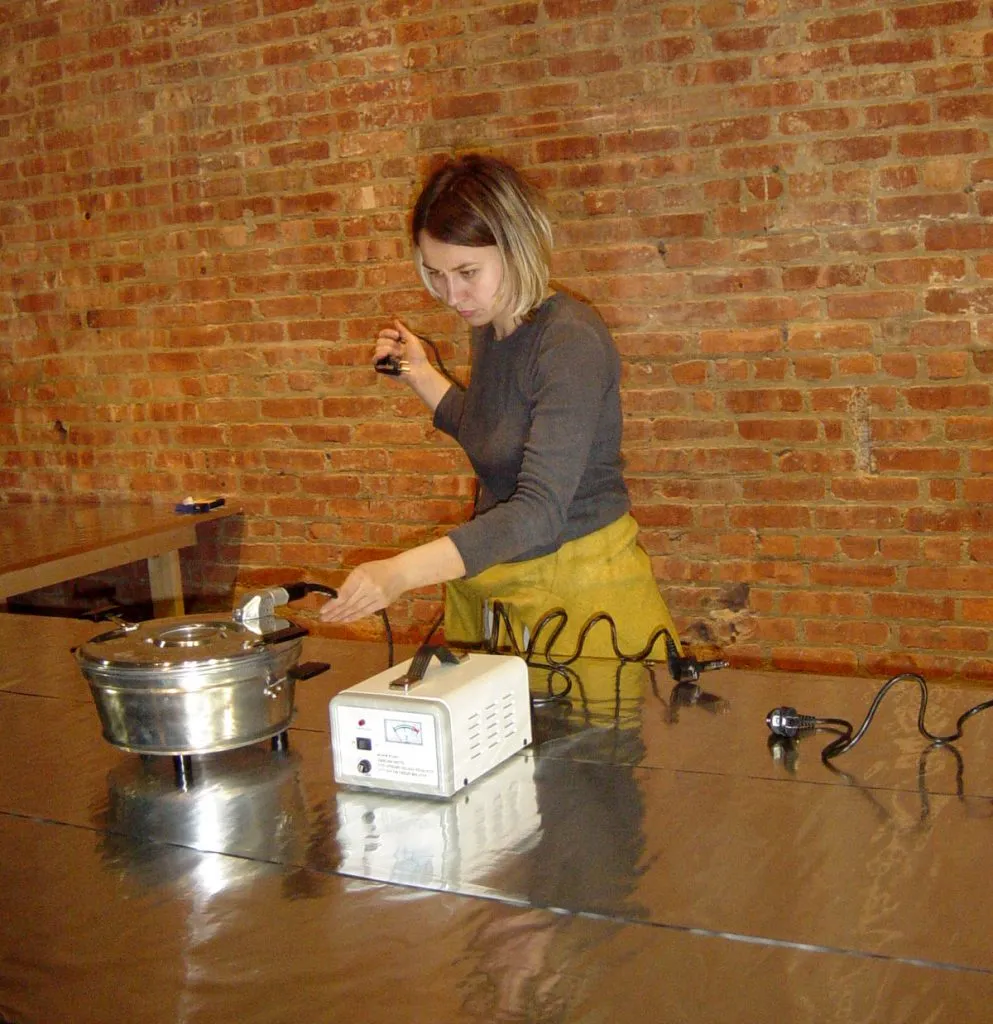
The collision of comfort and discomfort, of banquet pleasures and a literal threat to our footing, is not all. This is more than a joke, more than tripping up artistic and social conventions. Jabłońska captures another paradox of opening events: their ambivalent, open-and-closed character. She makes use of the location of the Łódź gallery, enclosed within a courtyard tightly surrounded by tenement buildings. The architecture of the gallery pavilion, surprising in relation to its former function as a market hall and its impoverished surroundings, is — one is tempted to say — Sansovinian, Venetian. A row of large arched windows runs around the single-storey building. For the gallery’s purposes they are naturally covered; the shabby courtyard is denied entry. The domain of art is isolated and closed. We therefore have a double enclosure: the gallery and the courtyard surrounding it. A clean box inside a dirty box. By deciding to uncover the windows, Jabłońska opens one space onto the other. With this single move she abolishes the “art world’s” safe isolation and disrupts the ceremony’s ritual space. Although only a step away, the neglected courtyard is far removed from the carefully groomed gallery interior. What is more, the artist wants to allow the audience to go outside and look at itself through the windows. As she herself examines the ritual, she wishes to invite its participants to look at themselves reflectively. Is this simply one happening among many? An idea for an opening “unlike any other”? A subversive conceit? A little of each, but also something different and something more. Examining the obvious is a good method. It makes us continually ask new questions. What role has been assigned here to the audience — to us? Are we the object of scrutiny, or a subject intended to scrutinise itself? But do we come to an art exhibition to look at ourselves? To see ourselves in our habits, poses, expressions and helplessness when something knocks us out of those habits? Why not?