
Mediterranean Beaches in Jerzy Nowosielski’s Painting
Andrzej Szczepaniak
The most perfect study of landscape is the study of the desert. (…) And what is the essence of nakedness? It is that I have nothing there, that there is as little as possible of what might be. Undressing a person means bringing them to a state of desert landscape; lack is the essence of nakedness, the absence of something. To paint a desert landscape is a great undertaking, but it is best to paint a nude1.
Jerzy Nowosielski, 1991
The countries of the Mediterranean basin possess a variety of beautiful beaches. Its coastline offers almost every kind, from sandy and rocky to pebbled. Expansive and seemingly endless, crowded with beachgoers or deserted where the mountains meet the sea directly, they are often overgrown with maquis. Ships, vessels, boats and kayaks are also inseparable elements of their landscape.
The waters of the Mediterranean have an astonishing range of colours, rich and compelling to every eye. They entice with turquoise and every shade of green and blue, combined with the golds and silvers of the rising and setting sun. This is a paradise for tourists and painters fascinated not only by the landscape but also by the mystique of the human body. It is there that one can observe bodies bathed in sunlight—warmed and resting, cooling in the shade. Thanks to a climate favourable to travellers and sunbathers, the region attracts vast numbers of visitors throughout the year.
Jerzy Nowosielski saw these countries and beautiful beaches. He usually visited them with his wife. Zofia Nowosielska once wrote to the Różewiczes: ‘My dears, like true millionaires we have arranged a holiday for ourselves here. We eat, drink, swim in a sea full of rocks and sea urchins, and do nothing! For two weeks, however, we toured like mad: Athens, Livadeia, Hosios Loukas, Delphi, Anion, Pyrgos, Olympia, Sparta, Mystras, Argos, Mycenae, Corinth, Piraeus, Heraklion, Knossos, Hagios Nikolaos and Kritsa’2.
This region, full of monuments and beautiful landscapes and the cradle of the oldest great religions, must have remained in the artist’s memory. It was not merely an idea of these places, but remembered, real views that entered his paintings and stayed almost until the end of his life—one of his final painted works was a large panel entitled simply Beach. Indeed, his entire oeuvre abounds in paintings bearing that title. He returned to them repeatedly and each time surrendered lovingly to the charm of beaches and of the women sunbathing on them.
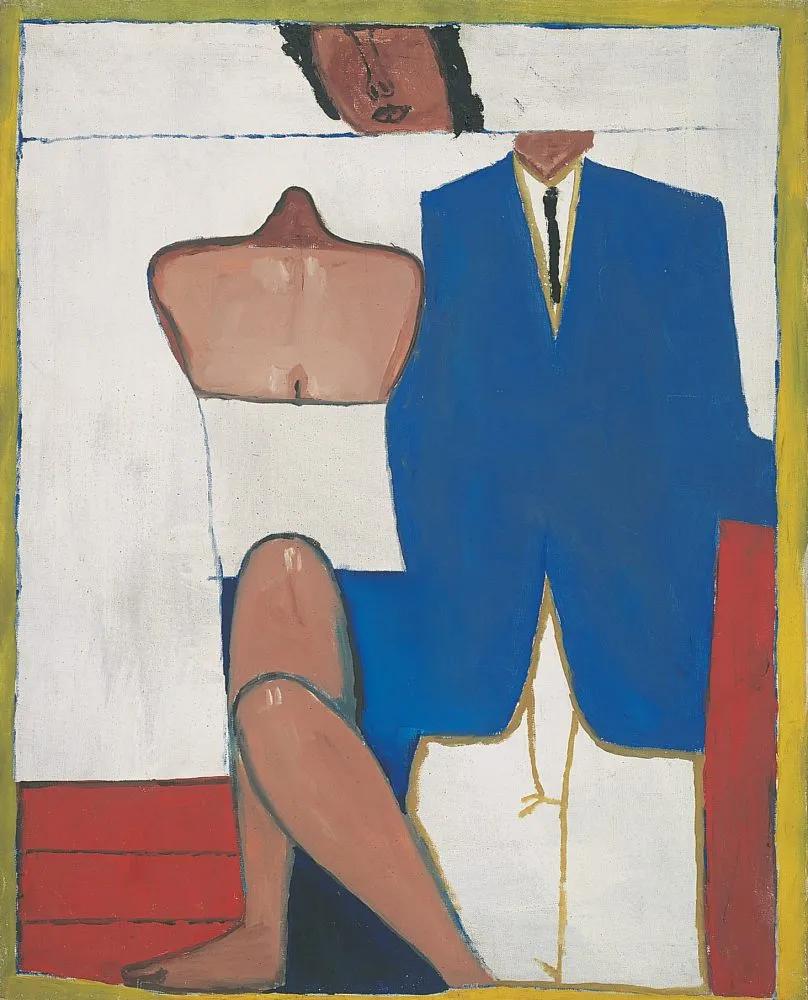
His oeuvre abounds in female nudes and beaches in different variants. In the 1950s and 1960s his painterly activity concentrated above all on combining an abstract spirit with elements of broadly understood formal figuration. His approach to depicting figures, based on the canon of Byzantine and Old Rus’ iconography, crystallised clearly at that time. This inspiration from Eastern painting is especially evident in the female nude. The style he developed for presenting the female figure undeniably shares much with the Hodegetria icon. Analogies can be seen both in physiognomy—dominated by an elongated, olive-complexioned face with a long nose, narrow lips and almond-shaped eyes—and in the treatment of garments, whose folds break sharply at bends. In many paintings, girls by the sea wear around their hips something that resembles a perizoma more closely than a bathing costume. His method of organising the picture’s space and planes is also characteristic—or, more precisely, their absence as in an icon—through either a flat, usually monochromatic background or a distant marine horizon.
A widespread opinion about Byzantine painting, repeated even by people who work with art, holds that it encouraged a particular schema and canon which, in their view, imposed itself upon and clearly restricted the painter, compelling work according to established rules. Byzantine art, however, was not a hermetic manifestation of ossified iconographic proposals operating through hieratic form as a binding rule. It developed its own canon and distinctive painterly language, but this did not restrict the artist in any way. The language was not so rigorous as to preclude formal development, an individual perspective or, ultimately, modification. Contrary to appearances, Byzantine art’s reductive specificity offered the painter many possibilities. Jerzy Nowosielski also perceived its considerable potential, because if something is reduced, there is a greater chance of attaining freedom than when no rules apply. The visible synthesis of the human figure in the icon served primarily to define its essence as faithfully as possible. That proved particularly interesting to an artist who wished to transplant such an approach into secular painting, irrespective of the subject addressed.
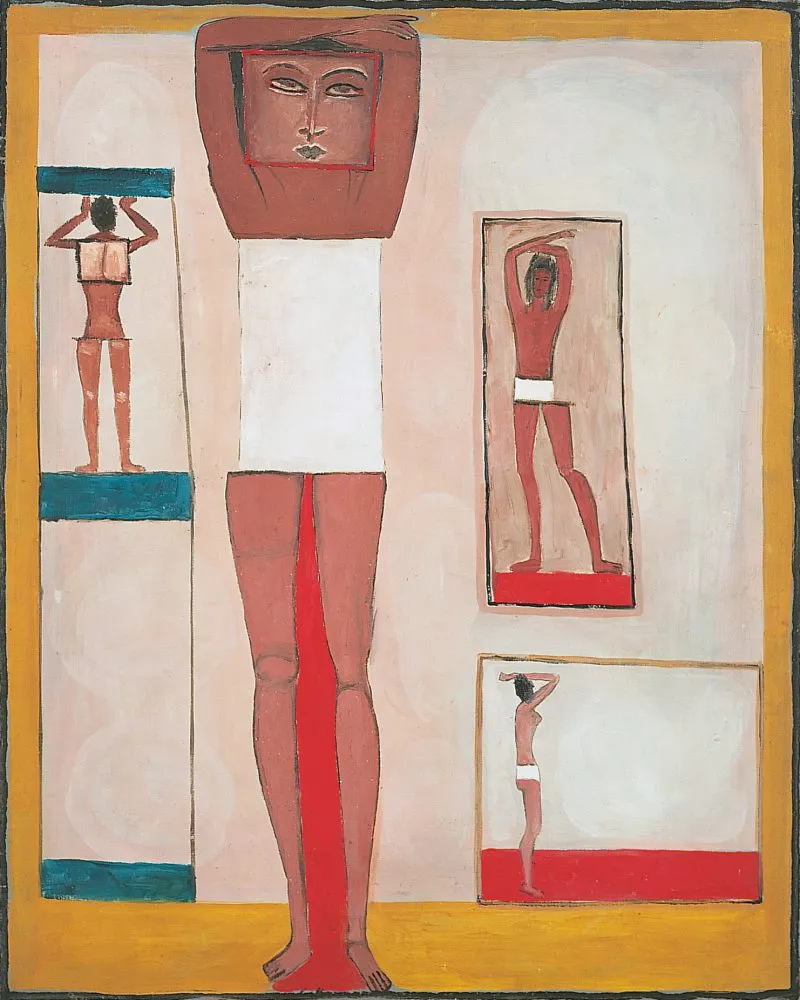
He achieved this successfully in paintings of women on the beach, whose bodies became ever more visibly sublimated and elongated. Their silhouettes, with the distinctive geometry outlining the muscles of abdomen and chest, began to resemble figures from the Palaiologan Renaissance. This manner of painting brings a certain generalisation of form which, through appropriate representational devices, is intended above all to create an ideal image of the woman existing in the artist’s consciousness, for whom he continually longs. The culmination of the devices Nowosielski introduced into modern art came in the 1960s, when critics began frequently to use the term ‘modern icon’ to describe his painting. The figurative series made at that time featuring Egyptian women and girls, or Black women on the beach, combined elements inspired by the icon with a deliberate primitivism that was always present in the painter’s work. Some fragments of the nudes and landscape itself were deliberately geometrised and cut horizontally, much as a magician at the circus saws his assistant in half. The women’s faces resemble masks and are strongly typified, while the pictorial space, likewise divided into several fragments, provides room to depict variants of the figure, posed differently each time. All these formal and stylistic devices deliberately employed by Nowosielski were intended largely to make the communication as pure as possible. By reducing a scene with women to a pure sign or situational shorthand, the painter sought to lend the depicted event a kind of iconic fidelity. He wanted to touch the very heart of the matter rather than rely on strands that had accumulated around it and seemed superfluous to him. He touched the symbolic essence of the image. The image-woman.
It has often been repeated in the literature that Nowosielski sacralised secular subjects. The fact that he adopted a particular iconographic and stylistic type from the heritage of the Eastern Church and used it in the realm of the nude does not in itself prove such sacralisation. A nude does not become sacred merely because its composition resembles that of an icon. One can speak of the holiness of the nude when, appropriately purified of burdensome, unnecessary details, it communicates information about its existence in another dimension and thereby touches the sacred.
With each successive painting, the artist sought to accomplish precisely that. It was not easy, for how can one imagine another, sacred reality when, perversely, one employs the instruments of empirical reality for that purpose? How can elements of real and sacred reality be reconciled? Unequivocally choosing one reality over the other would risk failure. Jerzy Nowosielski became convinced that only the juxtaposition of elements of both—a kind of discord between fragments of the real world, or rather the world we receive as secular, and fragments of supernatural beings, between the profane and the sacred—and their differentiation could produce the expected effects and result in a good work containing a magical element. He employed the icon because it itself comes from supernatural reality, ‘is the result of the human spirit’s effort towards redeemed reality’, and possesses a mystagogical function. If a picture were deprived of its magical element, the painter argued, one could not speak of art at all. ‘My only profession of faith is that art must exist within the sacred, that outside the realm of the sacred art ceases to be art. I have no other artistic credo. Of course, my technique has certain properties, but that is not an artistic credo. Those are restrictions for my own use. This cannot be expressed in words. An artist cannot want everything; the artist must restrict the field of action’3.
There is a great deal of the sacred in Nowosielski’s beaches and girls by the sea. The beaches become a theatrical spectacle, as if a contemporary mystery play in which the woman performs the leading role. Here we encounter another echo of icon painting, whose principles for organising compositions with multiple figures were built upon the experience of ancient theatre. Sometimes the silhouettes of naked or half-naked beachgoers in his paintings become increasingly slender. By reducing the body’s reality, they seem to transfer its form to other strata. In their contour-enclosed form they became beings from another world and thus, in some sense, more perfect, because they attempted to apprehend an ideal image of woman rather than a specific model. In short, by dematerialising an invented image, Nowosielski showed his dream Eve, remembered from paradise, the woman for whom he longed and to whom he returned continually. He transferred her from real to supra-real reality. His nudes therefore appear more as heavenly bodies than images of flesh and blood. With evident pleasure and a measure of voyeurism, he observed these beach scenes: girls in bikinis stretching or sitting motionless by the shore. They fascinated him obsessively. His Eve consequently had to unite the problem of corporeality with the spiritual aspect, because in this he saw the very point of painting the nude. Another matter is that only in woman did he perceive the possibility of success in this field: ‘Man is merely the beginning of woman; only from his rib did substance have to be drawn so that woman could arise. A man is someone who initiates us into the mystery of humanity, but the true human being is a woman’4.
The actresses in these beach scenes ‘directed’ by the artist raise their arms, stretch, crouch or simply display themselves in stillness. Yet their beach rituals contain nothing banal. It is not merely a matter of the actions they perform. Nowosielski’s beach nudes, marked by a distinctive mystery, unfold in an intimate dimension, while their vivid reds and oranges, browns and ochres further help to dematerialise all his seaside spectacles. His multi-figure beaches were almost always constructed according to a similar compositional scheme and palette: rectangular sandy views with a narrow strip of blue sea were filled with exceptionally slender girls in bathing costumes, either lounging on towels or walking along the shore. Barges can also be seen on the water and kayaks scattered on the shore.
Solitary female figures on the beaches attempt to elevate the problem of Eros in art to higher spiritual storeys, naturally emphasising most strongly the feminine element that interested Nowosielski. All temptations associated with corporeality become, on these canvases, a kind of adoration of the body in a sacramental and heavenly dimension. Yet this does not reject the enticing elements, because they are the driving force in the process of introducing that body into a supra-real dimension. The painter repeatedly stressed that stripping the nude of the erotic element in this way fundamentally misses the point, because a nude without eroticism simply becomes pointless.
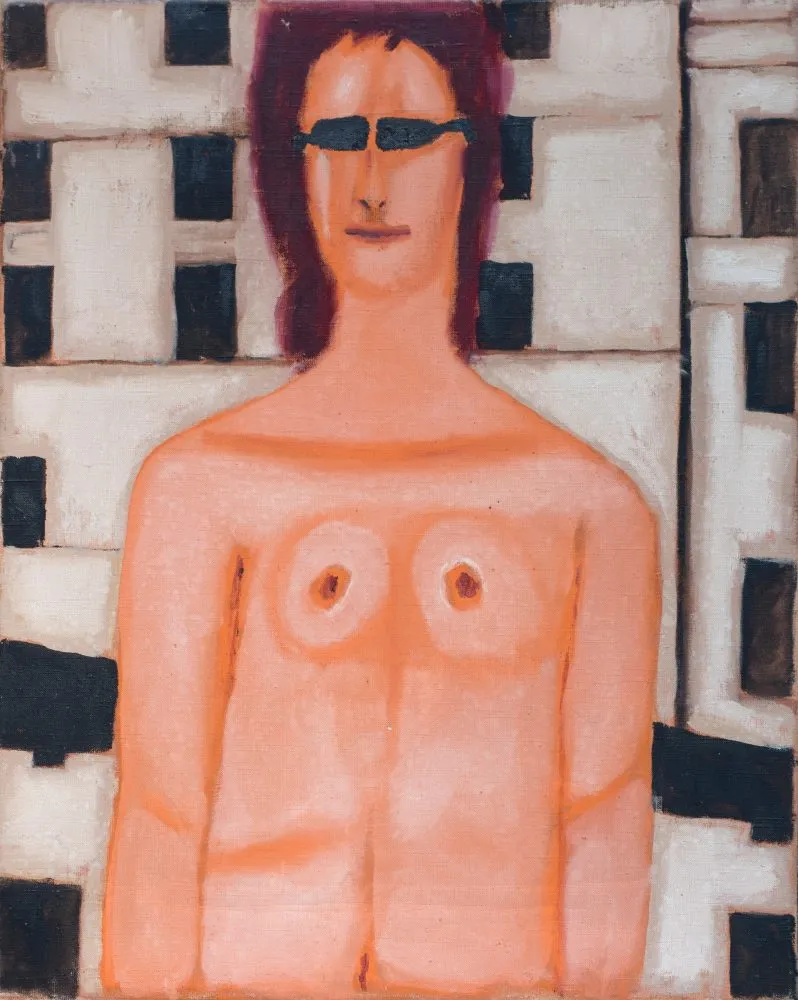
During the 1970s and 1980s, the painter developed the series of beaches and seaside views. In his pictures, resting by the sea became an example of conceptually and formally reduced nudes—or rather half-nudes shown with their backs to the viewer—with a strip of sand in the foreground and the sea behind. The compositional formula of these works recalled iconic portraits of pillar saints surrounded by smaller scenes in border compartments. Only seemingly identical, the depictions of girls in these series, described as ‘icons of desire’, transformed the nude into a synthetic ideal of the sacred body that was nevertheless not devoid of eroticism. The sacred element here cannot be overlooked. By purging the silhouette of unnecessary modelling, sublimating it and using formal means sparingly, Nowosielski realised his approach to Eros, which, as one of the four Greek manifestations of love, elevates corporeality itself—or rather introduces it into higher levels of consciousness. No one in modern painting had previously attempted such a procedure in the field of the nude while referring to the icon’s multifaceted experience.
Nowosielski’s enduring fascination with woman and with the spiritualisation of her corporeality, which enabled the eternal conflict of sacred and profane to be united, assumed another form at this time in a series related to the beaches, entitled The Rape of Europa and Girls on a Ship. Europa—the Phoenician princess, daughter of the Mediterranean and mother of the first Europeans, who gave our continent its beginning—disappeared without trace. She was sought everywhere in vain and has not been found to this day. This does not mean, however, that the search has ceased. Assorted artists—poets and painters—attempted to find her, each in their own way. Jerzy Nowosielski sought the lost Europa on the contemporary ferries that, like ancient ships, carried girls away across the great water into the unknown. The girls on these ferries are elongated, somewhat impersonal, faceless torsos formed by combining fragments of spirit and matter. They are ideal women through whom the artist demonstrated that the coexistence of sin and divinity makes the nude complete, because sensory values cannot be represented if the element of great desire is lost along the way. Looking at Nowosielski’s Europa, we enter the strata of his consciousness and become fellow travellers into the depths of a painterly imagination that clearly cultivates the image of the female body and adores its forms, thereby transferring it into another dimension.
Through his almost mystical nudes, we can know him as a worshipper of women, an adherent of his own religion, paying homage at once to heavenly Sophia and fallen Sophia. This erotically spiritualised aspect of his art takes our thoughts much further, to the figure of Ecclesia—the symbol of the Church depicted in Byzantine iconography precisely as a woman. And, following Vladimir Solovyov, frequently quoted by the painter, one may even see in her a worshipped Goddess: ‘…because love in its four forms (Eros—Philia—Agape—Stergethron) is divine—because God is love, human art deals above all with love, since this is truly the only subject of genuine, serious human curiosity, human interest and human longing’5.
As memories and returns to personal fascinations, the paintings also feature Black Women on the Beach, Tibetan Beaches and Memories of Egypt. The Black Coptic women in compositions from the 1980s and 1990s are perhaps the most synthetic treatment of the nude Nowosielski ever created. They are almost female emblems without faces or hands, sitting majestically in turbans on beaches, their feet wrapped in white towels. Behind them stretch the sky and a narrow strip of sea on the horizon. Their black, flat bodies are now a conventional transposition of figuration in which detail is deliberately omitted because it seems redundant or even obstructive. These bodies present a metaphysical ideal of woman, a model of beauty created by the artist, reconciling elements of the corporeality of the real body—with its eroticism—with the highly subtle body that refers to the body in its redeemed form.
The nudes on Nowosielski’s late beaches become ever more visibly slender and elongated, but despite this treatment, intended to dematerialise the figure, they lose none of their piquancy. This is largely due to colour, most often a sharp pink, orange or red. The consolidation of the female image, practised by the artist for many years, assumed an extreme form in the 1990s, while synthetic treatment of the pictorial plane and increasing economy became binding principles. The sunburnt, brown girls in the large pool composition of 1998, painted for a private residence in Warsaw, assume the form of three-dimensional figures holding static poses. The group composition is in fact a multivariant representation of the same figure in different manifestations. Three horizontal bands complete the whole: orange sand scorched by the sun, a dark-blue sea and a white-and-orange sky. It is one of the last paintings Nowosielski made.
All these Mediterranean beaches of Greece, Italy or Spain, invented and remembered from holidays, will remain an intriguing subject in his painting for ever. Returning to them over many years, Jerzy Nowosielski created his own original Mediterranean landscape, which in an exceptional way assumed the appearance of mystical and mysterious landscapes with women—tempting and fascinating us.
*Andrzej Szczepaniak, curator and art historian. Lives and works in Kraków.
1. Nowosielski + Painting and Eroticism, interview by Tatiana Oppersdorff and Iwona Sabat, in Krakowski Kurier Konferencyjny. Plastyka I, Kraków, June 1991, pp. 2–4.
2. Postcard from Z. Nowosielska to W. and T. Różewicz, 20 September 1979; Malia, Crete.
3. Zbigniew Podgórzec, Around the Icon: Conversations with Jerzy Nowosielski, Warsaw 1985, p. 194.
4. Nowosielski + Painting and Eroticism, interview by Tatiana Oppersdorff and Iwona Sabat, in Krakowski Kurier Konferencyjny. Plastyka I, op. cit., p. 3.
5. Jerzy Nowosielski, Eros against Pornography, in Ars erotica, exhibition catalogue, National Museum in Warsaw, Warsaw 1994, p. 16.