
Jerzy Nowosielski in the Łódź Art Scene (1950–1962)
Agata Mendrychowska
“Jerzy Nowosielski lives in Łódź. The spacious studio which he and his wife recently moved into was created, as was customary, by converting part of the attic in a large new block of flats in the northern part of the city. Through the rectangular slit of its low windows one sees lines of muddy streets converging in the distant perspective, a monotonous grey crystallisation of roofs and the cones of chimneys disappearing into the dirty mist”, writes Mieczysław Porębski in the first monograph on the artist.
Jerzy Nowosielski moved from Krakow to Łódź in 1950, coinciding with the difficult period of Socialist Realism in painting. The compulsion to submit to the doctrine imposed by the authorities caused many artists to withdraw from official artistic life. Nowosielski's wife, the painter Zofia Gutkowska, had just begun work in Łódź as a set designer at the Arlekin Puppet Theatre. Thanks to Ali Bunsch, an acquaintance from his student days in Krakow, Nowosielski also secured a post immediately after arriving in Łódź, as artistic director of the State Directorate of Puppet Theatres. “It was a sinecure for six months,” he recalled, “because in reality I had no power; the director decided everything. The only thing I learnt was how to issue myself travel orders very efficiently. I travelled all over Poland, held conferences with writers and inspected theatres. My entire salary went on these representation expenses, and we lived on my wife's salary.” Before leaving for Łódź, the artist had been Tadeusz Kantor's assistant at the State Higher School of Fine Arts in Krakow. With the introduction of the doctrine of Socialist Realism, Kantor—the creator of an experimental theatre and recent organiser of the First Exhibition of Modern Art in Krakow—was dismissed on the orders of the Ministry of Culture and Art. Nowosielski then resigned from his job. “I was in a hurry to get to Łódź because my wife had found a post there,” he explained. Władysław Strzemiński, co-creator of the curriculum at the State Higher School of Fine Arts in Łódź and initiator of Europe's second International Collection of Modern Art, which the artist had donated to the Museum of Art in Łódź before the war, had just been dismissed from that institution. The Collection, meanwhile, was closed to visitors because it did not meet the principles of Socialist Realism.
Immediately after arriving in Łódź, Nowosielski sought contact with Strzemiński, who had gathered around him a group of young artists in the Łódź milieu who continued his Theory of Vision. The two artists had met before, during the 1940s, when Strzemiński, founder of the School of Fine Arts' Department of Spatial Art, reportedly told Nowosielski: “I'll give you some good advice: enrol with Kantor at my school and I will teach you. You are inexperienced, and I will give you knowledge…” By 1950, however, Strzemiński was on the margins of artistic life. “I met Strzemiński during the most tragic period of his life,” Nowosielski recalled, “when he had been thrown on the rubbish heap and was eking out an existence on the margins of artistic life. He did not even have anything to paint with because paints were unavailable, and he liked to paint thickly in oils. When I arrived in Łódź, the very next day I went to the Union to ask for Strzemiński's address, and some lady there said to me coldly: Mr Strzemiński does not belong to the Union. So I had to ask elsewhere for his address. I could really only talk to Strzemiński about the weather, because our views on painting, drawing and literature differed so profoundly. His theoretical views were very precise. He knew for certain, and that was the end of the matter! I visited him to show him a certain solidarity, to let him feel that somebody was interested in and respected him. He was utterly broken and isolated. His pupils visited him, of course; that was his micro-environment. But I wanted him to have some broader contact too. I wanted to offer him human companionship, some warmth and human friendship. Because I could not talk to him about art.”
At the time, Nowosielski painted sporting scenes from photographs “for himself”, a subject on which he had worked since the late 1940s. Although, as he claimed, he treated ideological matters “like a typical Surrealist, that is, with a certain wink”, he too found himself in a dramatic professional situation: “I was afraid they would throw me out of the Union and deprive me of the right to practise my profession. I was constantly on the verge of civil death. None of my paintings passed the jury at the OWP1, and that threatened me with a ban on artistic activity. I was refused an allocation of paints from the Union; in the shops you could get only a few colours of some little paints or other, while the allocations included whole good sets of Russian paints. But Grygiel, the Union's president, said: ah, painting like his is… and so on. Besides, painting itself could be regarded as a crime at the time if the relevant authorities decided to persecute you.” During the subsequent years of Socialist Realism, the artist did not participate in exhibitions. “I sat at home and painted. (…) I could not adapt. It was not even that I did not want to. It was beyond my capabilities,” he admitted. During this period, Nowosielski designed sets and costumes for the Arlekin Puppet Theatre in Łódź. From 1951, he also began working as a painter of polychrome decorations in Orthodox churches, while reading the writings of Eastern Christian philosophers, and his worldview gradually changed. During the war, Nowosielski had stayed at the Lavra of Saint John the Baptist near Lviv, where he learnt to paint icons. “But then I left,” the artist wrote. “For other experiences, other painting, other artistic temptations. In addition, I lost my religious faith, and therefore the essential, fundamental motivation for taking an interest in the icon.” After many years of atheism, Nowosielski recovered his faith. Asked whether he remembered the moment, he replied: “… it was April 1954. I was passing the Orthodox cathedral in Łódź, looked at it and suddenly, at that moment, everything reversed. It was a certainty.” This change in worldview was linked to a phase of searching in his art, of which the artist spoke years later: “And suddenly I faced a question. What am I actually to do? How am I to be in this Church as a human being, as a painter, as a so-called artist? Perhaps an ‘artist’ cannot be in the Church at all? And this was where my experience with the icon helped.”
Within the Łódź art scene, Nowosielski found the greatest affinity with Teresa Tyszkiewicz, a painter who came to Łódź after the war to teach at the newly established State Higher School of Fine Arts. Because Socialist Realism was then obligatory, however, she resigned from her post in the painting studio, independently mastered the skills required for textile design and then established the Department of Textile Printing, to which she would bring Jerzy Nowosielski in the late 1950s. The artist's circle of close acquaintances also included Stanisław Fijałkowski, a painter, pupil of Władysław Strzemiński and teacher associated with the Łódź School. “(…) In Łódź I stayed close to Teresa Tyszkiewicz, and she knew a great many young people, such as Fijałkowski and others, so we had a very good social and collegial context that helped us enormously, psychologically, to make it through those hardest years,” Nowosielski recalled. Tyszkiewicz, known within the milieu as “the Countess”, organised gatherings of writers and artists in her flat. Although officially she produced illustrations for children, including for Świerszczyk, during the 1950s her painting—as only a few people around her knew—was inspired by tachisme, the gestural art then current in the West. Her other activities included keeping a diary in which she recorded thoughts about her work, reading and meetings. She also noted conversations with Jerzy Nowosielski, with whom she shared an interest in theology. The artists discussed occultism, the reincarnation of the soul and the Christian philosophy of Saint Thomas Aquinas.
It was only during the Thaw, in 1954, that Nowosielski participated in a group exhibition at Zachęta in Warsaw, which also included Tyszkiewicz from the Łódź milieu. From that point, he also joined the city's artistic life, presenting his paintings in exhibitions by members of the Łódź district of the Association of Polish Artists and Designers at the Art Propaganda Centre.
Polish art then entered a period of reckoning with Socialist Realism. The landmark Arsenal Exhibition in Warsaw presented extraordinarily expressive works opposed to the aesthetics of Socialist Realism. That same year, Nowosielski participated in an exhibition of nine painters associated with the Krakow Group, which critics called “the exhibition of the moderns”. When Nowosielski summarised the period of Socialist Realism in the Krakow Group's artistic activity, it is difficult to escape the impression that he was speaking above all about himself: “Between 1950 and 1955 there was a break in our activity—which does not mean that we stopped working during that time. It was precisely this period of interruption when we finally matured and defined ourselves as individual painters. When we resumed the activity of the ‘Krakow Group’ in 1955, we were already different people—each of us was doing something very much his or her own.”
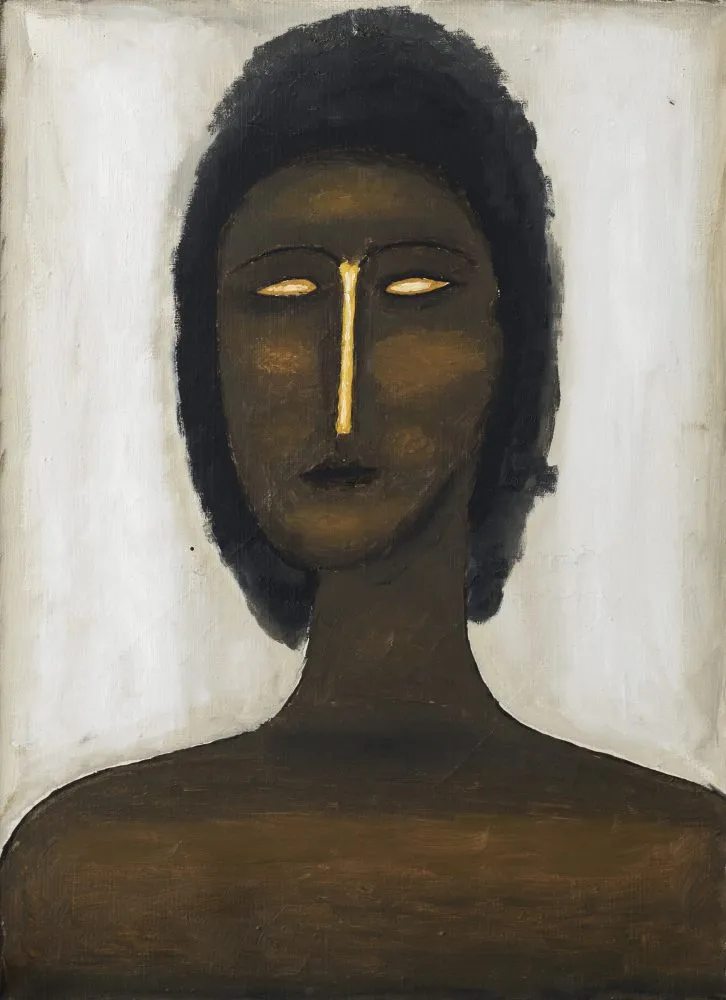
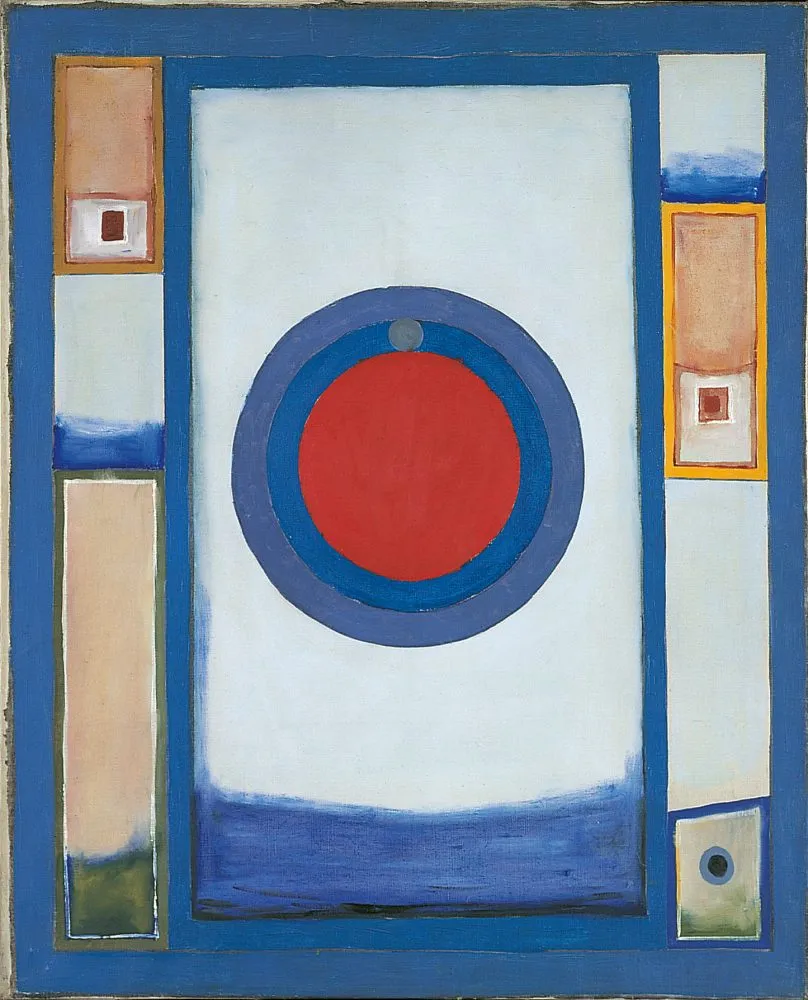
At the beginning of 1956, Nowosielski opened his first solo exhibition at the Association of Polish Artists and Designers premises on Piotrkowska Street in Łódź. It included approximately fifty paintings made since his studies at the School of Fine Arts in Krakow, from 1946 to 1956. The exhibition, however, passed without notice. Several months later, the same exhibition, enlarged with his newest works, was shown at the Palace of Art in Krakow and received positive reviews. “I venture to claim that Nowosielski is currently the only Polish painter of the younger generation to possess a distinctly separate plane of visual expression, his own world of illusionistic space which he continually improves,” wrote Edward Etler, who was connected with Łódź2, in “a report on the presentation of works by an artist from Łódź” in Krakow. “And this world, enclosed within visual stylisation, owes nothing to Modigliani—although he admires him, incidentally—but to Byzantine art, in which he is immersed up to his ears. Hence the particular calm and static balance of his canvases, the distorting elongation of the body, and therefore what prompts associations with Modigliani, as well as a characteristic detail whose origins are easiest to grasp: cold, icon-like ‘highlights’ repeated almost everywhere (…). Thus I regard reaching back to Byzantine models and seeking in them a method, some philosopher's stone and a route towards modern painting as a valuable innovation.” Perhaps the scant interest in the Łódź exhibition was influenced by the poor premises, as Etler went on to write: “[The exhibition] also took place here in Łódź—but in the perfectly concealed premises of the Artists' Union, which guaranteed its complete secrecy. One thing is certain: until the small room on Piotrkowska gains the popularity as an exhibition venue enjoyed by the Artists' House in Krakow, every presentation of work there will have the character of merely ticking a box.” Nowosielski showed paintings of sporting subjects, portraits referring to the style of the icon and landscapes “whose Łódź character can be seen from a kilometre away”. He did not, however, show his abstract paintings from the late 1940s. Years later, he would call this current of geometric abstraction in his painting “a state of split artistic personality”.
After the period of Socialist Realism, the art of the “modern” artists came to the fore. Marian Minich, then director of the Museum of Art in Łódź, sought funds to recreate an exhibition space for the International Collection of Modern Art and to purchase works by “young Łódź artists”. Modern art did not, however, gain easy acceptance in a working-class city. Minich had already discovered this while running courses for workers in the Bałuty district of Łódź before the war. Exhibitions of “modernists” were organised in various cities, of which the Łódź exhibition would go down in history.
Henryk Anders, a Łódź critic and art historian, recorded the event in a study of art in the city: “In July 1956, despite the summer holidays, 12,500 people went to the Gallery to see the exhibition of the “eight modernists”. In September, the first presentation of tachisme in Łódź—paintings by Głowacki—drew about 15,000 curious visitors who tried to see it amid incredible crowding in the small room on Piotrkowska Street. Neither exhibition was greeted with applause—on the contrary, they were among the most fiercely debated and attacked.” Despite the exhibition's extraordinary popularity, the Presidium of the National Council and the Artists' Union received a protest against the “hooligans of art” signed by a dozen or so “art lovers”, while the visitors' book filled with comments. “The exhibition shows pictures—products of sick imaginations. I believe that exhibitions which offend our remaining sense of aesthetics and beauty should be prohibited by the public prosecutor… Those who write that they like the exhibition pretend to be highly cultured experts, but their level is that of a single-celled organism. Pithecanthropus could have painted something more human with his left foot… this idiocy in painting will not be accepted even in 100,000 years. Unless radioactive dust softens every brain in the world…” These are among the more interesting comments quoted by Anders. A month after the Exhibition of the Eight had ended, Głos Robotniczy was still writing about Nowosielski's Łódź Landscape: “There is certainly no such street in any city. Nowosielski painted in perspective. But what sort of perspective is it? (…) Ordinary boards in the fence are twice the height of the tramcars. (…) And is any factory chimney equal in width to a four-storey building? Certainly not! One would like to say: gentlemen, do not push the art of painting onto the pathless wastes!” This entire storm surrounding the Łódź modernist exhibition largely passed Nowosielski by, as in mid-July he left for Italy to participate in the Venice Biennale. On the way, he stopped in Vienna, from where he sent his wife Zofia a postcard: “We ate dinner in Vienna, in a beautiful courtyard near St Stephen's; now we are drinking Coca-Cola so that we know what it is.” He had been invited to take part in this prestigious international exhibition by Mieczysław Porębski, a friend since their wartime studies at the Kunstgewerbeschule in Krakow. “By now I know the whole Biennale by heart; in any case, it is pretty lousy this year. The French are worse than I thought—the sculpture is good,” he summed up his impressions of the Biennale in a few words in a letter to his wife Zofia. The artist also visited private galleries, but it was historical art that interested him most. Writing to Zofia Nowosielska from his onward journey through Italy, he reported: “I have Padua (Giotto) and Ravenna behind me. Ravenna in particular cannot be reproduced in any colour reproduction. The colour of the mosaics there is impossible to convey—as I discovered by comparing it with numerous facsimile reproductions.” He shared his impressions of Florence: “the cathedral and S. Miniato are a great surprise to me. In terms of the power of their impact, I have seen nothing like them in architecture. Black-and-white marbles composed obsessively, without end (it is one of the largest churches in the world). Today, only Nikifor could invent something similar.” The artist also devoted considerable attention to Orthodox art: churches—he travelled by boat to Torcello to see one—and icons. “The Uffizi Gallery—wonderful—modern—some first-rate Old Russian icons—a quarter of the museum in Lviv,” he wrote in a letter to his wife. The journey would also influence the artist's later projects. In the polychrome decoration of the ceiling of the church in Zbylitowska Góra, he planned to include “golden stars like those I saw in S. Maria in Cosmedin in Rome”.
After Nowosielski returned, several newspapers published interviews with him about his impressions of the Biennale: “Apart from Venice, I visited Padua, Ravenna, Florence and Rome. I saw a great deal of modern painting, paying particular attention to mosaics and pre-Renaissance painting. I think that, in this respect, I saw everything there was to see,” he concluded in one interview.
In 1956–1957, Nowosielski created the only non-geometric abstractions in his entire oeuvre. This episode in his work, connected with gestural painting, as Stanisław Fijałkowski now describes those pictures, prompted debate in the Łódź art scene. Nowosielski presented the non-geometric abstractions in a solo exhibition in January 1957 at the Central Bureau of Art Exhibitions premises at 102 Piotrkowska Street. They were evidently a surprise to the Łódź milieu. The artist showed them alongside the still lifes, mountain landscapes, geometric abstractions and portraits already familiar to the city's public and critics. In the exhibition leaflet, consisting of his own text, Nowosielski stated: “While working over the past year, I concluded that all figuration obstructs my spontaneous creation of visual effects that would satisfy me fully. If one abandons traditional studio habits, the territories available for exploration are vast and mysterious.” Nowosielski deliberately also showed recent works inspired by the art of the icon. In the introduction to the exhibition catalogue, he explained: “Despite breaking with a certain type of figuration which I have practised until now, I feel that my present paintings remain in some inner relationship with the painterly traditions that have inspired me hitherto.” Edward Etler again commented on Nowosielski's painting, noting that “the horizontal trace of the brush here fulfils the role of the traditional highlight and derives from the icon…” An entire page of the Łódź fortnightly Kultura was devoted to commentary on the exhibition, which was really a case for and against Nowosielski's work. Etler explained the artist's new type of non-figurative painting by comparing it with tachisme3: “I have never concealed my belief that Nowosielski is the most interesting figure in the Łódź group of painters,” the critic wrote. “But it is only after the latest exhibition that I repeat those words with genuine satisfaction. For it turns out that Nowosielski is already bringing his artistic credo to the very beginnings of our tachisme…” Etler's opponent was Stefan Wegner, a friend and, until recently, close collaborator of Władysław Strzemiński, who published an unfavourable article in Kronika entitled When the Angels Died. “I prefer the view that art should be explained, made accessible and promoted rather than judged—especially current art—to other approaches,” wrote Wegner, author of the series of articles How to Look at a Painting, published in Głos Robotniczy. “At the same time, there are cases that provoke one to take a position. A few days before his exhibition opened, I happened to see Jerzy Nowosielski at lunch. My first thought was that he had probably returned from some exotic expedition beyond the reach of such amenities of civilisation as a barber. His pink face was covered by a rather long, though sparse, beard and vividly resembled Robinson Crusoe in children's colour illustrations. (…) Somebody beside me muttered that Nowosielski had returned from Italy. I still could not understand what this masquerade had to do with a stay in Italy. Nowosielski had, after all, represented Polish art at the Venice Biennale. I had known him as an exemplary imitator of Modigliani, and this still did not explain the transformation of his countenance. Only the exhibition gave rise to certain suspicions. This is existentialism. The facial hair is the external expression of a philosophical attitude towards life. And we sit here—a journey to the West remains in the realm of dreams—knowing nothing. The relevant authorities must value Nowosielski highly, since they selected his artistic achievements for an international exhibition in Italy, where Nowosielski, together with several other artists, represented the achievements of Polish art.”
Before the war, Wegner belonged to the Modern Artists group, established at the initiative of the a.r. group. In the post-war years, he collaborated with Strzemiński on organising the State Higher School of Fine Arts, of which he was dean and subsequently rector. After Władysław Strzemiński was expelled from the School in 1950, Wegner was relieved of his post at his own request. During the following months of 1957, Wegner and Nowosielski would join the newly formed Fifth Circle group4. They would also sit on the organising committee of the Second Exhibition of Modern Art in Warsaw and be appointed lecturers at the State Higher School of Fine Arts in Łódź.
“… during the Thaw, I saw a series of his paintings,” Wegner continued in Kronika. “Fat female flesh peered from the walls, plump limbs, an abundance of charms. (…) There was something of Modigliani in it. It seemed to me that it would be more consistent to draw directly on Gothic painting. Some saw modernity in it, but when asked, they could not say what this modernity consisted in.”
Years later, Nowosielski himself admitted: “And yet I actually suspected that I had not become a ‘modern’ painter. I could not. I recognised this because, at exhibitions of paintings by my colleagues, the ‘modern painters’, I had the irresistible impression that my paintings somehow did not fit, that they were intruders barely tolerated by their surroundings, admitted to the company as though ‘through connections’.”
Stanisław Fijałkowski, who was Nowosielski's friend—the artists had adjacent studios on Zachodnia Street and often visited each other—described one conversation about the non-geometric abstractions of that period: “There were no suggestions or corrections in front of the paintings; each of us was already determined to do something different. We respected each other as two painters who did their own thing as well as they could, but we avoided direct intervention. I remember only one occasion when he began painting coloured lines against an abstract background. I said that it strongly reminded me of all the experiments our tachiste colleagues were making. And he replied: ‘Well, yesss, except that they started and did not finish. It has to be carried through to the end, and I shall do it.’ I liked those paintings very much, incidentally; I simply thought that he was following a fashion.”
Tachisme was then the newest current in the European visual arts. Although it ultimately failed to “express the age”, as Zbigniew Herbert wrote, as a tendency oriented towards creative freedom it quickly gained artists' interest. This is demonstrated by Julian Przyboś's review of the Second Exhibition of Modern Art in Warsaw in 1957—Przyboś, like Wegner, supported Strzemiński's art—which complained of “chiefly a shallowly understood tachisme here” instead of “the idea of a sensitive eye's rigour, the discipline of thought”.
At the turn of 1956 and 1957, Tadeusz Kantor, an ardent advocate of tachisme, visited Łódź to deliver a lecture and slide presentation on Art Informel. Several months before Kantor's visit, Zdzisław Głowacki, a well-known Łódź Socialist Realist, surprised the public by presenting paintings referring to tachisme in an exhibition organised after his return from Italy. “… Jerzy Nowosielski's paintings have nothing in common with the canvases of Kantor or Głowacki, or with those I saw several weeks ago at the exhibition of young artists from the Krakow District,” Etler continued in Kronika. “Tachisme already had an established position in the previous exhibition season, and is now becoming an increasingly frequent artistic fact.” Gestural painting, which fell within the broad concept of tachisme, was also practised by Teresa Tyszkiewicz, who was close to Nowosielski and whom Strzemiński dismissively called “the intuitionist”.
In the discussions later recalled by witnesses, she always opposed rationalism in painting, whose spokesman was Stefan Wegner. “To be honest,” Etler wrote, as though referring to judgements of this kind, “I must venture the supposition that, on the plane of theoretical consideration, our ‘avant-garde’ simply lacks criteria when confronted with Nowosielski's explorations. Strzemiński had, after all, already reached the point of extracting structure in a painting. Yet he was too great a rationalist to reconcile himself to the thought that structure could be independent of the imagination.”
Several months later, in the Przegląd Kulturalny survey (no. 17/57), Artists on Art, Nowosielski was asked: “Can you indicate an example of a famous painterly misconception—a theory or artist—in Poland or abroad?” He replied: “Strzemiński's Theory of Vision, promoted by some of his heirs. I value Strzemiński as a painter. I regard his theoretical investigations, however, as an insignificant by-product of his painting.”
During the following years, Nowosielski participated in exhibitions abroad that, after the isolation imposed during the Stalinist years, presented Polish art in the West. These included the São Paulo Biennial of Contemporary Art and 15 Polish Painters at the Museum of Modern Art in New York. He also undertook additional work: he designed sets and costumes for the Pinokio Puppet Theatre's production of Hans Christian Andersen's The Tinderbox, with music by Krzysztof Penderecki. He created colour schemes for the façades of Łódź tenement buildings and illustrations for a novel by Zbigniew Nienacki serialised in the Łódź periodical Kronika. He also designed the cover, illustrations and graphic layout of a volume of poetry by Bernard Sztajnert, one of the poet-members of the Fifth Circle group. The illustrations revisit motifs of fragments of streets, brick walls, building gateways and chimneys that had already appeared in his Łódź landscapes and paintings of gymnasts from the early 1950s.
In 1956, Nowosielski received his own studio in a newly built block of flats on Zachodnia Street, in which “the very low rectangular windows set into the walls (…) embrace, with natural arms, an image of the visible world as captivating as Jerzy Nowosielski's landscapes of the outskirts of Łódź hanging nearby”. Years later, Jerzy Nowosielski described Łódź, sketching in words a cityscape similar to those he presented in his exhibitions during the 1950s: “Few people realise how beautiful this city is—or perhaps was even more so. It is strange, because before I moved there, I had a premonition that it would give me much joy. But who genuinely delights in little wooden houses and tall painted fences? Who noticed the kerbstones whitewashed in spring? For me, for a painter, it was so important that, when I arrived from ‘historic’ and beautiful Krakow, the city did not impose some overly formulated, overly self-conscious aesthetic. I breathed a sigh of relief. Piotrkowska—a cosmopolitan street that could just as well be in Harbin—but farther on, such genuine little streets and houses, so human in scale… And also the most basic, poorest functionality of the blocks of flats, those built before the First World War—somewhere in Bałuty, already bordering the fields—the sudden end of the city and then complete countryside. I have never seen such an abrupt transition from city to countryside anywhere else. This most modest construction—testimony to the investors' stinginess—resembles theatre sets lost in a field. It was so close to the painting of the great modern primitives, whose pictures in our times pass judgement and sentence on the age's falsehood, even its most moderne form.”
The artist also worked as a lecturer at the State Higher School of Fine Arts, where he was appointed in 1957 as a contract “vocational teacher” for fifth-year students in the Decorative Textile Design studio. Then, from 1958/1959 to 1961/1962, until his return to Krakow, he taught students in the Faculty of Painting, replacing the recently dismissed Socialist Realist Tadeusz Grygiel. What advice might he have given his students? “There is only one danger for a painter,” he wrote in one article: “to be drawn into the orbit of correctness imposed by the prevailing aesthetics. All other dangers may be regarded as less threatening.”
Bibliography:
• Bernard Sztajnert, Chwila ahistoryczna, Łódź 1958.
• Piąte koło. Malarstwo-poezja, [exhibition catalogue: graphic art and poetry], Łódź 1958.
• Jerzy Nowosielski [catalogue of the exhibition at Zachęta State Gallery of Art],
ed. Jolanta Chrzanowska-Pieńkos, Warsaw 2003.
• Henryk Anders, Obskurantyzm i Nowatorstwo, Kronika 1956, no. 19, pp. 1–2.
• Dwugłos o Nowosielskim, Kronika 1957, no. 3, p. 5.
• 100% abstrakcji. Nowocześni w Łodzi 1955–1965, [Galeria 86 exhibition catalogue], Łódź 2004.
• Prorok na skale. Myśli Jerzego Nowosielskiego, selected and arranged by Roman Mazurkiewicz and Władysław Podrazik, Krakow 2007.
• Krystyna Czerni, Nietoperz w świątyni. Biografia Jerzego Nowosielskiego, Krakow 2011.
• Jerzy Nowosielski. Sztuka po końcu świata. Rozmowy, selected by Krystyna Czerni, Krakow 2012.
• Jerzy Nowosielski. Zagubiona bazylika. Refleksje o sztuce i wierze, introduction and editing by Krystyna Czerni, Krakow 2013.
• Jerzy Nowosielski. Listy i zapomniane wywiady, introduction and edited by Krystyna Czerni, Krakow 2015.
*Agata Mendrychowska is an art historian and curator of contemporary art exhibitions in Poland and abroad, and is affiliated with Atlas Sztuki in her day-to-day work.
1. The National Exhibition of Fine Arts. The First National Exhibition of Fine Arts took place at the National Museum in Warsaw in 1950. The exhibition was intended to constitute “the conclusion of the period in which the bourgeois ideologies of Colourism and Modernism influenced our art”. The Second and Third National Exhibitions of Fine Arts took place in 1951 and 1952 at the Central Bureau of Art Exhibitions, Zachęta, in Warsaw.
2. Edward Etler (born 1931), whom Zofia Nowosielska calls “little Etler” in one letter to her husband, is a director and journalist of Jewish origin and a graduate of the Łódź Film School. Nowosielski created illustrations for his short story, published in the Łódź periodical Kultura in 1957; Etler emigrated to Israel in 1968.
3. Tachisme, from the French word tache, meaning “stain”—also known as Art Informel, from the word “informal”—is a French term for non-geometric abstraction based on improvisation and painterly gesture, which developed in Europe during the 1940s and 1950s. Its equivalent in the United States was Abstract Expressionism, and contemporaries regarded it as a complete break with tradition. Its origins can be traced to Surrealist creative automatism. Tachisme also had an equivalent in avant-garde music. John Cage represented a similar artistic attitude.
4. The Fifth Circle group, founded in 1957, included painters, poets, architects and art historians. Its painters were Stanisław Byrski, Stanisław Fijałkowski, Zdzisław Głowacki, Lena Kowalewicz-Wegner, Lech Kunka, Andrzej Łobodziński, Jerzy Nowosielski, Eugeniusz Pisarek, Ireneusz Pierzgalski, Henri Poulain, Czesław Sadowski, Antoni Starczewski, Mieczysław Szadkowski, Teresa Tyszkiewicz, Stefan Wegner, Zygmunt Zagańczyk and Krystyn Zieliński.