
In Conversation with Sławomir Belina
Interview by Krzysztof Cichoń
Krzysztof Cichoń: What do you put in the “occupation” box?
Sławomir Belina: On my American visa I wrote “editor”. On the Vietnamese one: “dancer”. But I am also considering such archaic professions as midwife and matchmaker-panderer.
K.C.: Should pumping up a ball at five in the morning in St Mark’s Square in Venice in order to insert it into your backside be regarded more as a substitute orgiastic technique or as a purifying one in the spirit of Meister Eckhart?
S.B.: Probably a resultant of both techniques. And the word “substitute” is entirely appropriate here. Throughout the three-day shoot we were guided by a single thought: beat the tourists to it.
K.C.: How can you tell a tourist from an artist these days?
S.B.: Well… Artists arrive in St Mark’s Square earlier?
K.C.: Why do you not perform in costume in Praga? Could this not become a new urban fashion — an extreme sport for residents of Saska Kępa, for example?
S.B.: But I do perform in Praga. That is precisely where it all began, in the infernal Saturator club. You know, it would be wonderful to see you and your family out for a Sunday stroll one day, all dressed in, let us say, straw.
K.C.: I am a humble academic and cannot afford straw for my entire family in the capital, but one can dream. Do you have a general yet precise name for what you do? Kurt Schwitters called his lifelong obsession Merz, a word cut from the name Commerzbank.
S.B.: It has no name. Although I regard myself as the spiritual heir of all the world’s drag queens, so perhaps post-dragging?
K.C.: Or, in our language, “enrobement”. Polish Enrobement has a certain ring to it; for the uninitiated, perhaps late post-dragonism. Who do you feel you are? Why do you dress up?
S.B.: It is more a question of who I do not feel I am, since I dress up.
K.C.: Do you intend finally to take up ice dancing? I ask because I hear you are going to Cairo…
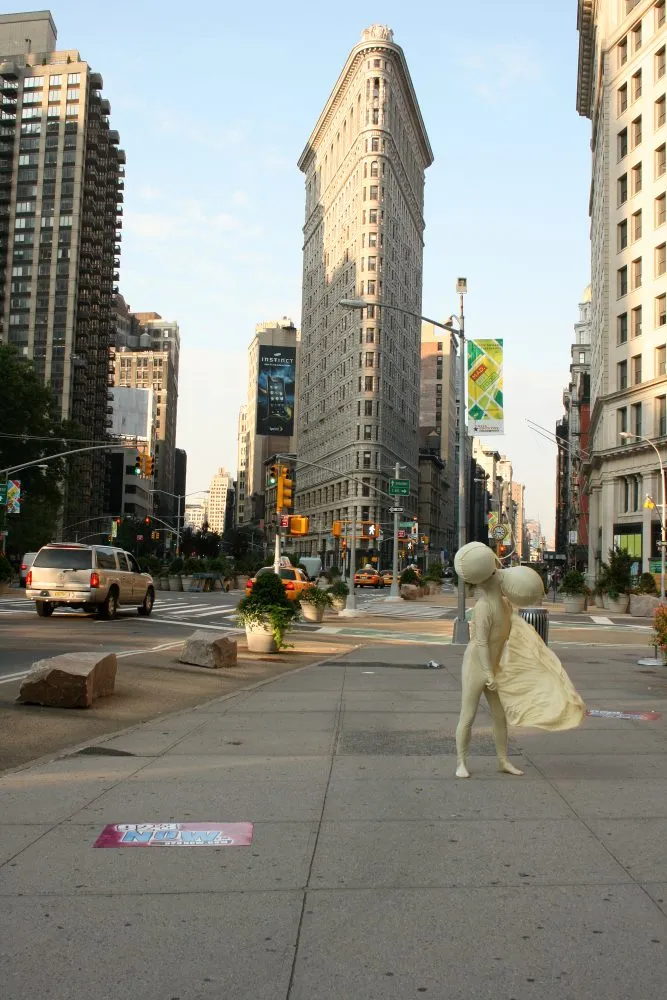
S.B.: Cairo probably not just yet, but I am indeed preparing an ice show — on skates.
K.C.: For years critics have seen what you do as combining the tradition of working with the body that emerged from Jerzy Grotowski’s theatrical experiments with the impulse — typical of Tadeusz Kantor’s stage idiom — to impose upon the actor a costume-prop that radically constrains them. Yet public awareness has been slow to recognise that a third source of your practice is Władysław Strzemiński’s concept of Unistic dance. Why do you think that is?
S.B.: Perhaps because Unistic dance appeared only as an appendix to Strzemiński’s late, post-war and still relatively little-known text The Functional City. As a kind of supplement to his urban-planning theses, Strzemiński describes there what he believed to be the simplest way of moving through public space, which he termed the “optimal vehicle”.
K.C.: It really is an extraordinary text…
S.B.: It is a shame that it is so little known. Every dancer, conductor and architect should know this work. Strzemiński continued revising it to the very end. Reading the whole manuscript is fascinating. What he crossed out is equally important. I would like to publish the complete text. Copyright is the problem.
K.C.: You eagerly seek out, read and use in your practice various texts that are often entirely forgotten or overlooked: Strzemiński’s aforementioned appendix to The Functional City, Grotowski’s seminar notes, or Kantor’s unstamped drawings. How does this relate to the costumes you construct?
S.B.: We both know what “apocrypha” means. I believe it means precisely “hidden”, and I simply like to hide — and from time to time to dazzle with something uncovered.
K.C.: Indeed, your fondness for hiding is evident to anyone who tries to arrange an interview with you. So you are a declared apocryphist, a costume apocryphist who keeps well away from the established canon. You said you would like to publish the fragments you have unearthed; I thought you would continue exhibiting them in costume editions…
S.B.: As I said, the rights to these works are a problem. Sometimes one reaches them in a not entirely, hm… canonical fashion, so I shall probably remain with costume editions. Believe me: it is not worth uncovering everything that is covered.
K.C.: Is it true that in the workshops you irregularly conduct as part of your Manic Dance Studio, senior managers and officers of the uniformed services pursue the boldest costume fantasies with the greatest enthusiasm?
S.B.: The part about the officers is not true…
K.C.: Am I right in thinking that Strzemiński’s particular physical condition as a dance theorist pushed you in the direction that led to your collaboration with Hanna Väätainen? Somehow I do not believe that you read her dissertation RUMBASTA RAMPAAN. Vammaisen naistanssijan ruumiillisuus pyörätuolin kilpatanssissa entirely by chance…
S.B.: It was partly chance. We met at a NOFOD congress, in 2004, I think. Then nuclear power helped…
K.C.: ?
S.B.: Hanna was conducting research near Turku, and Wizz Air had just begun flying there from Gdańsk to carry Polish construction workers employed on the nuclear power station. But it is true that reading Strzemiński prompted my interest in the therapeutic aspect of dance.
K.C.: It is rare for Poles to boast of securing a grant under the EU’s Seventh Framework Programme, and yet a seemingly exotic subject — Metropolitan Dance as a Strategy for Sustainable Non-Verbal Public Communication in Its Therapeutic and Symbolic Dimensions — proposed by a Polish-Finnish duo, found favour. Did you find the application process difficult?
S.B.: Had it not been for Turku’s white nights, I doubt we would have made it through.
K.C.: You worked on it until morning…
S.B.: For several weeks.
K.C.: To what extent have the therapeutic and gender dimensions so strongly present in Väätainen’s research influenced your practice? Does what the public will see at Atlas Sztuki also have therapeutic significance? Is art a therapy — for those who look, or those who create?
S.B.: A whole series of difficult questions. I do not know who comes to exhibitions at Atlas Sztuki, but there will always be someone who could use therapy. Watching repeatedly is of course not enough; one must decide to repeat the movements. We shall see. I am curious myself how it will work this time.
K.C.: Do your costumes have a gender?
S.B.: Sometimes, although I could not tell you which.
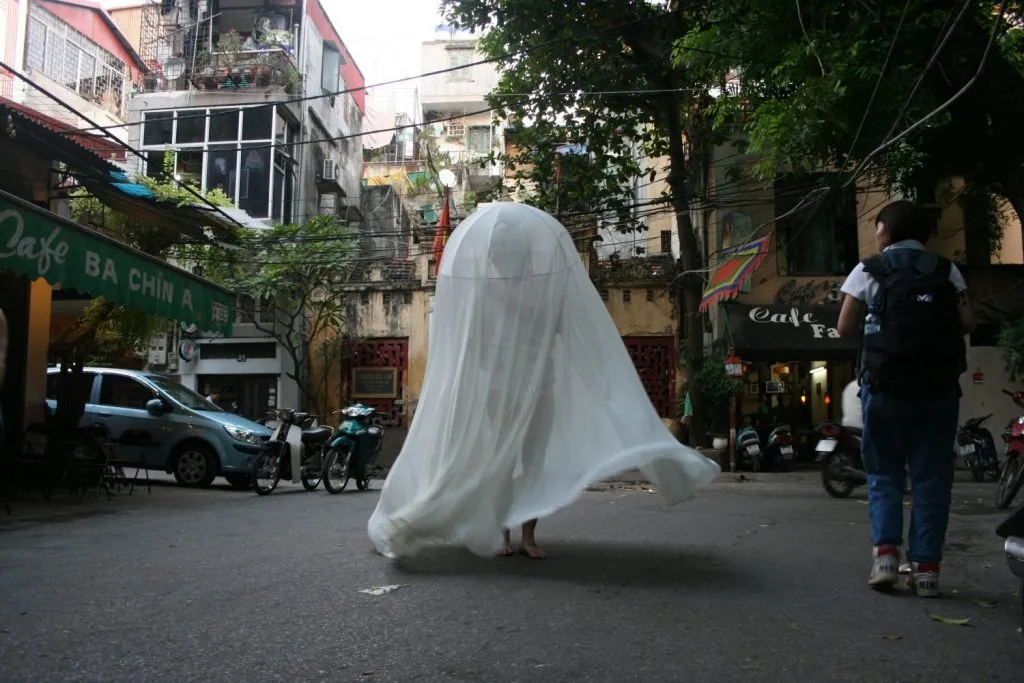
K.C.: History — art history, for example — is excellent for identity problems. Within a modern-minded history of Polish art, your actions, dominated by costumes that almost entirely conceal their protagonist, must be read à rebours against those of Jerzy Bereś, who scarcely went to excess with his costumes. This likewise led to the unavoidable display of gendered elements. As Piotr Piotrowski observed with remarkable accuracy: “[…] performing naked, Bereś touches as it were upon two spheres: political reality in the broad sense — though always the reality here, in Poland — and the problem of the artist, the artist entangled in history and responsible for the shape of reality, of the past and especially the future, the artist as bard. The national elements present in the artist’s actions (the colours of the national flag) eloquently attest to his involvement in the country’s history. Their connection with the artist’s prominent role […] invokes the Polish Romantic tradition. In the nineteenth century, when the country had lost its independence as a result of its territory being occupied by three neighbouring empires, it was the artist (often, though not exclusively, the poet) who conferred (or discovered) meaning in history. […] Bereś consciously invokes these grand narratives of Polish culture, drawing on their authority in a confrontation with the usurping power of the Communists. The artist’s naked body is therefore the vehicle of an authority confirmed not only by the metaphysical meaning of history, whose culmination is salvation, but also by the phallocentrism of European culture, evoked affirmatively rather than critically. The artist’s penis, marked with a red-and-white dot, becomes a phallus: a symbol of the authority of the creator, genius, bard and prophet, but also of the authority of culture. This, then, is the source of the strength and historical legitimacy of resistance to Communist power […].” Sławek, I have quoted this passage not to ask about your credentials, but to situate the costumes that conceal you within Polish art, with due respect for the appropriate methodological perspectives. In the distinctly inhospitable climate of totalitarian rule, Jerzy Bereś, hard as a bard, took his clothes off; despite global warming, you wrap yourself tightly in soft material. What does it mean?
S.B.: Hm…
K.C.: Professor Piotrowski drew attention to the “phallocentrism of European culture”, while I would point to your conspicuous display of what, using terminology from Boy-Żeleński that fits perfectly here, might be called the “willy” — and in an action undoubtedly set in the New World, on a New York street. Cosmopolitanism, perhaps? Do you consider yourself a Polish, or at least a European, dresser-up?
S.B.: Above all, I consider myself a Polish dresser-up! Although, unlike Bereś, I would not yet dot the i.
K.C.: If you are Polish, why do you travel across every continent? Is it the effect of tempting budget-airline offers?
S.B.: Let us call it belated Wanderjahre, or rather Tanzenjahre. I read that Łódź is now to be the centre of the world, so I decided to begin here and then spread across the entire globe. It is quite literally a global strategy. As for New York, every artist ought to be tempted by the New World…
K.C.: Every tourist too…
S.B.: I try to arrange my travels in circles, as Gurdjieff planned his. I have already been north, so now it is the south — Hanoi, Cairo. It is also about the wholeness of the human being and, at the same time, the most archaic circle dances around a fire.
K.C.: Let us return home. I hear you ultimately declined the post of director of the ice rink in Opole. Was the chief reason the city authorities’ rejection of your expansion plans, above all the addition of a fourteenth row to the stands and the necessary change of the venue’s name that this entailed?
S.B.: There were artistic differences as well. In this case I was interested in mass entertainment in a convivial, singalong style. The city favoured refined avant-garde spectacles with explicit sexual elements. We could not reach an understanding.
K.C.: Why do you now use only individual costumes? Is it simply a consequence of your consistent adherence to personalism?
S.B.: Let us say that it is easier to do something alone than with someone else — unless it is with a child… As for personalism, you are right. I am a personalist to the point of pain. After all, persona is nothing other than the Latin word used to translate the Greek term for the mask that conceals an actor.
K.C.: None of the artists — or tourists — remembers that any longer. Children are a rewarding subject. Recently, doing all sorts of things with children has become increasingly American, even in Europe. Or perhaps you yourself are secretly a child? Did you perform at school assemblies?
S.B.: Indeed, one recited one thing or another at school assemblies. And to return to children: nine-year-old Kuba danced in my film quite astonishingly — and in a rather European way.
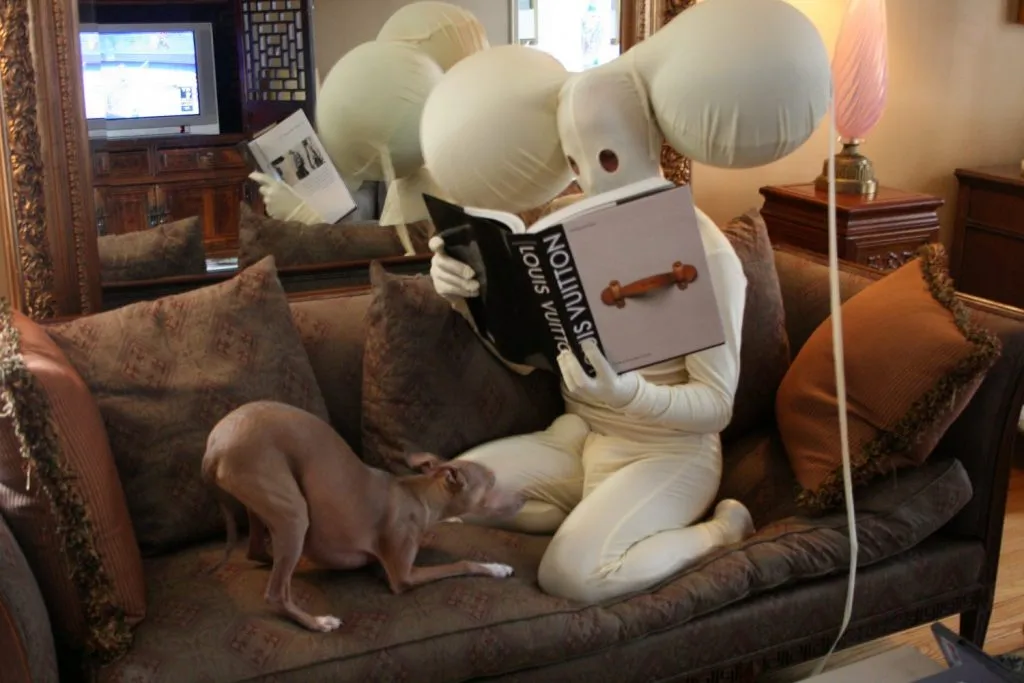
K.C.: One genuinely final question. In 1960, I believe, after what Grotowski recalled as the “splendid press campaign” mounted against his performances in the capital, he received a letter from Irena and Tadeusz Byrski: “[…] do not give up; they will laugh at you — when a person does something in earnest, others split their sides laughing.” Has anyone split yet?
S.B.: I have noticed a few cracks, but none of much consequence. Cracks appeared — and opened — in circles associated with the local advertising market.