
In Conversation with Ludwig Wilding
interviewed by Krzysztof Cichoń
Krzysztof Cichoń:Is this your first exhibition in Poland?
Ludwig Wilding: Yes, and I am very pleased about it. Art is more important than politics. This exhibition matters to me, also because of history. When speaking about politics, I always mention what people endured under the Nazis, and I care deeply that it should never happen again. My family opposed the Nazis, and as a young man I experienced a great deal, one might say. Art makes us aware that everything exists in relation to its surroundings. I think art can also help us to find good relationships, including those between neighbours.
K.C.: Can what you do be defined precisely and rationally, or will it always be somewhat intuitive by its very nature?
L.W.: Defining what I do is difficult. Op Art might be one point of departure, for example, although to me that is a very poor term.
K.C.: Why is it poor?
L.W.: Because the name itself narrows things down, restricting our reception to the optical, to what reaches us only through the eyes. In fact, it concerns what reaches our soul through, among other things, the eyes.
K.C.: The soul?
L.W.: Yes. It is more than optics; it is something that touches our inner being.
K.C.: In that case, we are dealing with Geist-art, a spiritual art.
L.W.: Yes, that is true. In my objects, in art objects (Kunstobjekte), one can perceive something deeper. Put differently, something that might be called universal principles of cognition (Erkenntnisprinzipien).
K.C.: Art referring to geometry or the physiology of vision is often situated on the boundary between art and science.
L.W.: What I do is visual art. Naturally, in a certain sense I am a scientist. I have always experimented. I have conducted many experiments involving optical illusions. Science is genuinely fascinating. There is a general belief that science and art go hand in hand, that they are connected. I agree. There is nothing in science that cannot be applied in art and vice versa—much from art can be transferred into science. Artists have made various discoveries that were later applied in science. So science and art certainly belong to one and the same structure.
And when an artist claims to have nothing to do with science or its development, that is simply untrue. It is sheer foolishness.
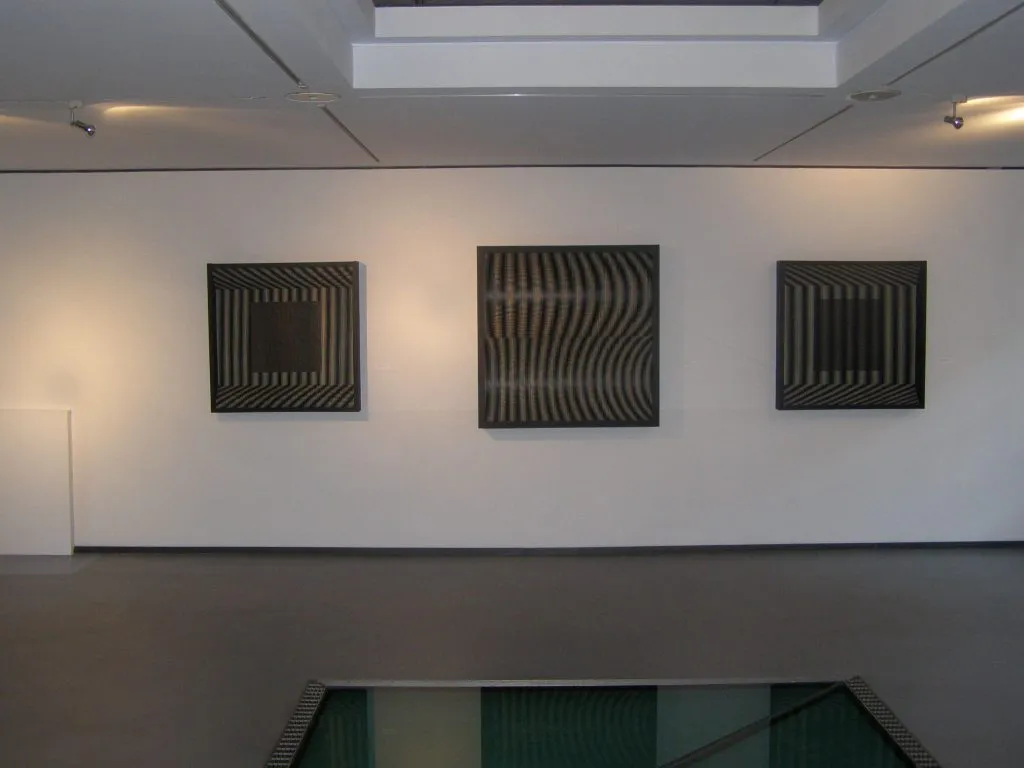
K.C.: So your activity also has a scientific character?
L.W.: Yes, of course. Above all, I am interested in visual phenomena.
L.W.: I simply feel that I can change objects, change the appearance of things. And visual phenomena make it possible to reach the human soul. Under the influence of such phenomena, which at first may shock or irritate, people become more sceptical. They begin to look at everything more closely. That is very important. It is an important ability in the political sense too. People begin to wonder what is illusion and what is space. My works are spatial works (Raumobjekte). After all, I myself am also in space—people are a kind of spatial object. Their lives unfold in space. That is why I try to transfer my point of view to the objects I create. That is why I experiment with them. In my view, we must assess every thing not according to a single criterion, but by taking into account all the criteria available to us.
K.C.: Were your first works spatial too?
L.W.: No, they were more conventional. I began constructing my first works relating to space in the 1960s. In my view, flat, two-dimensional perception or representation is a mistake. Two-dimensional seeing leads to two-dimensional, flat thinking, and that is a serious problem. My principal thesis is that we should not and cannot consider anything in only two dimensions; we should not flatten things that are spatial. This is also a problem of truth. There is a teapot standing between us now. From my point of view, its handle is on the right. From yours, it is on the left. Which of us is telling the truth? Who is right? Some will say that we both are—that the handle is both on the left and on the right. This is a simple example of the connection between the apparently specialist problem of seeing bodies in space and the question of truth…
K.C.: An approach that already appears among the Cubists.
L.W.: Yes, that is the classic beginning of spatial problems in twentieth-century art.
K.C.: What role does mathematics play in your work?
L.W.: I am a good mathematician. Even at school I calculated better than my mathematics teacher. And I always say that artists who proudly declare that they understand nothing about mathematics are not good artists. On the other hand, I personally know several artists who are convinced that saying they are good at mathematics automatically means they are good artists.
K.C.: You undoubtedly use Greek inventions such as the golden ratio in your work. Is the Pythagorean tradition, which regards number as the most important principle creating and ordering reality, important to your practice?
L.W.: You are asking about the golden ratio, the harmonic division, the divine proportion—the division of a line segment into two parts so that the ratio of the longer part to the shorter is the same as that of the whole segment to the longer part. I now have the golden ratio in my eye. I simply see, for example, that something is 1.5 to 2.8 to 7. As I have said, I had dealt with mathematics for a long time. Geometry, however, developed by itself; I had it in my eye, without calculations. Naturally, various calculations were needed when producing some objects, and then I returned to mathematics.
As for geometry, I think every artist has their own geometry, a simple geometry.
K.C.: Art that refers to geometry is surely not devoid of artistic expression. Can artistic expression (Kunstäusserung) be free of emotion? Do your works express emotions?
L.W.: Of course, and quite powerful ones. It is not a matter of everyone standing before a picture automatically understanding what it is about and reacting equally automatically. In my view, we can speak of true, profound emotions when a picture helps the viewer grasp and understand their own existence, their own situation. People often begin to laugh in front of some of my works. They stop, move closer, step back and finally begin to laugh. That is nothing other than emotion.
K.C.: You use a cheerful geometry.
L.W.: Yes, that is a good phrase. Geometry is not at all so abstract.
K.C.: I was going to ask whether all your works should be seen as successive experiments that ought not to be described in terms of a joke, but this has just become clear.
So let me ask about a theme that appears very frequently in Polish texts devoted to geometry-based art: the connection between geometry and the sacred. Have you encountered such an interpretation of your work?
L.W.: Indeed, in the past, when art was principally religious art, symmetry, for example, played a very important role. Gothic and Romanesque churches are palpably geometric. As for the sacred, it is connected in some way with truth, or rather with the search for truth. This is akin to art, because art has spiritual value and no material value.
K.C.: What, then, do you think of the ‘art market’, fairs, rankings and investment in ‘art’?
L.W.: I hate the capitalist approach to art. What matters in art cannot be measured. And not everything can be bought. That is out of the question. Even when an artist dies, their art continues to live; it lives its own life. A picture has spiritual value. That is precisely why, proceeding from this assumption, I began making replicas of my works. The originals cost a great deal, but anyone can buy a replica and hang it in their home. For that reason, when a new idea appears, it produces not one picture, one example, but an entire series. In this way one can also refine one’s own ideas.
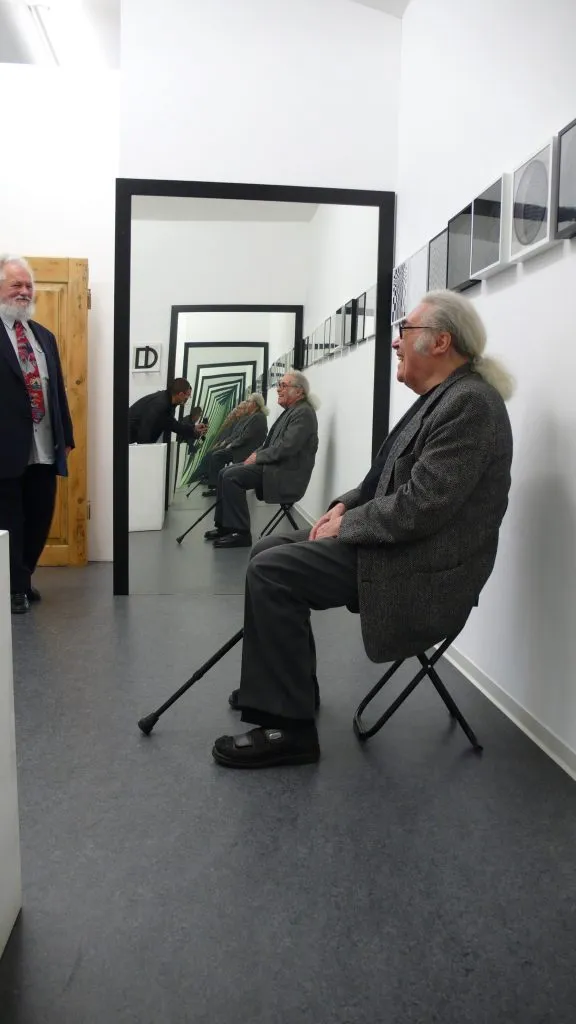
K.C.: How important are seriality and repetition—something that makes creation resemble the procedure of scientific research conducted according to the principle of induction in modern natural science?
L.W.: As I mentioned, I usually created a dozen or sometimes twenty pictures from a single idea. I made two objects, sold them, and then made another two. Here at home I have a small workshop in the basement, and this is where the works were made, one after another. In reality, practical considerations decided the matter. Large-scale production was in no way worthwhile. Once I made ten or twenty copies of each picture, and it was one great disaster—they were later sold at auction in Zurich.
K.C.: How long do you work on your pieces?
L.W.: I am a spontaneous person, but work on an object generally takes around fourteen days: sketching it and planning it. I also need various kinds of machines and a computer; I use everything that has been invented.
But above all I value spontaneity. When I create something new, when a new idea comes—I jump for joy.
K.C.: Does your art require commentary and explanation, or does the viewer understand it equally spontaneously without any commentary or explanation?
L.W.: People are usually astonished and surprised at first. But surprising people is also what my activity is about. Generally speaking, I am convinced that people who come to an exhibition to see my work understand what I want to convey. Above all, these pictures literally set people in motion. Optical illusions can, after all, be explained easily. And to be honest, rather than discussing art with people, I prefer to be surprised by their opinions and comments—and naturally to be praised. I am pleased when the viewer is satisfied.
K.C.: For many contemporary artists, at least in Poland, satisfying the viewer is synonymous with a compromise irreconcilable with art.
L.W.: But that is precisely what art is for! In reality, our time is one of constant movement. People today are forced into unceasing haste. And I create for people, remain constantly in motion and try to keep abreast of everything.
K.C.: With which artistic tradition do you feel connected?
L.W.: Constructivism, of course; Willi Baumeister, under whom I studied in Stuttgart; the Bauhaus, but also Kandinsky, Malevich and early Concrete Art, Max Bill and Josef Albers. Principally those concerned with problems of symmetry and relativity.
K.C.: Does that genuinely still influence your work?
L.W.: I always told my students that if they wanted to concern themselves with something specific, painting for example, they had to study the entire history of human development—in the philosophical, spiritual and historical senses. Only in this way can one find something for oneself, one’s direction in life. Naturally it is impossible to study the entire history of art’s development in such detail, including the art of Mexico, Egypt and so forth, but one can at least do so visually. I went to Egypt, Mexico and Japan and tried painting in different ways. When I had studied what were probably all the stages in art’s development, and slowly, after several decades, arrived at what was my own, I understood what I wanted to do in life.
Naturally, I once thought differently from the way I do today.
K.C.: Could the Bauhaus tradition be repeated today? Can we expect a similar experiment to take place in art once again?
L.W.: The Bauhaus and the Constructivists worked according to new principles, used new elements and pursued reduction until the proverbial ‘Black Square’ appeared. Everything had to be integrated, comprehensive and brought to synthesis. In my view, however, nothing can be reduced any further, because the contemporary world is already so complex and integrated.
Bauhaus art also began using geometry and new mathematics. But in my opinion this tendency too will soon come to an end. There is already too much of it. When people do the same thing over and over, it eventually resembles an exercise, and one simply feels surfeited. Every art has its end. As in my own case, which I mentioned: I went too far with the quantity of works and it ended at an auction in Zurich.
K.C.: Should an artist always work alone, individually?
L.W.: It is very important that we can create art together. Even when the greatest artists work individually, they cannot create what an entire group can. Scientists always work in teams, all together, and benefit from it. If artists worked together, they could create much more. When I taught at the Academy, I conducted an experiment with my students. Ten people sat at a table. They were given one sheet of paper and each person painted something on it in turn. There was something extraordinary on that sheet; everyone contributed to what emerged, and it was incredible. I called the experiment a ‘dialogue of souls’, ‘communicative relativity’. It was intended to prove that working in groups is very important, particularly for young people. Together one can do everything much better and create something great; there is strength in a group. Young people are much stronger when they are together, when they share ideas and create something jointly. We are made to live in community; only community has strength.
I am a member of the first free artists’ association [name]. At first the group had sixty members. After several years there were more than three hundred, and it continued to grow. Over ten years, Italians, Yugoslavs, French, Belgians and British artists joined. In my view there were no Poles in the group, though I do not know exactly. It was genuinely the first international European association bringing together real artists. It had common ideas and shared visions. That was of enormous significance. Artists had previously joined groups and founded associations, but these existed and functioned only locally, operating only within a given country. Our association was groundbreaking: it was the first international movement and international association to bring together people from different countries with different ideas. It was not an organisation, but a group of people who collaborated and, in order to reach any agreement, all discussed matters, spoke with one another at length, exchanged ideas and made joint decisions about exhibitions. The first such exhibition took place in what was then Yugoslavia, in Zagreb. It was that exhibition which gave rise to new tendencies in art. Later there were exhibitions in Paris, again in Zagreb and in Germany. Although each person made their own work, it was astonishing how closely connected they were. There was a strange bond, a kinship, between the artists. Everyone collaborated smoothly, although in fact they had not even known one another before.
It is interesting that ideas about art arose at the same time in different parts of the world. Those ideas were alive; one could feel a breath of freshness and life.
K.C.: It might seem that such works are ideally suited to enlargement to an architectural scale. Why is there so little architecture referring to Op Art or visual paradoxes?
L.W.: A good question. I conducted experiments of that kind. In my series of paradoxical bodies, I built a model of a paradoxical tower. Architecture has relative significance for me. There are several quite good architects today; they build museums. There are also many places where interesting buildings based on contemporary architects’ plans could be constructed, buildings with a specific function, such as an information centre. But there is almost no chance of that. One may have an idea, but one generally loses out to the client’s commissions. An artist does not have complete freedom.
K.C.: Are any of your works shown in public space—not in collections or museums, but in the street?
L.W.: Not as far as I know.
K.C.: Do you make your works personally, or commission their production, as artists associated with Op Art and Minimal Art did in order to emphasise that the trace of the hand has no significance and does not determine whether something is or is not art?
L.W.: These days I usually have assistants. The trace of the hand does not determine whether something is art. I experiment with every new idea until I am satisfied with the results. I then commission the works or their elements on the basis of plans. On the other hand, if by the trace of the hand we mean the complete spontaneity distinctive to human beings, the exercise of spontaneity that opposes mechanical repetition, then such gestures have value.
K.C.: Can your work help us reach what is called objective truth, external to and independent of us?
L.W.: No.
K.C.: ?
L.W.: Objective truth does not exist.
K.C.: Is what you do, then, merely aesthetic arbitrariness?
L.W.: Aesthetics is fairly superficial. Such an approach almost always ends in some kind of formalism, producing ‘beautiful’ furniture or pictures. What matters is structure, grasping the structure that surrounds us.
K.C.: What do you think of the concept of ornament? Are your works ornamental? Is geometrising art simultaneously ornamental?
L.W.: What matters is that ornament can be seen as perhaps the oldest example of thinking about and showing structure. And I am a structuralist.
K.C.: And what do you think about Adolf Loos’s famous statement from the beginning of the twentieth century: ornament is crime! Does that not make geometrising art at least an offence?
L.W.: Ornament cannot be reduced to tattooing. What determines the quality of an ornament, in my view, is time: its relationship to time. In that sense, our life is ornamental.
K.C.: It consists in repeating the same forms…
L.W.: …in time.
K.C.: Are your works not contemporary trompe-l’œil?
L.W.: Like Op Art, that term narrows the scope of certain phenomena and reduces everything to deceiving the eye. In some of my works, one can literally try to immerse oneself, to dive in.
K.C.: Is your art autonomous, separate from the rest of reality, so that seeking connections between your life experiences, reading and views makes no sense in your opinion?
L.W.: That is difficult to explain. My activity consisted in working with figures and paints. It is not a Bauhaus idea, but it originated there. My philosophy, my view of the world, is therefore that we must continually approach truth and all things in order to perceive them from different perspectives and points of view.
If we do not do this, we shall eventually find ourselves in a tunnel with no exit. As I have said, this also applies to the social sphere and to politics.
As for religion, in my view every religion proclaims that everyone is equal and important, regardless of whether they are poor or rich. The poor are simply weaker, and the rich do not care for them; that is the entire tragedy of the world.
K.C.: Have you never felt like making something completely different? Something resembling Pollock’s drip paintings, for example?
L.W.: But I was also a Tachist in the 1960s. My works were exhibited alongside those of Pollock, Wols and Mark Tobey.
K.C.: When did you last paint a horse, a nude or a still life?
L.W.: …Probably when I was a student…
K.C.: And when did you last paint a portrait of your wife?
L.W.(glancing at Frau Wilding): Hm… we did not know each other when I was a student. Probably never. I would have to do it in two dimensions, and flattening one’s own wife is not very interesting.
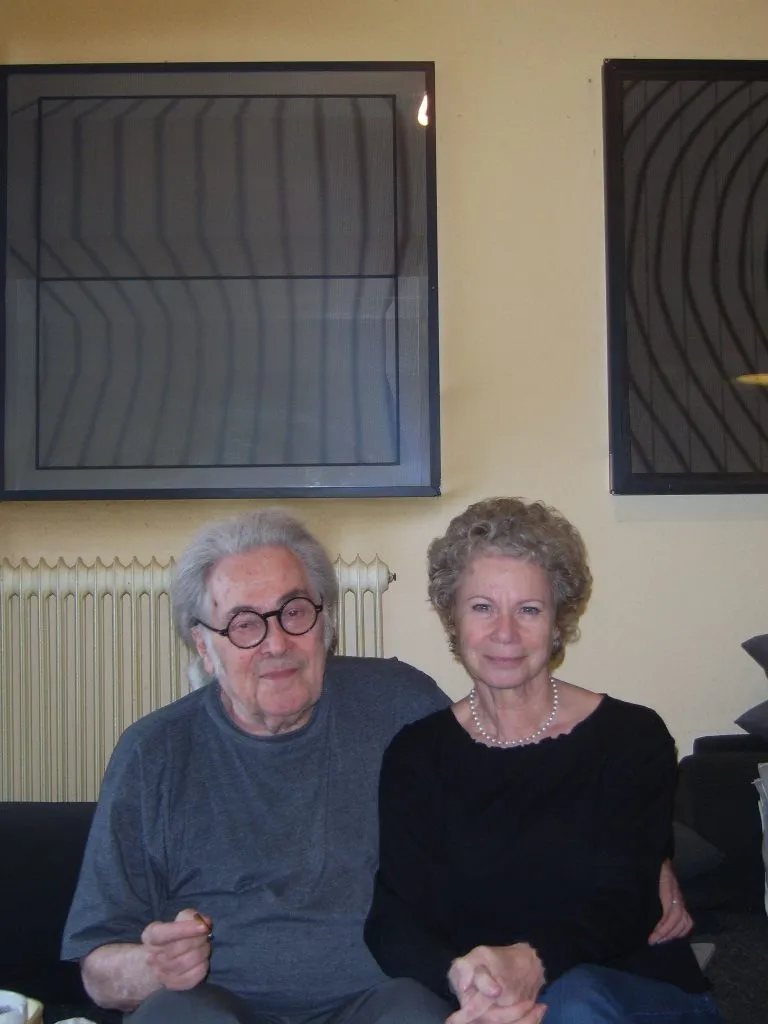
Buchholz, 28 March 2007