
Portraits of Air
Interview by Krzysztof Cichoń
Krzysztof Cichoń: Where did this work come from?
Elżbieta Janicka: From thin air and from what is stirring beneath the surface. From the daily bustle of the here and now. From journeys to Bełżec, Sobibór and elsewhere.
K. C.: When did you begin going there?
E. J.: Six years ago.
K. C.: Do you travel by car?
E. J.: No, by PKS buses and stopping trains, and partly on foot, because that produces a completely different experience of time and space—and an incomparably broader field of observation.
K. C.: I understand that you did not take photographs at first.
E. J.: No.
K. C.: On which visit did you begin photographing?
E. J.: During the third journey, after two years. By then I knew what I wanted to do. Earlier I had not photographed, conscious of the trap of convention. I could not imagine taking out a camera, looking through the lens, beginning to frame shots, searching for the most advantageous viewpoint and waiting for the best light—because what criteria would I actually have followed? The same as always? And what would it have been, anyway? Reportage? Landscape? Still life? So I assumed from the outset that I was not carrying out any task or making any work, and that I was especially giving art a complete rest. That is, you know, I did take some photographs. With a 35 mm camera. As a tourist. I photographed and did not photograph. Fairly randomly, all in all. I do not even know exactly what, because I made no prints and everything disappeared into a pile of negatives and contact sheets. I certainly remember a photograph of the station hut and the bizarre monument to the “victims of fascism” at Sobibór, which looks like a monument to the Polish Mother and which—I hope—will finally disappear in favour of something that makes more sense. What else? Some keys dug from the ground, armbands, fragments of crematorium ventilation systems and the obligatory railway tracks. From Treblinka I brought back a photographic herbarium—compiled very carefully and methodically.
Because, you see, a person sets out on a journey filled to the brim with images—for example, of the earth vomiting decomposing corpses. The camp at Bełżec stood on a rise, so the swollen, rotting, stinking flesh, dripping fluids, slid down the slope. That was how those pits overflowed. In short, the result was what one SS man described as “a terrible mess”. Yet even where a terrible order reigned instead of a terrible mess, the industrial processing of people marked with a six-pointed star into corpses continued, followed by a fierce struggle with the corpses thus produced. Pulling them from vehicles or chambers—with hands or hooks—chopping them apart, lifting, dragging and cramming them into pits, or burning them immediately. Crematoria that broke down and became blocked, their capacity always insufficient. Mills for grinding bones, which were not perfect either, because they did not quite grind them into complete dust and powder. Where bodies had been buried in the earth, they were dug up and extracted again after several months. Once more they were lifted and dragged—despite limbs and heads falling away—crammed onto pyres and burned in the so-called open air. The burned remains were ground.
And so a person arrives at the site, and what is there… There are herbs and flowers. Mushrooms, bilberries, blackberries, raspberries, wild strawberries, butterflies and birds, bees and crickets. Grass snakes basking lazily in the sun. Mists descending or rising. Balsamic aromas. A clear sky or a sky with clouds. The sun and moon, planets and stars. Green, green and green. These are beautiful, good, safe places—simply figures of paradise. And there is one message: “Nothing happened. Everything is fine.” Naturally, only until a splinter of human bone enters your body. I brought something like that back from the Rzuchowski Forest, that is, from Kulmhof am Ner—accidentally, in my sock. I brought it back, and then took it back—to the place.
In the shortest possible terms, you land in outer space. These truly are journeys into outer space.
K. C.: Why did you focus specifically on the air?
E. J.: Ash circulates in the air. We breathe this air. And what of the wind, clouds and rain? The ash is in the earth, rivers, meadows and forests—subjected to an uninterrupted recycling in which we participate without leaving where we live, when we buy yellow cheese from the dairy cooperative in Kosów Lacki at the local grocery shop, or honey from those areas, or tartare sauce from Wizna. Because animals graze there. In Treblinka, yellow triangular road signs depicting a cow stand beside the road. A sign with a cow beside the sign saying “Treblinka”.
We are confronted with the problem of non-burial and the impossibility of conducting a burial. This problem has both a symbolic and a physical—not to say physiological—dimension. There is no funeral without a sarcophagus, however understood—the Greek word “sarcophagus” means “flesh-eating”—whose function is to absorb the mortal remains and bring forth the spiritual image of the deceased. Put in the briefest terms, a funeral is a sarcophagus. Here a sarcophagus is out of the question, unless we are the sarcophagi—absorbing these remains from everywhere and in different ways.
K. C.: I wonder at what point you decided that it would be something entirely invisible. It could, after all, have been something more concrete—butterflies, for instance. This moment of sublimation is also a motif that recurs in high art. It is extraordinarily anaemic: it holds back, afraid to do anything recognisable or leave any trace.
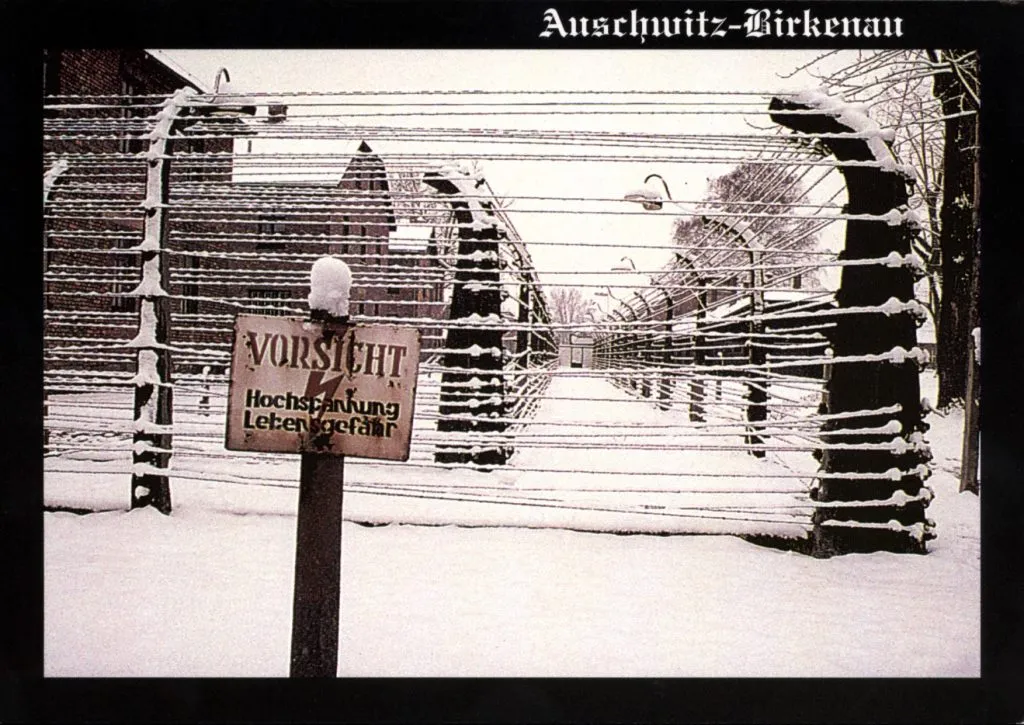
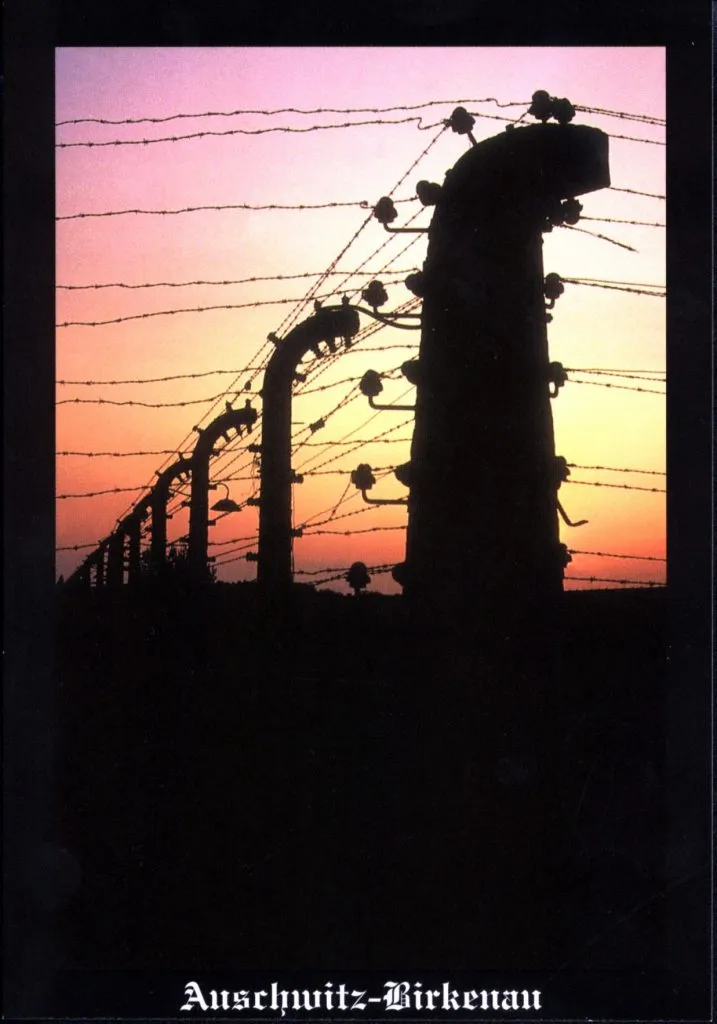
E. J.: Art consists in reflection: on the subject, on what, and—above all—on how. Alongside approaches that you have called “anaemic”, the field also has a tradition of profusion and excess, using realist and Surrealist figuration in the work of artists such as Marian, Segal and Kitaj. In photography, meanwhile, there is a tradition of depicting in the sentimental convention of “homeland photography”—a worn-out and dead tradition, but one persistently applied to the problem of the Holocaust. This tradition culminates in the “artistic” view from a death camp. Here you are. I have a whole collection of fetching little postcards in the poetics of “sweet, sweet Auschwitz” and “the charm of Birkenau”. Looking through this set, you begin to regret that you were not there during the season.
K. C.: Indeed. And how was it with your work? At some point, you have to decide on a particular shot: set the camera upright or lay it down.
E. J.: Or lie down with the camera.
K. C.: Yet you must have read about this approach somewhere between the texts about ash.
E. J.: It came over me, assailed me, when I was not thinking about it at all. And it came from looking, listening, smelling, breathing… and eating. Only later did I realise that texts about the Holocaust contain not only ash but also air full of ash—Jastrun, Sutzkever, Ficowski, Darowski, Grynberg and Celan all write of it.
K. C.: How did the moment of decision arrive—the moment of purification: only white and a frame bearing the word AGFA?
E. J.: I do not quite know how to put it, but visualisation was irrelevant to me at that point. Nor do I really see purification here. Analogue photography—which is what we are discussing—is materiality through and through. It consists in matter coming into contact with matter through the mediation of matter. Even when we are unable to recognise the subject represented, we are dealing with the representation of a subject. In this sense, abstract photography does not exist. Analogue photography is always a material trace. I knew—only this, but with complete certainty—that I was concerned not with the sky but with the air. Yet how does one photograph air itself? It occurred to me, however, that by leaving the shutter open for longer one could catch quite a lot of that air inside the camera, and it would somehow leave its imprint on the film. I wanted to obtain such an imprint. I did not give much thought to how it would look. My earlier photographic experiences helped me accept the visual result of this operation: investigating the elementary properties of photography, the possibilities and limitations created by its technical parameters. The autonomy of the medium has always fascinated me—the possibility of letting the medium run free, or almost free, because that is what photographing without looking through the lens and without a light meter amounts to.
K. C.: Without the captions beneath the photographs, the possibilities for interpreting them—an interpretation naturally distinct from the author’s intention—would be far broader, if not entirely open. We would look at this whiteness in a completely different way.
E. J.: The titles are almost ingrown into the image; they cannot be separated from it. And even if the captions beneath the images were absent, the viewer would retain a clue in the form of the manufacturer’s printing on the film, which is not an ornament here but a message—disturbing and arousing suspicion. AGFA inevitably calls to mind the period of its greatest prosperity, namely the Second World War. Propaganda companies and rank-and-file Wehrmacht soldiers worked with AGFA materials, as did members of the SS, photographers in German Nazi camps and prisons, the Deutsche Wochenschau, the professional Hugo Jaeger and the amateur photographer Walter Genewein. The images of the Holocaust that we have before our eyes, because they have become part of our surrounding iconosphere, are primarily AGFA. One need not be a specialist in the history of photography.
K. C.: And the sound in the dark and empty sound chamber?
E. J.: The sound chamber—and therefore sound altogether—was not part of the plan. It is difficult, however, not to hear these places. They are extraordinarily intense, acoustically “insistent”. The first recordings were working material. They were full of hiss and crackle and, moreover, interrupted by announcements of “take one, end of take one, take two…” and so forth.
K. C.: Sound with a frame?
E. J.: Yes, with a frame. And terribly “dirty”. So I hired professional equipment with an external microphone, solidly shielded from the wind, and made proper recordings. I then played both versions to friends, still not really knowing what it was meant to become. During one of these “listening sessions”, Zbigniew Dłubak said—more to himself than to me—that one could hear wires in that “dirty” sound recorded directly by the camera. He meant the hum of the battery, the hum of current in the cables—neither quite in the background nor quite in the foreground, intrusive and uninterrupted. To him, it was the sound from the quarantine section at Birkenau, where there was no silence even when silence reigned. That was when I chose the test recordings, “raw”—with the hiss, breathing and blows of wind.
K. C.: Where did the title of the whole come from? The “bench ghetto”, introduced by order of the Minister of Religious Denominations and Public Enlightenment, dates from 1937. The administration of the University of Warsaw then began “marking” students’ record books…
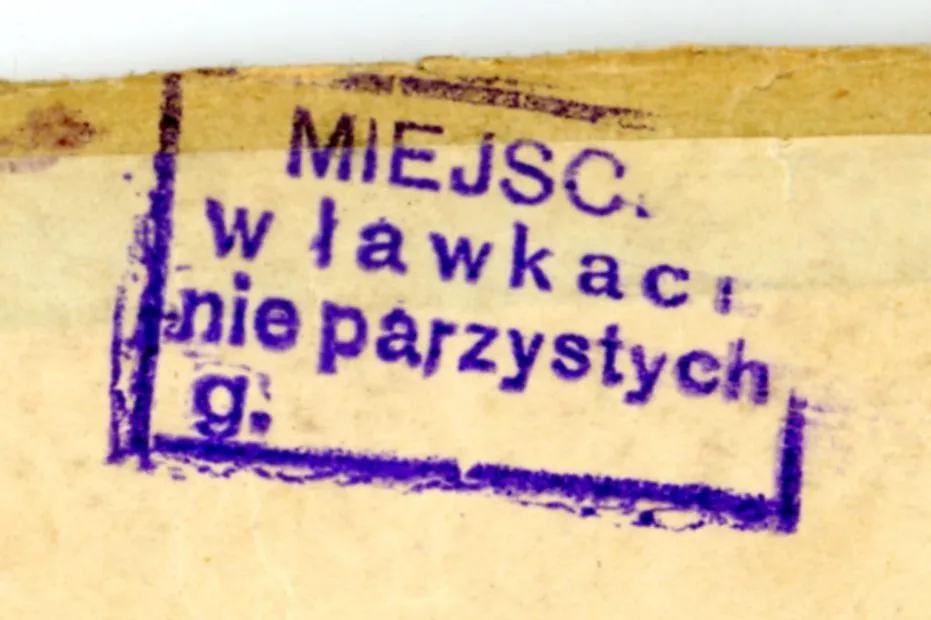
E. J.: A rectangular stamp. Purple ink. “Place in odd-numbered benches”, meaning “Jew”, meaning a construct-abstraction—homogeneous, unchanging, essentialist. “Do not buy from a Jew!” “Beat the Jew!” “For it is our disgrace and shame to be ruled by the false Jew.” The singular expresses the essence of the matter. The construct-abstraction reduces multiplicity to unity, difference to identity. It denies reality. It deprives of life—symbolically and, in “favourable” circumstances, literally. The “bench ghetto” was a success of the All-Polish Youth, consisting in harnessing the Polish state to another antisemitic practice while at the same time—as “Wszechpolak” and the Catholic-national-radical press wrote—being barely “a drop in the ocean of needs”. And because we know what happened before, during and afterwards, this small stamp gives us insight into the irresistible logic of the sequence: separation—stigmatisation—elimination—extermination.
A few days ago—we are speaking in June 2006—we heard praise for the “bench ghetto” from the heir of the pre-war All-Polish Youth, a member of a governing coalition party that decides education policy in Poland. To affirm antisemitism today is to endorse the mechanism that led to the Holocaust. It is difficult not to ask about a community that has produced such a governing elite. Is it a community with a past as “involuntary witnesses to the Holocaust”, or perhaps a community with a past as “participant observers”—in thought, word, deed and omission—a community from which relatively few people withdrew, actively or passively, thereby becoming a new minority in their own country, with all that this entails?
Joanna Tokarska-Bakir called the place assigned to Jews in culture—seen as “the Jew”—a “dangerous place”. Her observation concerned folk culture, but it can be applied to a substantial part of dominant European culture, including Polish culture. A “dangerous place” is a conditional, temporary place that may simply disappear at any moment—a place overlooking the “bench ghetto” and the ghetto tout court, the pogrom and the Holocaust. An “odd-numbered place” is precisely such a “dangerous place”. And on another journey, in a forest clearing at Sobibór, I realised that the “odd-numbered place” was right here—here, where wild strawberries grow; that this is precisely what it looks like.
K. C.: I would like to return to the resemblance between the aesthetics of emptiness—often attributed to works addressing the Holocaust—and the very mechanism of xenophobia, which is, after all, a mechanism of pushing out the stranger, getting rid of them, sending them somewhere far away (to Madagascar, for example), from where they will certainly never return. One aim is to seize the empty/free place left behind by those expelled. Is the psychologically understandable need to say and do as little as possible in works about the Holocaust—to say nothing, show nothing, remain silent before what seems incomprehensible and inhuman—not a kind of involuntary and rather ghastly repetition, a sanctioning of the effects of that original expulsion?
E. J.: Is the aesthetics of emptiness a repetition and sanctioning of the mechanism of exclusion? A repetition—yes. But a sanctioning? Rather, it is an attempt to express and make visible the ultimate consequences of exclusionary thought; an attempt to provoke shock, a form of appeal to the viewer, a sign of the impossibility of crossing over or taking another step, of paralysis, perhaps even a silent scream. Figurative or symbolic works—which frequently do not avoid a poetics of accumulation and excess—would be the same. These actions are ambiguous; you are right. Each is also subject to the objections Adorno formulated against Schoenberg’s A Survivor from Warsaw. This is probably a kind of structural trap that cannot be avoided.
K. C.: In this context, let me ask once again whether your photographs are empty or full of air. The question of vacuum contra plenitudo seems to me decisive in interpreting these works.
E. J.: Odd-Numbered Place is full. Full of air. Filled with presence. In this work I took as both my point of departure and reference something concrete, accessible to sensory experience. And here—unfortunately, yes—I agree with you. It is a journey to the end of the process of processing and disposal to which Jews as “the Jew” were subjected—a journey to the limit of the principle of exclusion. Except that this end is simultaneously a beginning, insofar as the work is about us, here and now. For while living amid Poland’s idyllic landscapes, it is difficult not to think about the idea of “purification” under the sign of Blut und Boden, which—through its implementation in practice—culminated in the cry: “O earth, cover not thou my blood, and let my cry have no place!” One also thinks of the idea of the Endlösung—the final solution whose result was a final binding together. Today we have the ashes of the excluded in the earth, water and air that were denied them during their lives. Sometimes I have the impression that the principle of this recycling, in which we participate and which we cannot interrupt, was foretold by the words Bad und Inhalation, written on the façade of the gas chamber at Bełżec—as though, in the long perspective, they were intended for those who would remain alive, on the spot. You know, I have lived here since birth, and every time I am newly astonished by the claim one so often hears in Poland A, B, C, D, E and F: whatever else one might say, we should erect a monument to Hitler for what he did to the Jews.
K. C.: Is art a good medium for remembering the Holocaust? Perhaps art is unsuited to it?
E. J.: The visual arts are as suited and unsuited to it as poetry and literature. The image was no less entangled in the Holocaust than language. The necessity and impossibility of expression are simultaneous and equally strong. In the winter of 1943, Jankiel Wiernik—a carpenter and Treblinka prisoner who built the gas chambers there—wrote, anticipating the insights of artists and philosophers: “No one could imagine, even in the boldest fantasy, a picture such as that which I saw and experienced. Nor could any pen describe it. I wish to present everything faithfully. Let people know. Let the whole world know what ‘Western culture’ is.” Every action and every omission is a cultural text. We relate to culture from within culture. This horizon cannot be crossed.
K. C.: Is not the historical-archival effort moving in the opposite direction nevertheless a better way to deal here and now with the memory of the Holocaust—to retrieve, excavate and assemble fragments, list names, places and dates, and fill this empty place with stories?
E. J.: That would be the spiritual image whose production, whose drawing forth from itself, is the sarcophagus’s task. To retrieve what can be retrieved and piece together what can be pieced together. I try to do this in my daily life too. Because it is better to be left with something—anything—than with nothing. Better late—too late—than never. Yes. This is a way, or rather an attempt, to deal here and now with the matter of the Holocaust. And it is precisely the matter of the Holocaust that I cannot deal with.