
Beyond the White Cube
Adolfo Montejo Navas
Regina Silveira’s Interventions
The intense relationship between art and architecture is nothing new. We need only recall how different media have been combined throughout history: in the context of Western history, for example, sculpture in Greek temples, Romanesque churches and Gothic cathedrals, or painting in the interiors of palaces and chapels.
Until around the fifteenth century, one could say that architecture and the other arts not only coexisted in a certain manner, but that the former even enjoyed a privileged position. Architecture was the purpose, the cause of the entire endeavour. This chimerical union of the arts became impossible around the nineteenth century, and over time every means of expression gained independence. Yet architecture’s connection with functionality — utilitarian spaces, dwellings and so forth — contradicts the proclaimed autonomy of the visual arts’ language. This is why contemporary artists attach such importance to activities connected with architecture and with spaces beyond the white cube, that visually pure environment mythologised by modernity.
Numerous twentieth-century artistic experiments, and specifically those of the 1960s, enabled the appropriation of spaces in which the exhibition is considered both place and work of art. The semantic fields of happenings, performance, environments and installations reveal these new dimensions, far removed from the whiteness and neutral ideology of classical rooms and the normative borders separating art from worldly reality, yet closer to our lives, communications, space and time. If the “eternity of display”, to quote Brian O’Doherty, proclaimed within the gallery or museum allows no such contamination and remains untouched in a kind of halfway world of temporary circumstance, most critical interventions pursued by contemporary art concern how we think about space and its relationships with power, how we establish a new exhibition topology and, on the basis of such deterritorialisation, plan less binary coordinates of space and time.
Collaboration in moving from an art of space towards a time-based art of becoming has recently become a frequent and inspiring practice, especially once we recognise that our environment has changed as profoundly as our modes of perception. A new regime of visuality has emerged.
Regina Silveira’s poetics belongs to this mutated context, since she is perhaps the artist who most frequently and decisively introduces such aesthetic questions into her work. “Outside art’s protected spaces lies its transformative power, which acts with doubled force whenever it provides reality with new sensations and is capable of turning a passive gaze into curiosity and an engaged attitude,” the artist says. This transformation encompasses the part of her work concerned with architectural spaces — interiors, exteriors and the threshold spaces between them, continually alternating as though they were different objects of inquiry. Across the decades in which her images became part of architectural structures of various kinds, we encounter works that already contain a spatial reading, above all Símile: Office 2 (1992), Apartamento ou Graphos (Apartment or Graphs, 1996) and Auditorium (2002). All present transformed designs of furniture that play with fractured two-dimensionality, creating images and, quite literally, vertiginous visions. Works such as Solombra (1990), Behind the Glass (1991), Vórtice (Vortex, 1994), Equinócio (Equinox, 2001) and Captura (Capture, 2001) emphasise such operations at the boundaries of interior and exterior space, resulting in passage-works. The interventions for Arte/Cidade (Art/City) in São Paulo similarly reinforce an interest in boundaries within urban space and the locus of the city, particularly Cor Cordis (2002), as do interactions with the surroundings through open-air projections such as Super-herói (Night and Day) (Superhero (Night and Day), 1997) and Transit (2001). The incorporation into the artwork of this contaminated flow of multiple contacts and records produced in the city made many of the aesthetic situations presented here possible. As the artist herself explains: “In recent years, certain works and interventions have interacted with architecture on an urban scale, with the city itself supporting their visualisation.” Most of these works are in fact spatio-temporal meditations in situ that simultaneously liberate the artwork from passive reception.
The move towards examining the other side of shadow — light — has become increasingly explicit in her recent production.
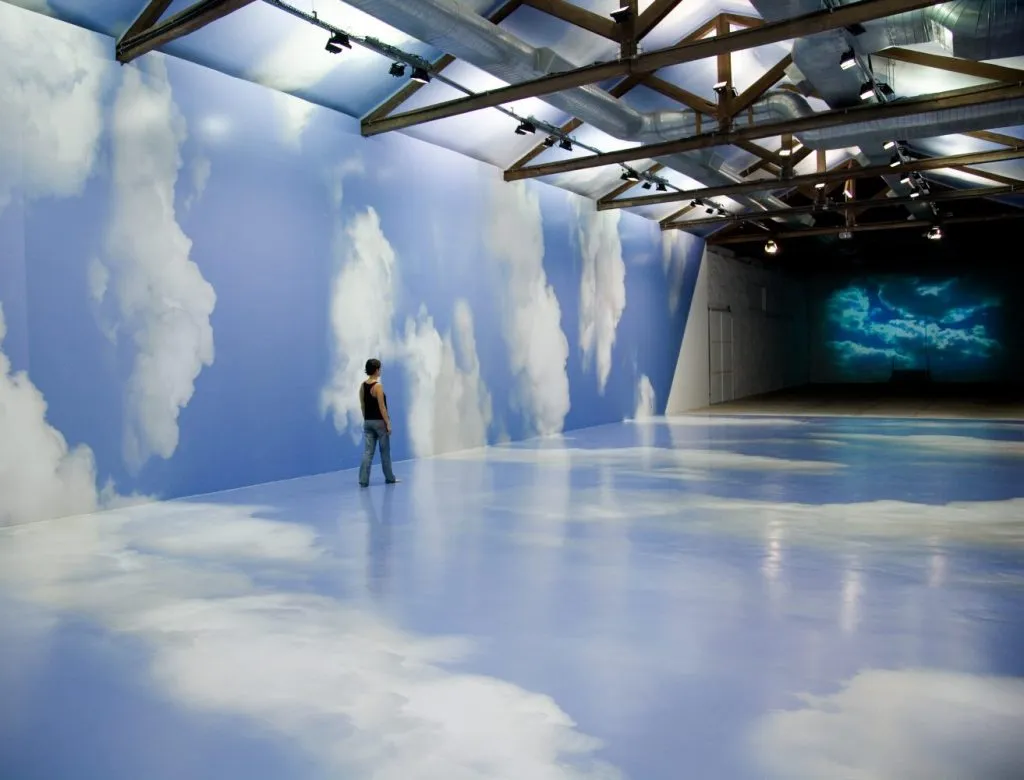
In this sense, her three major exhibitions form a trilogy: Claraluz (Clear Light) at CCBB in São Paulo in 2003; Lumen at the Palacio de Cristal/Museo Nacional Centro de Arte Reina Sofía in Madrid in 2005; and Ficções (Fictions) at Museu Vale do Rio Doce in Vila Velha in 2007. Light as event and structure produces effects of great density, regardless of its true nature or its source, whether existing or imagined. This trilogy combines an interest in the visual investigation of light — recording or inscribing it within spatial structures and joining the immaterial to powerful physicality in buildings with a strong presence — with the transformation of its architectural appearance into a situation, a new construction saturated with mystery or magic, using fragmentation and invasion as its operative strategy. There is always a cognitive illusion here, a search for a state of poiesis — invention — with a visual origin.
The artist appears to fulfil Vitruvius’s Renaissance requirement in De Architectura, Liber Primus that, in addition to other knowledge, one should “know how to read the stars and be familiar with the celestial system”. In recent years she has drawn a map of a visual cosmology within which we are placed as inhabitants, astonished by what we see. The growing presence of the sky, the celestial universe and light as a horizon — from Equinócio (2000) and Lunar (Lunar Landscape, 2002–2003) to the trilogy mentioned above — is not free of allegory, rich in meaning.
Regina Silveira’s poetics also develops a game of combining virtual visuality as fiction, at times immaterial, with spatial contexts of great materiality, producing simultaneously a sensation of lightness and a dense sensory vibration. This paradoxical reality resides within the very paradox of images and their continually unfolding effects, especially when a doubly ambiguous means of replicating reality creates explicit illusionism and, consequently, a visuality held in suspension.
On the other hand, the catalogue of her work from the past five years reflects an international body of activity — Mexico City, Houston, Bogotá, Lima and New Delhi — that exceeds the scope of this text. Nevertheless, this itinerary includes the intervention Derrapando (2004), a site-specific work at Centro Cultural de España in Montevideo, an invasive assemblage of tyre tracks across the building’s façade; Irruption Series (Saga) (2006) at the sixth Taipei Biennial, where extraordinary human footprints covered the ground outside the building; and Mundus Admirabilis (2007) at the Brazilian Centro Cultural Banco do Brasil, where Silveira created an architectural box from a nightmare — transparent and filled with enlarged images of insects. Nor should we forget the urban interventions likewise produced within an architectural context using moving visual projections. Perhaps Noor (2005), presented at the World Performing Arts Festival in Lahore, best embodies the essence of moving images: an image existing in time and changing like a chameleon wherever it appears. The artist projected the word “light”, written in Urdu calligraphy, onto popular sites across the city.
Within this challenge, all the artist’s interventions contain a partial deconstruction of space and a decontextualisation of its physical requirements, expressed in recurring aspects of her work. Whether she reads external spaces and architecture by analysing light sources, with a dazzling abundance of imagery and perceptual and poetic bewilderment, or strikes with selected images — insects, tyre tracks, footprints and so forth — that can strip a place of its established meaning, a measure of critical irony is always present. In every case, the broad range of visual simulations constitutes a poetic language, constructive and deconstructive, supported by an industry of visual technologies — masks, projections and digitisation — in order to produce captivating works and emancipatory visualisations.
The powerful presence of architecture in art, and especially in Regina Silveira’s work, symbolises an approaching fluidity between art and life, closer to the visual contamination in which we exist each day. It also represents the recovery of place as context — without earlier forms of decoration or wall ornament — in which a different aesthetic perspective can be achieved. It is also a spatial appropriation, a commitment to hybrid works whose linguistic modifications alter spatial signs. Such a reading of places undoubtedly emphasises the interconnection of each space’s requirements — whether architectural, environmental or sociopolitical — in order to reach another, complex aesthetic experience. It is not without reason that architecture as a medium is essentially impure: it admits looking, living and dwelling. In fact, all site-specific works and spatial interventions — so-called public art — are connected with the inhabitation of the world promoted by art on its path towards a new visuality.
Polish translation by Agata Mendrychowska
*Adolfo Montejo Navas is a poet, critic and independent curator. His books include Inscripciones (1999), Íntimo Infinito (2001), Pedras Pensadas (2002) and Na linha do horizonte (2003), as well as essays on contemporary art.