
Politics According to Art: Krzysztof Wodiczko’s Guests
Adam Mazur
Several months after the opening at the Polonia Pavilion in Venice’s Giardini, we can now say with certainty that Krzysztof Wodiczko’s Guests was received rather coolly by critics, and with a certain reserve.
Admittedly, several reviews—or rather, commentaries—appeared in the Polish press, gliding swiftly and effortlessly past the exhibition, as it were, in order to address the more media-friendly projects presented in the national pavilions at the Venice International Art Biennale1. There was no storm and thus no thunder, but there was also no deeper reflection on what the Polish pavilion actually was. On the one hand, the critics’ conspicuous indifference towards Guests is unsurprising. Despite the fairly numerous exhibitions and projections organised for him in Poland after 1989, Wodiczko seems out of place within Polish art discourse. For example, in the discussion of “art and the left” conducted in Kresy under Piotr Kosiewski’s editorial direction, the name of Wodiczko—a left-wing artist par excellence—does not appear once. In his text Gallery Scum Must Be “Trendy”…, Janek Sowa points to a fundamental lack of empathy in thinking about engaged art—an empathy which, in Sowa’s view, is the distinguishing feature of every leftist2. The author cites the negative examples of Artur Żmijewski (“the first cynic of Polish art”, alias “Doctor Mengele”) and Wilhelm Sasnal (“gallery scum”), but fails to offer the almost self-evident positive example of Krzysztof Wodiczko, a politically engaged artist apparently possessed of precisely such left-wing empathy. Similarly, the 2007 manifesto The Applied Social Arts names numerous artists, critics, politicians and even popular Hollywood actors (Jeremy Irons, for example), yet makes no mention of Krzysztof Wodiczko3. Similar examples could be multiplied. Several years ago, Piotr Piotrowski already observed that: “[…] when exhibitions appear by artists whose intellectual stature and artistic merit are hardly questioned by anyone—for example, Krzysztof Wodiczko’s exhibitions and presentations—journalists who concern themselves with observing artistic culture limit themselves to news briefs, ignoring the need for substantive analysis. Has any leading light of the local art press analysed the work by Wodiczko, shown twice in Warsaw, that revealed Polish racism through statements by refugees and migrants from the so-called Third World living in Poland? Has any of them analysed another, slightly later project by Wodiczko, shown in Kraków, which concerned domestic violence—undoubtedly one of the most serious problems in our social life? These are, unfortunately, rhetorical questions, revealing how art criticism, including that of Poland’s largest mass-media outlets, newspapers and electronic media, is utterly unprepared to conduct this kind of discussion and in fact confines itself to rather naïve deliberations over whether critical art is art or journalism.”4
In this context, the critical reception of Guests in the Polish media did not depart from the norm. On the other hand, one might have expected “some” discussion. Time passes, criticism develops and becomes more sophisticated, while Krzysztof Wodiczko’s work forms part of the intensely debated current of critical, socially engaged—even overtly political—art. In the recent past, exhibitions in this spirit at the Polish pavilion—Katarzyna Kozyra’s Bathhouse (1999) and Artur Żmijewski’s Repetition (2005)—provoked exceptionally animated debate, yet there has been silence about Wodiczko. The question is why.
At first glance, comparing Krzysztof Wodiczko’s work with artists a whole generation younger, who created “their” pavilions several years earlier, may seem provocative. If we adhere to chronology, it should be noted that Wodiczko (b. 1943) was already working as a fully formed artist when Żmijewski (b. 1966) and Kozyra (b. 1963) were still at primary school. In this sense he is closer to Grzegorz Kowalski (b. 1942), a professor at the Academy of Fine Arts in Warsaw and the teacher of the creators of Repetition and Bathhouse. If reviewers found Wodiczko’s exhibition Guests too “polished”, “theatrical”, “politically correct” and “aestheticised”, this was due in part to the inevitable comparison with earlier projects by critical artists. According to this logic, the Polish pavilion should present ever more forceful and improper works, advancing the avant-garde paradigm of always being “ahead”. Fortunately, Wodiczko eludes such a conception of art history. Treating the creator of Guests as though he were an excessively proper, late-arriving student of Kowalnia is a serious misunderstanding. Wodiczko is, rather, an independent master who, in his works, texts and seminars over at least the past two decades, has proposed a formula for socially applied art completely different from that of Artur Żmijewski and artists from the Kowalnia circle. Yet reversing the perspective and looking at Krzysztof Wodiczko’s Guests through the prism of the pavilions by Katarzyna Kozyra and, above all, Artur Żmijewski appears to have a deeper cognitive value. This particular approach will allow us to understand the significance of Wodiczko’s artistic proposition more fully and to locate him on the map of the current debate in contemporary Polish art about forms of politicality and social engagement.
Kozyra’s Bathhouse, Żmijewski’s Repetition and Wodiczko’s Guests are linked not only by their belonging to the critical current, but also by their use of film. While Kozyra’s and Żmijewski’s projects aroused outrage and consternation through a panoptic voyeurism that radically transgressed the boundary of the visible, Wodiczko moves in the opposite direction. Instead of cameras hidden in a bathhouse or prison, the creator of Guests prefers to conceal his protagonists behind mist—or, as some would have it, behind milky or steamed-up glass. He does so to provide them with protection and a sense of security. In this way the Others, as though “sheltered behind the artist”, have an opportunity to speak freely.
From objects exposed to scrutiny and exploitation, they once again become—during the exhibition—subjects capable of articulating their condition. On the one hand, Guests differs formally from the artist’s earlier works (with the exception of the exhibition If You See Something…, Lelong Gallery, New York, 2005); on the other, at the conceptual level, the latest exhibition can be compared with Alien Staff (1992), Porte-parole (1993), Dis-Armor (1998) and the numerous public projections Wodiczko has created over the past quarter-century. In each of these projects, the artist used specially designed tools to allow others to speak—and thereby to make their presence felt—in public space. In Guests, the public space that interested Wodiczko for years has been narrowed to the four walls of the gallery’s white cube. The exhibition inside the pavilion becomes an amplifier, a symbolic instrument transmitting knowledge about the condition of migrants: people who are excluded and subsist on the margins of public life. The critical edge of this exhibition-as-instrument is directed at the cultural elite—privileged in terms of social status, but also in terms of the position it usually occupies within the gallery. This is a fairly significant difference, because the addressee of the earlier public projects was not so much the circle of experts and regulars surrounding art, but a mass audience, often a chance passer-by. In the project shown at the Venice Biennale and at Atlas Sztuki, paradoxically, “we” are the guests and “they” are the hosts.
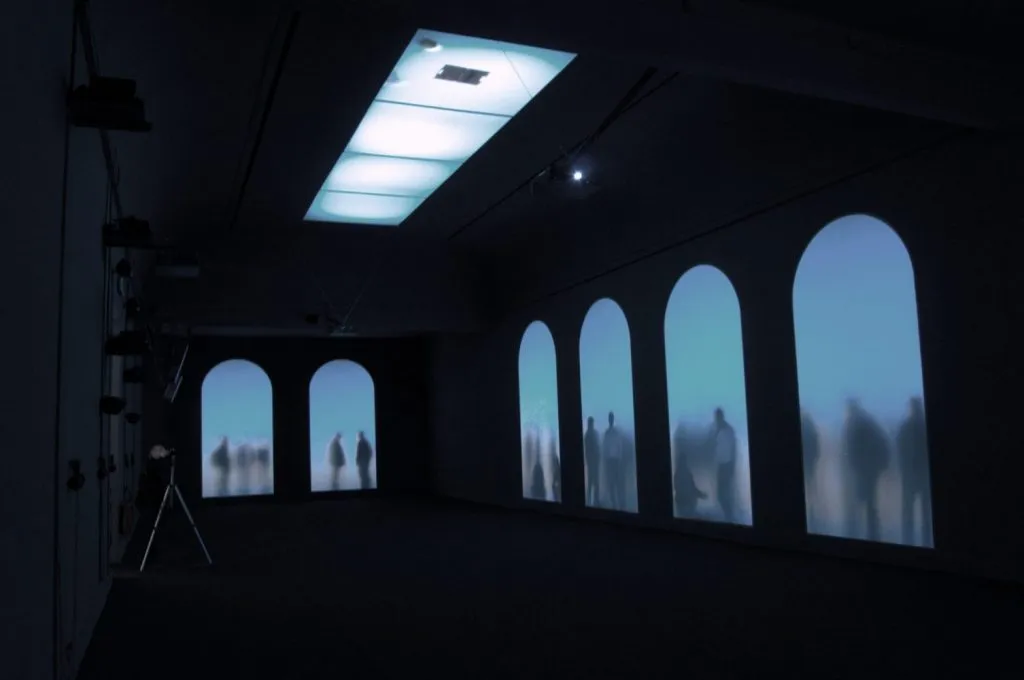
The anonymity and invisibility of the Others is irritating, but in a different way from the anti-humanist art of Kozyra and Żmijewski, anti-humanist in the sense that the people shown in their films are objectified. Wodiczko is a socially engaged artist, but he is not interested in existence at the level of the body, in its biological, animal dimension (Greek: zoē). Krzysztof Wodiczko’s proposition for politically and socially engaged art consists precisely in transcending this level and consistently politicising bare life, as Giorgio Agamben would put it5. Wodiczko uses—even abuses—his position as an artist to appeal to the excluded. He appeals to them to give voice to their lives and thereby, in a performative speech act, to establish their own subjectivity. The confessional nature of these stories does not alter the fact that the words acquire symbolic meaning: they concern the “good life” (Greek: bios), life within a community, and the political, cultural and economic problems connected with that life. Gallery visitors may feel discomfort at being addressed by people who customarily have no voice, people whom we see at work but do not hear and do not want to hear (“they are supposed to work, not talk”). By placing the projection in a hushed interior, Guests emphasises the power of the word becoming a voice even more strongly than the public projections or Alien Staff did. For the first time, the voice of the Others is heard in the Polish pavilion in Venice. Vietnamese, Chechens and Ukrainians annex Polonia, for better or worse, while the critical silence that “answers” their voice is, in this context, as meaningful as it is embarrassing.
Krzysztof Wodiczko not only hides the Others behind milky glass, but also gives these people an exhibition understood as a symbolic tool with which to fight for their rights—for the right to be seen and heard by the elite. Both Bathhouse and Repetition, meanwhile, were exhibitions showing a process by which individuals were stripped of the rights due to them. Kozyra’s filming of bodies in a Budapest bathhouse with a hidden camera, or Żmijewski’s reduction of unemployed people to prisoners and guards identified by numbers, demonstrated how far the artist—in this case almost synonymous with Agamben’s sovereign—could go in exposing the “bare life” of others. The assertion of the artist’s power over others was certainly political and made it possible to see, almost literally, how the mechanisms of power operate. Rather than exercising his power over others, Wodiczko prefers to share it and allow disadvantaged, marginalised groups to make use of it. One might therefore venture the conclusion that the critical force of Katarzyna Kozyra’s Bathhouse and Artur Żmijewski’s Repetition is comparable to that possessed by Krzysztof Wodiczko’s Guests, with the difference that the vector of Guests points in a completely different direction. If critical art from the Kowalnia circle exposed strands that were, in the Nietzschean sense, all too human, Wodiczko always remained an incorrigible humanist in his work—an Enlightenment idealist, even. If Kozyra and Żmijewski caused consternation by placing the viewer in the position of witness and, in a sense, accomplice to an artistic action treated as a kind of process of dehumanisation and objectification, Wodiczko likewise places the viewer “regarding the pain of others” (to invoke the title of Susan Sontag’s essay6), but at the same time does everything possible to make us recognise that suffering as our own, and to see in the situation of the Others a connection with our own condition and, more broadly, the human condition. The ambivalent responses to Guests—particularly the distance from political correctness emphasised in press reports—are all the more symptomatic because Wodiczko’s idea for the exhibition had already emerged in 2002 and was to concern the situation of undocumented Polish workers in Italy. Wodiczko’s pavilion project lost, however, to Stanisław Dróżdż’s winning Alea Iacta Est. Perhaps critics would have found a project about Polish migrants more interesting: they could have written about the injustice and difficult fate suffered by their compatriots abroad. In the meantime, however, Wodiczko made a significant shift: for him, Poland is now not so much a country of emigration as one of immigration. It still seems incredible that the Others might regard Poland as a promised land, a country in which dreams of peace, prosperity and the “good life” can be fulfilled. Today, “our migrants” regard Poland as Poles hungry for freedom, peace and prosperity once regarded the mythical West. Now that accession to the European Union and the Schengen Area allows Poles to travel freely and take up legal employment in almost the entire EU, memories of the humiliations associated with the status of undocumented workers, unwanted arrivals and, finally, “inferior people” have quickly and easily faded. As the statements collected by Wodiczko and made available in the Polonia Pavilion reveal, the experiences of Poles—which one might have thought had shaped the consciousness of successive generations—have not translated into the way refugees and foreigners are treated7. At the same time, this perspective clearly shows how Wodiczko “universalises” Guests, whose stories concern the condition of migrants in Poland as much as the state of affluent Western societies. This wholly new perspective should be taken into consideration in future reflections on Wodiczko’s work and Polish art in general.
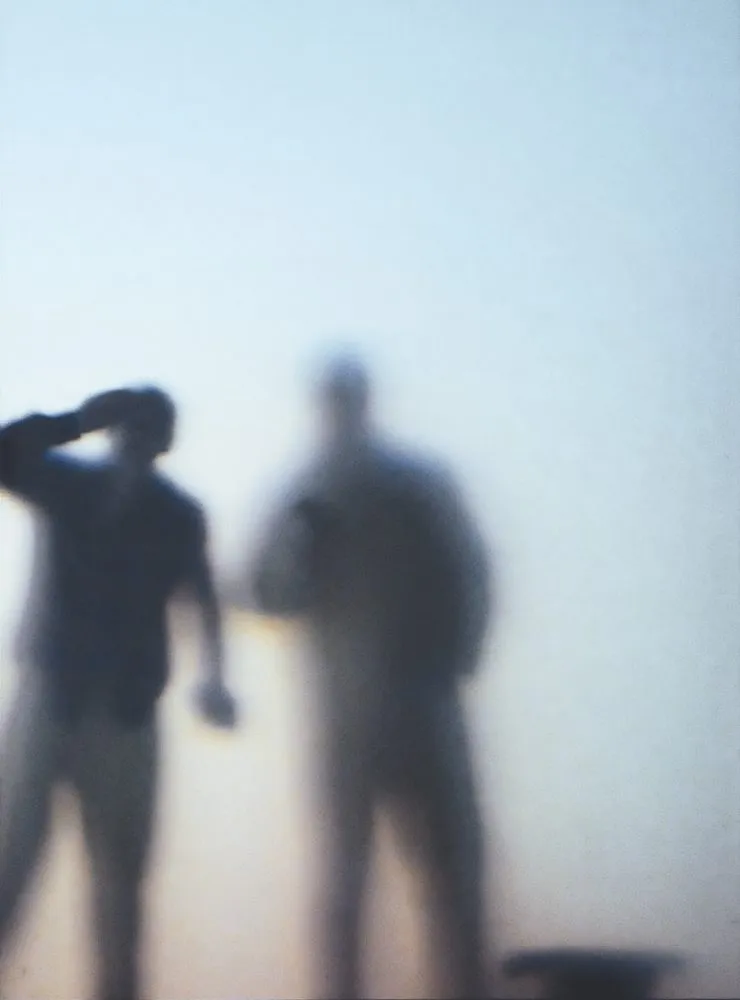
The political, but also ethical, demand for a “good life” expressed in the statements of the “guests” invited by Wodiczko—in contrast to the “bare life” that once interested Kozyra and Żmijewski—is accompanied by a beautiful visual setting, which consequently causes consternation and attracts critical attention. While visiting Wodiczko’s exhibition, it is difficult to resist the work’s formal appeal and its compositional and technical perfection. Aesthetics in engaged art arouses the suspicions of critics (particularly those on the left), who suspect a formalist deviation. Although examples could be given of even more highly aestheticised works by engaged artists, there is no doubt that beauty in Krzysztof Wodiczko’s Guests is both significant and problematic, as opaque as the mist from which the guests emerge. If the “excessively politically correct” content repels, the projection’s visual form fascinates and seduces critics, who would prefer to remain on the aesthetic surface: to look rather than listen. But that is impossible. Wodiczko makes perfect use of the tension between form and content to construct an ambivalent work. The artist plays on the viewer’s emotions and draws on a whole range of associations familiar not only from the history of art. The exhibition prompts numerous comparisons, from Plato’s cave to a church filled with apparitions. Wodiczko is a master at creating “powerful images”. His ethically oriented art is simultaneously a strong aesthetic proposition, considered in every detail. In this sense the creator of Guests does not need to explain to anyone—as happened, for example, with the intercut images of Ingres and Rembrandt in Bathhouse—that what he is doing is art. However banal it may sound, visual means serve every artist to a greater or lesser degree, including the engaged artist. Unlike Żmijewski and Kozyra in their “anaesthetic” art, Wodiczko demonstrates that aesthetics can be used to articulate strictly political content8. It is worth noting that this “aesthetic approach” is a novum in Wodiczko’s own practice: although his earlier works were superbly designed and technically refined in every detail, formally they were nevertheless much more austere, Constructivist and sharp in their minimalist functionalism. In other words, they lacked all the visually pleasing softness provided by the “steamed-up glass”. Wodiczko seems to be testing how effective a theatrically striking form can prove, even though it remains fairly restrained in comparison with, for example, Isaac Julien’s equally political films9. In any event, Guests is no longer the naturalism of Kozyra’s Bathhouse or the television-documentary style of Żmijewski’s films, which constitute a particular norm for thinking about the aesthetics of critical art in Poland10. Set against the rough prose of Żmijewski’s films, Wodiczko’s video installation is quite poetic and highly metaphorical. This may explain the difficulty Polish critics have had in responding directly to Guests: having assimilated Michel Foucault’s writings in the 1990s, they are now, slowly, doing their homework on Jacques Rancière. If Żmijewski’s films can be regarded as thoroughly metonymic (political reality in Democracies is represented by footage recorded during street demonstrations), then Wodiczko—as already noted—uses metaphor (the very title Guests says a great deal). When Żmijewski holds workshops, he wants to bring people into collision and sharpen the conflict between them. Wodiczko, meanwhile, invites his guests to confess, almost to undergo therapy; he wants to alleviate suffering and heal the symbolic wounds of individuals and the community. If Żmijewski practises, to paraphrase the title of one of Piotr Piotrowski’s books, “art according to politics” (agonistic politics, we should add), Wodiczko proposes something entirely different: that at long last we begin to understand politics according to art. In other words, rather than going to war with conservative society and its political representatives, Wodiczko asks us to examine the situation of the Others attentively, to listen to their voices and, through art, to develop a sensitivity to the suffering of others11. With this “soft” approach to reality, Wodiczko himself appears as a “guest”, a “stranger” in Polish art. Wodiczko’s art unfolds over time and matures with the viewer; its purpose is to sensitise and to heal rather than to traumatise (another association prompted by the Polonia Pavilion is the psychoanalyst’s consulting room). In the misty, hushed gallery space, conducive to concentration, one can reflect on a change in Wodiczko’s work—or rather in his attitude and stance. He is becoming less and less an artist-politician (as he still declared himself to be in connection with Public Art at the Ujazdowski Castle Centre for Contemporary Art in the mid-1990s12) and increasingly a kind of therapist, attuned to reality and caring for the community. This new calm appears to be accompanied by even greater self-confidence and an awareness that work towards change must be continuous, but that change through art does not simply arrive through the design of one device or another. Wodiczko’s statements at the press conference, in interviews and in the catalogue texts accompanying Guests, in which the artist distances himself from the role of politician, also contrast with the effectiveness demanded of artistic action in Żmijewski’s The Applied Social Arts. The influence of Wodiczko’s art on social reality certainly cannot be described by means of an algorithm. Guests lies beyond both consensus and antagonism, the two concepts that frame today’s debate on politics and art. Wodiczko subtly crosses the divisions carved out by critical artists in the 1990s and demolishes established patterns of thought, but at the same time pays the high price of remaining “outside” the current debate. Perhaps Irit Rogoff’s category of “criticality” would help us recognise and bring Wodiczko’s proposition into discourse, rather than continuing, as researchers have done until now, to cling to a Foucauldian key supplemented with passages from the agonistic theories of Chantal Mouffe and Ernesto Laclau13.
A visit to the gallery in which Guests is shown resembles a visit to a church. Polonia has something of an empty cathedral about it, something drawn partly from Franz Kafka’s prose and partly from Alain Badiou’s philosophy. An abandoned church filled with shadows is only apparently an inappropriate metaphor, troublesome because of its gravity. Ever since his first projections on monuments laden with meaning, the artist appears to have had no difficulty with this play of associations. Wodiczko transforms the gallery space (the temple of art) into a place where the spectacle of exclusion unfolds before the eyes of viewers (the faithful). The guests are like the damned wandering through this artistic purgatory, denied the grace of the “good life”. They remain in the pitiable position of those excluded from the “universal church” (although in the case of the Polonia Pavilion, “universal” may not be quite the right word; perhaps “national church” would be more apt).
On the other hand, viewers are also placed in a rather awkward, uncomfortable position. It recalls Dante being led through the circles of hell by Virgil. We rebound from the pane of glass that limits us and our view; we cannot see clearly. The guests speak to us almost in whispers and do not impose their story upon us. To hear them requires concentration; to understand them, a little empathy.
*Adam Mazur, PhD, critic, art historian and American studies scholar; lecturer at the Warsaw School of Social Psychology. Curator at the Ujazdowski Castle Centre for Contemporary Art. Editor of Obieg magazine (https://obieg.pl).
1. See S. Szabłowski in Dziennik; K. Boratyn, Unwanted Guests, in Arteon 7/2009, pp. 12–13; A. Mituś, Art Olympics under the Banner of “Making Worlds”, in Obieg, http://archiwum-obieg.u-jazdowski.pl/wydarzenie/12931#1; G. Borkowski, Venice Is Not Dead—Revitalising Modernism, in Obieg, http://archiwum-obieg.u-jazdowski.pl/wydarzenie/12931; D. Jarecka, Our World Is Too White, in Gazeta Wyborcza, http://wyborcza.pl/2029020,75475,6666124.html, accessed 1 July 2009; M. Lisok, Venice Biennale: The Disoriented and the Botanists, in Dwutygodnik 11/2009, https://www.dwutygodnik.com/artykul/398-biennale-w-wenecji-zdezorientowani-i-botanicy.html
2. J. Sowa, Gallery Scum Must Be “Trendy”…, in Kresy 1–2 (77–78)/2009, p. 181.
3. A. Żmijewski, The Applied Social Arts, in Krytyka Polityczna 11–12/2007, pp. 14–24.
4. P. Piotrowski, The Sarmatian’s Sabre and Historical Memory, in Art According to Politics: From “Melancholy” to “Passion”, Kraków 2007, p. 216.
5. G. Agamben, Homo Sacer: Sovereign Power and Bare Life, Warsaw 2008.
6. S. Sontag, Regarding the Pain of Others, New York 2003. Extracts in Tomasz Łysak’s Polish translation, in idem, Extracts from Susan Sontag’s War History, Obieg 1 (73)/2006, pp. 46–51.
7. Today we are in Schengen and inhabit a different world, as Lajer-Burchardt notes in her text. This is already the First World, not the Second or Third; although still economically underdeveloped, it is nevertheless a “first-class” area.
8. A separate question is the aesthetic turn in Kozyra’s art as she pursues her dreams…
9. See the exhibition and catalogue Isaac Julien, Western Union: Small Boats, Ujazdowski Castle Centre for Contemporary Art, Warsaw, April–May 2009.
10. See I. Kowalczyk, Body and Power: Polish Critical Art of the 1990s, Warsaw 2002. In her now canonical book, Kowalczyk does not mention Krzysztof Wodiczko even once. This significant omission—and its consequences—would require a separate analysis.
11. I use the phrase “go to war” deliberately: much of the criticism supporting critical art adopts precisely this Tyrtaean tone. The flagship examples are the writings of Izabela Kowalczyk (above all the book Body and Power…) and Piotr Piotrowski (the essay Art According to Politics, published in the book of the same title). Piotrowski analyses works from the critical current in detail, including Kozyra’s Bathhouse, but passes over Wodiczko in silence. This is strange in an author who called for Wodiczko’s practice to be restored to the discourse of contemporary art in Poland. See note 3. 12. J. Ch. Royoux, New Threads in the Case of the Stranger: A Conversation with Krzysztof Wodiczko, in Krzysztof Wodiczko, Public Art, exhibition catalogue, Ujazdowski Castle Centre for Contemporary Art, Warsaw 1995, p. 223.
13. It is no accident that texts by Laclau and Mouffe were published in the same issue of Krytyka Polityczna as Artur Żmijewski’s manifesto (11–12), under the title In Praise of Antagonism.