
On Spacetime and Interaction: Wojciech Fangor’s Work from 1958 to 1975 and Today
Stefan Szydłowski
Through the open window comes the noise of cars passing at irregular intervals, repeatedly disrupting a work by Heiner Goebbels that I am listening to half by chance (because I listen to Polish Radio 2 at night, because I have not changed the station or switched off the radio). Over this is superimposed Tadeusz Woźniak’s The Master of Light, playing from the stereo of a black BMW for a group of men with shaved heads. Interpenetrating melodies, sounds, noises, texts, signs and symbols: this is not the Goebbels who first comes to mind in Poland, but Heiner; these do not seem the right listeners for the song’s poetic lyrics; and, finally, this is hardly the time to be thinking about any of it. Yet beneath the surface, I sense a close relationship between this everyday reality and what I see when I look at a black-and-white photograph of Study of Space that I received from Wojciech Fangor.
What is art, and what is reality? What is history, what is society, what is spacetime? Philosophers, scientists and artists offer us different answers to all these questions. An answer that is right for us may also be right for others, if they are prepared to understand the diversity that has shaped history and our ways of thinking and organising ourselves. The works Wojciech Fangor created after 1958 made an important contribution in this respect.
Wojciech Fangor has been present in art for sixty years. He has filled this time abundantly with works of art. Their number and quality define Fangor’s place in art history and stimulate interest in his creative path—its twists, ascents and returns, and everything he encountered along the way. In the case of artists who enjoy such popularity, questions about their oeuvre arise spontaneously: questions about the possibility of evaluation, about what matters most, what defined their artistic profile, what determines the character of their work, and where one should seek the key to understanding the distinctiveness of their style and artistic position. One might ask at what moment it became clear that Wojciech Fangor would become an outstanding painter, or when the artistic concerns of his works acquired definition; when his achievements took root in the historical consciousness of people in the art world; or what the artist himself considers most important. The connection between the final two questions is particularly interesting: social reception and the artist’s self-knowledge, exhibitions, reviews and acquisitions, as well as works of art and the artist’s thoughts. Fangor belongs to the family of avant-garde artists who spoke about the current tasks of art and their own role in addressing them.
Given the social dimension of Wojciech Fangor’s art, therefore, the period from 1958 to 1975 merits particular distinction. It is a time of ideological and painterly coherence, of spectacular exhibitions, successes and lively critical interest in his work. During this period, Fangor had the celebrated Study of Space exhibition at the Nowa Kultura Salon in 1958 and an important solo exhibition at the Solomon R. Guggenheim Museum in New York in 1970. It was a time of considerable activity for the artist in painting, exhibiting and theory: the period of Positive Illusory Space. A publication on Study of Space appeared in 1960, followed by the theory of Positive Illusory Space.
Today we are witnessing a distinctive revival of interest in this period of Wojciech Fangor’s work. The third version of the artist’s own reconstruction of Study of Space can now be seen at Muzeum Sztuki in Łódź, in the galleries of ms2. Not all of the twenty canvases displayed at the time are currently available; the artist has replaced some with others, building a new study of space in his own way, in a new place.
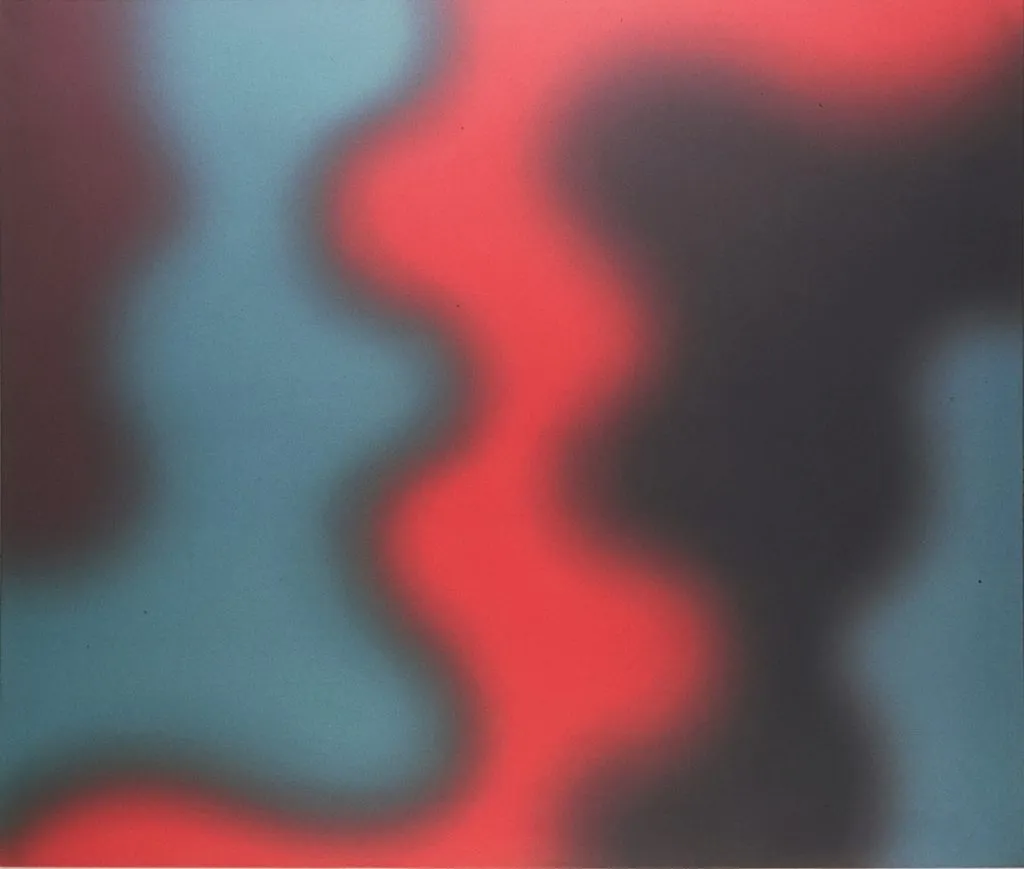
The exhibition at Atlas Sztuki, meanwhile, juxtaposes in two galleries two perspectives within which Wojciech Fangor’s work has developed and continues to develop. One is a superb selection of twelve works that crown the period of Positive Illusory Space. They were created between 1969 and 1975, and four of these large-format paintings were shown at the Guggenheim (where there were thirty-seven in all). The second part is an installation that continues the reflection on the social conditions of perception and on interpretations of the artist’s life and work: another study of the multiplicity of perspectives, of differences in how exhibitions are received, of the artist’s own ideas and the changing ways in which they are understood, and of their reception by the public and art critics—a study of spacetime.
Before considering the works presented at Atlas Sztuki, it is worth recalling the works and ideas that led to them.
Immediately after the Study of Space exhibition, Fangor told Barbara Majewska: ‘Today, mystery (emphasis—S.Sz.) resides elsewhere than it did in the past. Today, there is no opposition between man as a closed, finite personality and the finite, closed construction of the painting. Man and painting understood in this way have little to say to one another. It seems to me that today, more than ever, the individual senses his dependence upon his surroundings and the relativity of his position. I am interested in how art can be practised in the face of these changes’1.
The statement rang out powerfully. One can hear within it a note of rebellion, of a break with the existing form of thought and method of painterly work; at the same time, it was a diagnosis of the state of affairs, of the situation in which painting found itself, and a reflection upon the challenges and tasks confronting the painter. At the time, Wojciech Fangor was conscious that he was participating in a cultural turning point. He understood that it was not painting itself that was ending, but its existing formula. At such a moment, it is difficult to think about continuation, continuity or what should and could be improved. Revolutionary vocabulary enters the language, corresponding to the radical nature of change and rupture. Although this breakthrough had been maturing for much longer and outside painting—in poster design and architecture; in observations of social transformations; in the discoveries of twentieth-century physics, mathematics and astronomy; in new technologies and the civilisational changes that followed them—it was precisely in 1958 that the artist’s new position was constituted both artistically and theoretically.
In an interview given in 1989, when describing the radical transformation of his painting in the mid-1950s, Wojciech Fangor emphasised the role of his loss of faith in instrumental painting and painting used instrumentally: painting that relinquished its already relative autonomy, and relinquished it for too long. Yet doubt alone could probably have produced only bitterness. For a constructive reorientation towards what mattered at the time to occur, and for him to escape the growing impasse of the existing formula, new paths of creative development were needed—architecture and poster design proved helpful in finding them. They meant the artist neither had to remain stubbornly entrenched in lost causes nor shed his skin overnight. Activity in fields that at first glance seemed remote from painting, and that drew him away from the painter’s true creative work, proved important to his further development. In fact, it was through the experience gained in poster design and collaboration on architectural projects that he came into contact with the issues most important to the art of the second half of the twentieth century. ‘I understood that space is a material just as the plane is,’ Fangor said, ‘that artistic ideas can be developed both on the plane and in space, independently of utility—it need not be a building or monument—and that real space can be the material of a work of art, just like a painting. And this was the origin of the 1958 exhibition’2.
The first half of the 1950s was a time of re-evaluation; social reality was moving ever further away from its propagandistic image. Fangor’s existing outlook—his sympathy for a concerted, collective effort to raise the country from its pre-war backwardness and post-war ruins—had not been exhausted. What had been exhausted was his support for the policies then being pursued, their immediate aims and forms. It became increasingly difficult for the artist to believe that he shared the same ideals as those governing the country. He needed time to reflect, and to find a new foundation and a new form for his painting.
‘Art creates a new form,’ Mikhail Bakhtin wrote, ‘as an expression of a new, value-creating relationship to something that has already become reality for cognition and action: in art, we recognise everything and remember everything (in cognition, contrary to Plato’s formula, we neither recognise nor remember anything). This is precisely why the moment of novelty, originality, surprise and freedom has such significance in art: because there is something against which novelty, originality and freedom can be perceived—the recognised and co-experienced world of cognition and action. It is this world that appears anew in art, and in relation to it the artist’s activity is experienced as free. Cognition and action are primary, which means that they create their object from the beginning; what is known is not something recognised and remembered in a new light, but something defined for the first time. Action, too, lives only by what does not yet exist: everything here is new from the beginning, and therefore there is no novelty; everything is ex origine, and therefore there is no originality’3.
The artist needed time to develop a new view of the reality contemporary to him and to find a space for the genuine development of his talent as a painter. Graphic design—particularly the poster—and exhibition design, sometimes called small-scale architecture, proved an excellent refuge during this period of reflection and exploration. The utilitarian nature of both artistic fields allowed him to develop his technique without becoming mired in ideological intricacies. The quality of one’s actions could be tested directly by observing the responses of the artistic community and the public. In this sphere, a straightforwardness and honesty, together with a minimum of economic calculation, had always been required, offering a sense of dependence on elemental forces rather than solely on the favour of representatives of political power. The greater the utility, the less short-term, instrumental politicking and manipulation of people.
Fangor felt that the existing means of painting were too restricted and too weak to sustain an effective, direct and immediate dialogue with the viewer; there was too much metaphor and too much burden from the tradition of representation and interpretation. Applied graphic design was different, and the poster different again: everything seemed obvious and direct there. One could say plainly what the point was, and the task of finding the simplest means of expression in order to reach the goal by the shortest route was self-evident. Years later, the artist recalled: ‘(…) these forms seemed to me much more effective in the use of visual art as an instrument of propaganda. Besides, applied graphic design was in the fortunate position of being a young phenomenon. For the theoreticians of Socialist Realism, it was almost virgin territory… and they did not really know how to interfere in its aesthetic substance. (…) There was a clear formal tolerance here. It offered greater freedom than painting pictures for the salons’4.
The spatiality of architecture and the poster’s dependence upon subject and recipient made the artist newly aware of the multidimensionality and multidirectionality of the world around us, and of the complexity of our presence within it. Practice in architecture and poster design became a useful point of observation and self-education. The world is not merely a collection of materials to be processed; we, too, belong to this world. What, then, is inside and what is outside? What is the result of our decision and present perspective, and can the outside become the inside when that perspective changes? This is no longer verbal acrobatics straining towards sophistic models, but a fairly common observation, astonishing in its obviousness. The point is to live and develop without allowing oneself to be exploited or manipulated. This dialectic, reflecting the complexity and relativity of our points of view and decisions, occupied the artist’s thoughts. When he wrote in 1960 about what a contemporary painting should be—that it should ‘emanate outwards through its surface’—he had in mind precisely the new painting he was discovering. ‘The contemporary painting has ceased to be a hole in a frame through which one looks into the depths’; it should find an appropriate, entirely new form in order ‘to incorporate spacetime into painting’. One must therefore go against the current and do something new in defiance of what had hitherto been newest—to formulate the avant-garde’s task in one’s own terms: to contain everything within the flatness of the painting’s two-dimensional space and bring art closer to life. Let us recall once more: experimenting with space by means of paintings led the artist to discover the different exhibitions that could be produced using the same works. ‘Instead of relying upon accidents that were not always fortunate,’ Wojciech Fangor recalled, ‘we began creating new paintings as elements for building a collective work. Our first task was to define the conditions these new objects had to satisfy. Their difference from individual paintings consisted in removing compositional features that enclosed the painting within a finite whole. At the time, we called them “hungry”, because they were forced to satisfy their compositional needs by joining with one another.’ This discovery produced two forms in the development of Fangor’s work: one consisted of tensioned structures and installations; the other led to another discovery, Positive Illusory Space, consistently realised in paintings produced until the mid-1970s. The celebrated circles are a classic example of a work applying the discovery of spatiotemporal relationships within the bounds of a single canvas. These paintings have been described repeatedly. Thanks to the coloured circles that ‘softly’ merge into one another, painted in sfumato, we experience the impression of a perspective turned towards us—in contrast to the perspective of Renaissance origin, which led us into the depth of the painting. The surprising impression is intensified by the ordinariness of a painting made as paintings had been for centuries, with a brush and oil paints on canvas. This was a revolution in painting. Fangor achieved more than anyone since Kazimir Malevich, drawing upon everything painting before him had prepared. Wojciech Fangor crossed the boundary of the work then defined as a ‘painting’ without disturbing its materiality or physical structure in any way, without damaging the canvas or frame and without abandoning any of painting’s age-old concerns—he placed them in a new light. He revealed the painting’s cultural dependence not only diachronically, upon tradition, but also demonstrated its contemporary dependence upon culture and new forms of human life.
Let us repeat after Mikhail Bakhtin, already quoted above: ‘The artist’s task consists first and foremost in establishing genuine contact with life—from outside life itself. In this way, art creates an entirely new vision of the world and depicts the reality of transience, something inaccessible to other types of cultural creativity. This external reality of the world made present and fixed in art (as well as the reality that is partly external and internal) always accompanies our emotional attitude towards the world and life6. In aesthetic activity, the dispersed meanings of the world are integrated and condensed into a finite, self-sufficient image. Art gives what is mortal (contemporary, past, present at this moment) an emotional equivalent that provides it with shelter; it points to an axiological perspective in which the impermanent world acquires the weight of an event-value and attains an eternal form. Through the aesthetic act, being reveals itself within a new dimension filled with values; a new person and a new axiological context—the plane upon which the human world is contemplated—are formed’7.
Art, then, does not duplicate the world or build a parallel reality. It creates ‘a new form as an expression of a new, value-creating’ relationship to something that has already become reality for cognition and action. Here we find a consonance, an independent trace, a lesson that can offer us much and prepare us for an encounter with Fangor.
Fangor rendered obsolete the painting as a report from the stage of contemporary life, confined to the possibilities of representation accepted by state, institutional and peer censorship, and ultimately by self-censorship. Fangor leads us outside the ‘theatre’ and shows us how to discover what is happening to us in our own time. It is no longer the plane of the painting that matters, but the real space in which we stand before a painting that provokes an exploration of unique relationships between form, colour and light. The same material object becomes a different painting each time, because it is impossible to approach it twice by the same route and at the same speed. This property of Fangor’s paintings—works conventionally called circles, waves, amoeboid and amorphous paintings, in which diffuse transitions from one colour to another disconcert us—together with their openness and indeterminacy, ambiguity and uncertainty, makes genuine contact with life possible. Wojciech Fangor animated the painting; in contact with the viewer, it lives a life of its own, which astonished critics called immanent vibration and kinetics.
An important feature of Fangor’s position is a ‘sensitivity to dichotomy’. He planned to contrast indefinite smears of paint with defined visual forms, ‘signs in the form of faces, hands, etc.’… In the event, an entirely new dichotomy was constituted, leading us beyond the canvas: between the painting and its surroundings, between what was intended merely as an underpainting and the painting as a historical form of representation. The problem posed here was not the illusory nature of painting. It was not a question of how to cross the boundary of illusion or bring art closer to reality. Instead, the problem of another illusion was posed—a problem whose appearance abolished the modernist and avant-garde programme of crossing the boundary between art and life. Fangor revealed the illusory and self-destructive nature of this programme. Art cannot seek to dissolve into life, nor can life subordinate art to itself. Art’s task is to show life and enable its authentic experience through new methods developed on the ground of art that correspond to new conditions of life. This is precisely why Fangor was neither accepted nor understood by post-avant-garde devotees and guardians of the glory of avant-garde strategies. Valuable ideas concerning the greatest possible involvement of people in a creative approach to life, education and participation in shaping the conditions of life in every possible dimension can retain meaning only when their historical limitations are understood; ignoring these limitations is in fact a bourgeois cultivation of drawing-room avant-gardism. There are no discoveries or theories that provide solutions once and for all. The sole axiom is the necessity of rejecting dogma and permanently seeking solutions appropriate to the present. Wojciech Fangor abolished the problem of the avant-garde. He showed that art is neither entirely independent of social conditions nor absolutely dependent upon politics, religion or science. It is relatively independent, autonomous, and as such participates in shaping the image of our lives.
The paintings we encounter at Atlas Sztuki are elusive, just as the transitions between historical or cultural epochs are elusive. How much Romanticism is there in the twentieth-century history of Poland? How do past and present interpenetrate? How many archaic forms do we find in our lives and in language? By abandoning contours, with the purity and schematism they carry, Fangor turned towards soft transitions from colour to colour and towards an indeterminacy that provokes an effort of exploration and critical thought. In the form of circles or amoeboid shapes, several colours flow into one another, blurring the distinction between one and the other; active and passive, cold and hot interpenetrate. So do good and evil, truth and falsehood; so fluid and indistinct are the tectonic spaces of our memory. Indeterminacy is a space of (social) dialogue. These paintings are maps of the memory of incomprehensible matters—of what cannot be represented clearly and distinctly, just as disputes about our history cannot be brought to an end. This is why their poetry is filled with melancholy.
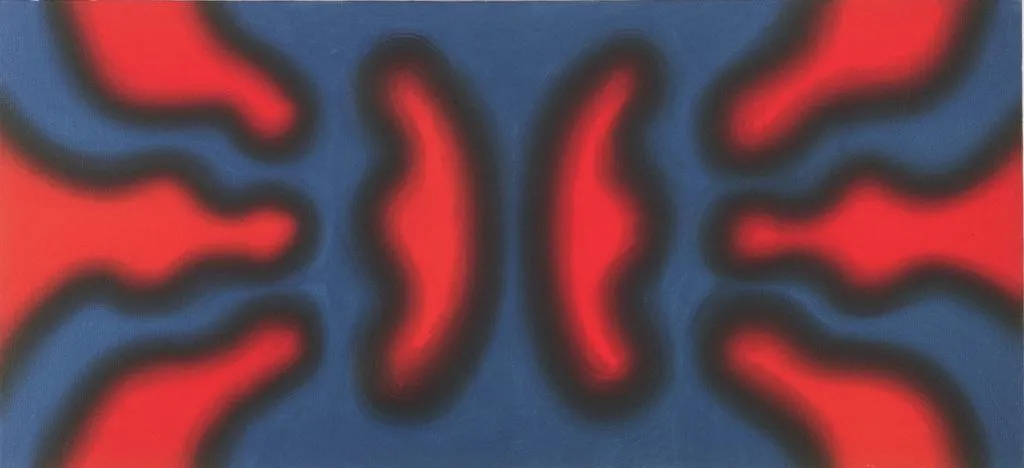
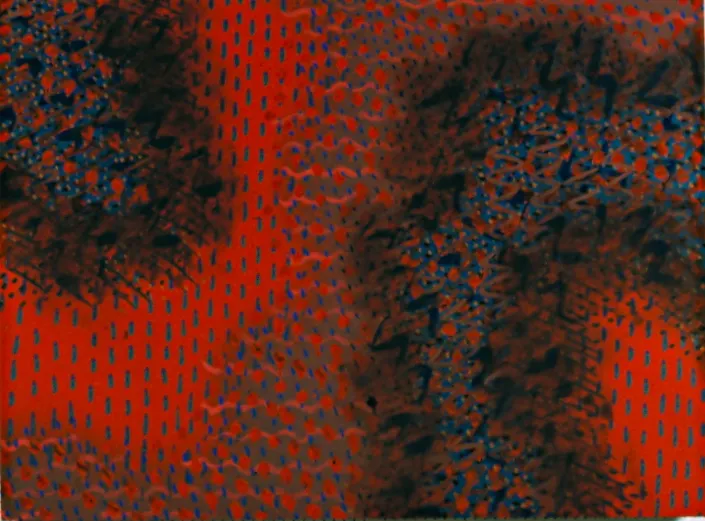
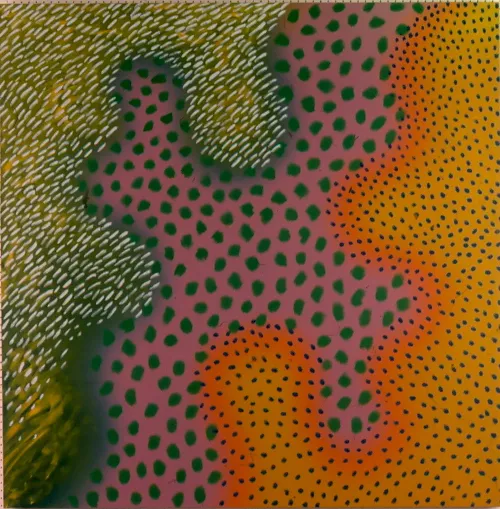
Twelve paintings can be seen at Atlas Sztuki. These are large-format works—the largest the artist had painted at any point in his life up to then—and for this reason, among others, they are rarely shown. In view of today’s fairly widespread practice of assessing art through the prism of its institutional presence in our lives, the paintings on display would have to be regarded as the pinnacle of Wojciech Fangor’s achievement. The painting M 43 from 1969 (305 × 610 cm; in the permanent collection of the Museum of Contemporary Art in Radom) opens the exhibition. It is a classic work of this period: the transitions between colours are elusive, simultaneously attracting and repelling our gaze. We attempt to find the boundaries between colours—boundaries that do not exist, that have dissolved in the colours’ elusive interpenetration. There is also a certain broken promise in this painting. In works from this period, one usually finds some form of symmetry in Fangor’s construction of the image. Here it is absent, although one might suppose that a suggestion of it can be grasped in the slight repetition of the shape. Perhaps it lies somewhere beyond the painting, as though not everything could fit here despite its scale. As we continue and pause before the paintings on the adjacent walls, we discover this essential quality of openness: regardless of their format, the paintings seem to tell us that, just as every map can be only a part of the map of the universe, they too are merely fragments in their own way. They have no frames, material or immaterial; they are open works. Yet they try to communicate that there is something graspable—a certain principle, colour or form that allows us to recognise them and place them within a certain order of thought to which the artist’s work of that period refers. In M 18 from 1970, as in other works, we find the sfumato technique practised and described by Leonardo da Vinci. In 1958, Fangor turned to it in the works from Study of Space in order to make the means into the end, the tool into the method. Within Fangor’s work, the synonyms of sfumato are exploration and indeterminacy. By softening the transitions between colours and turning the boundary or edge between white and black into boundless grey, he gains a space of visual exploration, the highest value. Indeterminacy shown within the painting attains the highest value because it is a space of opening, movement and life that cannot be confined within any abstract formula. The paintings from 1975, SU 2 and 3, differ visibly in this respect, although not so much ideologically or conceptually as visually. Edges and transitions have been effaced by other means. Beyond what was used in the other paintings, the artist employed a thicket of dots and lines, and zigzags creating the illusion of many superimposed planes and spaces, thereby intensifying the impression of the observed object’s three-dimensionality. The paintings MA 83 and 84 are exercises in self-irony, closing and opening the composition of the painting, a game with himself, something akin to soliloquies. Naturally, the presentation would be incomplete without a painting depicting an iridescent circle of colours. This example is exceptional: one of the few against a black ground. Black, red, blue and white shimmer and merge into one another; vibrating, they seem to move towards us, the viewers.
Fangor practised in his paintings an ‘edgelessness’ in which colour softly disappeared until it made the eyes ache—not for its own sake, as it did among Op artists (as they themselves acknowledged), but to find new means of expression more adequate to the indeterminacy of our times, of which he was becoming increasingly conscious.
Among the paintings and in relation to the installation shown at this outstanding Łódź gallery, it is worth emphasising once more that Wojciech Fangor followed the path defined by the idea of Positive Illusory Space. This means that he primarily made paintings in which a kinship was perceived with the then newly emerging Op Art. Their distinctiveness did not become the object of detailed analysis, but instead led to their classification as Romantic Op Art. Although the individual works participating in Study of Space were not subjected to proper analysis, today it is clear that they anticipated methods of painting that would not emerge until the middle of the following decade. Thus, alongside Op Art works, we have others that can be presented without any abuse of the term as examples of Minimal Art, as well as works that are conceptual paintings.
Fangor abolished the ceremonial status of the artist but retained his professionalism. Everyone must follow their own path between the paintings and find the one most appropriate to them, yet only a professional can undertake this preparation of the ‘terrain’. One is tempted to say that world art needed almost thirty years—from 1958 until the exhibition Les Immatériaux, organised by Lyotard at the Centre Pompidou in 1985—to approach Wojciech Fangor’s idea of art, breaking down a door that had been opened years before. ‘(…) representations associated with the concept of “material”, which reinforce Man’s direct sense of identity, are becoming weaker. What is at issue here is experience, memory, work, autonomy (or freedom), even “creation”, and, more generally, the radical difference from everything that is not Man. The idea of general interaction is strengthened instead’8.
Lyotard writes of material and of the relationship between subject and object, thought and matter. Fangor considered this in his own way on the ground of art. He deprived paintings of their former determinacy and, consequently, stripped artists of their priestly robes. Painting itself was placed alongside, and on an equal footing with, the arrangement of space, exhibition structures, the existing interior architecture and its furnishings.
Until Fangor’s time, looking at paintings involved finding within them some fixed form of one’s own reflection—hence the panic of the first reviewers. They did not find in his works their own conception of the work of art or their own world. Instead, they found something surprising for which they were unprepared and which fitted neither them nor their imagined world; it therefore had to be rejected, ridiculed (Witz) or regarded as underdeveloped (Stajuda). Relationships rather than material objects became the main protagonist—spacetime, as Fangor would say. This is why Fangor’s work did not appear within criticism’s field of vision: criticism could not find its identity, concepts or definitions within it. Instead, it encountered an indeterminate situation that compelled it to explore the unknown (unstable interactions in place of a stable ‘substance’)9.
Unlike many artists and thinkers, Fangor did not become intoxicated with new technologies. He acknowledged them while simultaneously demonstrating through his artistic practice that new technological revolutions would not replace history. Technology is a form of human activity that influences our history to a considerable degree, but it will not create that history for us.
Wojciech Fangor’s art and oeuvre possess the quality of generating new understandings and interpretations; they are open to the changing time and perspectives in which they are experienced. They help us come to terms with—although not always understand—the fate we share with others in the contemporary world.
*Stefan Szydłowski holds a doctorate in philosophy and works on social philosophy, cultural theory, aesthetics and art criticism. He organises exhibitions and seminars, serves as academic secretary of symposia and conferences, and curates exhibitions by leading Polish and international contemporary artists.
1. Wojciech Fangor, exhibition catalogue, Centre for Contemporary Art Ujazdowski Castle, Warsaw 2003, p. 13.
2. F. Kuduk, Początek rozmowy ... [The Beginning of a Conversation…], Sztuka 1989, 4/89, p. 7.
3. M. Bakhtin, Dialog, Język, Literatura [Dialogue, Language, Literature], ed. E. Czaplejewicz and E. Kasperski, Warsaw 1983, p. 56.
4. F. Kuduk, Początek rozmowy … [The Beginning of a Conversation…], op. cit.
5. Wojciech Fangor, exhibition catalogue, op. cit., p. 13.
6. Compare H. Bergson’s view: ‘The past, being virtual in its essence, can be grasped by us as past only if we adopt the movement by which it unfolds into a present image, emerging from darkness into daylight.’ H. Bergson, Pamięć i życie [Memory and Life], texts selected by G. Deleuze, trans. A. Szczepańska, Warsaw 1988, p. 41.
7. M. Bakhtin, Dialog, Język, Literatura [Dialogue, Language, Literature], op. cit., pp. 60–61.
8. J. F. Lyotard, Les Immatériaux, in Muzeum Sztuki [The Art Museum], anthology, Kraków 2005, p. 224. It is worth recalling a statement Fangor made in 1958: ‘The magic of space and its reception in time suggest a comparison with music. Elements arranged in rhythms and phrases that come and go, pass yet remain in our memory; the possibility of constructing a multi-stranded composition; and many other characteristics recall music as an art realised in time. It seems, moreover, that research into stereophony foreshadows the introduction of the factor of space into music alongside time.’ Wojciech Fangor, exhibition catalogue, op. cit., p. 10.
9. See J. F. Lyotard, Les Immatériaux, op. cit., p. 226.