

The Unruliness of Nobel Freedom Can Be Beautiful.
The decision of the Nobel Committee on such a reasonable award this year Peace Prize Can be a great opportunity for architects, designers, declaring a professional interest in beauty to better understand the problem with using symmetry, looking for balance and harmony. The Łódź conference has just ended The beauty of architecture Dedicated.
All the aforementioned qualities traditionally combined with beauty can be seen in the decision to "Salomon" reward the Belarusian, one organisation from Ukraine and one from Russia. Aleś Bialacki suffered and is a brave man, merits Memorial For Russian historical consciousness, it is impossible to overestimate and Ukrainian Centre for Civil Liberties Over several years of its activity, it has also done a lot.
The problem stems from the fact that these elections, gathered together, instead of strengthening each other, are slightly nullified. The symmetrical sharing of attention of all countries where "something is happening" is unbearably paternalistic. It reveals more the need to keep a distance from Eastern European Slavic incomprehensibility than the desire to appreciate courage and stubbornness.
Paternalism, resulting from the unwavering belief that one has established and correct canons, patterns, theory, also accompanies any discussion about beauty. Meanwhile, one of the most obvious features of modernity is that beauty does not only result from correctness or harmonious adherence to rules. This has changed irretrievably in the 20th century. Largely due to the madness of the general war. Beauty has grown up and does not need the guardians of all-knowing under-daddy curators with politically balanced views.
At stake in this war is freedom, freedom as something inherently incorrect. That is why the feeling of beauty is so strong (albeit short-lived) in moments when we see that someone, even for a terrible price, gains freedom. It is not a "balanced" moment, agreed in detail with the environment, and politically reasonable. This leads to a deep dissonance between the intention and the wording of this year's verdict of the dignified Committee in Oslo. Also in the field of physics.
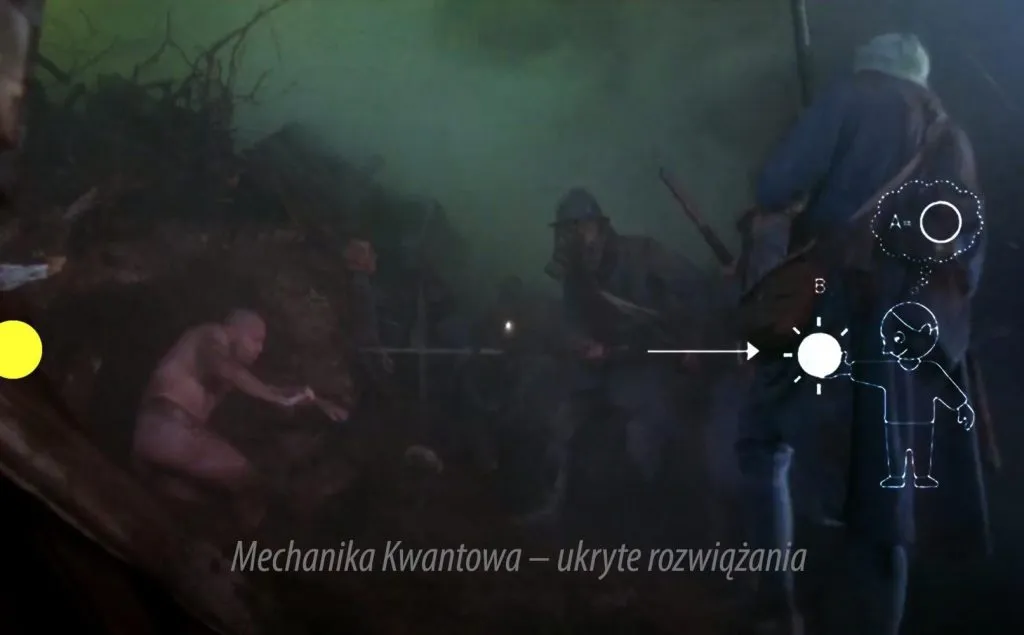
John Stewart's Inequality Bell has its years, it comes from 1964. Thanks to this year's Nobel Prize in physics, he will now have his pop culture quarter of fame.
What results from the experimental confirmation that our intuition and sense of reality are not compatible with the world of elementary forces that determine the quantum layer of reality on which the macroscopic layer in which we live is built?
What does this mean, for example, for those who are now hiding from fire, trying to hit the enemy? Nothing, nothing directly.
Quantum effects do not decide on the battlefield, they melt in the mud like everything around. The colored balls that physicists talk about have nothing to do with the mechanics of the balls flying in our direction.
On the other hand, we still do not know whether the state of battle, a state that constantly occurs in history (which has been expressing its rhetorical amazement with this state for thousands of years) is not a ghostly clumsy, atavistic and mimetic staging of quantum insolvability.
Undecidenability, which we cannot accept, because it destroys any stable hierarchy.