

Most Situations We Encounter in Life Have Already Been Painted in Old Pictures
We are more willing to look at bad images, images that carry negative emotions. We cannot help looking at them; that is why we have a bundle of instincts, so that our organism can sometimes protect itself independently of a head crammed with thoughts. If we detect signs of danger, we will watch in that direction intently. Politics and marketing have always exploited this, as has anyone seeking another person’s attention.
It is worth remembering that we view such images in recession—and this does not mean the state of the economy. It means the way these images operate: they compel recessio, an involuntary, instinctive ‘stepping back’. A manoeuvre like any other, one might think, since we are guaranteed freedom of movement.
The trouble is that, while moving backwards, our eyes remain fixed on some fascinatingly terrible picture. It shows plainly that close behind us—closer than we imagine—monsters a hundred times more dangerous than those we are staring at are following step by step.
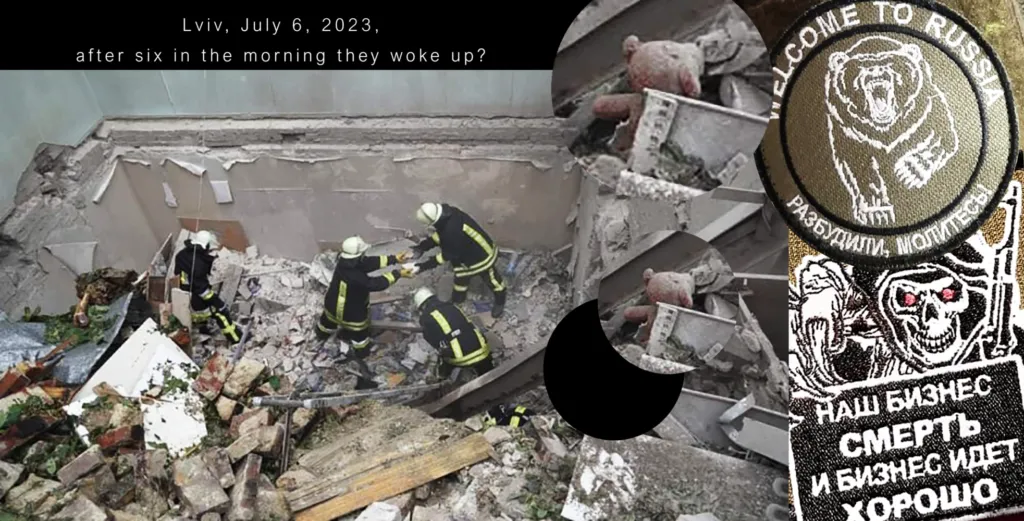
On Monday, 11 July, the NATO summit in Vilnius will begin. Someone should take there the teddy bear from a block of flats in Lviv, from the second or third floor. Does anyone want to live in a circus whose main attraction is the training of bear cubs through fear?
Welcome to Russia.
The Patriot system is said to be about 70 per cent effective against missiles and to have a range of 100–160 kilometres. The distance by road from Lviv to Rzeszów is 170 kilometres.